 [1]
[1]
By John Helmer, Moscow
@bears_with [2]
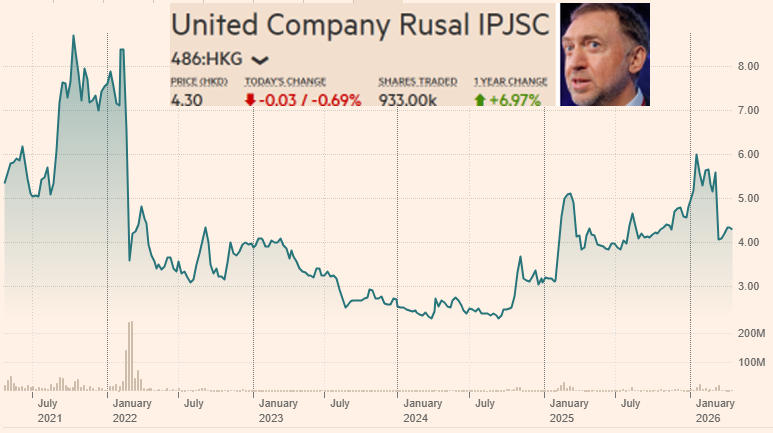
The combination of personal sanctions and asset seizures against the Russian oligarch Oleg Deripaska (lead image), corporate sanctions against his Rusal and EN+ companies, and the cutoff of alumina feedstock supplies from Australia and the Ukraine have done visible damage to Rusal’s Hong Kong-listed share price [3] (lead image).
At the pre-Ukraine war peak of 2021, the market capitalization of Rusal was HK$115 billion (US$14.8 billion); the share price ran up to HK$8.50. But then as the Special Military Operation began and sanctions and asset confiscations escalated, this collapsed to just HK$48 billion (US$6.2 billion) in December 2024. By this April, however, share price recovery has lifted Rusal’s market cap to HK$66 billion ($US8.4 billion); the share is now at HK$4.31.
First listed on the Hong Kong Stock Exchange in January 2010, Rusal’s share price has never reached its initial public offering (IPO) price of HK$10.80; that price was rigged by Deripaska with insiders who included Nathaniel Rothschild, John Paulson, and the Russian state bank VEB. (they sold out swiftly and richly within the first year). At its 2021 high, the share price reached just over HK$8.00.
The published annual financial statements of the company show that net profit was $3.2 billion in 2021 [4]. It then began falling year by year – to $1.8 billion in 2022; $282 million in 2023; $803 million in 2024 [5]; and finally to a loss of $455 million in 2025 [6].
Since February of this year, however, the US war against Iran, and Iran’s counterattack against the Hormuz Strait and the aluminium-producing Arab states from which the US have launched their attacks, have begun to dig Deripaska’s company out of its loss-making hole.
The archive of reporting on this oligarch, his rivals, and the Russian aluminium business is a very long one, and can be followed retrospectively here [7].
Deripaska’s attempt to kill me for this coverage began on December 29, 2009, and was first documented here [8] and then in the Moscow courts.
Comparing the market valuation of the operations and profitability of Rusal’s American peer, the Aluminium Company of America (Alcoa), and its Chinese peer, the Aluminium Corporation of China (Chalco), the chart lines show Rusal following the global supply and demand trend downward, but it was unable to break above the zero line when the others have gained.
FIVE-YEAR CHART OF THE RUSAL SHARE PRICE COMPARED TO ITS US (ALCOA) AND CHINESE (CHALCO) PEERS
 [9]
[9]Source: https://markets.ft.com/data/equities/tearsheet/summary?s=486:HKG [3]
The new global supply and demand situation caused by the Iran war has sharply improved Rusal’s prospects, according to a new Moscow analysis. Here is a verbatim translation of Olga Samofalova’s Vzglyad report [10] into English; it was published on April 23. There are no illustrations or reference links in the Russian text; they have been added here for clarification and corroboration which readers may now follow up.
 [11]
[11]Source: https://vz.ru/economy/2026/4/23/1412944.html [10]
 [12]
[12]April 23, 2026
The “black swan” has arrived on the aluminum market
By Olga Samofalova
The conflict in the Middle East has affected not only the oil and gas markets. The non-ferrous metals market is experiencing the largest supply shock since the 2000s. Why have factories in the Persian Gulf stopped, and who is in a vulnerable position due to the shortage of aluminum, without which no aircraft or car will fly?
The global aluminum market is facing an unpredictable “black swan”: the supply shock due to the conflict in the Middle East has become the largest in the non-ferrous metals market since the 2000s, Reuters writes, citing an assessment by a Mercuria metals analyst.
 [13]
[13]Source: https://www.mining-technology.com/news/middle-east-conflict-aluminium-supply-concerns/ [14] Reuters report: https://www.reuters.com/world/china/aluminium-faces-black-swan-supply-shock-mercuria-says-2026-04-22/ [15] The source is Mercuria [16], a Switzerland-based metals and energy trader and asset investor.
In this opinion, the closure of smelters in the Persian Gulf will lead to a serious shortage of aluminum in 2026. The price of aluminum on the London Metal Exchange (LME) has already reached a four-year high of $ 3,672 per tonne last week.
 [17]
[17]Click for enlarged view: https://markets.businessinsider.com/commodities/aluminum-price [18]
The Middle East produced about 7 million tonnes of aluminum per year, which is about 9% of the global supply. At the same time, aluminum coming from the Middle East is difficult to replace. Mercuria forecasts an aluminum deficit of about 2 million tonnes from now until the end of the year. However, this estimate may be an undercount as it assumes a rapid recovery of alumina supplies through the Strait of Hormuz and the resumption of plant operations as early as this quarter. In the event of a prolonged conflict and further restrictions on the supply of alumina to the Persian Gulf countries, the shortage may become even more significant. Wood Mackenzie has talked about a deficit of up to 4 million tonnes in 2026.
“There have already been extreme episodes on the market, for example, the price spike in 2022, when aluminum reached a record $ 4,073.5 per ton. But I rather agree with Mercuria’s thesis that this is the largest single supply shock for the non-ferrous metals market in the post-2000 year period. At the same time, physical damage to factories, a logistical gap in raw materials, low stock reserves and weak opportunities to quickly replace lost volumes in the United States and Europe have converged here. This really makes the current situation exceptional in scale for the last 20-plus years,” says Vladimir Chernov, analyst at Freedom Finance Global.
Why have aluminum plants in the Middle East stopped?
 [19]
[19]“Firstly, some of the facilities were damaged by impacts. Significant damage was recorded at Emirates Global Aluminum at the Al Taweelah site (above) in the UAE, and this is the largest plant in the region, which produced 1.6 million tonnes of metal in 2025. Secondly, due to disruptions in the Strait of Hormuz, factories began to lose access to raw materials. Alumina is needed for smelting, and ships with bauxite and alumina changed course in March,” says Chernov.
Alumina is an intermediate raw material in the production of aluminum. Due to the blocking of the Strait of Hormuz, its supply has sharply decreased. “The Arab countries do not have their own raw materials; they traditionally serve as a transshipment point where alumina is brought to the state of aluminum ready for smelting by electrolysis. At the time of the outbreak of the war, they had supplies in their warehouses for three to four weeks. During the truce days, some of the supplies will probably reach the ports, and some of the aluminum can be exported. But all the same, factories are forced to reduce or stop production, because they operate on 100% imported raw materials,” says Alexander Bakhtin, investment strategist at Garda Capital.
THE HORMUZ CHOKEPOINT FOR ALUMINA AND ALUMINIUM
 [20]
[20]Source: Google search result for "how much alumina enters Hormuz per year, [how] much aluminium exits" [21]
To top it all off, there have been power outages. Alba’s lines in Bahrain were shut down in mid-March, accounting for 19% of capacity, and Qatalum was reducing capacity utilization due to problems with gas supplies. “This is especially painful for aluminum, because electrolysis cannot be switched on and off without losses and a long restart,” explains Chernov.
The United States and Europe are in a particularly vulnerable position, as they have low reserves. Last year, the United States imported almost 22% of its aggregate aluminium imports from the Middle East, while Europe imported about 18.5% (Trade Data Monitor data). The US imports come mainly from Canada ($5.98 billion), United Arab Emirates ($1.49 billion), South Africa ($461 million), Bahrain ($435 million) and Argentina ($414 million).
 [22]
[22]Already, premiums to the commodity market price have jumped to records in the United States and to an almost four-year high in Europe. This means that not only exchange-traded aluminum is becoming more expensive for consumers, but also physical supply, says Chernov.
“First of all, countries which depend on aluminum imports and have high electricity prices suffer, since in aluminum production up to 40% of the cost is not raw materials, but electricity costs. First of all, we are talking about Europe, Japan, South Korea and the USA (20-30% of the metal imported from the Gulf countries). To a lesser extent, but India and China also have a dependence (about 10%),” Bakhtin notes.
Due to the shortage of aluminum, the local auto industry, aircraft manufacturing, construction and packaging industries will suffer. According to Rusal, in 2025, transport accounted for 25.6% of global aluminum demand; construction 18.8%; packaging about 17%.
Russia produces more aluminum than it consumes: about 3.8 million tonnes per year versus 1.2-1.5 million tonnes. Exports go mainly to China, Turkey, India, South Korea and Japan. It is unlikely that we will be able to increase supplies. However, Russia will be able to make money by making the product more expensive.
RUSAL TABLE OF PRODUCT DESTINATIONS BY COUNTRY AND VALUE, 2023-24
 [24]
[24]Source: https://rusal.ru/upload/iblock/463/voxtdd56vf2xwmjfvw0yfujh0gulbx52/RUSAL_AR_2024_EN_e101.pdf [5] -- page 13
“The price increase will significantly increase the margin and profit of Rusal, the monopolist in this market. At the peak of the conflict, the company’s share price rose by more than 20% relative to January-February prices. For the budget, at current prices and exchange rate, the increase in taxes may amount to about Rb130-150 billion per year,” estimates Bakhtin.
On the LME, aluminum rose to $3,672 per tonne on April 16. “If we compare this with the average selling price of Rusal for the whole of 2025, which was $ 2,652 per tonne, then the increase is about 38%. This is a very strong movement. If we assume that export volumes will remain near the levels of 2025, and the average selling price in 2026 will be at least 15% to 20% higher than last year, then the increase in revenue for the aluminum segment may amount to hundreds of millions of dollars. If the price stays closer to the current extreme levels, the effect will be even higher. But the end result will depend on discounts, logistics, bonuses, and the sales structure by country,” concludes Chernov.
 [25]
[25]