 [1]
[1]
By John Helmer, Moscow
@bears_with [2]
In the long history of political thinking in the world, the great Russian contributions have been to the recognition of human oppression and the mind required to fight it.
Bakunin, Kropotkin, Lenin, Trotsky, Stalin: these names are no longer absent from Moscow bookshop shelves, but their lessons are not taught in the Russian school curriculum and classroom.
Thinking is not the same as doing, that’s to say fighting against oppression and winning — in which the great Russian names in this short history must share their place with others: Zhukov with Giap, Mao, Bolivar, Mukhtar, Krim, Castro. The longer history of generals is full of men who fought for oppression and won. The history of kings, and of generals who have made themselves kings, doesn’t count – by definition they are for oppression. Except perhaps for Cromwell.
In his speech to the Valdai Claque – er, Club — on October 1 [3], President Vladimir Putin attempted to apply his political thinking to his method for combating oppression against Russia first of all, naturally; but also against oppression worldwide in which “the radical shifts and opening up here opportunities they create, fuel ambitions, willingness to take risks for the sake of an apparent big win.”
Putin remembered the language of his Russian predecessors very well. He omitted their category terms “capitalism” and “imperialism” – “narrow and inadequate ideological patterns instead of pragmatism”, he called them. But he repeated the operational one, “ruling class”, three times.
The Japanese “ruling class”, he hoped, would share with Russia “the same disposition towards mutual, joint work in the interests of both countries.” “The ruling class of the United States”, he believes [3], “has an understanding of how to build relations…but in the end the US is guided by its own national interests, especially under President Trump”. In Switzerland, “the case is not in the size of the country, but in the ruling class that makes the decisions. The point is how responsible it is for the interests of its own people and how capable it is to conduct an independent, sovereign policy.”
Not since Stalin has a Russian leader attempted to explain in public what he thinks to be the root causes of these wars; and what he has decided must be the Russian method for dealing with the ruling classes of enemy states.
Unsaid, the President’s implication is that Russia doesn’t have a ruling class; that he doesn’t represent a ruling class himself; and that in the absence of capitalism ruling at home and expanding as imperialism abroad, he can negotiate for Russia’s immediate defence and long-term security with the “national interests” of the enemy states, “especially under President Trump”.
And not only Putin for Russia and Trump for the US, but also Netanyahu for Israel in its wars in Gaza, West Bank, Lebanon, Syria, and Iran.
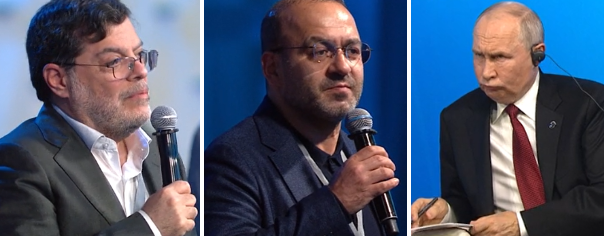
“The problem of Israel,” he told Taha Ozhan, a Turkish state advisor who asked about Israel’s five wars, “must be determined by the Israeli people. The people of Israel must define in the course of their democratic electoral procedures all Israel’s problems.” In response to an Iranian question about the Israeli-American wars against Iran and Palestine, Putin said the killing of Iran’s national security advisor Ali Larijani was “a mistake”, and that the genocide in Gaza “is one of the most acute and sensitive humanitarian problems.”
“The whole world is watching closely,” Putin continued, “and admires the courage, heroism of the Iranian people and its steadfastness, and …in the state management, in the armed forces, in the IRGC, and in the people, the readiness for self-sacrifice in the name of the people’s future.”
Not the Palestinians, Putin omitted to say. About them, he said: “the Palestinian problem, I said, again I repeat, it can be solved only on the basis of the creation of a full-fledged Palestinian state. As for the fact that US policy towards Palestine is determined by Israel, this is unlikely, I will allow myself to say. I know Turkey’s position on these problems. But still, the current US leadership is guided primarily by its national interests — in this I have no doubt knowing President Trump.”
Putin also has no doubt knowing that “the interconnectedness of the world is here and is not going away. The might makes right principle sometimes [sic] appears to guide certain international actors who are convinced of their own military-political, economic and, as they think, moral exceptionalism. We know perfectly well from history that this never ends well.” In this history that isn’t ending well, Putin believes [3] there may be a few European “moral exceptionalists” – not capitalists, not imperialists, and certainly not Trump nor Netanyahu.
THE SPEECH
 [4]
[4]Left to right, Seyed Mohammed Marandi, University of Teheran, state spokesman; Taha Ozhan, The Ankara Institute, former Turkish government advisor; President’s Putin’s immediate reaction to Ozan’s question of “the problem of Israel”. Click to view the full 3 hour, 20-minute session. [5]
THE PODCAST
 [6]
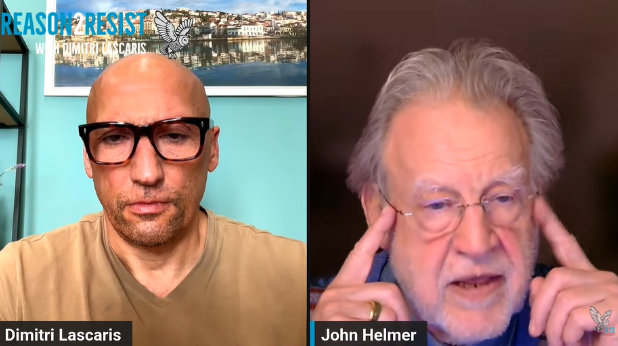
[6]Click to view or listen: https://www.youtube.com/watch?v=lqy_fLCfe3w [7]
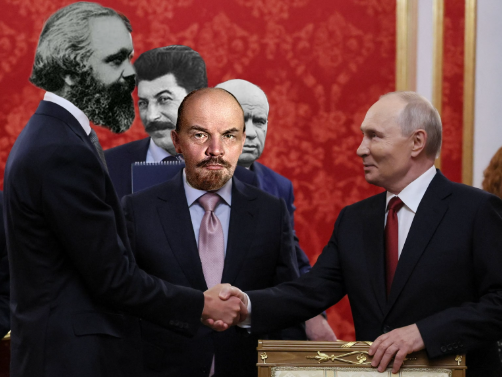
NOTE: Lead image, left to right: Karl Marx, Joseph Stalin, Vladimir Lenin, Nikita Khrushchev, Vladimir Putin.