 [1]

By John Helmer, Moscow
@bears_with [2]
This week the US Navy sent one of its maritime surveillance aircraft, the Boeing P-8A Poseidon, on a special mission off the coast of Bulgaria in the Black Sea.
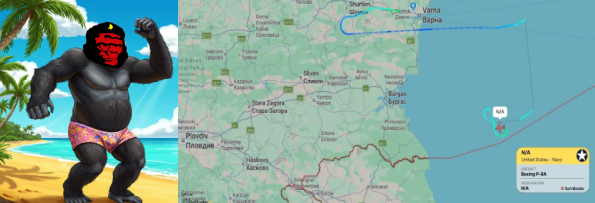
According to the Itamilradar.com [3] website (lead image, Itamilradar map) which monitors NATO air and naval operations in the region, “the flight track shows the aircraft operating over the western Black Sea, east of Varna, before making several turns over the maritime area. According to the available tracking data, portions of the mission were flown below 9,000 feet, a profile consistent with maritime surveillance.”
“This is an important distinction. While the P-8A Poseidon can perform intelligence, surveillance and reconnaissance missions, it is also specifically designed for maritime patrol, anti-submarine warfare and the detection and tracking of surface vessels. Its flight profile alone cannot establish the exact mission, but the prolonged activity at relatively low altitude supports the assessment that maritime patrol was a significant part of today’s sortie. The deployment comes against a particularly tense backdrop. In early October, two merchant ships were attacked by aerial and maritime drones inside Bulgaria’s exclusive economic zone, with one vessel sinking. Further attacks were reported off Bulgaria and Romania in the following days, including incidents involving ships in Romanian territorial waters. These incidents have raised concerns about the vulnerability of commercial shipping along NATO’s southeastern flank. Although an exclusive economic zone is not equivalent to territorial waters, attacks there can still threaten vital maritime routes and create significant security challenges for coastal states. [3]”
“A P-8A operating in this environment can help build a clearer picture of maritime activity by combining radar surveillance, electro-optical sensors and other mission systems. Depending on the tasking, it can contribute to identifying vessels, monitoring suspicious movements and supporting a broader maritime situational awareness picture.”
“Suspicious movement” – to the NATO allies, including Bulgaria which joined the alliance in March of 2004, that means Russian civil cargo and military movements in the Black Sea.
According to the Italians, the Poseidon flight is news-breaking. “It had been several months since we last tracked a US Navy P-8A conducting a mission over the Black Sea, making today’s activity noteworthy independently of the current security situation.”
The NATO reason for it is twofold: on the one hand, the allies are trying to break the Russian blockade of military supplies moving inward to the Ukrainian coast, and of Ukrainian wheat and other grains moving outward [4]. On the other hand, Turkey is trying to preserve its Russian gas, oil, coal and steel supplies from attacks by NATO-guided, Ukrainian-operated air and sea drones, and assert its 90-year Montreux Convention role as the guardian of the Black Sea through the Bosporus and Dardanelles straits [5]. The Turks are worried that the spillover of NATO’s war with Russia may strike at these straits as the US wars against Iran and Ansar Allah are striking at the Hormuz Strait and the Bab el Mandeb.
In this morning’s new Gorilla Radio podcast with Chris Cook, we discuss what the US, Turkey, Bulgaria and the others in the war against Russia aim to achieve in their Black Sea operations at the moment. Click to listen, starting at Minute 30: https://gradio.substack.com/p/gorilla-radio-with-chris-cook-debbie [6]
For background on the new Bulgarian chapter of the Black Sea game, read this [7].
For the archive of earlier Black Sea war operations, including the Black Sea Grain Initiative, click for this June 5, 2023, report [8] and its sequel on July 20, 2023 [9].
This week too, the Kremlin-sponsored Vzglyad security analysis publication reported [10] in unusual detail on Turkey’s attempt at a protected shipping-lane arrangement for Ukrainian and Russian cargo movements. This new report, translated into English verbatim, explains why, for the time being, Russia refuses to accept this Black Sea plan.
 [11]
Click to listen: https://gradio.substack.com/p/gorilla-radio-with-chris-cook-debbie [6] -- from Minute 30. For more than twenty years Chris Cook has been producing Gorilla Radio from Victoria, British Columbia. For the archive [12], plus introductions to Canada’s Resistance and the history as it took shape and fought the battles that had to be fought, click here [13].
 [14]
Source: https://vz.ru/politics/2026/10/20/1464926.html [10]
 [15]
October 20,. 2026
Why Moscow doesn’t believe in a maritime truce
By Oleg Isaichenko
Turkey continues to try to act as a mediator between Russia and Ukraine on the issue of shipping safety in the Black Sea. According to Turkish media, Ankara is proposing to create separate safe routes for merchant ships from both countries. However, experts note that the proposed scheme may affect Moscow’s fundamental interests. Why is the Russian side not ready to accept Turkey’s terms?
Ankara continues to push for the conclusion of a “maritime truce” in the Black Sea. According to the Turkish newspaper Milliyet, Turkish Foreign Minister Hakan Fidan has already submitted the relevant proposals to Russia and Ukraine. They provide for the creation of safe shipping routes and mutual renunciation of attacks on vessels.
According to Ankara’s plan, each side will be allocated a separate corridor. Ukrainian vessels will be able to proceed to the Bosporus Strait along the coasts of Romania and Bulgaria, while Russian vessels will travel through the waters of Georgia and Turkey. Moscow and Kiev are expected to refrain from attacking each other’s merchant ships and to commit to ensuring the safety of the designated routes.
Ankara has been making attempts to reach an agreement on the safety of navigation since August. At that time, the Turkish side called on Moscow and Kiev to take measures to protect navigation in the Black Sea. According to the Anadolu agency, the Turkish Foreign Ministry sent a proposal to the parties to establish a “mechanism for declaring a ceasefire.”
In the same month, Ukrainian drones attacked two vessels – the Yashar and the Nadezhda. According to iHa, the latter was flying the flag of Cameroon and was carrying fruits and vegetables from Samsun to Novorossiysk. As a result of the attack, a fire broke out on board. Four sailors were injured, three of whom were Turkish citizens. Subsequently, the crew was evacuated to Novorossiysk with the assistance of Russian naval forces.
In Moscow, the initiative from Ankara was met with restraint. Back in August, the official spokesperson for the Russian Foreign Ministry, Maria Zakharova, stressed that Moscow does not intend to repeat the mistakes of previous agreements. “If we are talking about a unilateral scheme similar to the one from 2022-2023, better known as the Black Sea Initiative, under which Moscow suspended hostilities in the Black Sea, then returning to this option would be inadvisable,” the diplomat said.
In September, the Kremlin’s position was once again outlined by Dmitry Peskov, the press secretary of the Russian president, RBC reports. He emphasized that agreements on security in the Black Sea must be comprehensive in nature. “It is currently difficult to see solutions in any individual segments. This requires very complex negotiations,” the Kremlin representative explained.
 [16]
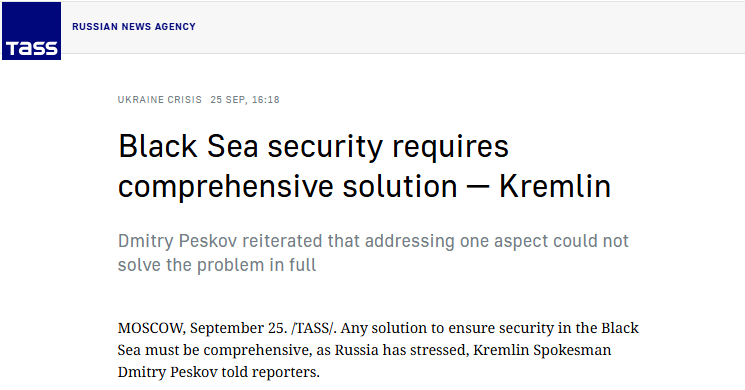
Source: https://tass.com/politics/2192855 [17] " ‘If we are talking about ensuring security [in the Black Sea], the solution must be comprehensive. It is difficult to envisage solutions in individual areas at present. This requires very complex negotiations. That is what we have been saying,’ he stressed. Peskov said Turkey had previously sent its proposals on security in the Black Sea to Russia, among others, but no specific talks on the issue are underway. "Because, let me repeat, addressing one aspect cannot solve the problem in full. It needs a comprehensive solution," he concluded.”
Thus, despite Ankara’s ongoing efforts, Moscow’s position remains virtually unchanged. Russia does not rule out negotiations on the safety of navigation, but it is not prepared to agree to individual restrictions without comprehensive agreements that would take its interests into account.
“Ankara is primarily trying to resolve its own problems. The escalation of the conflict has led to the fact that shipping in the Black Sea has been virtually paralyzed. Among the vessels that suffered from the UAV attacks were Turkish ships. There have also been numerous reports of Turkish sailors being injured,” said Stanislav Tkachenko, professor at the Department of European Studies at the Faculty of International Relations, St. Petersburg State University, and an expert at the Valdai Club..
“Moreover, Ankara is accustomed to receiving income from the passage of ships through the Bosporus and the Dardanelles.” Therefore, any unrest in the water area immediately affects revenues to the Turkish treasury. The country also has more ambitious goals: without active shipping, it will not be able to become a gas hub and a major center for trading in petroleum products, which it has long dreamed of,” he argues.
The instability in the region affects not only Turkey’s transit revenues but also other sectors of its economy. In particular, the flour milling industry plays a significant role in it, political analyst Ivan Lizan emphasizes. “However, this sector largely depends on imported grain, and traditionally, Russia and Ukraine have been the largest suppliers. Now the conflict is creating serious problems for Ankara in this area as well,” the source believes.
At the same time, Turkey’s economic interest in restoring shipping does not in itself mean that the truce it proposed will be implemented. According to Tkachenko, any initiatives of this kind will be doomed to failure until one of the parties answers the fundamental question: how to prevent the use of sea routes for the illegal supply of weapons to Ukraine? “Turkey certainly cannot guarantee that Kiev will comply with such agreements,” the expert is sure.
“Moreover, the corridor it proposes through the waters of Romania and Bulgaria could open an unimpeded channel for the Armed Forces of Ukraine to supply ammunition and military equipment. And judging by the outlines of the plan published by the Turkish press, Moscow may also be required to guarantee the safety of such shipments. This, of course, is completely unacceptable,” Tkachenko continues.
Thus, from Moscow’s perspective, the issue concerns not only the safety of shipping but also the conditions under which it will be restored. At the same time, making concessions on this issue is currently disadvantageous for Russia from an economic standpoint, the expert believes. “Kiev is not abandoning its attacks on our energy infrastructure. Volodymyr Zelenskyy’s office is quite open about the fact that its goal is to destabilize our entire industry and service sector. Under these conditions, a blockade of the sea “exit to the world” for the enemy is a logical response to its actions,” he adds.“Therefore, today the question of finding an ideal maritime deal for Moscow is not on the table.
Until 2023, the ‘grain deal’ was in effect, under which ships heading to Ukraine were inspected in Turkish territorial waters, including with the participation of Russian representatives. However, under the current conditions, this format will no longer suit us,” Tkachenko clarifies.
Lizan also draws attention to the changing military balance in the Black Sea. “The cost of controlling the water area has noticeably decreased in recent years.” Currently, the Russian Armed Forces are addressing this task primarily with the help of drones, the cost of which is not comparable to the damage inflicted on the enemy. Today, we truly dominate the Black Sea, and Moscow has no intention of sacrificing this result for the sake of another state’s interests,” the political analyst says.
Of course, domestic exporters are also experiencing certain inconveniences. Nevertheless, over time, some of the grain could be redirected to the Baltic ports and Murmansk, “although this scenario will not be able to fully replace the southern waters,” Lizan adds.
“The main calculation is based on the fact that Russia has significantly more resilience than Ukraine, so our economy will be able to withstand temporary difficulties more easily. Since it was Kyiv that initiated this confrontation, Moscow sees no reason to accommodate it. All the more so now, when we have a real opportunity to see this through to the end,” the analyst is confident.
 [18]
Under these conditions, according to Lizan, Ankara will not be able to take responsibility for ensuring that the Ukrainian side complies with the agreements.” “She has already acted as a guarantor of the ‘grain deal’ and really tried, but the Europeans ignored all of Moscow’s demands, the Americans were not eager to comply with them, and Kiev acted in its usual style of ‘Krivoy Rog diplomacy [birthplace of Vladimir Zelensky],’” Lisan concluded.