 [1]
[1]
By John Helmer, Moscow
@bears_with [2]
A sixty-year old Greek whom nobody has ever heard of outside Athens has just revealed how the NATO war against Russia is being waged; why it will be permanent; and why the end-of-war terms President Vladimir Putin has made public stand no chance of being accepted.
Ever.
The Greek has also revealed the crucial condition for this permanent war against Russia: the Ukrainians must do the fighting and suffer the losses of men, equipment and territory, so long as there are no direct losses in the territories, commercial revenues, and especially the election returns of the NATO allies, starting with Greece and including the Trump Administration. The war against Russia is being won in each capital of the NATO alliance, and will continue to be a winner, so long as there are no money-costing and vote-losing “accidents” or “incidents”.
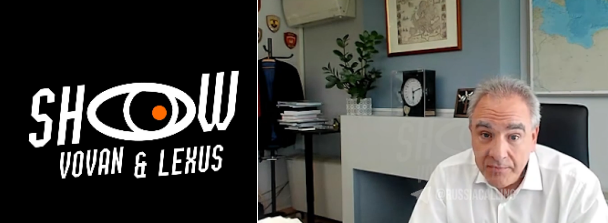
Those are two terms from Athanasios Dokos (lead image, right) who acknowledged “that’s a bit scary, to be honest.”
Dokos is the National Security Advisor to the Prime Minister of Greece, Kyriakos Mitsotakis. Educated at Cambridge and Harvard, he was an academic, think tanker and advisor to the Greek Defence and Foreign Ministries until 2019 when he became the National Security Advisor. Last year Mitsotakis promoted Dokos to cabinet-level rank as Secretary-General for National Security.
When he was telephoned from Kiev on June 24, he thought he was talking to Rustem Umerov, now the head of the National Security and Defense Council, formerly Ukraine’s Defense Minister and part-time resident of Florida [3]. They had met the week before (June 18-19) Umerov reminded Dokos at the start of their call, but Dokos didn’t recognize the bogus voice; he thought he recognized Umerov, but never suspected he was looking at an AI-generated image, a deepfake. Dokos also didn’t know that Russia’s intelligence services have his personal telephone number and the security codes in use at the Prime Ministry. Dokos was talking to Russia’s most famous penetration spies – the telephone pranksters Vovan and Lexus.
To them pretending to be Umerov, Dokos revealed that as part of Greece’s long-term war strategy against Russia, it is continuing to implement plans for co-production of Ukrainian drones and Ukrainian drone warfare operations on Greek territory.
The first signal of this scheme was announced [4] last November by Prime Minister Mitsotakis with President Vladimir Zelensky; Dokos was one of the negotiators of that announcement. The Greek shipyard beneficiary of the deal to build Ukrainian naval drones at Skaramangas is Paramount Industries Innovation Systems Greece, a subsidiary of the South African Paramount group. Paramount has announced an aerial and naval drone deal with the Ukrainians two weeks before the Dokos-Umerov conversation, on June 17 [5].
The engagement of a corporation in South Africa — purportedly a BRICS ally of Russia — in the war against Russia has not yet been noticed in the Russian media [6].
In the company press release celebrating its Kiev deal, Paramount has revealed that “the boat and its drones are bound together through a system MAC HUB [7] calls MAC Mission Control, which it says links the platforms into a single network and coordinates them in real time from a mobile command post onshore [6].”
Onshore Ukrainian drone command and control systems – this is the top secret which Dokos has revealed he was asking Umerov and Zelensky to continue running without “incidents” and “accidents”.
Dokos also revealed that the head of the Greek intelligence agency EYP, Themistoklis Demiris [8], was in Kiev shortly before his conversation was recorded to meet his SBU counterpart Yevgeny Khmara to go over the secret terms of the drone plan and its deployment in Greece without further public discoveries and embarrassments.
Dokos and Demiris, “Umerov” was told, want to make sure that Ukrainian drone attacks on Russian vessels in the waters off Greece, launched from “onshore Ukrainian drone command and control systems” – Greek and NATO bases in the region — should not interfere with Greek shipping operations or deter tourism in the Greek islands.
“We understand the needs of war on your side,” Dokos also told “Umerov” that if the Ukrainian drone units want to target and kill Russian targets, “maybe you could find a Russian billionaire.”
Dokos wasn’t joking; his boss tried to laugh it off. Prime Minister Mitsotakis has ordered the Greek press into a cover-up. “Greek officials said Dokos had provided no confidential or classified information during the conversation, adding that communications security measures are being upgraded to deal with similar ‘hybrid attacks’…. Greek government officials said the pranksters used ‘highly advanced’ artificial intelligence technology. Similar attacks in the past have targeted senior European officials,’ they added [9]. ”
View the 12-minute conversation recorded and then broadcast in Moscow by Vovan and Lexus on Tuesday and Wednesday (July 1-2): in the original Russian here [10] and here [11]; in direct English [12]; and in the version circulating in the Greek media [13]. They are identical and authentic. The only Russian press report of the conversation appeared in Gazeta.ru on July 2 [14].
For the political significance of the exposés of Vovan (Vladimir Kuznetsov) and Lexus (Alexei Stolyarov), start here [15].
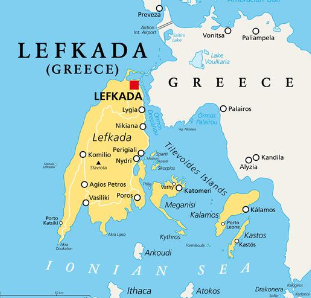
“Accident” and “incident” — they were the two terms Dokos used to refer to the Ukrainian naval drone which on May 7 went out of control and washed up on rocks on the western shore of Lefkada, a Greek island in the Ionian Sea.
 [16]
[16]Manos Tzafalias, a Greek investigative journalist who has been reporting on the “incident” and “accident”, has exposed the misreporting of the Greek press and the misinformation issued by the Greek Defence Ministry, Foreign Ministry and Prime Ministry. The cover-up is an attempt to conceal from Greek voters the collaboration between Athens and Kiev in the drone war against Russian tankers on the high seas, especially the Mediterranean. Greek voter sympathy [17] for Russia and opposition to the US and NATO war are the highest in Europe [18].
The most obvious data which Greek officials are keeping secret on the incident are the course, launch and control points of the errant drone on Lefkada itself. For more detail and background to the story, click to read this [19].
 [20]
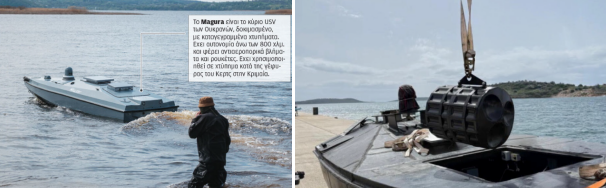
[20]Left: Ukrainian surface drone for deployment in Greece, announced in Athens in November 2025 [4].
Right: photograph distributed in the Greek press purportedly to show the dismantling of the Ukrainian drone after it had been towed from Lefkada on May 8 [21]. A Greek source in a position to know says this photograph is likely to have been fabricated as are reports in the mainstream Greek media that the drone was carrying explosives and that these were later detonated by a Greek bomb squad. Reports and statements in answer to parliamentary questions by Greek defenсe and shipping ministry officials through the month of May have created confusion in the Greek Communist Party (KKE) and the Greek social media on the drone itself, on the Ukrainian operation which launched it, and on the advance knowledge and approval of the Greek government in such operations against Russian targets [22]. For more on Greek involvement in the drone attack on the tanker Qendil off the southern Crete coast in December, read this [23].
During the conversation, Dokos made a written note when he was told that there is a conflict over operational policy between the Ukrainian Defense Ministry on the one hand, which directs the drone war, and the SBU intelligence agency and Zelensky’s office which wanted Dokos to understand it regretted the Lefkada “accident”. This was news to Dokos – “we understand the needs of war but we don’t want that war to take place in our territory or our waters… If the [Minister of Defense Mikhail Fedorov] is not listening to President Zelensky any more, he has to decide whether damaging one Russian ship is worth losing Greece’s support. It’s as simple as that.”
Unspoken by Dokos but not less “simple as that” is the Greek Government’s decision to go to war against Russian targets in the Russian hinterland, Russian waters of the Black Sea, and on the high seas has been worth losing Russia’s support for Greece over the three centuries since Greece won its independence from the Ottoman empire [24]. For more on the money at stake in the Greek-Russian relationship since 2000, read this [25].
“I’m now more worried than in the beginning of our conversation because it looks like there is a rift between the office of the president and the Ministry of Defense… You need the whole NATO behind you.”
Dokos was not saying that Greece is withdrawing from the war against Russia. He was telling Zelensky through Umerov – so he thought – that the drone war in the Mediterranean should be coordinated with the Greek military to avoid “accidents” and “incidents” that might be politically damaging with Greek voters and risk revenue for the Greek oligarchs running the shipping and tourism businesses of the country.
 [26]
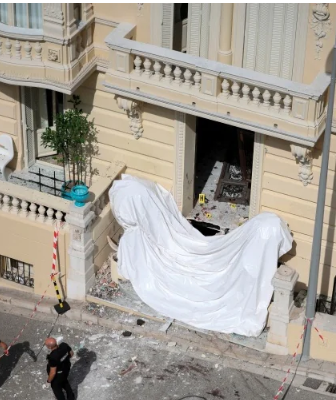
[26]Dokos suggested that better targeting – killing a “Russian billionaire”, he said – would be less risky. His only qualification for a policy of assassination of individual Russians on Greek territory, he added, was that “they don’t come to Greece any more. They go to Turkey or other places” (Min 5:13-24). Dokos was implying the Greek government’s support for the SBU bombing of Vadim Yermolaev and his wife at their apartment in Monaco on June 30 [27].
“It could cause a very serious and unnecessary crisis between our two countries,” Dokos meant between Greece and the Zelensky regime in Kiev if there were another drone “accident” or “incident”. He did not mean that the war against Russia was unnecessary for Greek politicians, their business supporters, and voters. He did not mean that onshore Ukrainian command and control operations against Russian vessels are objected to by Mitsotakis – on condition that the strikes take place outside Greek territorial waters.
Dokos assured his interlocutor that Greek profit-making plans for the drone war and from NATO financing of co-production of drones and other weapons for the war against Russia will continue “hoping that nothing will happen to make us change our position, like an incident as we discussed.”
“Also,” he told the pseudo-Umerov, “I will be expecting from you a draft agreement on the drone deal so that we can examine the content, the conditions, and we can start discussing about signing a bilateral one.” The secret Dokos revealed here is an awkward one for Mitsotakis who claimed that he and Zelensky had signed this bilateral agreement seven months ago. Dokos revealed that the “formal” terms of agreement have yet to be agreed and signed with Kiev, and there have been no follow-up in “detailed discussion at the operational level where we will decide whether you will send someone here or someone from our side will come to Ukraine and talk about the specifics.”
Dokos was implying that he didn’t know if the Ukrainian drone operation which went out of control off Lefkada on May 7 had been under NATO direction without high-level Greek civilian knowledge. Or else the Greek National Security Advisor didn’t want to admit that the “rift” he regretted to hear between military and civilian officials in Kiev might also be occurring in Athens.
“It’s important we have open channels of communication that we can discuss an incident” – Dokos concluded the telephone conversation. By open channels of communication Dokos wasn’t saying what exactly the Greek intelligence chief Demiris was telling the Ukrainians in Kiev at the same time. A check of Greek and Ukrainian media and official reports has not confirmed the visit to Kiev by Demiris.
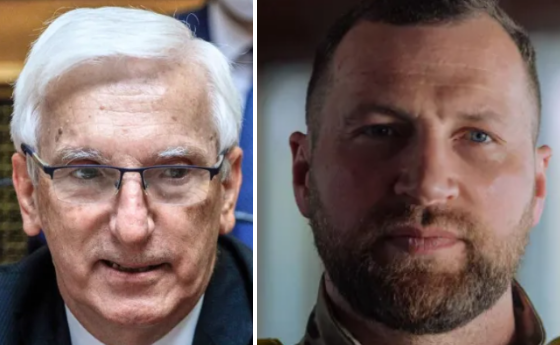 [28]
[28]Left, Themistoklis Demiris, Greek intelligence chief (EYP) since 2020 [29], right, Yevgeny Khmara, Ukrainian intelligence chief (SBU) with major-general rank since January 2026. “Khmara has a background in the SBU’s military units. Liberal nationalist media like to speak of ‘two SBUs’ - the good, fighting SBU, and the bad, corrupt, Moscow-infiltrated non-fighting SBU. Khmara is a representative of the first, hence why Zelensky appointed him to be the public face of the institution. Khmara will probably have at least some control over matters such as made-for-media special ops against Russia and the SBU frontline units, but the bulk of the SBU’s activities — extortion of domestic business, counter-intelligence, and all the lucrative meat of the institution — will be under control of the man who lives and breathes it: [Deputy SBU chief Alexander] Poklad [30].”
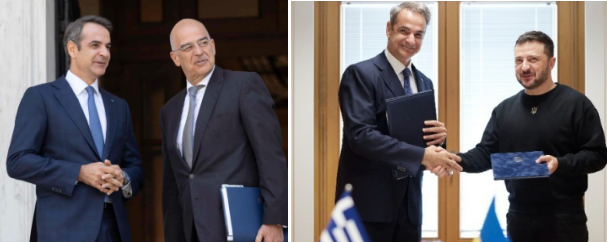 [31]
[31]Greece’s war plans against Russia, November 2025 – Prime Minister Mitsotakis with Defense Minister Dendias; with President Zelensky
The Russian Foreign Ministry spokesman, Maria Zakharova, had reacted to the Lefkada drone discovery on May 15 [32]: “On May 7, Greek fishermen discovered a Ukrainian-made unmanned surface vehicle (USV) laden with 300 kilograms of explosives, its engine running, and its navigation sensors, antennas and AI-assisted communication systems turned on, at the southern tip of the Ionian island of Lefkada. Greek investigators have identified it as a Cossack Mamai-type sea drone designed for reconnaissance, surveillance and sabotage attacks. The event has stirred a ballyhoo in the country. The main version discussed in the Greek public and political communities is that the drone was launched to attack a tanker of the so-called Russian shadow fleet when it passed the island.”
“The Greek authorities remained silent for a long time. It was only four days later that the Greek Foreign Ministry issued a brief statement in which it described the incident as ‘extremely serious’ and endangering the freedom of navigation and fraught with risks for civilians and the environment. It announced that Greece will not tolerate the Mediterranean and Greek waters being turned into a ‘theatre of military operations.’ However, the Greek government’s belated and cautious reaction has provoked an outcry among Greek journalists, who have accused officials of indifference and an attempt to hush up the incident with the Ukrainian sea drone. There were calls for reviewing the Athens’s pro-Kiev course.”
“Many people in Greece saw that incident at proof of the Zelensky regime’s intention to broaden the conflict and to involve as many countries as possible in it. This is actually yet another serious evidence of the growing scale of Ukrainian terrorism, which poses a real threat to any country in Europe regardless of the volume of its assistance to Kiev [32].”
In Zakharova’s reference to “Ukrainian terrorism” she was accusing the Mitsotakis Government of no more than “Athens’s pro-Kiev course”. Dokos has now acknowledged that Greece believes it is at war with Russia –“it’s as simple as that.” There has been no reply to this from the Russian Foreign Ministry. Not yet.
A month ago Zakharova had said the NATO drone war was extending northwards as well as southwards. “In turn, the prime minister and defence minister of Norway, who were also attending the gathering in Estonia [June 9 [33]], promised to supply to Ukraine, before the end of this year, 200 armed and sensor-equipped unmanned surface vehicles of various configurations and/or drones to the amount of $127 million. It was claimed that their joint Ukrainian-Norwegian development made it possible to “defend the Black Sea corridor” that was allegedly of “paramount importance for international food security.”
“This reminds us of the recent Ukrainian USV explosion in the port of Constanta, Romania, the far from single-digit cases of live Ukrainian USV’s detected, for example, off the coast of Türkiye (Samsun), or the incident near the Greek island of Lefkada, for which Kiev later officially apologised. So it comes that the Norwegians have actually announced their direct involvement in preparations for and delivery of AFU strikes against Russia’s Navy and its energy and port infrastructure on the Black Sea. In fact, they have declared their intention to assist in escalating tensions in the region and interfere with international navigation safety [34].”
In Greece, the “outcry among Greek journalists” and the “many people” opposed to the expansion of the war, as Zakharova referred to them, were limited to the Greek Communist Party (KKE), its deputies in the Greek parliament, and its supporters in the press and unions. Russian officials have not identified them politically. In the only explicit statement issued in Athens to date, this is what the KKE has declared [35]: “The biggest ‘security gap’ that emerges from the content of the conversation of the Prime Minister’s advisor with the Russians who impersonated the Ukrainian officials, is the incalculable dangers that the criminal policy of the country’s involvement in the war, which is implemented by the New Democracy government and for which no other party makes a ‘sound’, entails for the Greek people.”
“It is just chilling to hear the Greek official say that ‘we understand the needs of the war’, when he has just been informed that a new strike with Ukrainian sea drones against Russian targets near Greek islands is imminent and simply asks that this not be implemented because ‘we are in a tourist and pre-election period’…Indicative of the cynicism of the involvement in the war is that the Prime Minister’s advisor, after the above and as if nothing has happened, raises the issue of signing an agreement for the co-production of maritime drones with Ukraine! In addition, it is clear from the conversation that the Greek government is aware that the drone found in Lefkada was targeting a Russian warship, as Rizospastis [KKE newspaper] has revealed.”
“Here and now, Greece must get out of the carnage of war before it is too late – before there is a new agreement with the Zelensky regime, the US-NATO bases must be closed and the country must withdraw from sanctions on Russia. The people must severely punish the government and the parties of this involvement in the war [35].”
Last Friday (July 3) Dokos gave a detailed interview in Athens explaining and excusing himself.
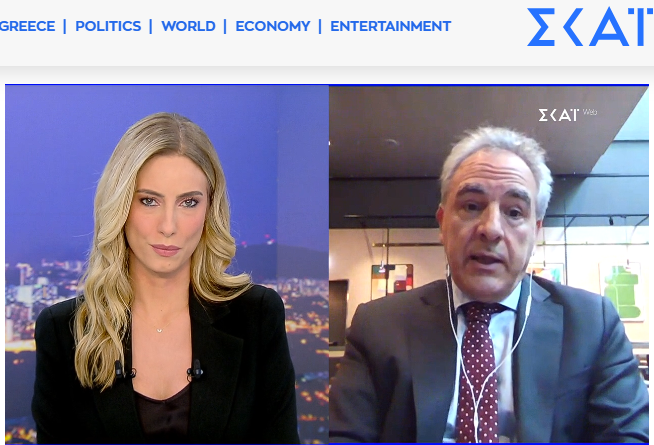 [36]
[36]Source: https://www.skai.gr/news/politics/o-thanos-ntokos-mila-ston-skai-gia-tous-rosous-farser [37]
He had been fooled, Dokos said [37], by the credential coding of the call in advance, by the voice simulation, and also by the fabricated image of Umerov whom he thought he saw at the Kiev end of the line. “This is the worrying thing, because until now our own security protocols, because we had seen that there were many incidents of such let’s say pranks in telephone conversations and President Macron and President Duda of Poland and several other leaders, prime ministers, ministers had also fallen victim. We said that now we will have both a voice and an image…the worrying thing for all of us is that now even what they see with our eyes is no longer always safe and this can have profound consequences for information, communication, political dialogue. A series of issues that even concern our daily lives.”
Dokos blamed Russian intelligence for the breakthrough call: “Obviously the timing is not accidental, but I think that if you look at all the moves that are being made, sometimes the period before elections is chosen and we had very intense activity. This time Russian services… I don’t think anything was said that could create a problem.”
NOTE: Manos Tzafalias’s investigations [38] are unique in Greek journalism because they appear in the form of tweets in both Greek and English. Here [39] is the most recent English-language tweet on the Lefkada drone affair. Click on the respective ALT captions in the tweet's illustrative images for more evidence and political and military connections the mainstream media miss, or attempt to conceal.