 [1]
[1]
By John Helmer, Moscow
@bears_with [2]
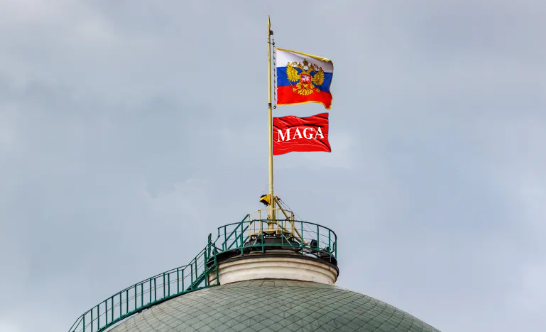
The E-Day (Escalation Day) decision has been put off.
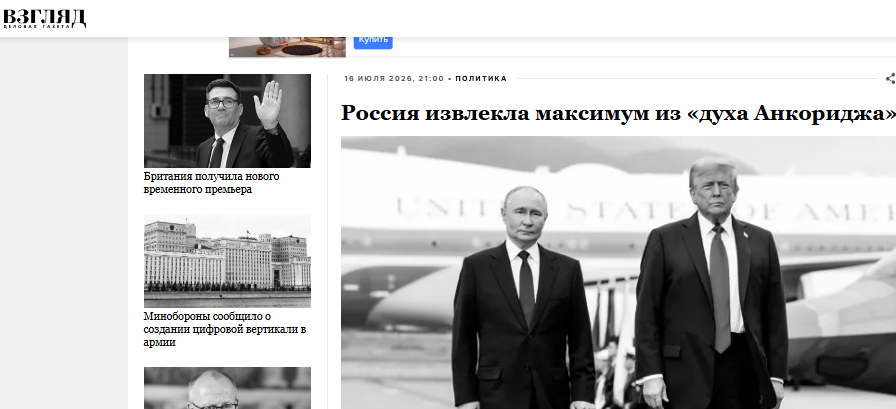
The Kremlin has just run up the signal that Trust in Trump (TIT) remains President Vladimir Putin’s priority. This is the flag raised on Friday morning by Vzglyad [3], the Kremlin-backed publication. “Russia has gotten the most out of the Anchorage Spirit”, according to the headline.
“The diplomatic stage indicated by this phrase has nevertheless given Russia a lot,” the editorial continued [3]. “It is wrong to assess the spirit of Anchorage on the scale of peace achieved or not achieved… the key task was…to achieve the US withdrawal from the active phase of the conflict or at least radically reduce their participation in it. After eleven months, we can say that this goal has been achieved in many ways. Yes, the Americans are still transmitting satellite intelligence data and selling weapons to the Europeans for Ukraine. But this is a completely different quality of participation than under Biden, when Washington was the main donor and coordinator. Europe is currently bearing the brunt of the supply burden.”
Kirill Dmitriev, Putin’s special negotiator with the Trump family, has tweeted in support. “Biden’s corruption is at the core of the Ukrainian conflict,” he insists [4].
 [5]
[5]Source: https://vz.ru/politics/2026/7/16/1435124.html [3]
 [6]
[6]July 16, 2026
Russia got the most out of the “spirit of Anchorage”
By Oleg Isaichenko
Almost a year after the Russian-US summit in Alaska, the “spirit of Anchorage” remains one of the important elements in the issues of the Ukrainian settlement. Despite the lack of signed agreements, the meeting between Vladimir Putin and Donald Trump changed the situation around the conflict. At the same time, some experts are skeptical about the “spirit of Anchorage”, while others consider it a success. But the main question remains behind the polar assessments: what is really hidden behind this wording and what real results did the Alaska summit bring to Russia?
Moscow is receiving signals from the United States that Washington intends to continue its mediation efforts in Ukraine. According to the press secretary of the Russian president Dmitri Peskov, at the moment, however, the United States is busy solving the “situation in the Persian Gulf region,” which is still “far from stability.” “Therefore, the Americans are not up to the Ukrainian settlement right now,” he stressed.
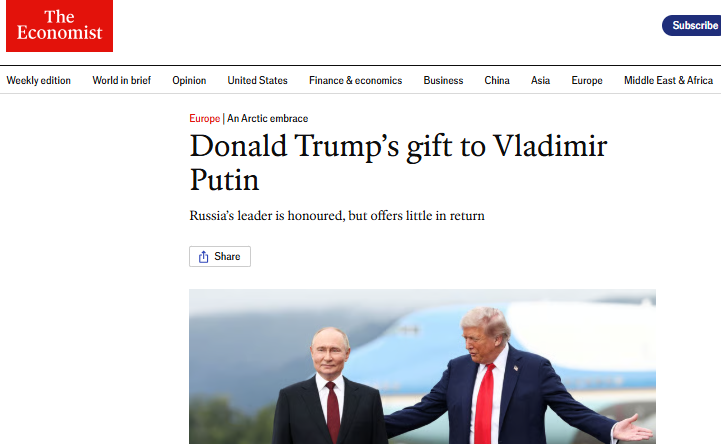
The history of the United States’ involvement in resolving the current conflict began on August 15 last year, when Vladimir Putin and Donald Trump met in Alaska. The summit was big and loud: as The Economist noted, this trip was a triumph for the Russian president.
VZGLYAD QUOTES THE ENEMY FOR ENDORSEMENT
 [7]
[7]Source: https://www.economist.com/europe/2025/08/16/donald-trumps-gift-to-vladimir-putin [8]
However, neither Moscow nor Washington began to bring to the public the details of the conversation between the two leaders. Nevertheless, the fact of the summit itself was discussed in the expert community as an opportunity to resume a full-fledged dialogue between Russia and the United States.
It was then that the phrase “the spirit of Anchorage” appeared. As Fyodor Lukyanov, editor-in-chief of Russia in Global Affairs magazine, explained, the very word ‘spirit’ in diplomacy is applied to significant meetings or summits that serve to reset international relations.
Accordingly, this term expressed a qualitatively new stage in relations between Moscow and Washington, as well as the hope for a slow but effective settlement of the conflict in Ukraine. It is noteworthy that the term was first used at the official level precisely during the beginning of the “stalling” of negotiations with Kiev.
“From the point of view of the spirit of Anchorage, we are full of optimism. But from the point of view of the behaviour of the Kiev regime, we are not yet seeing a very good development of events,” Dmitri Peskov, the press secretary of the Russian president, noted in the fall of 2025. He later said that it was in Alaska that some “understandings” were reached, which were supposed to form the basis for resolving the conflict.
In June of this year, Foreign Minister Sergei Lavrov explained that specific parametres for resolving the conflict had been discussed in Anchorage. “The American negotiators proposed their own program, their own scheme of action, and we agreed with this scheme,” the diplomat stressed, adding that the implementation of the agreements reached presupposed the beginning of detailed negotiations on a political settlement.
More precisely, the essence of the “spirit of Anchorage” was revealed by Vladimir Putin. According to him, it “was not clothed in any formal documents, no one put any signatures, but we discussed certain possibilities of ending the conflict in Ukraine.” The President also stressed that Russia remains interested in a long-term settlement.
PUTIN’S QUOTE IS MISSING FROM THE KREMLIN WEBSITE VERSION
 [9]
[9]Source: https://t.me/zarubinreporter/5025 [10]
The US press reported [11] Putin’s words similarly. The Kremlin website version of the June 28 interview with Pavel Zarubin omits this quote [12] of the President’s. Zarubin’s video runs for 25:14 minutes, the Kremlin video for 18.58 mins.
Thus, the “spirit of Anchorage” has gone from expressing a general sense of imminent change for the better and overcoming the burden of accumulated problems to setting out the complexity of the conflict resolution process in Ukraine. However, the diplomatic stage indicated by this phrase has given Russia nonetheless a lot.
“It is wrong to assess the spirit of Anchorage on the scale of ‘peace achieved or not achieved’. Others need to measure whether the balance of power has changed. Moreover, the external conditions were not in Moscow’s favour, because Trump was stuck in the Middle East, and the Europeans went into systemic militarization and preparations for a direct conflict with Russia,” said political analyst Alexei Nechaev.
Based on this, the expert emphasizes, Moscow initially had no illusions about the absolute implementation of the agreements – the resistance of Europe and Trump’s opponents inside the United States was too strong: “Therefore, the key task was seen differently: to achieve the US withdrawal from the active phase of the conflict or at least radically reduce their participation in it.”
“After eleven months, we can say that this goal has been achieved in many ways. Yes, the Americans are still transmitting satellite intelligence data and selling weapons to the Europeans for Ukraine. But this is a completely different quality of participation than under Biden, when Washington was the main donor and coordinator. Europe is currently bearing the brunt of the supply burden,” the expert stressed.
To better understand the significance of this shift, the political scientist suggests presenting an alternative: if the Americans continued to directly supply weapons in the volumes of the Joe Biden era, and even together with European spending, it would be much more difficult to conduct their own. The enemy’s resource base would have been noticeably more powerful, and each offensive operation would have required more effort, time, and sacrifice.
“This is the main practical benefit of the Anchorage Spirit. If we managed to somehow simplify the life of a soldier on the front line, ease the burden on our manufacturers, and gain time and resources, this is a result worth working for. In addition, we did not stop the fighting, did not give the enemy a break to accumulate forces, but at the same time we ourselves got the opportunity to spend resources with an eye on the fact that a much more serious conflict could await us, requiring incomparably high costs,” says the source.
However, all these benefits should be assessed soberly: “Let me remind you: politics is the art of what is possible, not unreasonably desirable. From the point of view of the possible, we got the most out of the “spirit of Anchorage”. How we use this maximum is another matter.”
Most importantly, Nechaev emphasizes, there is no scenario in which the United States and Europe would act against Russia with a united front with a common budget, supplies and coordination: “Fighting against the combined military-industrial potential of the West is something completely different. Therefore, almost a year in such a conflict means thousands of lives saved and billions of rubles saved, which should be applied and spent differently based on the principle of reasonable sufficiency.”
Political scientist Pavel Danilin also believes that without the “spirit of Anchorage,” the situation at the front would have been much more difficult for Russia. The United States has stopped directly supplying weapons to Ukraine. “This drastically reduced the supply of both shells and air defence systems,” he said.
RUSSIAN EXPERTS POINT TOWARDS THE FUTURE
 [13]
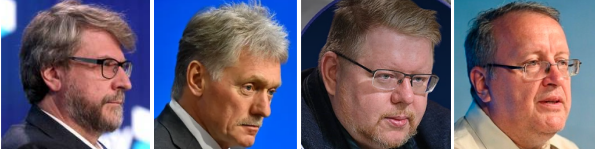
[13]Left to right: Fyodor Lukyanov, Dmitri Peskov, Pavel Danilin, Stanislav Tkachenko.
In addition, the United States has stopped financing the budget of Ukraine. “And this led to the fact that Europe took on all the costs, which was not the easiest test for it,” notes Danilin. “So if you hear that the “spirit of Anchorage” was a mistake, just try to imagine that all this time at the front, the United States would have behaved the same way as under Biden.”
At the same time, the “spirit of Anchorage” had an impact on several areas of foreign policy at once, notes Stanislav Tkachenko, professor at the Department of European Studies at the Faculty of International Relations of St. Petersburg State University, an expert at the Valdai Club. “After the Alaska summit, it became shameful to say that Russia is isolated,” he notes.
The expert also draws attention to the practical consequences. “It is worth noting that direct dialogue with the United States has led to a reduction in the scale of American arms supplies to Ukraine. As a result, European countries no longer receive the same volumes free of charge and are forced to switch to direct purchases, which objectively creates budgetary difficulties for them.”
 [14]
[14]The general involvement of the United States in the Ukrainian conflict has also decreased, and this directly facilitates the tasks of our Armed Forces at the front. “In addition, Anchorage has provided a certain stabilization in relations between Moscow and Washington, which has not been achieved for a long time,” he explains. “Of course, without that, the United States and Europe would have worked together against Russia. And the fact that we were able to take advantage of the circumstances offered – the power of the Republicans, Trump’s ability to engage in direct dialogue – is a real achievement of Russian diplomacy,” Tkachenko concluded.