 [1]
[1]
By John Helmer, Moscow
@bears_with [2]
In the early morning of March 4, Sri Lanka time, the Islamic Republic of Iran Ship (IRIS) Dena was attacked by the US submarine USS Charlotte with two torpedoes.
The first destroyed the Dena’s propeller shaft and stopped her dead in the water. Her position was at coordinates 6.0073 degrees North, 79.8654 degrees East: that was nine nautical miles (nm) outside Sri Lanka’s territorial waters; 19 nm (35 km) west of the harbour of Galle, a port on the southwestern coast of the island.
At the 30-knot speed the Dena had been moving, she was 18 minutes from the safety of Sri Lankan territory. Immobilized, however, the Dena captain, Abuzar Zarri, gave the crew the order to assemble on the aft deck in full visibility of the Charlotte, and prepare to abandon ship. As the crew mustered, a second torpedo was fired by the Charlotte to sink the Dena and kill the crew.
The torpedo warhead explosion broke the keel; the Dena sank in less than five minutes.
Of the crew’s 180-man complement, 32 were rescued from the water by the Sri Lankan coast guard, including Zarri and the first officer; 87 bodies were recovered; 61 were lost. Altogether, 148 were killed.
On the Charlotte, submerged at a distance from the Dena of less than 10 nm (18 km), there was an interval of approximately ninety minutes between the first fire order and the second, the kill order. A close-range film of the second torpedo strike, recorded [3] by the Charlotte, was released to the press by the Pentagon.
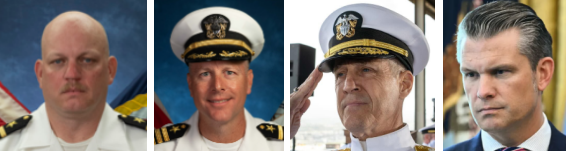
Four men participated in the chain of command through which these two strike orders were requested; decided; transmitted; executed.
They are Commander Thomas Futch [4] (lead, left), commander of the USS Charlotte; Captain Jeffrey Fassbinder [5] (second left), chief of the Submarine Squadron 7 of the US Pacific Fleet; Admiral Stephen Koehler [6] (centre), Commander of the US Pacific Fleet; and Peter Hegseth (right), the US Secretary of War (Defense).
Hegseth announced in a Pentagon briefing [7] on March 4 what he wanted the public to believe he had done. “Yesterday in the Indian Ocean, and we’ll play it on the screen there, an American submarine sunk [sic] an Iranian warship that thought it was safe in international waters. Instead, it was sunk by a torpedo, quiet death. The first sinking of an enemy ship by a torpedo since World War II.”
Hegseth was deceiving. He knew two torpedoes had been fired; it was the second which sank the Dena. He knew the Dena did not “[think] it was safe in international waters”. This was because US intelligence had been reporting to the Pentagon and the US Navy’s Pacific Fleet command that the Iranian Navy had been requesting safe haven for the Dena and its two escorts, IRIS Lavan and IRIS Bushehr, in Sri Lanka, then India, for more than seven days before the March 4 attack.
Admiral Koehler knew because he had met [8] with Sri Lankan officials in Colombo between February 19 and 21 to deter them from taking Iran’s side. “We stand with Sri Lanka in facing shared security challenges—from maritime domain awareness to countering transnational threats”, the US Embassy announced [9]. On March 4, the Sri Lankan newspaper Tamil Guardian [10] editorialized: “Did Washington’s Sri Lanka visit precede a secret naval strike? Questions grow after Iranian frigate sunk.”
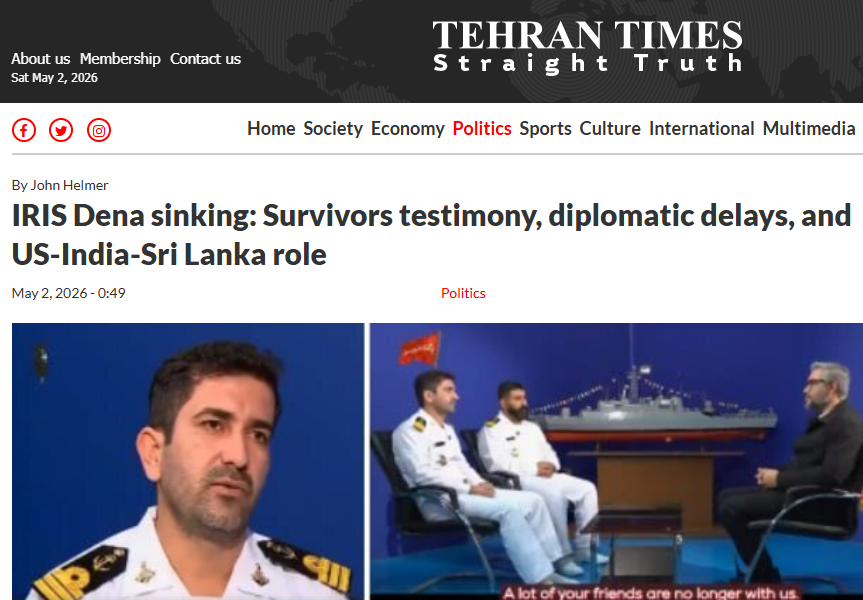
In the new article just published in the Tehran Times, the evidence of the Dena attack has been summarized and the political implications weighed – for the US and for the governments of Sri Lanka and India, which joined the US in the preliminaries, before the attack of March 4, and in the aftermath.
Click to read: https://www.tehrantimes.com/news/525994/IRIS-Dena-sinking-Survivors-testimony-diplomatic-delays-and [11]
 [12]
[12]On March 13, 183 members of the Lavan crew were repatriated from Kochi to Iran; on April 14, the 32 Dena survivors and 206 members of the Bushehr crew were allowed to fly home from Sri Lanka. The larger political question remains: whether the sinking of IRIS Dena was merely a wartime naval strike—or a coordinated act enabled by diplomatic obstruction.
For Tehran, the answer appears increasingly clear. What happened off the coast of Sri Lanka, Iranian officials argue, was not simply an attack on a warship. It was the deliberate destruction of a disarmed and disabled vessel and its evacuating crew prevented from reaching safety—and a test of who in the region chose neutrality, and who did not.
For more evidence and detailed reconstruction of the events, see the series of articles published on March 24 [13]; on March 29 [14]; and on April 21 [15].