 [1]
[1]
By John Helmer, Moscow
@bears_with [2]
Even presidents-for-life reach their dotage like everybody else. They prefer to die in their own beds, also like everybody.
In these three recent pieces, the case is made that Putin’s Russia – reading number 1 by Paul Craig Roberts — and Erdogan’s Turkey – reading number 3 by Abdullah Bozkurt — are like everybody, too.
In reading number 2, the case is made by Andrei Melnichenko, a Russian oligarch whose power and fortune come from banking, fertilizers, and coal, that short of death in bed or in war, the rule of President Vladimir Putin should not be succeeded by battlefield defeat, Trojan Horse subversion, nor by military rule. Rather, Russian rule should be based on the peaceful co-existence of Russian capital with international capital; Melnichenko calls that “respect for national sovereignty”.
By Russian capital, Melnichenko doesn’t say but means his own and the Russian oligarchy. By international capital, he doesn’t say but means the US empire and its satrapies, including the wealth havens Dubai, St. Moritz and Zug, where Melnichenko has kept himself, his counting houses, aeroplanes and boats since 2014 [3].
Melnichenko is proposing to die peacefully in bed – that’s a Trump-brand bed for which Melnichenko is content to pay a license advance, a management fee, and an annual royalty.
Putin has never explained why his understanding of capitalism, Russian and international, is neither the Marxist-Leninist version of his Soviet education, nor the liberal globo-American version of his political practice. That’s because he has never admitted in public his personal version of religious capitalism, which he confided in secret to President George Bush when they met in October 2001 [4]. ” There is a contradiction between a new, young, aggressive financial Islamic capital and the old one,” Putin said. “A moment came when the new generation began to see the old as its competitor. From the time bin Laden became your partner, he felt himself your competitor. His desire to move to Central Asia or elsewhere was his desire to muscle in and subjugate all others to his will. In reality, it is a financial issue. Religion is secondary. The real goal is to have a place in the centre of world finances, a place that is already occupied. They want to push away representatives of Jewish capital or, if not, they will try to destroy the centre and shake it up and, ultimately in that way, to take its place.”
Added to his fear of state capitalism, communism, and socialism, which Putin has made public [5], he has tried to balance the Russian economy between Islamic capitalism (Turkey, United Arab Emirates, Saudi Arabia) and Jewish capitalism (Israel, the US), and ended up taking sides with the latter.
In the immediate future, Paul Craig Roberts concludes there will be no dying peacefully in bed in Russia for as long as the Trump administration is not deterred or defeated in the drone war. “It’s an escalation,” Trump said on July 8 [6], “but it’s also an escalation that can help lead to an end.” Secretary of State Marco Rubio explained what Trump meant [6]. “What you’re discussing is the ability of Ukraine to reach deep inside of Russia and conduct strikes. I think that’s one of the dynamics that’s changed in this war over the last few months, and that is that the Russians are finding it more difficult to defend their own airspace. And what we hope that means is that it’s going to create the space now to negotiate the end of this war.”
Deafness to what they are saying, not to understand this, Paul Craig Roberts writes [7], is naiveté, folly, “extraordinary blindness to reality…Reality has proved to be too much for Putin. He has proven himself to be unable to cope with clear and obvious challenges.”
This is the appearance of Russian politics from the outside.
From the inside of Russian politics, Melnichenko has given a special interview [8] with The Economist, which is owned by a group of oligarch families – Agnelli of Italy (43.4%), Stephen Smith of Canada (26.9%), and Cadbury, Sainsbury, and Schroder of the UK [8]. Melnichenko has proposed that a nuclear-armed Russia cannot be defeated in the current war without nuclear retaliation, and that the alternative to that should be an international accommodation of the oligarchies.
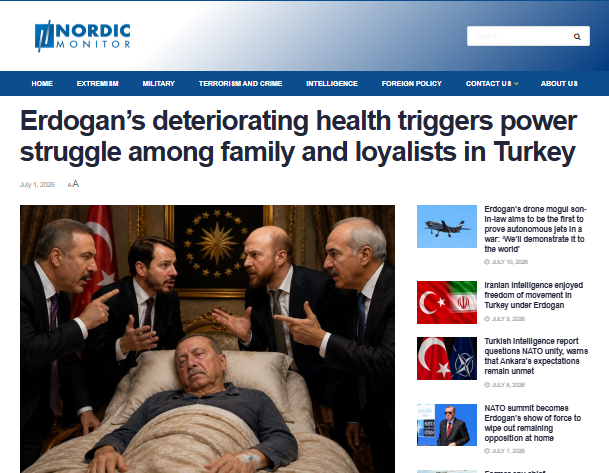
The third piece documents the decline into the final stage of epilepsy by the Turkish president, Recep Tayyip Erdogan, and the escalation this is causing of the contest to replace him from four candidates, not one of which is as committed to preserving the current Turkish strategy with Russia as Erdogan. “Rival factions within the ruling establishment, including the AKP, the cabinet and Erdogan’s own family, have reportedly been positioning themselves for a post-Erdogan era amid concerns that health complications could abruptly end his political career [9].”
In the history of the Turkish sultans, abrupt ends haven’t been medical ones.
If you read these pieces at the beach, watch out that the sand doesn’t get into the pages. I’ve added a little myself.
Reading No. 1
Paul Craig Roberts is a former senior US Treasury official and professional economist, now based in Florida. He writes regularly at this website [10] and podcasts [11] with Nima Alkhorshid each week.
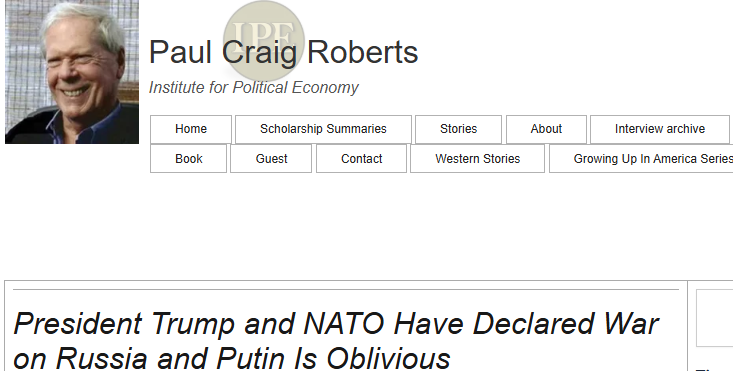
Here [7] is his latest essay on Putin’s war performance. “Putin’s inability to understand that Russia is at war with the West and that his prevarication for 4.5 years has vastly widened the war and totally changed its character has created the opinion among Russia’s patriotic elements that ‘Putin is a lost cause.’ That has been my conclusion for some time. Putin is still thinking and acting as if the conflict is limited to Donbas and that Russia is on the verge of winning as hardly any of Donbas remains in Ukrainian hands. Putin recently told Trump that the Europeans are a war party because they don’t understand that Putin’s ‘Special Military Operation’ has succeeded in clearing Donbas of Ukrainian forces. Putin mistakenly thinks that the war is over and all that remains is the settlement. Putin dismisses the increasingly effective attacks on the Russian motherland as ‘terrorist events.’ Putin’s extraordinary blindness to reality is difficult to understand [7].”
 [12]
[12]Source: https://paulcraigroberts.org/president-trump-and-nato-have-declared-war-on-russia-and-putin-is-oblivious/ [7]
It is not because Craig and I agree with each other that he quotes me from time to time, and I am republishing his piece now. The reason is that, despair at them or not, these are the conclusions to be drawn from the evidence.
On some of these conclusions Craig and I don’t agree. I’ve been making the case over the past 26 years of case studies of Putin’s rule that it’s not a case of his inability to understand: it’s a case of his balancing, temporizing, equivocating, and then of taking one side against another. In coalmine safety, coke battery air pollution, privatization of state shipping fleets, etc., etc., the pattern is always the same — the economic base always dictates the outcome, and that base is the Russian oligarchs.
As their price for not publicly opposing the war they oppose in fact, they have taken special favours in compensation for their loss of foreign assets to sanctions; they now demand state budget compensation for the damage the US drone attack strategy is doing to their energy production assets. This is also a system of institutionalized corruption and deception.
Reading No. 2
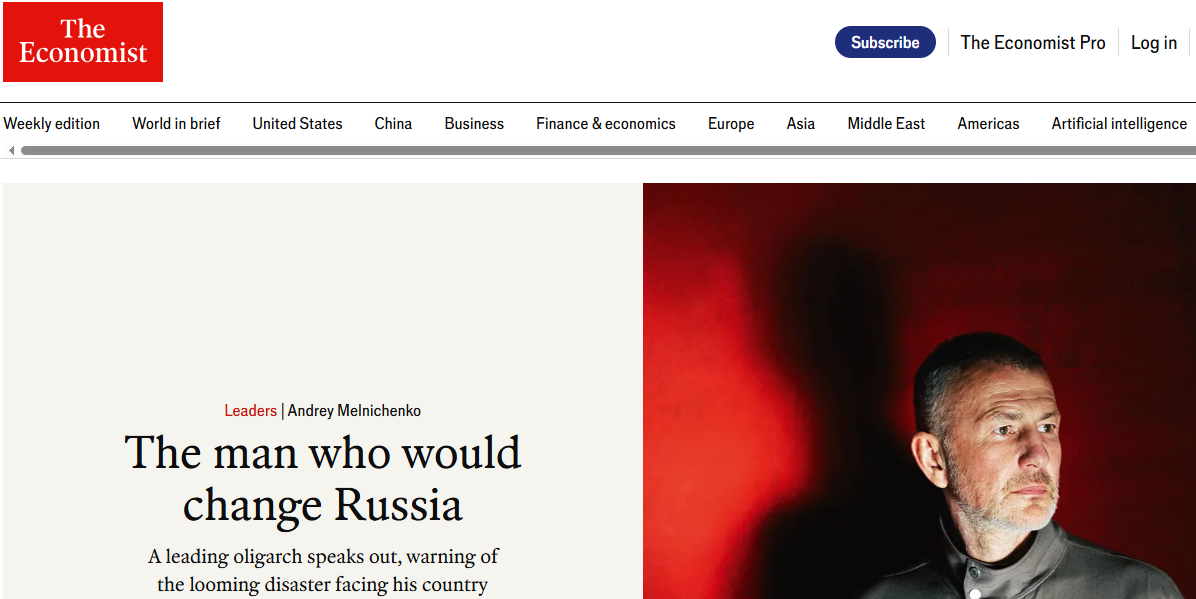
Andrei Melnichenko appears to have done more than to have accepted a brief interview request from London. Instead, he commissioned what The Economist [13] reports as “nearly 60 hours of conversation”. The publication doesn’t reveal what role its proprietors played in the preliminaries and in the terms – what editing Melnichenko did with the tape-recordings and drafts before they were published. “It is a remarkable intervention from an insider living in Moscow who understands the risks of speaking out in Vladimir Putin’s Russia,” the publication editors claim. Intervention is what this is. Sixty hours of conversation produce between 400,000 and 500,000 words. The Economist has published about one percent. What Melnichenko was prompted to say, what he replied, and what he and the editors agreed to publish are intervention indeed.
Three years ago, he commissioned a luncheon interview with the Financial Times, the Japanese owned propaganda platform in London. The interviewer was a former FT bureau cub in Moscow who moved to Latvia when the Special Military Operation began. Living in Dubai at the time, after fleeing Switzerland, Melnichenko talked [14]. He resisted the reporter’s repeated prompts for his criticism of Putin. He then telephoned the London editors to correct what he said was a misinterpretation of one of his answers on war crimes.
Melnichenko has taken no chances with the new interview.
 [15]
[15]Source: https://www.economist.com/leaders/2026/07/09/the-man-who-would-change-russia [16] The original text is paywalled. Full texts will be available shortly.
Until the paywall is breached, the best summary of Melnichenko has been published by Oleg Tsarev, the Ukrainian political leader who lives in asylum in Crimea, and has been the target of Kiev assassination plots. Read Tsarev’s publication here [17].
To understand Melnichenko’s records, business method, and corruption, there are 35 reports in the archive here [18]. For the record Melnichenko has made in the US courts of his and his wife’s vanity, click to read this [19] and this [20].
 [21]
[21]Source: https://johnhelmer.net/in-the-oligarchs-backyard-mr-mrs-andrei-melnichenko-sue-for-100-centimetres/ [19]
Reading No. 3
 [22]
[22]Source: https://nordicmonitor.com/2026/07/erdogans-deteriorating-health-triggers-power-struggle-among-family-and-loyalists-in-turkey/ [9] A current Turkish intelligence agency report on Turkish strategic differences with NATO, read this [23].
Because Bozkurt is one of the best analysts of Turkish politics, he is in exile [24] in Sweden to protect his life. His last detailed report on the corruption which has developed between Russian oil companies, banks, and Turkish intermediaries in schemes dependent on personal links to Putin and Erdogan, can be read here [25].
For more on these personal links and the Turkish lobby in the Kremlin, read this [26].