 [1]

By John Helmer, Moscow
@bears_with [2]
Eating more chocolate isn’t the sensitive aphrodisiac that the kings of England have believed [3] since the 17th century.
But eating less chocolate, Russians understand today, is a sensitive indicator of social class, money-powered social mobility upwards and downwards, and confidence in the economic future. For this reason it is particularly sensitive news to report that, according to the latest consumption statistics, Russian chocolate eating is falling sharply across the country.
This is an economic recession alert which the Kremlin and the Central Bank of Russia are not acknowledging publicly. It is a red alert for what international surveys reveal to be the most chocolate-sensitive, sweetest-toothed people in the world. According to a 2023 survey [4], 56% of Russians surveyed said they consume sweets and chocolate regularly. Their appetite leads the Irish at 55%; the Turks at 54%; the Germans at 53%; the British at 51%; the Americans at 41%; the Chinese at 25%.
In the 2024 sequel, because of the war Russia was dropped from the survey. The proportions for the others remained roughly stable, except for the Chinese whose demand is growing [5].
Because there is a tight correlation between percentage growth of Russian Gross Domestic Product (GDP) and growth in chocolates eaten by Russian consumers, when chocolate eating stops growing or goes into reverse, this means that the GDP is going flat or negative – and vice versa. In wartime the chocolate news can be bad news. In Moscow today it is.
In January 2022, Sberbank, the national state savings bank, reported [6] that “the turnover from trade in confectionery products is directly proportional to the income of the population: if income grows 1%, turnover in the segment increases by 0.9%. Sber[bank]’s Centre for Macroeconomic Research predicts that the population’s income should grow by over 2% per year until 2026. Domestic consumption of confectionery products will increase by an average of 0.9% per year, reaching saturation in 2026. On average, Russians will consume 26.2 kg of confectionery products per capita per year in 2026, compared to 24.5 kg in 2020. At the same time, they are more likely to purchase expensive products, including chocolate.”
The bank then predicted that to meet this demand, confectionery production in Russia would “grow by 11%, from 4.04 million metric tons in 2021 to 4.47 million metric tons in 2026. Three-quarters of growth will come from increased exports, with higher domestic consumption making up the remaining quarter. A rise in income will allow Russians to spend more on sweets, which currently account for less than 6% of spending on food.”
At the time the Sberbank forecasters made these claims, the war had not yet begun. The Central Bank of Russia (CBR) had started the year with a fix of its key interest rate at 8%. But then, as the Special Military Operation began, the CBR lifted the rate in March to 20%. It then began wind the rate down until it was back to 8% in July. At that time Sberbank didn’t believe – didn’t say — the economy would be driven into recession either by the war or by the CBR’s policy to cap borrowing and curb demand with double-digit interest rates.
By the end of 2025, almost four years of war later, the macro-economic policy of the CBR and the government had worked their way through to the chocolate boxes, coated waffles, and bars on the grocery shelf [7]. “Russian consumption of sugar and confectionery fell to 28.2 kg per person in 2025, down from 28.8 kg in 2024 and the lowest level since 2004. Pure sugar, jam and honey declined, while consumption of chocolate and other confectionery remained unchanged… Consumption of chocolate and chocolate confectionery was unchanged at 5.8 kg per person [per annum], while other confectionery products remained at 4.4 kg. The contrast with falling consumption of pure sugar, jam and honey shows a divided market: Russian consumers reduced some forms of sweetness without cutting the measured volumes of chocolate and other manufactured confectionery.”
At 5.8 kg per person per year, the Russian chocolate eater’s level trailed [8] far behind the Swiss at 10.6kg per person per year; Danes at 10.5; Lithuanians at 10.2; and Germans at 9.6. Americans trail behind Russians at just 3.8 [9].
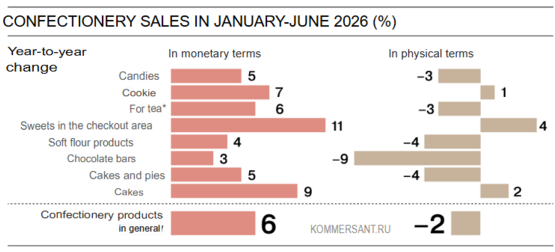
That was last year. According to the latest data [10] for the first half of 2026, chocolate sales in Russia have fallen by 9%. “This is the most pronounced decrease among all categories of confectionery products. In the second place cakes and cakes, which lost 4% of demand in the year. A similar decline was shown by soft flour products. Interest in candy decreased by 3%. The demand for confectionery products in general decreased by 2%.”
 [11]
This is a war impact. It has hit chocolate bars hardest – the volume of consumption over 2025 and into this year is down 17% and continuing to fall [12]. Dmitry Semenov, President of the Russian Union of Bakeries, used euphemisms to explain to Kommersant [10] that “business this year has faced a sharp increase in logistics costs due to the gasoline crisis and the need to raise salaries to retain staff.”
A commercial consultancy selling its report for the first half of this year claims [13] that “per capita consumption [is] in the 4.5–5.5 kg range, supported by strong domestic processing capacity and a well-established branded assortments—though real-term demand growth has slowed since 2022 due to purchasing power compression.” The report [13] also claims that recent growth in chocolate consumption has been through “online chocolate sales through marketplaces (Wildberries, Ozon, Yandex.Market) and brand-owned stores have grown at a compound rate of 25–30% since 2021, capturing an estimated 10–12% of total chocolate revenue by 2025, especially for premium and seasonal offerings.”
Beginning in July of 2026, Wildberries, Ozon and Yandex have all become targets for US and NATO-guided Ukrainian drone attacks, destroying up to 40% of warehouse stores and curtailing internet data transmission.
Not since 2004 have the chocolate manufacturers been facing such a steady fall in consumption, and admitting [7] it. They are responding by sharp cuts in their production; by diversifying their product lines; , and by reorienting their sales of chocolates to export markets. According to this report published in September, “the production of chocolate and confectionery sugar products in Russia has decreased by 9.9% and amounted to 1.9 million tonnes. In December 2025, chocolate production reached 0.2 million tons, which is 12.4% lower than in December 2024 and 12.6% less than in November 2025. This is evidenced by data from Rosstat, which TAdviser reviewed [4] in June 2026. Against the background of declining production in the industry, there is a drop in consumer demand. According to GFC-Rus, the volume of chocolate sales in physical terms has decreased by 7%. GFK-Rus explained that the drop in chocolate sales is offset by the growth of other confectionery categories. Chewable marmalade (+21.6%) and cakes with a long shelf life (+16%) grew the most in terms of volume. Waffles (+6%), marshmallows and marshmallows (+6%), gingerbread (+5%), and sweet biscuits (+2%) also increased. The growth is due to an increase in the frequency of purchases, although the average volume per purchase is decreasing. The share of non-western categories in the total volume of confectionery products is 63.5% in value terms, analysts noted. Stanislav Bogdanov, Chairman of the Presidium of the Association of Retail Companies, noted that over the past two years there has been an increasing demand for sweets of the healthy lifestyle category — sugar-free, high-protein products, dietary versions of chocolate, sweets, biscuits, waffles, pastes, marmalade, marshmallows and ice cream.”
There can be no mistaking that is a social class difference. It is the wealthy young urbanites who are spending more on their non-chocolate lifestyle. The polls also show they lead other Russians in wanting an end to the war on any terms [14]. The poorer Russians – outside Moscow and St Petersburg, contributing disproportionately to the manning of forces on the front and suffering casualties disproportionately — cannot afford the price of domestic or imported chocolate.
Read the Dances with Bears chocolate archive: https://johnhelmer.net/?s=chocolate [15]
 [16]
Source: https://johnhelmer.net/sweets-for-my-sweet-sweets-for-my-money-russian-chocolate-defends-its-market/ [17]
Until the war and the recession, domestic consumption accounted for 85% of chocolate production in the country [18]. This also insulated the Russian chocolate market from the impact of European and US sanctions, although food products, including chocolates, have not been explicitly banned for export to Russia. However, Ukrainian, European, and American propaganda pressures have caused some brands – notably Lindt & Sprüngli, Haribo, Fazer, and Marks & Spencer — to announce their withdrawal from production inside Russia and from direct exports to Russia.
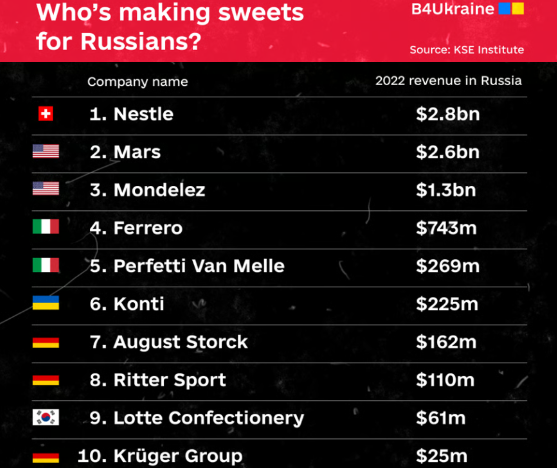
The leading international brands have remained [19], however. They are Nestlé (Switzerland), Mars (US), and Mondelez (US).
A small advantage has been gained by the domestic Russian chocolatiers. This year, it is estimated [20] that Russian chocolates are now supplying 93% of demand; that’s a gain of 7 percentage points over the pre-war level.
 [21]
Source: https://b4ukraine.org/whats-new/tricky-treats [19]
Large war losses have been suffered by the Ukrainian chocolatiers for whom Russia was their major market. The biggest of these losers was the Roshen brand owned [22] by Ukrainian president Petro Poroshenko.
Exiting European brands like Lindt have found ways to continue shipping into Russia, despite the appearances [20]. “Russian retail sales of Lindt chocolate bars rose 65% year on year in the first half of 2026, even as the broader bar-chocolate market contracted by volume. Products made in Switzerland and France continue to reach Russia through local importers despite Lindt ending direct supplies in 2022…Russian retail sales of Lindt chocolate bars rose 65% year on year in the first half of 2026, even as the broader bar-chocolate market contracted by volume. Products made in Switzerland and France continue to reach Russia through local importers despite Lindt ending direct supplies in 2022.”
These industry reports [20] don’t say so: “Lindt’s growth [is linked] to a narrower selection on store shelves and a shift by some consumers toward premium chocolate.” But what this means is that wealthier urban Russians are replacing the poorer chocolate eaters because they can afford the rising prices. They also prefer foreign brand-name chocolates to Russian brands. Russian oligarchs and Kirill Dmitriev, their Kremlin representative, eat Lindt Hello bars, not Rot Front bird’s milk (lead image).
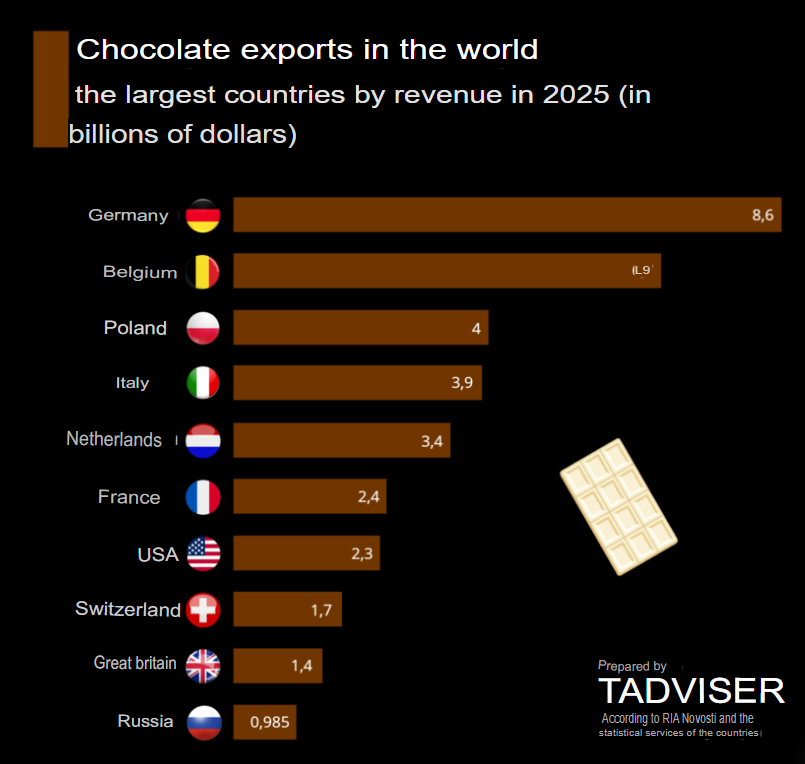
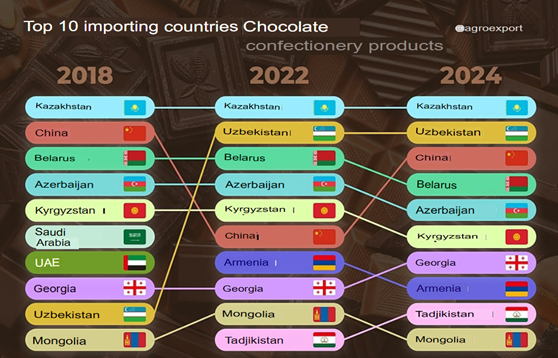
As domestic consumption shrinks, exports of Russian chocolate are increasing, elevating Russia to tenth place in the league of world chocolate exporters. Export volumes are rising as domestic producers shift to sales abroad
 [23]
 [24]
Source: https://www.tadviser.ru/ [25]
The leading companies with significant market share in Russia’s chocolate and confectionery industry are the domestic giant United Confectioners (Objedinennye Konditery, featuring brands like Alionka, Babaevsky, Krasny Oktyabr, and Rot Front), alongside major multinational companies such as Mars which owns the Korkunov product line; Mondelez which produces the Jubilee, Alpen Gold and Vozdushny (aerated chocolate bar) and Picnic brands; and Nestlé whose Russian products include Shedraya dusha (Generous Soul), Comilfo, Ruzanna, and Zolotaya Marka (Golden Mark).
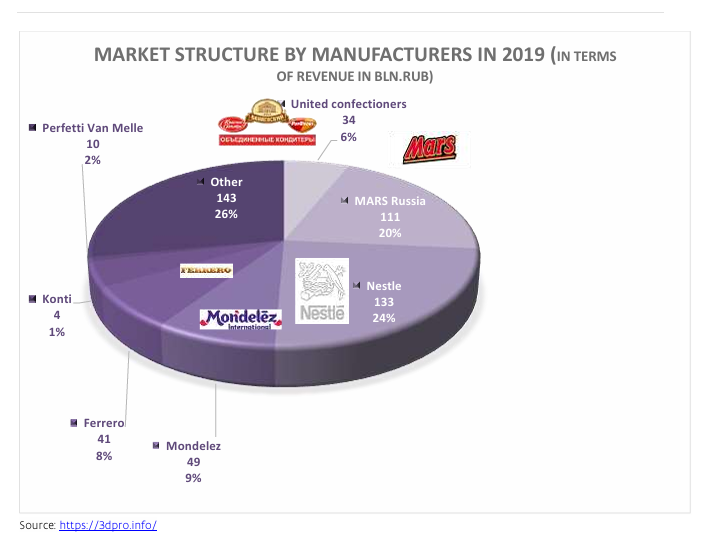
In 2019 a Belgian chocolate industry report estimated the Russian chocolate market shares of the major producers like this:
 [26]
Source https://export.flandersinvestmentandtrade.com/sites/fit_domains/files/media/report/2020-Russia-Confectionery%2520market_2.pdf [27] “The Russian Chocolate market is highly consolidated. Market key players as United Confectioners, Mars, Nestlé and Mondelez are providing around 60% of the total confectionery supply in terms of volume. At the same time, there is a market saturation in all segments that leads to increased competition and price wars, especially in large cities between network retailers. Both retailers and market leaders, in their attempts to attract the customers attention, are decreasing their margin and definitely, only consumers benefit this market situation.” Six years later, as the war sanctions against the Russian economy have intensified, Nestlé has continued to operate its Russian plants but suspended some of its brands. It is now in Kremlin-ordered temporary administration.
In 2021, when Dances with Bears made its last chocolate survey [17], the concentration of the market into foreign ownership was accelerating. “The only way NATO chocolate can conquer Russia is by the Fifth Column – that is, the takeover of the domestic market by the NATO brands Nestlé, Mars, Mondelez, and Ferrero. And this is exactly what has happened. In the current Russian chocolate market, these four manufacturers account for 61% of revenues – the money Russians spend on confectionery. Together, the two US groups, Mars and Mondelez, hold a 29% market share; Nestlé of Switzerland, 24%; Ferrero of Italy, 8%.”
“Russian chocolate experts see the future for Russian chocolate in rapidly increasing exports to new markets like China where chocolate eating is negligible. But they predict little chance the Russian chocolate manufacturers will be able to take domestic market share away from the foreign companies. This is because, under the pressure of falling income during the pandemic, rising inflation, and shrinking profit margins, Russian chocolatiers are replacing their traditional ingredients with cheap substitutes, wiping out the taste difference and advantage over their rivals [17].”
In a report [4] issued in September 2026, domestic dominance of the chocolate market was confirmed through United Confectioners (Uniconf) which “commands the largest local share of the Russian confectionery and chocolate market (around 20% or more depending on the specific sub-segment). Multinational Footprint: Combined, players like United Confectioners, Mars, Nestlé, and Mondelez have traditionally accounted for roughly 60% of total confectionery supply volume in the country. Recent Trends: In recent years (including reports through 2024–2026), local manufacturers and regional players like LLC KDV Voronezh and JSC Essen Production AG have also expanded their footprint amid shifting consumer preferences toward more affordable milk chocolate and chocolate-glazed candies.”
Uniconf is controlled [28] by Yury Gushchin who also controls the Guta Bank group and hotels outside Russia. He reportedly lives in the Seychelles [29]. He has been sanctioned [30] by the Kiev regime, but not by the US or European Union. This month, his executives told [31] the press that to offset falling profits on domestic sales, they are aiming to expand in the export markets of China and the Arab world. Chinese sales of Russian chocolate have been hampered by local counterfeiters producing cheap products with the Russian brand names [32].
An industry consultants’ report [12], released last week in Moscow, sounded optimistic as consumers substituted more expensive chocolate coated products for simpler, cheaper chocolate bars. “In 2026 we see a stabilization of the share of chocolate in the portfolio of customers, related to price adjustments and consumer adaptation. Despite the fact that chocolate bars showed a 3% drop in January–September 2026 compared to the same period of the previous year, the competitive interaction between the categories of confectionery products shows that chocolate has begun to ‘recoup’losses in the customer portfolio.: We see shoppers switching from crackers, waffles, and oriental sweets to chocolate bars and chocolates.”
Chocolate analysts in Moscow were asked how the war pressures and the shrinking consumer income are impacting on the market shares of Uniconf and the foreign chocolatiers, and the survival of the smaller, less capitalized regional producers. They refused to answer.