 [1]
[1]
By John Helmer, Moscow
@bears_with [2]
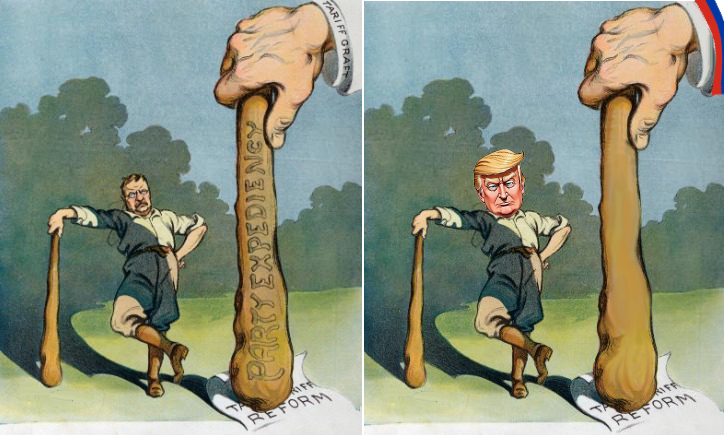
In his late afternoon, Tuesday, telephone call with President Donald Trump (lead image, right), President Vladimir Putin has followed the old Theodore Roosevelt (left) line. But he stopped short of agreeing to a summit meeting with Trump and Vladimir Zelensky in Delhi this coming weekend.
Kirill Dmitriev disguises the failure with a tweet [3]: “President Putin specifically praised First Lady Melania Trump’s efforts to reunite both Russian and Ukrainian children with their families — an important humanitarian contribution that rises above politics.”
Yury Ushakov has revealed [4] what didn’t happen: “The leaders agreed to continue the work on resolving humanitarian issues, including detainee and prisoner exchanges. Our President noted the efforts made by US First Lady Melania regarding the return of both Russian and Ukrainian children to their families…The presidents agreed to stay in touch and speak to each other by phone if the need arose.”
That’s a big IF.
This is the third time Trump and Dmitriev have tried pushing Putin into a troika summit. The first failed for Abu Dhabi in May 2025 [5]; the second failed for Budapest in October 2025 [6].
Zelensky has told [7] European reporters he is working on “on plans for Zelensky and Trump to potentially meet on the sidelines of the UN General Assembly later this month.” He has also told [8] the Israelis in Washington that there is “the possibility of another trilateral U.S.-Ukraine-Russia negotiation session, though no decision has been made. ‘We have this September, October to find any way to speak.’”
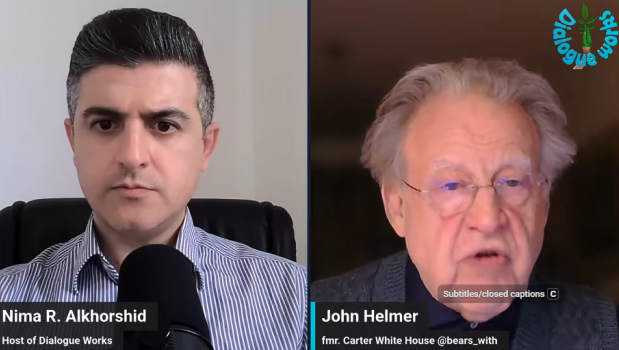
Listen to the new podcast with Nima Alkhorshid spelling out the three tracks of the negotiations which have now taken place; the soft-talk, big-money giveaway Dmitriev has told Putin will clinch a peace and pause deal; and the argument from the General Staff and Foreign Ministry for the big-stick options now and through the coming winter. Click [9].
Roosevelt had issued the same warning in 1901: “If you simply speak softly the other man will bully you. If you leave your stick at home you will find the other man did not. If you carry the stick only and forget to speak softly in nine cases out of ten, the other man will have a bigger stick. [10]”
The podcast went to air at 4 in the Moscow afternoon.
 [11]
[11]Source: https://www.youtube.com/watch?v=t6xu-ZTv5Hk [9]
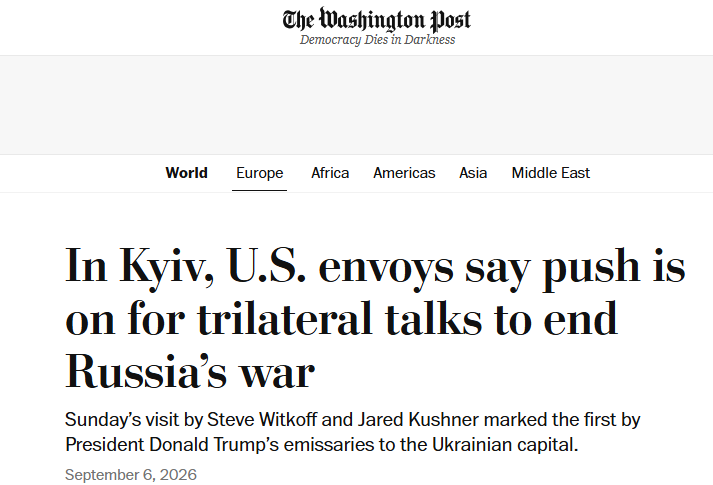
At that moment, the Kremlin spokesman, Dmitry Peskov, had been telling [12] reporters in Moscow to anticipate a telephone call with Trump. “ ‘We do not rule out the possibility that a telephone conversation between the presidents [of Russia and the United States] may take place following the trip of the American negotiators…You heard the statements from Kiev yesterday. Mr. Kushner made such statements. We also do not rule out the resumption of this trilateral format’, the spokesman added. At the same time, it is premature to talk about the place and exact dates, according to him.”
 [13]
[13]Source: https://www.washingtonpost.com/world/2026/09/06/us-envoys-kyiv-russia-ukraine-peace-talks-after-meeting-with-putin/ [14] “ ‘One thing Steve and I really thought would be productive is to go back to the trilateral format, which we were able to do about six months ago,’ Kushner said at the briefing.’And we've spoken with both parties, and so hopefully we'll have progress on that very soon.’ Kushner said he and Witkoff preferred the trilateral format ‘because we had everyone talking with each other.’ ‘Everyone was speaking in Russian to each other. We were discussing these issues in a very extra-friendly manner, all in Russian,’ he told the assembly of Ukrainian reporters in Kyiv.” https://kyivindependent.com/us-envoys-witkoff-kushner-arrive-in-ukraine/ [15]
In Ushakov’s read-out of the Kremlin meeting with Steven Witkoff and Jared Kushner, he had identified the Dmitriev plan for allocating the $300 billion in Russian Central Bank reserves, frozen in 2022 and used since then by the NATO allies to fund the war. “The negotiations,” he said [16], “did not limit themselves to the exchange of views on the settlement of the Ukrainian crisis, and the economic one was discussed in detail topics and possible large mutually beneficial Russian-American projects.” Click for more details of that scheme [17]. And here [18]is a parallel Witkoff-Kushner scheme, also for $300 billion, that was proposed for Iran.
The territorial, armistice, and commercial terms of the US plan were first published last November here [19]. Zelensky’s revision of the American 28 points into 20 points was issued last December [20].
The variation of this term paper which was on the table in Kiev on the weekend was reported negatively in the Kiev media on September 7 [21]. “Ukrainian official and public rejection of those terms is nearly unanimous. Ukraine’s longstanding red line, that it will never agree to the transfer of Ukrainian territory, property, or people into formal Russian Federation control because doing so would legitimize Russia’s unprovoked invasion, meant that Witkoff and Kushner’s trip to Ukraine and Russia ‘was just political theater,’ [Ukraine MP Anna] Skorokhod said. Skorokhod said she was aware of other new, harsher Russian peace terms delivered by Kushner and Witkoff to Kyiv from the Kremlin, but said she did not want to make them public because she had received the information by unofficial means.”
Official resistance to the Dmitriev line towards Witkoff, Kushner and Trump came from Foreign Minister Sergei Lavrov in an unusually explicit speech [22] at Moscow State University for International Relations in favour of the big-stick with the Americans and NATO allies. “We never wanted to be nice. Just wanted to negotiate honestly. But they do not know how to negotiate honestly on issues of key importance to the security of our entire continent…I don’t know if it will be appropriate, but I will say, nevertheless: the element of waiting is still present. Now, as they say, we must strengthen Russia’s influence in the world. Of course, it is necessary. We are doing this, the President of Russia is doing it. We have created such effective associations as the SCO, BRICS, many others. Established ties with other integration groups. They very much want to work with us, because we, I repeat, always, including in the economy, look for mutually beneficial solutions, and not try to say: “If you do not give me rare earth metals, then you will have such tariffs that you will suffer so much pain.” This is not our method. You know whose methods are. But the main decisive influence on the perception of us in the world and on the prospects of our influence, strengthening our positions in the world will have and is doing things at the front [23].”
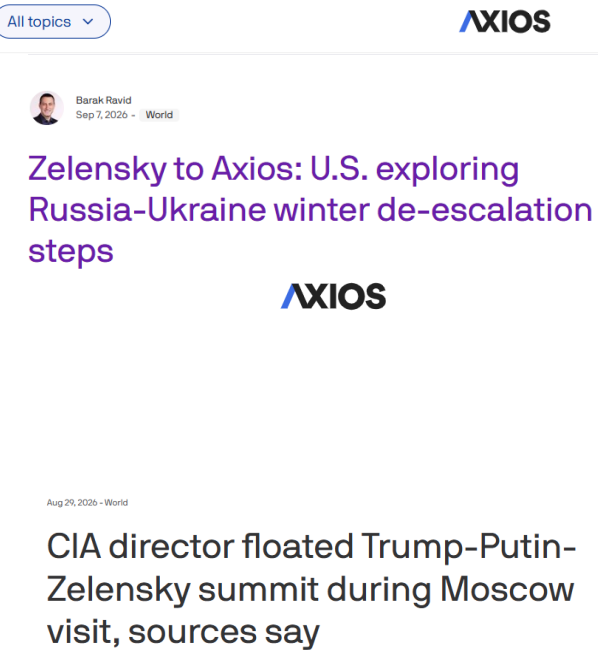
An Israeli reporter in Washington was briefed by Zelensky that he had discussed with Witkoff and Kushner terms for a limited de-escalation on the battlefield ahead of the northern winter, and before Russia’s parliamentary elections on September 18-20 and the US Congressional elections on November 3.
 [24]
[24]Source: https://www.axios.com/2026/09/07/zelensky-ukraine-russia-war-witkoff-kushner-putin-trump [8] and https://www.axios.com/2026/08/29/cia-director-ratcliffe-putin-zelensky-summit-war [25]
“While Zelensky said he’s convinced Russian President Vladimir Putin is counting on another brutal winter to weaken Ukraine, he added that Putin doesn’t want to antagonize the U.S. president ahead of the midterm elections. ‘My feeling [is] that Putin needs Trump,’ Zelensky said. ‘He doesn’t want … to upset him.’ Zelensky said that even if Putin doesn’t want to de-escalate, he could be pressured by the Trump administration to do so. When asked whether Putin might want to give Trump a diplomatic win before the U.S. elections, Zelensky replied: ‘Yeah [8].’ “
“ ‘There are ideas around energy [facilities] and around grain [shipments], around electricity [facilities] and around oil and gas [exports]. We have different interests, Russia and we,” Zelensky said. Asked whether the emerging U.S. approach involves both restarting negotiations and trying to reach understandings that would allow Ukraine and Russia to get through the winter without a major escalation, Zelensky said that interpretation was ‘very close to the reality of these conversations.’ He described the first objective as resuming negotiations and the second as trying to make the coming winter different from previous ones, when Russian attacks on Ukraine’s energy infrastructure heightened the war [8].”
Zelensky repeated that a troika summit is still a possibility.
“He said there is also the possibility of another trilateral U.S.-Ukraine-Russia negotiation session, though no decision has been made. ‘We have this September, October to find any way to speak,’ Zelensky said. ‘Without dialogue … we will not have [a] result. I think that President Trump can find a way to [a] real beginning of the process of negotiating before [the] cold winter,’ he added [8].”