 [1]
[1]
By John Helmer, Moscow
@bears_with [2]
In the memory of nations, a very special curse is reserved for the ruler who wanted peace not war; but was trapped by his enemies, not only into fighting on his enemies’ terms and timetable, but also into losing the war, and then losing the verdict of history of who was to blame for warmongering in the first place.
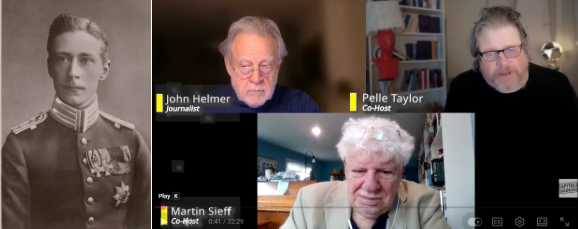
Wilhelm (lead image, left) – in 1914 the German Kaiser’s son, his successor as Crown Prince, and the loser of the war, his inheritance, and the throne – wrote in 1922, when it was all over for him, his father, and for Germany: “They”, meaning the British, French, Russians, “paid us the compliment of believing in our belligerence rather than in our incompetence.”
He was admitting, ironically but also ruefully, that after the Allied victory in World War I, it didn’t matter that pre-war German belligerence had been a lie, repeated over and over by the Allied leaders and in their media, especially by that arch-liar Winston Churchill, who loved war when it advanced his political power and fortune, as it almost always did.
In capitulation, Wilhelm was also conceding that he and his father would forever appear to have been to blame for their incompetence.
President Vladimir Putin had something similar to say about the war that has been forced on him and on Russia by the US, the British and French again, the Germans again – all of Europe.
In a finger he pointed at Mikhail Gorbachev, Putin said: “I would also like to highlight a certain naivety, idealism, or perhaps even complacency on the part of those who stood at the helm of the state during the final years of the Soviet era. Blind trust in Western partners and confidence in “gentlemen’s agreements,” when they thought they could simply take someone at their word and come to terms also played a cruel joke on the Soviet Union.”
Putin’s not going to fall for that joke, he emphasized. He was hinting that as he meant Gorbachev, his Russian listeners have all understood his references to Russians’ blind trust in US and NATO to mean Boris Yeltsin.
“The Soviet leaders wanted the West to like them, while Western leaders sought to reshape the world to suit their needs and to grab their share – preferably a large one – of the Soviet legacy. We can see the result now…Short-sightedness, narrow and unrealistic ideological dogmas instead of pragmatism, incompetence, and the practice of sweeping obvious problems under the carpet gradually exacerbated and undermined the Soviet Union’s domestic and international standing. Ultimately, these factors led to its collapse [3].”
Putin is implying that he himself never wanted Western leaders to like him. Or that if he once fell into that trap, he has now recognized the error of his way, and pulled himself out.
Fighting the war of the US and European states now, according to Putin, doesn’t mean falling into the traps they are setting with propaganda of Putin’s belligerence, provocations to draw him into battlefield traps. “We are not trying to scare anyone. What you have just mentioned – the Foreign Ministry’s statement and the letters it sent to certain countries – is not intimidation; it is a response to attempts to intimidate us. After all, it is not us who are making these statements about the need, possibility, or preparation for a war with Russia in 2029 or 2030. These statements come from Western and European politicians. We hear them constantly. Constantly. And then there are concrete actions: one exercise after another in the Baltic Sea, followed by attempts to detain our ships and vessels. All of this constitutes escalation, as I said in my remarks. All this is escalation.”
“If it comes to a direct attack on the Russian Federation – in this case, Kaliningrad, although it could potentially involve other territories as well – the question of Russia using all the weapons at its disposal would inevitably and immediately arise. That is inevitable…we understand that we would be facing an adversary with twice our population. It has immense economic and military potential. Yes, we would not have a vast array of forces and means at our disposal to counter such a threat. We would have to rely on our competitive advantages in this struggle. And what are they? The fact is that we possess such advantages in the means we have to defend ourselves. Yes, of course, France and the UK are nuclear powers. We understand that perfectly well and are fully aware of it. But no one else possesses the kinds of strike capabilities that Russia has today. And these are our competitive advantages…incidentally, neither that letter nor the Foreign Ministry’s statement mentions the use of nuclear weapons. They speak, as I have just put it, of employing all the forces and means available to our country. As for how that would actually happen, we will decide that ourselves [3].”
The response from the allies to Putin is to keep insisting on his belligerence, and also to dismiss what he says as incompetent. The obvious contradictions between the two don’t matter, because as the German Crown Prince had learned, the truth doesn’t matter. Striking first, winning the war at the end does.*
So what can that end-of-war be today when the war against Russia in Europe is a world war against Russia on all its fronts, and so a war against Iran and China, and against them all on the high seas and in the movement of money.
“Putin’s nuclear threats no longer work”, headlined [4] the editorial of the Financial Times yesterday. “The waning of the deterrent power of the Russian nuclear arsenal has, over time, made Ukraine’s western allies much less cautious about the kinds of weapons they are prepared to provide to Kyiv. Tanks, fighter planes and long-range missiles to fire at targets inside Russia — all once off the menu — have now all been supplied…The failure of nuclear deterrence is a particular setback for Russia. The possession of the world’s largest nuclear arsenal is one of the country’s only remaining claims to superpower status. Building and maintaining its stockpile is also enormously expensive. Russian pundits continue to fulminate and fantasise about nuclear strikes on Europe — presumably with the Kremlin’s encouragement. But these outbursts no longer make news in Europe [4].”
Down the street in London, the Guardian [5] has also editorialized on why Putin’s warfighting rhetoric is incompetent. “Putin might nevertheless calculate that a massive bombing operation this winter that turns off the lights, disrupts heating and damages waterworks and sanitation systems will break Ukrainians’ willpower, creating conditions for Russia to conclude the war with additional territory in hand…Still, the Russian leader’s strategy collides with some inconvenient facts, quite apart from Ukrainians’ proven toughness. The historical record shows that bombing campaigns don’t crush morale; they strengthen it. Ukrainians won’t be the exception. They regard resistance to Russia as essential for national survival.”
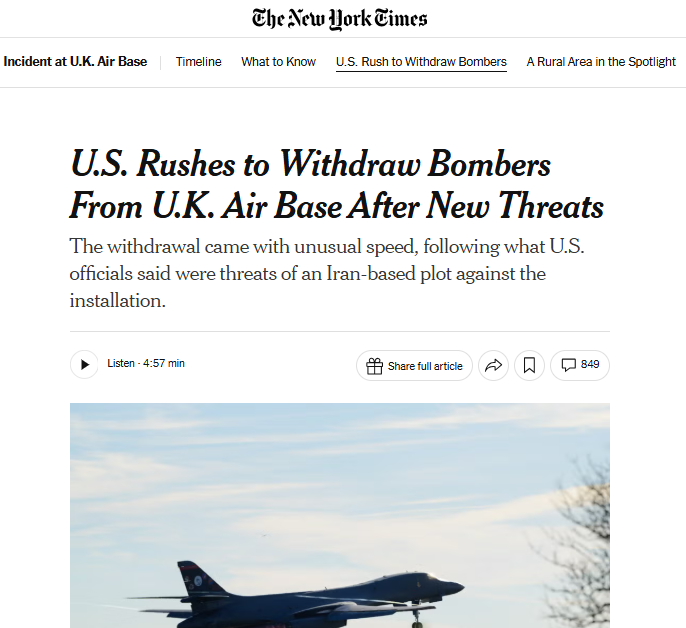
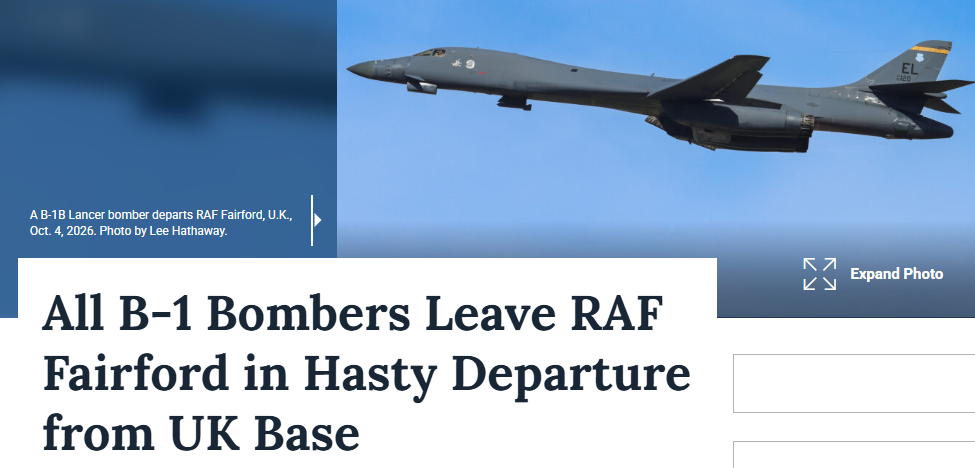
To make sense [6] of current American and British schemes for fighting their wars against Russia and Iran, Pelle Neroth Taylor, Martin Sieff and I (lead image, right) start by investigating the week’s big story of the US Air Force’s “rush” to leave its bomber base, RAF Fairford, in western England. US officials telling New York Times reporters what to print said “they believed that the plot was loosely modeled on an audacious attack that Ukraine launched against Russia last year when it smuggled drones deep into the Russian heartland and launched them from semi trucks. The attack destroyed or damaged at least a dozen aircraft, including many of Moscow’s nuclear-capable strategic bombers, on runways in Siberia and Russia’s Far North.”
“They didn’t fly out by accident,” claimed [7] President Donald Trump more than a week after British police arrested five people in the vicinity of the base, and one in London. “There were some threats and rather than tempting the enemy, we’ll capture the enemy and beat the enemy but why should we leave ‘em there.”
 [8]
[8]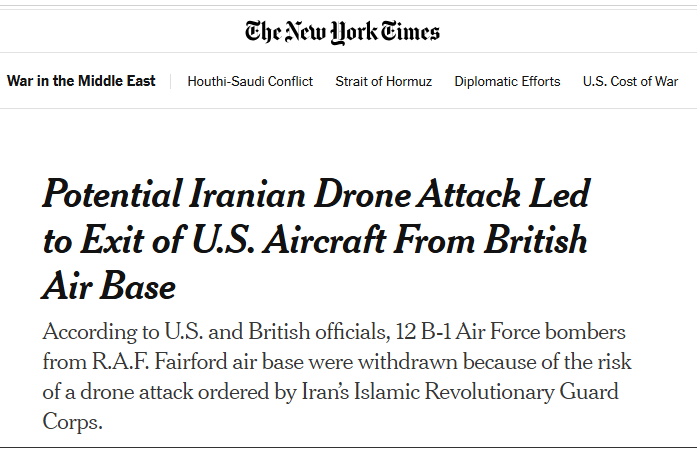 [10]
[10]Source: https://www.nytimes.com/2026/10/05/us/politics/iran-drone-attack-threat.html [11]
 [12]
[12]Source: https://www.airandspaceforces.com/us-b-1-bombers-leave-raf-fairford-uk-base/ [13]
[*] For the new history of how the World War I was plotted by the British, French and Russians to trap and destroy the Germans, with fresh parallels to today, read Pelle Taylor, The War Guilt Question [14].