 [1]

By John Helmer, Moscow
@bears_with [2]
There is a good reason that the podcasters on the Ukraine war draw large audiences by repeating the same mistake and not correcting it.
Delivering the certainty of war fact by podcasting the daily news from the battlefield several times a day is next to impossible. More certain is the process by which misreporting uncertainty replaces the genuine article. This is the iron law of media turning into propaganda.
On the uncertainty of the present war, read the reluctance of President Vladimir Putin to go to war with the most corrupt defense minister in the past hundred years of Russian defence; against an enemy of the combined western alliance aiming to inflict strategic defeat and breakup of the Russian Federation; without the support of Russia’s most powerful warfighting allies, China and India; over the opposition to war of Putin’s domestic supporters – the oligarchs, the banks, and the Central Bank of Russia; and despite the reluctance and resistance of the educated, prosperous, big-city youth.
“Home by Christmas” was the British public slogan when World War I began in Europe in August 1914; the war in Europe that isn’t is the Special Military Operation (SVO) – that was Putin’s point in February 2022.
“The attempt to appease the aggressor ahead of the Great Patriotic War proved to be a mistake which came at a high cost for our people,” Putin began his announcement [3] on February 24, 2022. “In the first months after the hostilities broke out, we lost vast territories of strategic importance, as well as millions of lives. We will not make this mistake the second time…For an infinitely long eight years, we have done everything possible to ensure that the situation is resolved peacefully, by political means. It’s all in vain…The whole course of events and analysis of the information in coming shows that Russia’s clash with these forces is inevitable, it is only a matter of time. They’re preparing. They’re waiting for a convenient hour. Now they also claim to possess nuclear weapons. We will not allow this… Circumstances require us to take decisive and immediate action. The people’s republics of Donbass appealed to Russia for help. In this regard, in accordance with article 51 of part 7 of the UN Charter, with the authorization of the Federation Council of the Russian Federation and in accordance with the treaties on friendship and mutual assistance ratified by the Federal Assembly on 22 February this year, I have decided to conduct a special military operation with the Donetsk People’s Republic and the Lugansk People’s Republic. Its purpose is to protect people who have been subjected to bullying for eight years, genocide by the Kiev regime. And for this purpose we will strive for the demilitarization and denazification of Ukraine. It is not our plan to occupy the Ukrainian territory. ”
Those two war goals – demilitarization and denazification of the Ukraine – have not yet been won. Over Saturday night, October 31-November 1, the 1,712th day of the SVO, 235 Ukrainian drones were shot down over 17 Russian regions; one civilian was killed [4]. Over the day Russian troops liberated 37 settlements, reclaimed more than 670 km², but lost 153 km². As a result, the growth of Russian territory amounted to 518 km² [5].” In the same period, Russian drone attacks on the Ukraine totaled 433 [6].
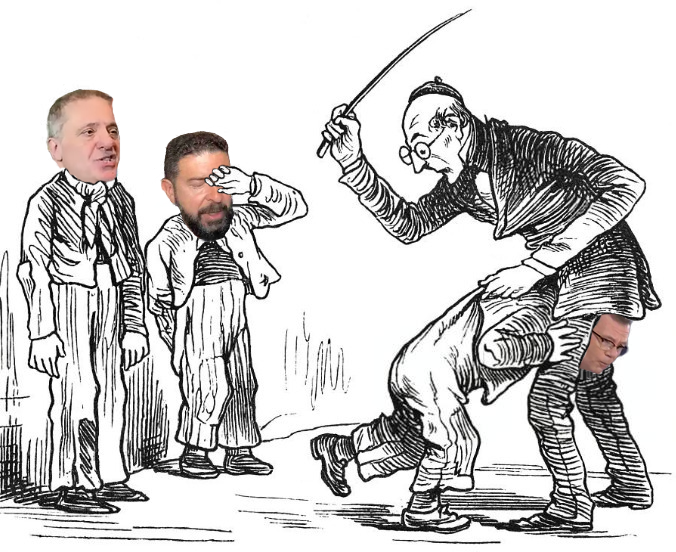
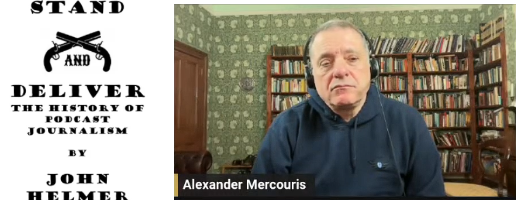
One of the popular war podcasters who has repeatedly reported this uncertainty as certainty is Alexander Mercouris (lead image, left). In the new book, Stand and Deliver, The History of Podcast Journalism, the reason he does this is revealed. His podcasts turn out to be evidence for the way in which the iron law of propaganda operates. The Mercouris story is also evidence of how it profits him and his business partner, Alex Christoforou (centre), to turn the iron law into gold for themselves.
Click to view or read [7] a sample of the book, now available in e-book, paperback or hardcover editions.
 [8]
Click Table of Contents and for sample: https://www.amazon.com/dp/B0HPFBZ1V7?asin=B0HPFBZ1V7&revisionId=&format=4&depth=1 [9]
EXCERPT FROM CHAPTER 3
 [10]
So far, the researchers of the podcasting medium have discovered that podcast audiences are drawn to presentations and speakers they agree with. When podcasts present differing views in a debate context, audiences become angry. They click off and exit, opting instead for podcasts with which they agree. When they are polled on the media which they trust, what they mean to say in answer is that they trust in their own convictions.
This is the underside of the iron law of propaganda: it’s what happens when the Big Lie and fake news make the truth implausible, unbelievable, untrusted. Plant false flags often enough and podcasting becomes the staging for false consciousness to take hold, like all other media.
“Podcasting has become the new political battleground: 85% of registered voters express confidence in podcast content compared to other media formats. Listeners consume content that reinforces their existing beliefs, training the algorithm to trap them in echo chambers that deepen polarisation under the illusion of informed choice. Additionally, podcasters operate largely outside of federal oversight with no enforceable standards for accuracy or accountability. This regulatory gap normalises misinformation and divisive rhetoric, forcing creators to escalate controversy simply to remain relevant [11].”
Bridging between representatives of different views, or debating between podcast presenters and their guest speakers is rare in podcasting, as a general rule. In politically charged podcasting, the pressure is intense on producers and hosts to restrict the points of this difference, preventing debate, and protecting the audience – and their revenue base – from views and guests the viewers disagree with. As one university study published in May 2026, reports [12]: “To study cross ideological conversation, we transcribed and diarized over 10,000 podcast episodes. We find that bridging guests tend to discuss a narrower set of topics during cross-cutting podcast interviews compared to non-bridging guests.”
In another university study, it was found that podcast producers select their guests from a network which tests the conformity of their ideas in advance. Upward trajectory from least noticed and small audience podcasts to popular, large-audience is a recruitment system that excludes disagreeable analysis [13]. This trajectory shows the trend for investigative journalism in podcasting, which just a few years ago drew audiences away from untrusted mainstream media, is already being overtaken, superseded, replaced by the same propaganda forces which grip the other media.
To illustrate how this process is operating, and also explain why, consider two rare samples of debate in this history – the first from October 2024 when I debated Gilbert Doctorow, and the second when I debated Scott Ritter a year later, in October 2025.The first scored just under 99,000 views; a little below the average viewer count of that month for the podcast platform, The Duran. The second scored 100,000 views; this was also below Ritter’s average audience count on Dialogue Works at the time; it was above my average audience.
…
Mercouris, the podcast producer, might have drawn the conclusion that debating differences was an audience-drawing asset. “This debate was a fantastic entrée! Please invite them to part 2,” a commenter wrote. But in the outcome, which took several days to materialize, Mercouris reversed himself and refused. He abruptly cancelled an invitation for me to appear for a follow-up. He did not explain his reason, then or since.
The reason is in Mercouris’s past record, and his recovery from that record for which he depends on Moscow.
Born in Athens in 1961 into a family of well-known fascist collaborators [14] and socialist party officials [15], Mercouris was schooled in London and graduated from University College, London, in 1982. He then worked as a junior solicitor at the Royal Courts until he became a barrister in 2006.
The six following years were documented in a report of March 2012 by the Bar Standards Board [16], a professional watchdog for lawyers in England and Wales. It had investigated [17] complaints of Mercouris’s misconduct in representing a client, and concluded with findings that he had “engaged in conduct likely to diminish public confidence in the legal profession or the administration of justice or otherwise bring the legal profession into disrepute” on four counts – forgery of legal documents, lying to his client, fabrication of a legal settlement, and inventing a kidnapping story in which he claimed to have been arrested by bogus police officers and taken to a meeting at the Royal Courts of Justice where P a senior law lord tried to bribe you to drop a legal case in return for a payment to you of £50,000 plus payment of your debts and mortgage knowing that this did not happen and dishonestly claiming that it did.”
The Board decided the evidence against Mercouris was true and he was disbarred, ending his career as a lawyer. He then began a new career as political analyst specializing on Russia. He was hired by Sputnik News, a state controlled and financed publication in Moscow.
Mercouris’s first article appeared in August 2014 and was critical of European court rulings in cases involving Russians. “There is always going to be a gap between people’s understanding of what is just/unjust and formal court rulings,” Mercouris began his piece. “Law will always strive to catch up with changing societal attitudes to ‘justice’ and ‘injustice.’ But law will always more or less miserably fall behind.” Sputnik bylined Mercouris a “London lawyer”.
Sixty-six articles followed in Sputnik by Mercouris at a rate of two each month; the last one appeared in March 2017. By then Sputnik was reporting Mercouris’s credentials as “a London-based writer on international affairs with a special interest in Russia and law…He worked for 12 years in the Royal Courts of Justice in London as a lawyer, specializing in human rights and constitutional law.”
By the time Mercouris stopped publishing in Sputnik, he had launched The Duran as a blog in 2016, and then as a Youtube podcast. The launch of Mercouris as the Russia expert he had not been before was financed by money banked in Cyprus with names arranged by Peter Lavelle (lead image, right) and Alex Christoforou. Lavelle was an American whose checkered career in Moscow began in the 1990s and included small-time investment broking and business columnist in The Russia Journal until its publisher Ajay Goyal fired him, and Lavelle was hired by RT, the state media platform.
Christoforou was the son of Charalambos Christoforou, a Cypriot diplomat whose postings included minister-counselor in Washington in 1981, and ambassador in Moscow in 1992. Alex went with his father and also studied at US universities.
The Duran, according to Lavelle in May 2016 [18], “is a PLC company registered in Cyprus with audited accounts. We have shareholders and an advisory board. Transparency is job number one for us. We do not intend to crowd fund. We will invite readers to invest in the project to become shareholders. At this point we do not have a single outside investor. Nonetheless, we are of course interested any ‘angel investor’ who wants to support The Duran.” Cyprus company registration sources [19] indicate The Duran was initially recorded in September 2016 as held by DRN Media Public Media Company owned by Mercouris, Lavelle, Alex Christoforou and Vladimir Rodzianko; a fresh registration record for The Duran began in 2023 [20]. Other corporate identities, also registered in Cyprus and trading for the three of them, included Reverse Gear Media Ltd. and Wadja Media Ltd. Rodzianko was a university graduate from Ohio before he joined The Duran in 2016 [21].
In April 2016, the audience views for The Duran were reported at 200. Mercouris then published an explanation of his disbarment and of the behaviour documented by the Bar Standards Board. He wrote [22] that he had suffered “a rapid descent into what I have no hesitation today in calling madness. I became increasingly delusional and detached from reality. I began to fantasise wildly, and disastrously I began to involve other people in my fantasies.”
The investigation and the disbarment, Mercouris claimed in retrospect, were the “best thing that could have happened.” He had been hapless victim, not culpable wrongdoer; he had initiated his removal from the Bar himself; disbarment wasn’t a conviction or a punishment because he had requested it; the British government, through the negligence of the National Health Service, was to blame [22]. “After suffering years of neglect at the hands of the NHS [National Health Service], I at last came into contact with a powerful institution that was concerned about me and which took my condition seriously. Once the Bar Council grasped that I had not acted out of malice or greed (I had never asked for or received money), and that my behaviour was caused by depression and drug-induced madness, they treated me with scrupulous kindness and fairness. Though in light of what had happened I had to be disbarred — something I asked for myself if only to protect myself — it was the Bar Council’s involvement that finally pushed the NHS to provide me with therapy instead of drugs…Without denying my own responsibility I cannot help feeling his was all unnecessary, and that a critical moment in my life I was let down. In my opinion the fundamental problem is that Western medicine thinks of depression as a form of illness, and treats it that way. Since the typical way of treating illness is to prescribe drugs, the reflex response to depression is to try to ‘cure’ it with drugs. This approach of course has the active encouragement of the drugs companies. I think it is completely the wrong approach.”
The targets of the misconduct which had led to his disbarment didn’t agree. As Mercouris’s Russian employment increased his visibility in the internet and podcast media, his former clients, Lorna Jamous and her son Tarik, launched court action [23] in London against Mercouris “seeking damages for personal injury in the nature of anxiety and post traumatic stress disorder (PTSD) caused by the defendant’s alleged breach of duty and related conduct during the period 2008 to 2009. At that time Mr Mercouris, as a legal adviser, was assisting Mr Jamous’s mother, Mrs Lorna Jamous.”
The High Court records reveal protracted litigation, multiple court hearings, orders by several judges, contested evidence, and appeals which ran from May 2016 until October 2020.
Mercouris’s defence, according to the judge’s summary in the court files, was: “Mr Mercouris completed his legal studies in 2006. He was unable to obtain pupillage.152 He became his 99 year old grandmother’s carer and, as a result of these events, became depressed and had a full nervous breakdown in the Summer/early Autumn of 2007. He remained depressed until 2012…The Defendant’s increasingly bizarre behaviour between 2007-2010 was the consequence of his mental health which was known, or ought to have been known, to Mrs Jamous.” — Para 44 [24].
The case concluded after more than four years with the dismissal of the Jamous claims against Mercouris on the technical grounds that the required time limit for filing her claims had run out and that the Jamous family had failed to comply with other court orders. At the start, the judge had “concluded that it was reasonably arguable that those actions on the part of the Defendant [Mercouris] in 2008/9 had caused her [Lorna Jamous] some psychiatric injury /exacerbation of pre-existing psychiatric illness and that she had suffered the same exacerbation or further exacerbation as her son in 2016.” – Para 53 [24].
However, time ran out for the claims to be tested, and there was no court trial of the evidence against Mercouris. In the final judgement, issued on October 23, 2020, Justice Edward Murray ruled: “there appears to be merit in Mr Jamous’s ground of appeal. Given the lack of supporting evidence, however, from Mr Jamous that would be needed to resolve the questions that I have highlighted above, this factor does not persuade me that the extension of time to appeal should be granted notwithstanding the other factors discussed above that weigh heavily in favour of refusing the application.” – para 140 [23].
In court Mercouris was saved by the bell. In the media Mercouris has been saved by his Russian links. So too his partner Christoforou: he told [25] a Cyprus press interviewer in 2023 that “Ukraine has been the making of him, a process that happened organically but is still rather stunning. A year ago, his personal YouTube channel was active (The Duran has been active even longer, since 2018, having started as a news blog a couple of years earlier) but his videos were getting around 5,000 views. Then came the war, and his popularity exploded”.
According to one source, Mercouris’s podcasting now generates more than $350,000 in annual revenue [26] from Youtube, and his assets are valued at up to $5 million. Another source claims larger takings and up to $10 million in assets [27]. More modest estimates put the annual revenue of the podcast between $36,000 and $100,000, and Mercouris’s net earnings [28] between $71,000 and $471,000.
The measurements by Social Blade of the rise and fall in views and subscriber numbers for Mercouris’s podcast confirm that this year his declines have been sharp, with the result that the annual estimate of his earnings has fallen [29] to a range of between $11,000 and $177,000.
But the chart line over time reveals another vulnerability for Mercouris. This is that on October 17, 2024, when Mercouris hosted the Helmer-Doctorow debate, the monthly rate [29] of his new views was falling 19% from its peak in August, and the monthly rate of new subscribers was down by 17%.
This is circumstantial evidence that, despite the keenness of some viewers for combat of views, not conformism, Mercouris did what the research shows podcast impresarios do. He banned me from appearing again. His refusal to explain his reason adds to the evidence that through his links to the state media management in Moscow, he was advised not to allow again the views of a journalist who was already banned from the Russian media and from Russia altogether.
 [30]
In retrospect, the truthfulness of the views which had been debated can be judged from the transcript. The outcome for the podcast was that it moved in the direction of propaganda.