 [1]
[1]
By John Helmer, Moscow
@bears_with [2]
To understand President Vladimir Putin’s recent public statements on the Russian economy, the Tuapse refinery fire, and security controls for the internet, the question is – does he believe what all Russians know to be obviously misstated and mistaken? Does Putin understand he is discrediting himself with Russian voters as the national parliamentary election campaign gets under way?
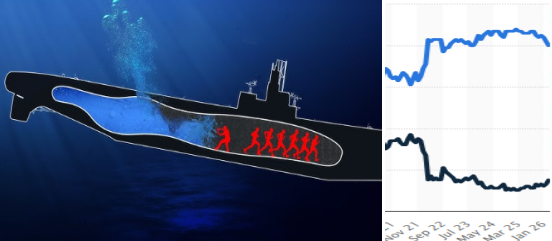
The voter evidence is plain to see in both the VTsIOM’s April report and in the Levada Centre tracking chart (lead image, right). VTsIOM [3]is a state polling agency, the Russian (until 1992 All-Union) Public Opinion Research Centre; Levada [4] is an independent group of Russian sociologists, based in Moscow and currently under state sanction as a foreign agent for having received US funding in the past.
According to VTsIOM’s daily tracking poll of trust in the country’s political leaders, Putin’s approval rating has dropped from 81% in mid-December to 71% this month [5]. This has not (repeat not) been accompanied by an increase in voter trust in the four parliamentary opposition figures, led by the Communist Party’s Gennady Zyuganov.
This downward line in the polls reflects the loss of confidence which Putin himself has triggered; it isn’t a response by voters to alternatives proposed by Putin’s critics in the opposition parties.
According to the March 18-26 survey by Levada [6] — conducted by face-to-face interviews with a random sample of voters in their homes across the country – “six out of ten respondents negatively assess the current political situation in Russia – 61% (including 52% considering it tense, and 9% critical, explosive), the share of such respondents has increased by 9 percentage points since May 2025. A third of the respondents look positively at the political situation in the country (including 27% talking about it as calm, 9% as prosperous). But since May 2025 their share has decreased by 10 percentage points…”
“More often than others, the political situation in Russia is assessed as tense, critical, or explosive by women (70%); those aged from 40 to 54; the less well-off (65% — 67% among those with barely enough for food); residents of cities with a population of 100,000 to 500,000 (68%); entrepreneurs (71%); those who believe that things in the country are on the wrong track (89%); and those who do not approve the performance of the incumbent president [6].”.
In Putin’s public speech to a session of his economic ministers and advisors, including Central Bank chief Elvira Nabiullina, on April 15 [7], the President acknowledged the obvious: “Statistics show that economic growth has, unfortunately, been slowing for two consecutive months. Overall, GDP contracted by 1.8 percent between January and February. Manufacturing and industrial production as a whole have suffered losses, as has construction, a strategically important sector.”
He then told voters not to blame him.
“Yes, experts point to calendar effects, weather conditions, and seasonal factors as the reasons for this negative performance. As I mentioned at our last meeting, we are fully aware that in January this year there were two fewer working days than last year, and in February, one fewer. These are, of course, objective circumstances, but it is clear that they are far from the only factors shaping business and investment activity in the country [7].”
Regarding the Tuapse refinery fire in the Krasnodar krai, the Ukrainian drone attacks began on April 16 [8]. Putin did not begin to address the public on what was happening until twelve days later, on April 28. In the mid-afternoon the Kremlin announced [9] that “the President received a report from the Emergencies Minister on fire situation in Tuapse following Ukrainian drone strikes.” This report [9] came by telephone from the Emergencies Minister, Alexander Kurenkov, who was calling from his office in Moscow. It was then announced that “in accordance with Presidential instructions, in the next few hours, Alexander Kurenkov will head off to Tuapse to personally oversee firefighting operations at the affected oil refinery and the elimination of consequences of the incident.”
Thinking to reassure voters who for several days had been watching dramatic television and social media reports of the extent of the fire, the acid rainfall, and the oil pollution in Tuapse, Putin said he was sending a subordinate but wouldn’t be going to Tuapse himself. He was remaining in Moscow to meet his health minister, the President of Congo, and visit an emergencies clinic in Moscow.
Putin was also recorded at a Kremlin meeting for “ensuring election security” as saying [10]: “Drone strikes against civilian infrastructure are also becoming more frequent. A recent example is the attack on energy facilities in Tuapse that could potentially cause grave environmental challenges. The governor has just reported – he is there on the ground or was there a couple of hours ago – adding that there don’t seem to be major threats and the people are coping with the challenges they are facing.”
At the same time Putin made an election pitch at Russian businessmen, blaming [10] the recession on Russia’s foreign enemies. “The Russian economy has for many years already been operating under serious external challenges. This includes a difficult economic environment, illegitimate sanctions, and a number of other adverse circumstances. You know well that in relation to many of our entrepreneurs and members of their families – and not even immediate family members, sometimes in the third generation – these very illegitimate sanctions are imposed. The same is being done in relation to entire major companies. At the same time, the overwhelming majority, practically all entrepreneurs, work effectively and with full dedication, take a patriotic position, sincerely strive to make their contribution to achieving Russia’s development goals, help our fighters at the front, and support participants in the special military operation and their family members. The state also needs to work in partnership with business, ensuring its lawful rights and interests.”
The widespread Russian voter reaction to Putin’s remarks was reported [11] by Oleg Tsarev, a leading figure in the Ukrainian opposition to the Kiev regime and an exile in Crimea: “It is very important that the president is given objective and truthful information. Now we know that Tuapse will be all right There are no serious threats. Sad irony.”
Tsarev’s irony is a political understatement. It’s sad for Russians to see and hear because the President appears not to understand the damage he is publicly inflicting on his own credibility.
So the question they are now asking is whether Putin is once again showing the loss of understanding of how his statements, actions, and inaction are understood in the country. Again: this refers to the sinking of the Kursk submarine on August 12, 2000, and Putin’s delay at the time, his refusal to acknowledge the obvious while he vacationed at the seaside, and his reluctance to meet and hear out his critics, face to face.
When Putin did meet the Kursk’s crew’s families at Vidayevo, the Kremlin reported [12] the six hours in four lines. What happened in fact was hostile questioning, bitter scepticism of Putin’s replies, and anger at the official cover-up [13]. Putin, then just eight months into his presidential term, directed his ire at domestic reporters who broke through naval base security to interview the crew’s families.
Read more on the Kursk [14] disaster.
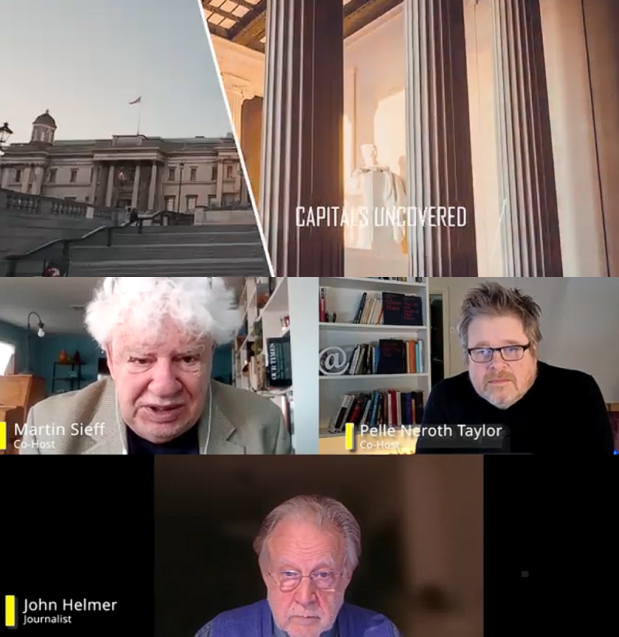
For public reaction at the time, and Putin’s subsequent recovery in voter polls, read this [15]. For a discussion of Putin’s Kursk syndrome, view or listen to the new podcast [16] with Martin Sieff and Pelle Neroth Taylor, recorded at 3 on Wednesday afternoon, Moscow time.
 [17]
[17]Source: https://www.youtube.com/watch?v=BzhvTr5ff-s [16]
NOTE: Several hours after the podcast concluded, the Kremlin reported that President Putin had initiated a telephone call to President Trump.
In the Kremlin read-out of the 90-minute conversation, Putin’s efforts to ingratiate himself with Trump were reported by spokesman, Yury Ushakov. These included -- Ushakov said -- Putin’s expression of personal solidarity with Trump over the attack incident in Washington; his congratulations to Melania Trump on her birthday and for “her contribution to the efforts to reunite Russian and Ukrainian children with their families”.
According [18] to Ushakov, Putin also promoted Kirill Dmitriev’s line of negotiations with Steven Witkoff and Jared Kushner for the “large prospects of mutually beneficial projects in the economy and energy, and a number of large-scale initiatives in the economy, as noted by the Presidents, already specifically discussed between representatives of our states.” As discussed in the podcast, every one of Dmitriev’s proposed “prospects”, “projects”, and “initiatives” has failed to secure US agreement so far.
In Ushakov’s summary [18], Putin reportedly told Trump that the US threat of “a ground operation on the territory of Iran is completely unacceptable and dangerous.” For alternative, Putin offered “all possible support for diplomatic efforts to find a peaceful outcome of the crisis and proposed a number of considerations aimed at resolving the differences around the Iranian nuclear program. For these purposes active contacts with Iranian representatives, leaders of the countries will continue in the Persian Gulf, as well as with Israel and, of course, with the team of American negotiators."
Putin omitted to record for Trump Russian support for Iran’s “interests”, as Putin had assured  Iranian Foreign Minister Abbas Araghchi on Monday [19].   Putin also did not register the Russian objection to the US blockade of the Hormuz Strait, nor to Israeli violations of the ceasefire in Lebanon, according to Ushakov’s read-out.

In a press gaggle [20] in Washington, Trump referred to the telephone conversation with Putin.  “We talked,” he said, “more about the war in Ukraine, but he would like to be of help. And I said before,  you help me, I want to end your [sic] war. So, we had a good talk. I've known him a long time. I think he was ready to make a deal a while ago. I think some people made it difficult for him to make a deal, but we talked more about Ukraine.”
Trump then confused the Ukraine with Iran in his remarks, claiming [20] “I think Ukraine, militarily they're defeated, OK? You wouldn't know that by reading the fake news. But militarily, look, their Navy -- so, they had 159 ships. Every ship is right now underwater. Typically, that's pretty good.”
 [21]
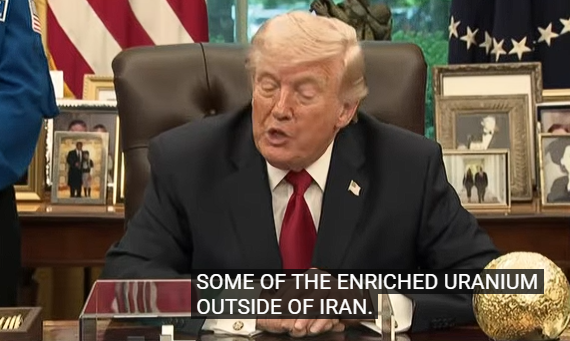
[21]According to Trump’s version of the call with Putin, “he told me he'd like to be involved with the enrichment if he can help us [sic] get it. I said, I'd much rather have you be involved with ending the war with Ukraine. To me, that would be more important. Because we're going to have that -- look, we're not going to let Iran have a nuclear weapon. And we've knocked out their Navy, we've knocked out their Air Force, we've knocked out their anti-aircraft everything apparatus, everything they have. Their radar, they have very little left. And they have some missiles, a small percentage, they have a small percentage of missile making facilities. We knocked out about 80 percent of them. The rest could come very quickly if we don't make a deal. They're not going to have a nuclear weapon. They know it and just about everybody else does, and so we talked about that a little bit.”
“He [Putin] doesn't want to see them have a nuclear weapon either. But I had a long talk with President Putin. I suggested a little bit of a ceasefire, and I think he might do that. He might announce something having to do with that. Did he announce [20] it yet?”
According to Ushakov’s read-out [18], which was published a few minutes after Trump’s remarks in the Oval Office, “Donald Trump positively assessed the Easter truce [on the Ukraine front] which Russia recently declared. In this regard, Vladimir Putin informed his American counterpart of his readiness to declare a truce for the period of celebration of Victory Day [May 9]. Trump actively supported this initiative, noting that the holiday marks our common victory over Nazism in World War II. “