 [1]
[1]
By John Helmer, Moscow
@bears_with [2]
Last week, the Supreme Commander in Chief of the Russian Armed Forces, Vladimir Putin, revealed two military secrets of his strategy for achieving Russia’s war aims on the Ukraine battlefield. They involve weapons he has fired in the past.
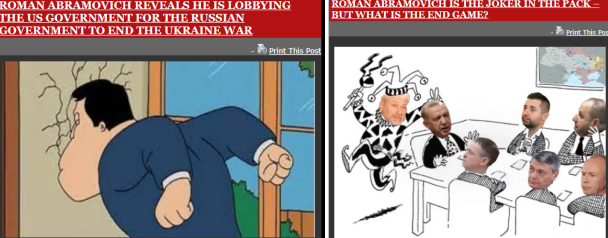
The first was the launch of the Oreshnik missile (lead image) at a Kiev region target, Belaya Tserkov (Bila Tserkva), on May 24; the second was the launch at Kiev of the oligarch Roman Abramovich (lead image).
The missile and the money bag.
US and NATO intelligence estimates indicate there are at least a half-dozen Oreshniks in the current Russian military inventory, with the production line adding a new one every two months [3]. In addition to Abramovich [4], there is one other oligarch weapon which Putin regards, he says himself, as “trustworthy and honourable”: that is Kirill Dmitriev [5] representing the Russian oligarchs in collective talks with President Donald Trump’s representatives.
The third military secret Putin has now revealed is that his confidence is unshaken in the success of these weapons despite the record of their repeated failure.
“I will share a major state military secret with you,” Putin told [6] a group of journalists on June 4 about the latest Oreshnik strike: “we simply struck locations where it was possible to observe the results. This applies to Belaya Tserkov and, even more so, to the DPR [Donetsk People’s Republic] area within the main fortified zone. Afterwards, our drones flew into the structure we hit, and we meticulously observed how the separating warheads were dispersed, calculating everything to the millimetre. This is crucial for us to make future decisions on the full-scale employment of the Oreshnik against designated targets, including urban areas.”
The second of his secrets Putin revealed the next day (June 5 [7]) to a business group at the plenary session of the St Petersburg International Economic Forum (SPIEF). “Three weeks ago [May 13], a representative of our business community contacted me with a matter. I have been acquainted with this individual for a considerable time; although we do not maintain close ties, I regard him as trustworthy and honourable. He called me and said: ‘Mr President, I am being invited to Kiev.’ I responded: ‘Well, by all means, go ahead; how does this concern me?’ He replied: ‘I felt it was imperative to inform you, as the discussion will likely involve issues pertinent to relations between our two countries.’”
“I advised him: ‘Listen, I cannot dispatch you in any official capacity; such matters should be the remit of qualified professionals from the Ministry of Foreign Affairs, the Ministry of Defence, and other relevant services – much as occurred during our negotiations in Istanbul. Therefore, I cannot sanction any official action on your part.’ He replied: ‘I merely wished to inform you of this invitation. I would go, listen, and subsequently report back to you on the discussions.’ I replied: ‘“I cannot prevent you; feel free to go.’”
“He travelled to Kiev, where he met with the individual, the author of that letter, at his residence, not at Valdai. Upon his return, I convened with him. Amidst the less substantive elements, the salient point was this: Mr Zelensky was requesting a meeting. I remarked: ‘I have never declined such requests. However, to convene merely for the sake of empty dialogue, as we say – I am well familiar with that…”
“Thus, I stated: ‘I see no merit in such a meeting.’ The sole objective, from the Ukrainian perspective, is to impede the progress of our Armed Forces, nothing more. We require agreements that endure not for mere months, not for half a year, but for a significant historical period. Let the specialists deliberate, devise solutions, and only thereafter can we convene, attend – as I mentioned – the signing of pertinent documents, or even append our signatures ourselves. However, a solution must first be formulated.”
“Now, to the most critical point, which the audience, particularly the Russian audience, will comprehend. This occurred, I believe, on May 21, and on May 22, Ukrainian forces executed a heinous terrorist attack on a college dormitory in the Lugansk People’s Republic, resulting in the tragic loss of children, adolescents. This constitutes a grievous crime. There were no military installations nearby, nor were there any military vehicles in the vicinity. That morning, I contacted this – shall we say – colleague who had journeyed to Kiev and asked: ‘What does this signify?’ They ask for a meeting whilst perpetrating such horrendous crimes as the murder of children. What is the implication of this? He responded: ‘I am at a loss for an explanation. They are contacting me once more; I will speak with them and subsequently apprise you and keep you informed.’ I replied: ‘Very well.’ I have not communicated with him since [7].”
After two days Vladimir Zelensky announced [8]: “Abramovich, he came to Kiev. He said…‘I have a message direct to you, and I want to get message and take message from you and to give it to Putin.’ But he said it has to be silently, without any kind of public messages. I said, ‘Look, it’s your choice…He came and he wanted to give me the message that they are ready to, that they want to fi—that they want to understand what we are ready to do…we spoke about any kind of compromises. I said, of all the compromises, after ceasefire, ceasefire is the biggest compromise from our side to your side…When he got message from me, he said…he will go directly to Putin. I said, ‘Okay, I am ready to meet… and we spoke about outcomes, what can be, and etc.,…after that we’ve got messages that they are ready for meeting only if Ukraine will do what they decided in Anchorage. But it’s terrible what they speak about…You can’t make decisions without us, about us. It’s unacceptable, and it will not bring peace.”
Abramovich told [9] the Financial Times: “Though Abramovich’s role has become less prominent since Russia began negotiating directly with the US last year, he remains involved in prisoner exchanges and other bilateral talks with Ukraine, including on aspects of a stalled US-led peace plan, according to people close to him. ‘He is needed because he is the only Russian they will tolerate. He gets along with everyone,’ one of the people said.”
In the current propaganda war, Comcast’s SkyNews is an American drone; the Financial Times is an Anglo-Japanese missile; Zelensky is one of their multiple warheads. This is how the separating warheads were dispersed, calculating everything to the millimetre.
For a backgrounder on the Oreshnik launches, click to read [10]. A damage assessment at the Belaya Tserkov site from the Kiev regime makes these claims [11].
For more detail on how Abramovich’s negotiation in Kiev was arranged, click to read Oleg Tsarev [12]: “Since the beginning of the conflict, Russian business has made great efforts to negotiate and stop the conflict,” Tsarev adds [13], “they wanted to do business, they wanted there to be no sanctions. In order to facilitate negotiations by informal means, Abramovich was included in the negotiating group.”
For the archive on Abramovich as the Kremlin’s trustworthy and honourable negotiator with Kiev, click to read [14] and this one [15].
 [16]
[16]An AI-assisted search reports that Abramovich and Dmitriev are not known to have met together on the Ukraine war negotiations. For the archive on Dmitriev, click [17].