 [1]
[1]
By John Helmer, Moscow
@bears_with [2]
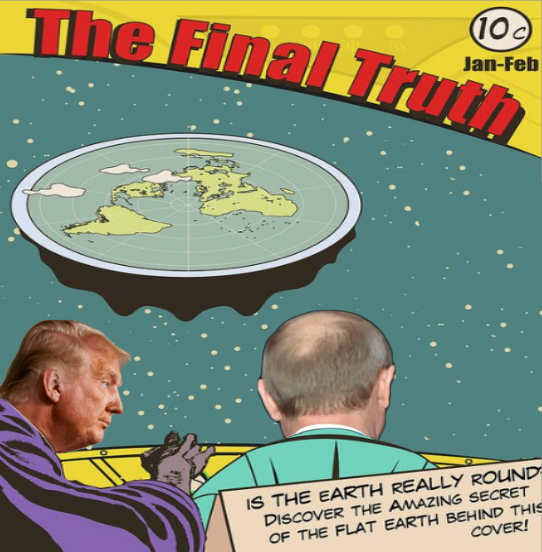
There was a map of the world on the wall of the Billy Mitchell Room [3] of the Arctic Warrior Events Centre. That’s where President Donald Trump met President Vladimir Putin at Elmendorf Richardson Airbase in Anchorage, Alaska, on August 15, 2025.
On the map, the world was flat. Crisscrossing it were lines marked at the bottom with the title of the map, TRIPP. That stands for “Trump Route for International Peace and Prosperity”. When Trump pointed it out, Putin thought he was joking.
Putin thought that what was said during the two and a half hours of their conversation was an agreement Trump would stick to. The Kremlin has called it the Anchorage Formula. The White House has never used the term [4].
Putin repeated it last Friday (June 5). Trump had agreed that he and the US would be the “genuine guarantor” of Russia’s long-term security in Europe, Putin said [5]. “Reliable guarantors are always helpful, but why the US administration and President Trump are being denied that role is beyond me.”
Putin was replying to Vladimir Zelensky in a letter published the day before (June 4). “We have heard,” wrote [6] Zelensky, “that you [Putin] were promised in Alaska the resolution of certain issues concerning Ukraine and Europe. But you can see for yourself that Ukrainian and European issues are not decided in Anchorage.”
Putin insisted he believes in Trump’s security guarantee. “Overall, I want to thank Donald for that effort – it was certainly useful. But there is still room for improvement. The work needs to continue.” The Kremlin report [5] has added that what followed was parenthetical “(Applause.)”
There is still no certainty about what was on the wall of the Billy Mitchell Room in Anchorage.
The TRIPP lines crisscrossing the world map around Russia are no Trump joke, though. They are certain, and on May 26, this was confirmed by US Secretary of State Marco Rubio in documents he signed in Yerevan, Armenia.
“First, the Secretary and Foreign Minister announced a bilateral framework agreement on the Trump Route for International Peace and Prosperity (TRIPP). This is a crucial accomplishment towards realizing the prosperous future envisioned in the historic commitments made on August 8, 2025, at the White House. The United States and Armenia are now one step closer to establishing unimpeded, multimodal transit connectivity within the region while respecting the sovereignty and territorial integrity of Armenia.The text also describes the contours of the TRIPP Development Company (TDC), a joint venture between the United States and Armenia intended to support trade, transport, and economic development while enhancing international, inter-state, and intra-state transportation connectivity. The United States is also working closely with the Armenian government on a TRIPP engineering survey. The United States remains committed to expanding global trade, peace, stability, and prosperity in the region.”
“Additionally, the Secretary and Foreign Minister signed the Charter on a Comprehensive Strategic Partnership between the Republic of Armenia and the United States, and the United States of America-Republic of Armenia Framework for Securing of Supply in the Mining and Processing of Critical Minerals and Rare Earths. With these developments, the United States and Armenia demonstrate their joint commitment to expanding the bilateral relationship and continue to fulfill the promises made in the Memoranda of Understanding signed by President Trump and Prime Minister Pashinyan on August 8, 2025 [7].”
The TRIPP line on the map is also an American security tripwire around Russia, Trump announced two days later (May 28).
“Soon,” Trump tweeted [8], “the United States and Armenia will break ground together on the Trump Route for International Peace and Prosperity, which will transform the South Caucasus, and help our wonderful American Energy Companies gain access from Central Asia all the way to the United States. For these reasons, Nikol has my COMPLETE and TOTAL Endorsement for Re-Election on June 7, 2026. With Nikol’s help, we will bring the United States, Armenia, the South Caucasus, and Central Asia to greater heights than ever before.”
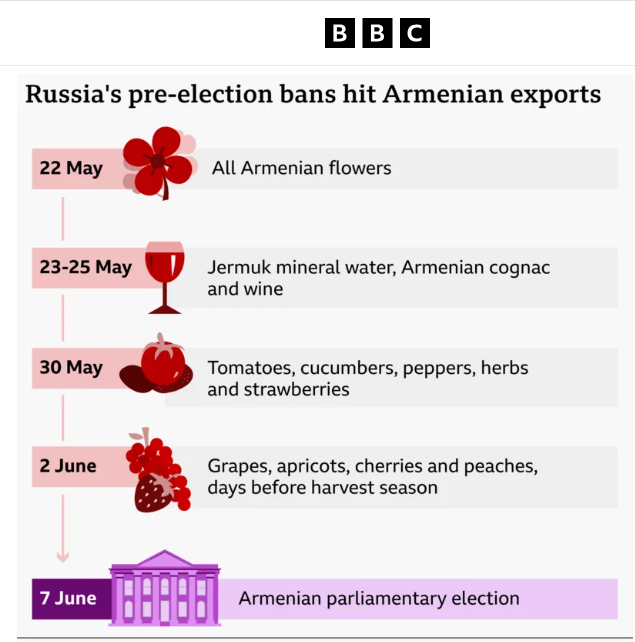
On June 7, Prime Minister Pashinyan’s party won the Armenian parliamentary election [9] with almost 50% of votes cast. The two pro-Russian parties of Samvel Karapetyan [10] and Robert Kocharyan [11] polled together just 33%. The Anglo-American media accused Russia of election interference, but not Trump [12]. The outcome is that Pashinyan will have seven seats less than he controlled before the election but still “a comfortable majority…For Moscow, the election turned into a geopolitical battlefield as it sought to protect its waning influence in the South Caucasus. The Kremlin likely assessed that it could not remove Pashinyan from power. It therefore focused on reducing his party’s gains and casting doubt on the legitimacy of his victory [13].”
Putin’s cautions to Armenia have been ignored [14]. “We would like to ask our Armenian colleagues to decide on their development path as soon as possible,” Putin said last week. “We have no objections. We will maintain good relations with Armenia no matter what development path it chooses to follow.” A week earlier Putin had sounded tougher: “We would be forced, in certain areas –and indeed, by and large – to scale back almost all of our cooperation with Armenia in the economic sphere related to integration processes…There would also be a reduction in trade in services, tourism, transport services, and other sectors…workers from Armenia would become subject to the requirements that apply to migrants from CIS countries…We would also have to restore the permit procedure for Armenian road carriers. This would be unavoidable; it is a separate and highly complex area of cooperation.In addition, rail freight tariffs would have to be adjusted from the current domestic Russian rates – which are currently applied to Armenian carriers – to the tariffs applied to other CIS countries. And, obviously, energy prices would rise.”
Putin then sent Pashinyan a card for his birthday [15]. Trump’s birthday present proved to be what Pashinyan wanted, and at the poll Trump has defeated Putin.
He is now extending the TRIPP further south in the US-Israeli war for regime change in Tehran and the extinction of the Islamic republic in the Middle East. “Final negotiations on ‘Peace’ are proceeding,” Trump tweeted, “subject to ignorance or stupidity getting in its way. The Blockade will remain in place, and in full force and effect, until a ‘Final Deal’ is reached [16].
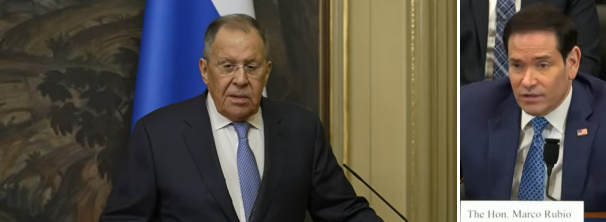
According to Russia’s Foreign Minister, the Anchorage Formula – that is, Trump’s guarantee of Russia’s security in Europe – doesn’t exist. “I very much hope,” Sergei Lavrov said [17] in Moscow on Monday (June 8), “that the experience of previous failures, when the West refused to fulfill its own supported agreements, will not be repeated in relation to the agreement in Alaska. But so far, unfortunately, our American partners have not shown any interest in this.”
Click to view or listen [18] to the new Capitals Uncovered geopolitics podcast with Martin Sieff (US) and Pelle Neroth Taylor (Sweden), aired on Monday afternoon:
 [19]
[19]Source: https://www.youtube.com/watch?v=OuOr1FTkuIg [18]
Putin delivered this warning to Armenian voters on May 29. He did not mention Trump’s vote for Pashinyan less than 24 hours earlier [8].
“I will now repeat the points I raised during that meeting, one by one. Our Armenian colleague, the Deputy Prime Minister, agreed that this approach is appropriate and that the matter should indeed be discussed honestly and openly. But before answering your question, I will say that I outlined these points in advance – not before this news conference, but during the restricted-format meeting. There is nothing confidential about them; on the contrary, I believe the public should be aware of it.
“Before proceeding further, I would like to emphasise something that I consider fundamentally important. The Russian and Armenian peoples are connected by longstanding ties of friendship and, without exaggeration, by a uniquely close relationship that has developed over centuries. There is a special bond between Russia and Armenia, and between Russia and the Armenian people. I said so to Nikol Pashinyan, and he can confirm my words. I told him that whatever serves the interests of the Armenian people is acceptable and beneficial for Russia as well: “Act according to what you believe is best for the Armenian people. You hold the authority here, and the responsibility for making decisions rests with you. Whatever decision you make will be respected – and no decision will undermine our humanitarian ties or our political relations.”
“That said, in this particular case we are solely discussing economic matters. These issues require careful consideration, analysis, and decision-making. As I have previously noted, the crisis in Ukraine began with efforts to move toward EU accession. We did not oppose such aspirations, but we pointed out that, for instance, phytosanitary standards differ substantially – which directly affects access to markets. Since Soviet times, in Russia and consequently across the countries that now form the EAEU, phytosanitary standards have been tougher than those applied in Europe. For example, we have restrictions regarding genetically modified products, and many people [in our region] do not wish to consume genetically modified food products – that is their choice, and we must take this preference into account. There have not yet been thorough studies regarding the effects of such products on human health. Also, technical standards are very different. Certain industrial products may be sold in our market while others may not. Differences extend to steel grades and so on. There are plenty of aspects that are simply not compatible today and cannot coexist.
“This does not mean that we are opposed to it; on the contrary, we support it. But it takes time and investment. For example, if you want to meet certain European standards – which may in some respects be more advanced than ours – you would need to invest resources in establishing the necessary production capacity. And the same applies in the opposite direction.
“Therefore, combining the two systems in one day is virtually impossible. As a result, we would be forced, in certain areas –and indeed, by and large – to scale back almost all of our cooperation with Armenia in the economic sphere related to integration processes.
“You asked about the advantages. This is how we see them. Some may disagree; that is open to debate. But what do we –and not only Russia, but all EAEU member states – see as the benefits of joining and strengthening the Union? First, access to a large and protected common market across the entire EAEU, including Russia and the other member states; duty-free trade; common technical and phytosanitary standards, as I have already mentioned – these facilitate market access and simplify logistics. Although we do not share a common border, we have nevertheless managed to ensure that the movement of goods and services is organised in the most efficient and cost-effective way possible. I will further elaborate on what I mean by that. Another advantage is low energy prices: in Europe, prices may reach around 600 euros, while for Armenia they are a little over 150 euros, though I do not recall the exact figure. The difference is significant. I am listing all the advantages because people often focus solely on energy. It is important, certainly, but it is not the only benefit.
“Then there is investment activity. According to data from the Eurasian Development Bank, accumulated investment in Armenia amounts to $4.9 billion, 86 percent of which is Russian. And this figure does not even include capital originating from Russia through indirect channels. In other words, Armenian business representatives operating in Russia often invest through third-party instruments. Therefore, the 86 percent figure does not tell the whole story; the actual amount is considerably higher.
“After the meeting in Yerevan, for example, European partners promised to invest 2.5 billion euros. How and when these investments will materialise remains to be seen. But 2.5 billion euros is still less than $4.9 billion, and that is before taking into account indirect investments, which are also, in essence, Russian capital. Now, regarding participation in free trade agreements: these would also be cancelled. What would that mean? First and foremost, it would entail the restoration of full customs controls and customs duties. We need to carefully assess what this would mean.
“The second consequence would be the cessation of mutual recognition of documents, particularly in the areas of technical regulations and phytosanitary standards. Agricultural products currently enter our market under these arrangements, but we would then stop recognising those standards and would have to review them. Perhaps we would recognise them and be satisfied; perhaps not. That remains to be seen. Where would products such as wine be exported – to Spain, France, Italy, Portugal? This is something that requires consideration.
“There would also be a reduction in trade in services, tourism, transport services, and other sectors. I will say more about transport in a moment.
“Furthermore, workers from Armenia would become subject to the requirements that apply to migrants from CIS countries. What does that mean? It means they would need to obtain patents to work in Russia. To gain access to compulsory medical insurance, they would need to reside in the country for at least five years, and so on. There are plenty of requirements. It would be an entirely different situation. People should discuss this clearly, directly, and honestly.
“We would also have to restore the permit procedure for Armenian road carriers. This would be unavoidable; it is a separate and highly complex area of cooperation. In addition, rail freight tariffs would have to be adjusted from the current domestic Russian rates – which are currently applied to Armenian carriers – to the tariffs applied to other CIS countries.
“And, obviously, energy prices would rise. The same preferences that exist today would no longer apply. According to preliminary estimates – not only ours, but also those from various experts – these changes could result in a loss of at least 14 percent of Armenia’s GDP. Whether that is a large or a small figure is open to discussion, but it is nonetheless something that must be carefully weighed and evaluated [20].”
 [21]
[21]Source: https://www.bbc.com/news/articles/c3626n1epd5o [22]
There was no Kremlin response to the Armenian election result during Monday.
Tass reported [23] “unprecedented electoral violations, including carousel voting. The electoral cycle was marred by arrests of opposition activists, which took place during the election campaign, the day of silence, and the voting day.” Legal challenges to the poll tallies by Karapetyan and Kocharyan were also reported by Tass [24].
The Russian Foreign Ministry announced [25] “the entire election campaign and the voting process itself took place in an atmosphere of harsh repression by the Armenian authorities against opposition parties and movements, their activists and supporters. Under the ‘shock’ of persecutions came and traditionally deeply revered in the country Armenian apostolic Church. All this is a gross violation by Yerevan of democratic principles and procedures for holding free elections. It is also significant that in the manner of persecution characteristic of the current Armenian administration, only those political forces that advocate the strengthening of the vital alliance with Russia…” There was no reference to the role the US had played.
Foreign Minister Lavrov then announced the Anchorage Formula is a dead letter because Trump wants it that way.
 [26]
[26]Left, source: https://www.youtube.com/watch?v=SYSqFq_E2wc [27]Right, source: https://www.youtube.com/watch?v=CVhpMrRE010 [28]
“If we talk about the negotiations quite recently, almost a year ago, in August 2025 in Anchorage, President Vladimir Putin (he also emphasized this), showing a spirit of compromise, adopted an absolutely specific proposal of President D. Trump. That’s how the negotiations ended. I very much hope that the experience of previous failures, when the West refused to fulfill its own supported agreements, will not be repeated in relation to the agreement in Alaska. But so far, unfortunately, our American partners have not shown any interest in this…But we are certainly concerned about the statement of Secretary of State, Rubio, who recently at a congressional hearing [28] said that the United States cannot be a mediator as they support Ukraine…Therefore, it is difficult for me to comment on the prospects of negotiations [17].”