 [1]
[1]
By Oleg Tsarev, Crimea, introduced by John Helmer
@bears_with [2]
The current restrictions imposed by the Trump Administration and NATO on Ukrainian drone and missile strike options against Russia reflect a strategy known as boiling the frog in warm water.
This is a strategy of gradual escalation, the timing of which is measured stepwise – so western strategists believe — in order to lull the frog into false confidence, and not to trigger the frog’s escape and its retaliation. That is, Russia’s counter-escalation with boiling water of its own.
The aim of the US and European strategy is the killing of Russia. The objective has been the same since 1917. This is the Hundred Years War against Russia. So long as the Kremlin and General Staff do not capitulate, this is going to be the Two Hundred Years War.
The belief in boiling the frog to death slowly started with experiments by German biologists in the late 19th century. Since then smart frogs have learned lessons from the German biologists, or else the biologists have grown smarter by learning lessons from the frogs [3].
From their experiments over the past century, Germans don’t learn the lessons Russians have tried to teach them. Americans are the new Germans; the lessons are the old ones. President Donald Trump is an old German.
In this new essay by Oleg Tsarev, published on August 1 [4], the lesson to be learned by Russia’s supreme commander-in-chief, President Vladimir Putin, has been explained scientifically, also discreetly. Tsarev is a veteran Ukrainian political leader who has survived Kiev attempts to kill him because of the clarity of his analyses – and the political appeal of his truthfulness to Russians and Ukrainians alike. He lives in asylum in Crimea [5], and publishes daily in this [6] Telegram account.
Tsarev is not saying the Americans are as unclever as the German biologists who first experimented with boiling the frog. He is not saying Putin is as unlearning as the frogs in the German laboratory. He is saying the myth of the slow boiling frog is a warning of the permanence and inevitability of the US strategic goal – if the lesson of counter-escalation isn’t implemented, and urgently. Tsarev’s boiling water recipe is for the Russian cook now.
“I would like to add that the existing restrictions for Kiev are a consequence of the Western policy towards Russia of ‘boiling a frog in warm water.’ According to this policy, the degree of escalation should be increased gradually so that Russia does not begin to respond harshly. But we must not forget that when the West decides that it is time, all restrictions will be lifted [4].”
There is another point Tsarev means readers in the centre of Moscow to understand; an old comrade of his expresses it this way: “We should put a stop to the reactionary cycle, the talk of tit-for-tat, symmetrical retaliation, mirror escalation, anti-terrorism not war. We must stop reacting to every Trump tweet, European declaration, Zelensky speech. MinOboron should stop labeling strikes as we launch them. We must start labelling the system that produces those strikes and strike at that.”
 [7]
[7]Oleg Tsarev’s Telegram essay has been translated verbatim, without editing, from this original [4]. Pictures and their captions have been added for reader reference.
 [8]
[8]Zelensky went to Washington to get missiles for Patriot — he asked for an emergency “winter package” of 300 interceptor missiles to repel the attacks of our ballistics. Trump said there are no missiles. And then Zelensky asked for a licence to produce anti-aircraft missiles, but realizing that starting production would take a long time, he also asked the United States to lift the ban on strikes on targets in Russia.
According to Kiev’s logic, if they have nothing with which to shoot down Russian missiles in the air, then they should hit the launchers on the ground. It’s cheaper and more efficient. One Patriot missile costs millions and shoots down one missile. But the destroyed launcher is all the missiles that it will not release.
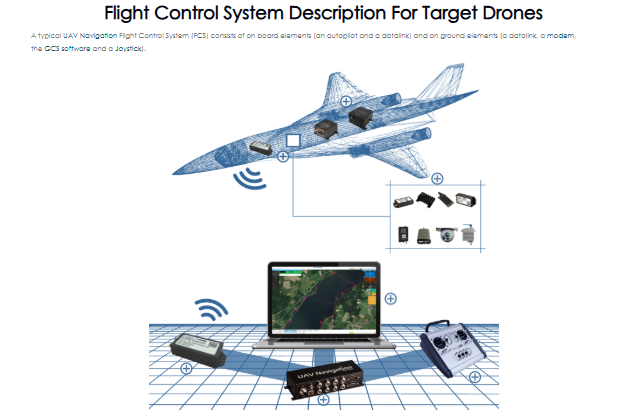
And Zelensky has asked for permission to use Starlink for strikes. The fact is that now Kiev can only operate over Ukraine via Starlink. The long-range drones that hit our refineries rely on inertial navigation and optical terrain recognition. They need predefined coordinates. However, this works with stationary facilities like factories, not with a launcher mounted on a truck that changes position every hour. Here we need a real-time operator and a communication channel over Russia – that’s Starlink.
It is already being used de facto: circuit [autopilot and carrier] boards that spoof coordinates have been found in drones shot down in Russia—a terminal might be physically downed near Voronezh, yet it reports to the network that it is in Germany. However, such a makeshift workaround is unreliable and cannot be scaled to hundreds of UAVs. Kyiv needs a legalized solution.
 [9]
[9]Source: https://www.uavnavigation.com/solutions/flight-control-system-description-target-drones [10]
Trump has not yet given Zelensky a clear answer, but said he would talk to Musk. Zelensky also requested a meeting with Musk himself. But Musk refused Zelensky.
It’s a similar story with rockets. On July 31, the Washington Post published a column by retired Rear Admiral Mark Montgomery of the Foundation for Defense of Democracies. His idea is not to spend scarce Patriots to intercept missiles that are already flying, but to hit Russian launchers before launch — with F-16s using ERAM missiles.
 [11]
[11]Source: https://www.washingtonpost.com/opinions/2026/07/31/how-ukraines-f-16s-could-stop-russian-ballistic-missiles/ [12] and https://www.washingtonpost.com/opinions/2026/07/31/how-ukraines-f-16s-could-stop-russian-ballistic-missiles/ [12]
The sale of such missiles to Ukraine — up to 3,350 units worth $825 million — was approved by the State Department back in August 2025, with Denmark, the Netherlands and Norway paying. The range is about 450 kilometres, the accuracy is about ten metres; they are resistant to electronic warfare. That is, it is a cheap consumable, and not an analogue of Storm Shadow. But 3,350 is the supply limit: the Pentagon has planned to transfer about a thousand missiles in two years, that is, a little over forty missiles per month. Also quite a lot.
However, Kiev’s main problem lies in the limitations of its use: currently, ERAM is allowed to be used only from Soviet aircraft and without retargeting in flight; the missiles have not yet been integrated programmatically under the F-16. Plus, separate Pentagon approval is required for each type of target in Russia.
Montgomery’s article lobbies for the lifting of these restrictions, which, according to him, can be carried out in a few weeks. But to date, as far as we know, no decision has been made.
It is about 490 km from the nearest Kiev-controlled border point to Moscow in a straight line. This is the edge of the radius of ERAM. In order to strike targets in or near Moscow, the F-16 must reach the very border with Russia, into the S-400 strike zone. That is, the real targets of these missiles are Belgorod, Kursk, Bryansk, Voronezh. Airfields, warehouses, launchers.
Kiev will try to hit Moscow with its Fire Point ballistics weapon, which [Denys] Shtilerman [owner and chief designer of Fire Point [13]] promises to hit in the autumn. Or American cruise bombs, if Washington removes their range and target restrictions. The second type of ERAM has a range of over 900 km, but there is no evidence of this.
 [14]
[14]Source: https://www.theatlantic.com/national-security/2026/07/ukraine-denys-shtilerman-drone-missile/687931/ [15]
 [16]
[16]I would like to add that the existing restrictions for Kiev are a consequence of the Western policy towards Russia of “boiling a frog in warm water.” According to this policy, the degree of escalation should be increased gradually so that Russia does not begin to respond harshly. But we must not forget that when the West decides that it is time, all restrictions will be lifted.