 [1]
[1]
By John Helmer, Moscow
@bears_with [2]
When an enemy sworn to destroy Russia comes to the Kremlin for talks, the record of what exactly was said can remain secret for so long that whatever calculations and interpretations were made at the time – by the enemy and by the Russian side – are no longer remembered and be taken into account when the visits are repeated and the enemy’s intention remains the same.
Trying to remember and take into account – that’s a task requiring блокноты, aides-mémoire, prompt cards. Sherlock Holmes wrote his reminders on his shirt cuffs. But more important than where they are hidden is whether they are remembered before it’s too late. In war it’s always that time.
A week ago in Washington, DC, the records of Mikhail Gorbachev, at the time General Secretary of the Communist Party of the Soviet Union, talking with his fellow Politburo members after the visit to Moscow of British Prime Minister Margaret Thatcher were declassified and published for the first time. The records date from 1987 and 1988.
Excerpts are reprinted here, along with links to the full documents.*
On Saturday in Moscow, Vladimir Putin, President of the Russian Federation, received Steven Witkoff and Jared Kushner, as he had anticipated in a press conference with Russian reporters four days before, on September 1. Between then and now, reading from papers and prompt cards, Putin has made several statements about the Americans.
Excerpts are reprinted follow, along with links to the full documents.By way of bloc-noting them, the question to be asked and answered is whether the intention of the enemy remains the same and of the Kremlin leader.
 [3]
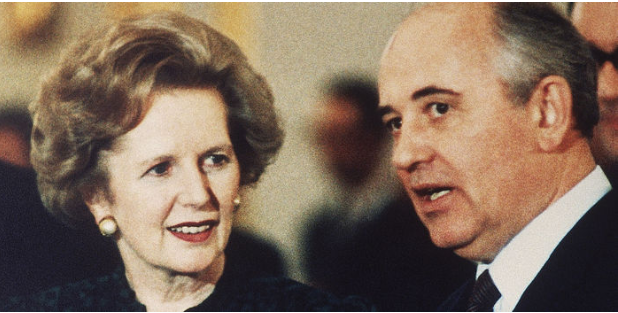
[3]Margaret Thatcher in the Kremlin with Mikhail Gorbachev, March 30, 1987.
 [4]
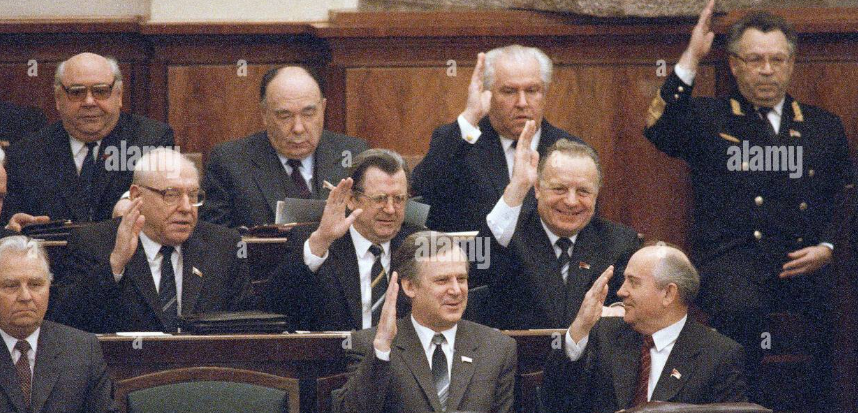
[4]Gorbachev at Politburo meeting and to his right, front row centre, Nikolai Ryzhkov, November 1988.
The new batch of documents released by the National Security Archive on Auigust 31 can be read here [5].
Document 1, Session of the Soviet Politburo, April 16, 1987 [6]:
“The conversation [with Thatcher] was conducted in the same manner: taking account of the realities and emphasizing the need to get rid of 1940s thinking… The main conclusion for us is that Thatcher puts trust at the forefront in international relations. She argued adamantly that the Soviet Union undermined its credibility: ‘We do not believe you,’ she kept telling me. ‘You very easily make decisions—on Hungary, then Czechoslovakia, then Afghanistan. We could not imagine that you would enter Czechoslovakia in 1968. But you did. You brought your troops into Afghanistan. We are afraid of you. You were warned what effect the introduction of SS-20 missiles would have on Europe and their trust. But you installed the missiles.’ So, comrades, this feeling is strong in Western minds…On the topic of trust I raised the issue of conventional weapons, but I saw that she, and the West, needs them to dominate the third world. They will hold on to this. So it will be very difficult to reduce conventional weapons. And, of course, her position in favor of nuclear weapons is like paranoia. I simply shamed her. I told her that her position goes against worldwide sentiments. The U.S. and USSR are beginning a process of disarmament; we are upholding a moratorium, while Great Britain does nothing. How do you appear in the world public opinion?”
Document 2, Session of the Soviet Politburo, May 8, 1987: [7]
“Remember, I told you about my meeting with Thatcher. She said they were afraid of us; that we invaded Czechoslovakia, Hungary, and Afghanistan. This perception is widespread among the public there. It persists in the minds of many people. Anti-Soviet propaganda is based on it. We should strengthen our policy for humanization of international relations with our actions. There were public statements by our generals in military journals, for example marshal Grechko’s article. They put the West on guard and strengthen their distrust.”
“We are not just sitting or lying on our military doctrine, we are trying to find a way to make the world more stable. Now even parity ceased to be a guarantee…about disbalance I must say: nobody in the Defense Council could explain clearly what strategic parity is. This is not a question of statistics, it is a question of military policy. Strategic parity means that we have a reliable guarantee of defense of our country. And the enemy will not attack us because in that case it would receive an unacceptable retaliatory strike. If we anticipate such a result, then we have parity. But if we start counting—they have a rifle, we have a rifle—then we should stop with the building of socialism. They have 6 billion people working on armaments. So should we try to catch up the number? We should put an end to such an approach. I ask the question: we will keep turning the country into a military camp? They clearly want to pull us into another round of the arms race. They are counting on our military exhaustion. And they will portray us as militarists. And they are trying to pull us in on the SDI. There are the positions, from which we should formulate our military doctrine…t is important for us to untie the line of trust, trust, and trust once again. The West is speaking about it all the time, and we are just cunning around. And if we are talking about Europe as [the territory] between the Atlantic and the Urals, then you (the NATO members) should go ahead and withdraw troops. We will have to deal with their troop numbers. Here they are afraid, because they would have to ship the Americans over the ocean.”
Document 3, Session of the Soviet Politburo, November 3, 1988: [8]
“This will make a great impression… after the agreement to liquidate middle and short-range missiles, and after Afghanistan, this action… the world will see that is not empty talk, these are policies. We will advance the entire process. I would put it this way: with all the significance this has for the impression in the world and for the advancement of our policy of peace, the most important aspect is still perestroika. Nikolai Ivanovich [Ryzhkov] is right: we will not succeed with perestroika without this action. There is no question that we should be militarily powerful. But we should achieve our power through scientific advancement, through technology, through qualified cadres and modern organization of our troops. Planes, missiles… but not like Karmal who sucks us dry but doesn’t produce results. We cannot be weak. This is the axiom. But we need to be powerful for security’s sake, not for the purposes of intimidation. M.S. also said that he is talking about unilateral reductions, not about the material that is going into the negotiations with the Americans and the mandate of Vienna meeting.”
 [9]
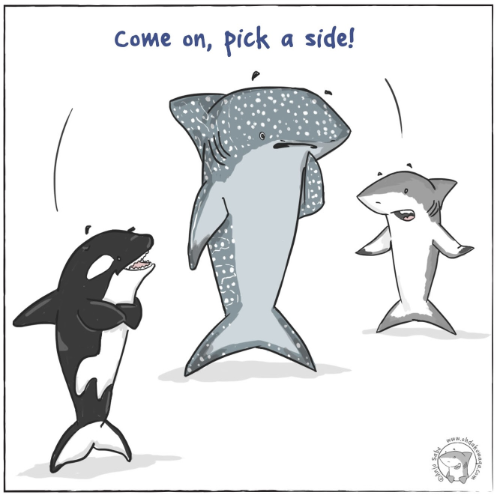
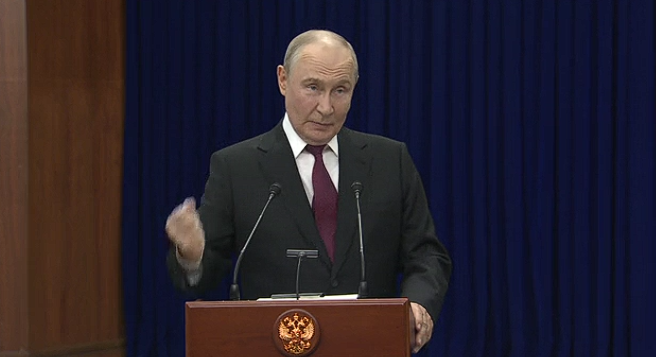
[9]Putin at Bishkek, September 1 (verbatim from video record): “The collective West back in Soviet times, they were defined back then. This definition still works. They are the sharks of imperialism…Well, we can punch them right in the teeth. Russia is ready to do that” -- verbatim.
Document 1, Answers to Media Questions, September 1, 2026 [10]:
Kremlin website translation: “we are quite comfortable with working with those who we know well and generally trust. These people are close to President Trump. In my opinion, they are sincere people who try to add practical content to our efforts. And President [Trump] trusts them, which is very important and without which no negotiations are possible. The thing is that everything is pointless if these people coordinate some issues with us but their top leader reviews the arrangements they make and divides them by a thousand or more. As far as we can see, he trusts them. That is why Mr Kushner and Mr Witkoff are always welcome here, and we enjoy working with them.”
“Pavel Zarubin: Good evening. A few days ago, you drew a rather unexpected analogy involving orcas, polar bears and the special military operation. So, who is who there, and whom did you mean?”
“Vladimir Putin: You know, it was quite spontaneous – it occurred during a meeting, I believe, at the Pedagogical University, and it was indeed an impromptu remark. As for orcas and bears… If your suggestion is that the orcas symbolise, so to speak, the collective West, I would say that the orca is, without doubt, a formidable predator, yet it is also a highly intelligent creature, a cunning one. The collective West, for its part, was assigned a specific definition in the Soviet era, which remains current to this day – the sharks of imperialism. Nonetheless, the essence, of course, is much as you have surmised. The thrust of my remarks was that if anyone attempts to drag us down the food chain and devour us, to consume us, they would be well advised to expect their teeth to be broken. And Russia stands ready to do precisely that, despite the insatiable appetites and ever-sharpening teeth of these sharks.”
Document 2, Plenary meeting of the 11th Eastern Economic Forum, September 3, 2026 [11]:
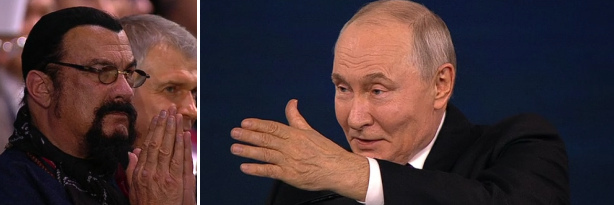 [12]
[12]At Vladivostok for plenary session of the Eastern Economic Forum, September 3, 2026 – left, Steven Seagal; right, President Putin.
“We are committed to restoring full-fledged relations with the United States, but this does not depend solely on us; it also depends on the American side. President Trump, as far as I understand, feel, and see, is committed to positive, constructive work. Everyone already knows about the contacts between intelligence agencies and the Administration representatives whom President Trump is appointing to continue the dialogue with Russia. It is all working. I hope it will ultimately lead to a positive outcome. We have many friends in the United States. One of them in this room is Mr Steven Seagal – I trust you will give him a warm welcome. He is the best ambassador for peace – well-known worldwide not only as an actor but also as a great friend of Russia in our country.
”Document 3, Meeting with US President’s Special Envoy Steven Witkoff and Jared Kushner, September 5, 2026: [13]
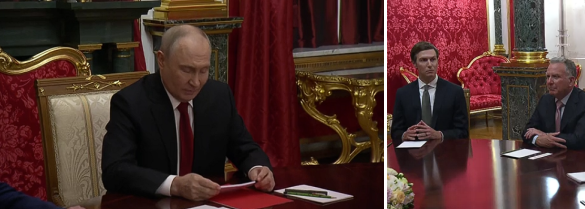 [14]
[14]Left to right, Putin, Kushner, Witkoff.
“The situation we are to sort out today is, of course, a difficult one. But before we begin, I would like to ask you to convey my best wishes and words of gratitude to the President of the United States, Mr Trump. While he realizes that he is facing a difficult situation, he nevertheless does not stop his efforts to resolve it and to contribute to the settlement of the Russian‑Ukrainian conflict. Today, we will discuss all its components and all its aspects, and for our part, we are also ready to inform you about our view of the situation. As you informed us, I know that you are planning to go to Kiev after visiting Moscow. In any case, of course, no matter what happens next, contacts of this kind are certainly always beneficial. And here, of course, the quality of mediation and trust in those who are engaged in it are very important. I’d like to tell you that we find it comfortable to work with you, and, of course, we have a very high level of trust during this work.”
[*] The new releases are from the notes recorded in the diaries of Anatoly Chernayev. He and the diaries aren’t new [15]. A Russian aristocrat at birth, Europhiliac by education, and Gorbachev’s principal foreign policy advisor between 1986 and 1991, Chernayev claims personal credit for prompting what Gorbachev said at the time and for promoting what the two of them meant after they lost power in 1991, and they were both talking for western donations to their retirement. For them Chernayev exchanged his diaries, which he donated in 2004 to the National Security Archive of George Washington University. He had started publishing some of his interpretations in 1993 in a book in Russian and English, My Six Years with Gorbachev. He continued leaking the records in interviews until his death, aged 95, in 2017. In his obituary in the New York Times he was reported [16] to have been “deeply disillusioned by the revanchist rule in Russia of President Vladimir V. Putin…he lamented the authoritarian and nationalist turn of the country under Mr. Putin and his aides.” In interviews and in the diaries, Chernayev was the major source for Vladislav Zubok’s history of 2021, Collapse – The Fall of the Soviet Union. For the book’s display of Chernayev’s and Zubok’s wish to be loved by the enemies of Russia, read this [17].