 [1]

By John Helmer, Moscow
@bears_with [2]
President Vladimir Putin stood President Donald Trump up in Shenzhen, China, on Wednesday.
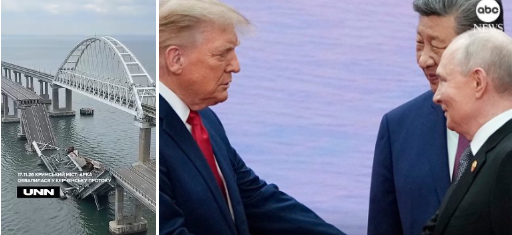
This is because the Russian side has concluded there is nothing that can be negotiated for terms of war settlement and future security with the Americans; and because Trump’s men, Stephen Miller, chief of staff, and Marco Rubio, national security advisor, don’t want to expose their man to Putin’s rebuke for having authorized and participated in the attack on the Crimea Bridge (lead image, left).
When Dmitry Peskov, Kremlin spokesman, announced that a bilateral meeting between Putin and Trump will not take place, as Yury Ushakov, national security advisor, and Kirill Dmitriev, special US negotiator, have been promoting, Peskov claimed [3]: “a lack of time had so far prevented such a meeting from being arranged.” This is false.
Ushakov gave several alibis to conceal what has been decided [4]. “They were not seated next to each other at the table, so they were unable to talk to each other there. There is another full day tomorrow. There will be a plenary session, during which it is always possible to find a moment to talk.” “When the leaders meet face to face, believe me, they will have a full-fledged conversation, regardless of whether they are sitting in armchairs, on chairs, on stools, or simply standing face to face. There will be a meeting [5],” This is true.
In their stand-up meeting as Putin and Trump were received by President Xi Jinping for the evening reception (lead image, right), their feet and hands did more moving than their mouths. “The President of the United States asked the Russian colleague how he was doing,” RIA Novosti, the Russian state media agency, reported [6].
Two days earlier in Moscow, Ushakov tried to promote the text of an agreement to be announced [7] between Putin, Xi and Trump, following their meeting at the end of the APEC conference. “The text of a joint statement to follow the three leaders’ meeting is being forged through arduous diplomatic work.” But if they could not agree, Ushakov added the obvious, “each of the leaders will provide their own assessment of their trilateral meeting if no joint communique is issued afterward.”
After the first day in Shenzhen, Peskov acknowledged nothing had been agreed [8]. “I can’t say anything as of yet; the work is still underway. Nothing will be certain until the very last moment.” He added the disclaimer: “We don’t have any extraordinary expectations. Our expectations are of the pragmatic nature.”
Pragmatic is Russian courtesy for nothing doing.
“No one is expecting [negotiations between the presidents].It will be an exchange of opinions on current topics [8].” Peskov also refused [8] to say that Putin will travel to Miami in a month’s time for the G20 summit which Trump will host. “It depends on a number of factors, on a huge number of conditions – and the president will make a decision based on them.” This means Нет, пока нет – no for the time being.
Foreign Minister Sergei Lavrov quipped [9] that this Shenzhen squib wasn’t damp. “We aren’t in the fortune-telling business, are we? We don’t make predictions. We prepare, and then we judge the outcome. Question: Still, as a diplomat, you have seen many momentous meetings. Some have even compared this one to Yalta. What do you make of that comparison? We never speculate about the future. We do our work.”
The remaining Trump promoter in the Kremlin, Kirill Dmitriev, has tweeted [10] the handshake, adding that “President Trump and his team seek peace in Ukraine”.
This is no longer the Kremlin consensus, and that’s the reason there will be no bilateral negotiations at the summit, and in all likelihood, no “joint statement.”
In his last stab at wishful thinking, according [11] to Dmitriev, a new speech to NATO officials on Tuesday (November 17) by Pentagon Under Secretary Elbridge Colby, “Colby’s TRUTH that goes against warmongering false media narratives.” He then reposted a two-paragraph excerpt of Colby’s speech being circulated by the Russian state media.
Dmitriev was taking Colby out of context and lying about the meaning of the speech. In fact, Colby implied his endorsement of the attack on the Crimea Bridge, and his commitment to sustaining the war, not ending it on Russian terms. The Russian state media have so far avoided reporting the evidence that a US Air Force electronic operations aircraft participated in the Crimea attack operation [12], along with other NATO fixed-wing AWACS [13] and drone missions [14].
“Our judgment,” Colby told [15] his NATO counterparts, “was that Europe can and would step up to assume the lead for its conventional defense and take primary responsibility for Ukraine’s defense. This has happened. Moreover, with that sustained European support, Ukrainian forces have continued to mount a resilient denial defense. This too is a very important point. Europe has taken the lead and is continuing do so — and Ukraine is continuing to hold the line. In October, for the second consecutive month, Ukraine gained more territory than Russia, and Russian forces suffered their highest monthly casualty toll of the war. The Ukrainian Armed Forces have rightly focused on defending the front lines, employing an innovative mid-range strike campaign using novel drone technologies and tactics to interdict logistics and deny Russian advances. This has proven very effective.”
“It is our view that focusing our support on the front lines and on associated mid-range strikes is the most effective way to enable Ukraine’s defence, and thus to set the conditions for an end to the war. This is because a successful Ukrainian denial defence substantially reduces the gains which Moscow can expect from continuing its war.”
“While the public conversation focuses on the spectacle of deep strikes designed to incur pain on the Russian population, our assessment is that such strikes have not been effective in driving an end to the war, nor do they contribute to blunting Russia’s advances on the front line. Moreover, such strikes, especially those that target civilian infrastructure, such as Wildberries, have actually probably hardened the Russian public’s resolve and the Kremlin’s own willingness to escalate…the focus of our support should be on enabling and advancing Ukraine’s ability to hold the line of battle and, where possible, make gains.”
“Strikes focused on the front line and direct support to that battle area of course fall into this category. But, consistent with this approach, strikes that target Russia’s warmaking machinery can also help contribute to slowing Russia’s advance on the front lines…Russia will continue to generate more manpower and mobilize its war economy for the long-haul. We all must therefore be prepared for this conflict — and thus Ukraine’s requirements along the lines I have tried to lay out — to endure, even as America prioritizes our own readiness for contingencies in the Western Hemisphere and the Indo-Pacific. Accordingly, Ukraine will need robust funding for the PURL initiative to continue. Sustaining the flow of critical munitions is essential for Ukrainian troops to continue holding the front line and to deny Russian gains through the winter months”.
“The Department of War’s funding requests to produce more munitions, drones, and other capabilities are simply essential for supporting Ukraine,” Colby concluded [15].
Mid-range strikes, in Colby’s war plan, mean the Crimea Bridge – and more: Russian oil refineries, Black and Baltic Sea ports and shipping. Mention of funding requests in this plan is Colby’s warning to the new Democratic Party majority in Congress not to withhold the votes for Trump’s new war budget.
On this evidence, now accepted by the Kremlin, what remains to be negotiated between Russia and the US?
Nothing, but not so fast. Listen to the evidence of the US role in the Crimea Bridge operation in discussion with Jamarl Thomas, broadcast live [16] at 0715 Washington time on Wednesday.