 [1]
[1]
By John Helmer, Moscow
@bears_with [2]
Roman Abramovich — the oligarch whom President Vladimir Putin has publicly declared [3] to be “trustworthy and honourable” and sent to Kiev last month to negotiate war terms [4] — has what is known on police blotters as FORM.
That is a long list of previous offences; dishonesty, deception, bribery, and extortion as method; destruction of rivals and self-enrichment as goals. In short, Abramovich’s career is one of a familiar and predictable type. Artless and wordless in the way big guns and big sums of money talk.
Russian public opinion polls confirm this is how most Russians think of him and other Russian oligarchs. So does this blotter of Abramovich’s business methods stretching back to 2003 [5].
When Abramovich faced the longest court trial he is ever likely to face – Berezovsky v Abramovich, [2012] EWHC 2463 (Comm) [6] — the UK High Court judge ruled that as plaintiff Berezovsky was so unbelievable and dishonest, she didn’t have to judge whether defendant Abramovich matched him; the onus of proof being on the plaintiff, and his proofs having failed, the judgement of the court went to the defendant. That was not a vindication of Abramovich’s trustworthiness and honour.
His form at the negotiations he arranged between Putin and Zelensky in Istanbul in March-April of 2022, turned out to be failure for Putin and for himself, as this report indicates [5], and also this one [7]. Abramovich’s form didn’t improve in last month’s negotiations in Kiev. Nicked again [4].
The second oligarch representative Putin runs as his negotiator for US guarantees of Russia’s security in Europe and an end to NATO’s permanent war is Kirill Dmitriev. He too enjoys what Putin calls trustworthiness and honourableness. These qualities, and Putin’s confidence in them, haven’t improved his form in the American negotiations. This is the blotter on Dmitriev [8].
Dmitriev was educated with high American university degrees; Abramovich [9] was educated in the Russian school of hard knocks. But the latter has learned two special skills the former lacks – how to control vanity in decision-making and, when his mind is made up, how to keep his mouth shut. Trust and honour aside, Russian women prefer the reticent Abramovich face to the goggle eyes and fish lips of Dmitriev. So too, the Ukrainians: according to the Financial Times chief reporters for Russia and the Ukraine, Abramovich is “the only Russian [the Kiev regime] will tolerate. He gets along with everyone [10].”
In the present war what does this count for?
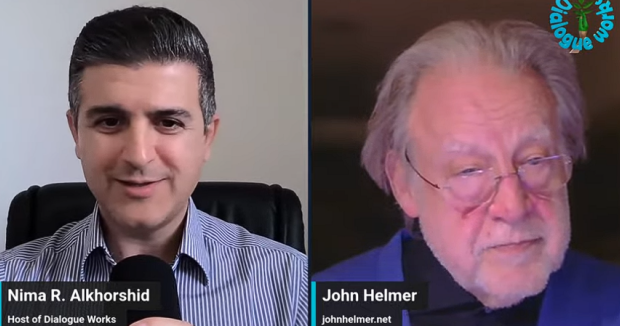
The failures of both Abramovich and Dmitriev at Putin’s direction have begun to trigger an intense debate in Moscow over what changes in strategy Putin should now make. This is the crisis in confidence which is explained in the new podcast with Nima Alkhorshid. This was aired on Tuesday afternoon, Moscow time. Click to view or listen: https://www.youtube.com/watch?v=SVN6F-3rZlM [11]
How to restore escalation control for Russia and credibility for Putin is the singular problem to be solved now. “We must start with unmistakable signals from Putin that he is recovering both,” a Moscow source in a position to know responds. “Dmitry Peskov retires, [Yury] Ushakov also. [GRU chief Admiral Igor] Kostyukov should be promoted and tested in a public political role; [Central Bank Governor Elvira] Nabiullina must be removed by her announcement that she intends to retire ahead of next June, starting her succession now; and after September 21 [Duma election results announced] a new cabinet of national unity should be formed with confidence-building figures like Dmitry Rogozin [12] and Mikhail Delyagin [13].”
PRESENTING THE CASE
 [14]
[14]Source: https://www.youtube.com/watch?v=SVN6F-3rZlM [11]
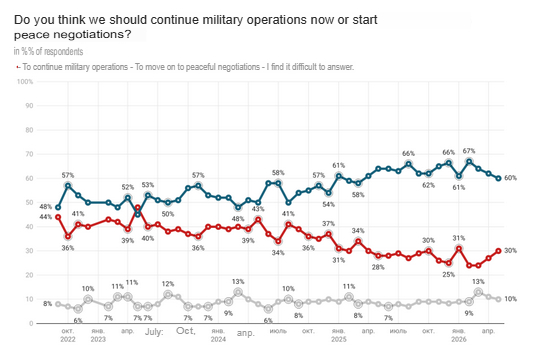
THE PUBLIC OPINION POLL EVIDENCE AFTER STAROBELSK
 [15]
[15]Source: https://www.levada.ru/en/2026/02/04/ukraine-conflict-in-january-2026/ [16] Nationwide face-to-face survey conducted between May 20 and 28
PUTIN ON ARMENIA AND THE UKRAINE SCENARIO, MAY 29, 2026
“The Russian and Armenian peoples are connected by longstanding ties of friendship and, without exaggeration, by a uniquely close relationship that has developed over centuries. There is a special bond between Russia and Armenia, and between Russia and the Armenian people. I said so to Nikol Pashinyan, and he can confirm my words. I told him that whatever serves the interests of the Armenian people is acceptable and beneficial for Russia as well: ‘Act according to what you believe is best for the Armenian people. You hold the authority here, and the responsibility for making decisions rests with you. Whatever decision you make will be respected – and no decision will undermine our humanitarian ties or our political relations.’”
“That said, in this particular case we are solely discussing economic matters. These issues require careful consideration, analysis, and decision-making. As I have previously noted, the crisis in Ukraine began with efforts to move toward EU accession. We did not oppose such aspirations, but we pointed out that, for instance, phytosanitary standards differ substantially – which directly affects access to markets. Since Soviet times, in Russia and consequently across the countries that now form the EAEU, phytosanitary standards have been tougher than those applied in Europe. For example, we have restrictions regarding genetically modified products, and many people [in our region] do not wish to consume genetically modified food products – that is their choice, and we must take this preference into account. There have not yet been thorough studies regarding the effects of such products on human health. Also, technical standards are very different. Certain industrial products may be sold in our market while others may not. Differences extend to steel grades and so on. There are plenty of aspects that are simply not compatible today and cannot coexist.”
“This does not mean that we are opposed to it; on the contrary, we support it. But it takes time and investment. For example, if you want to meet certain European standards – which may in some respects be more advanced than ours – you would need to invest resources in establishing the necessary production capacity. And the same applies in the opposite direction.”
“Therefore, combining the two systems in one day is virtually impossible. As a result, we would be forced, in certain areas –and indeed, by and large – to scale back almost all of our cooperation with Armenia in the economic sphere related to integration processes. You asked about the advantages. This is how we see them. Some may disagree; that is open to debate. But what do we –and not only Russia, but all EAEU member states – see as the benefits of joining and strengthening the Union? First, access to a large and protected common market across the entire EAEU, including Russia and the other member states; duty-free trade; common technical and phytosanitary standards, as I have already mentioned – these facilitate market access and simplify logistics. Although we do not share a common border, we have nevertheless managed to ensure that the movement of goods and services is organised in the most efficient and cost-effective way possible. I will further elaborate on what I mean by that. Another advantage is low energy prices: in Europe, prices may reach around 600 euros, while for Armenia they are a little over 150 euros, though I do not recall the exact figure. The difference is significant. I am listing all the advantages because people often focus solely on energy. It is important, certainly, but it is not the only benefit.”
“Then there is investment activity. According to data from the Eurasian Development Bank, accumulated investment in Armenia amounts to $4.9 billion, 86 percent of which is Russian. And this figure does not even include capital originating from Russia through indirect channels. In other words, Armenian business representatives operating in Russia often invest through third-party instruments. Therefore, the 86 percent figure does not tell the whole story; the actual amount is considerably higher.”
“After the meeting in Yerevan, for example, European partners promised to invest 2.5 billion euros. How and when these investments will materialise remains to be seen. But 2.5 billion euros is still less than $4.9 billion, and that is before taking into account indirect investments, which are also, in essence, Russian capital. Now, regarding participation in free trade agreements: these would also be cancelled. What would that mean? First and foremost, it would entail the restoration of full customs controls and customs duties. We need to carefully assess what this would mean.”
“The second consequence would be the cessation of mutual recognition of documents, particularly in the areas of technical regulations and phytosanitary standards. Agricultural products currently enter our market under these arrangements, but we would then stop recognising those standards and would have to review them. Perhaps we would recognise them and be satisfied; perhaps not. That remains to be seen. Where would products such as wine be exported – to Spain, France, Italy, Portugal? This is something that requires consideration.”
“There would also be a reduction in trade in services, tourism, transport services, and other sectors. I will say more about transport in a moment. Furthermore, workers from Armenia would become subject to the requirements that apply to migrants from CIS countries. What does that mean? It means they would need to obtain patents to work in Russia. To gain access to compulsory medical insurance, they would need to reside in the country for at least five years, and so on. There are plenty of requirements. It would be an entirely different situation. People should discuss this clearly, directly, and honestly.”
“We would also have to restore the permit procedure for Armenian road carriers. This would be unavoidable; it is a separate and highly complex area of cooperation. In addition, rail freight tariffs would have to be adjusted from the current domestic Russian rates – which are currently applied to Armenian carriers – to the tariffs applied to other CIS countries. And, obviously, energy prices would rise. The same preferences that exist today would no longer apply. According to preliminary estimates – not only ours, but also those from various experts – these changes could result in a loss of at least 14 percent of Armenia’s GDP. Whether that is a large or a small figure is open to discussion, but it is nonetheless something that must be carefully weighed and evaluated [17].”
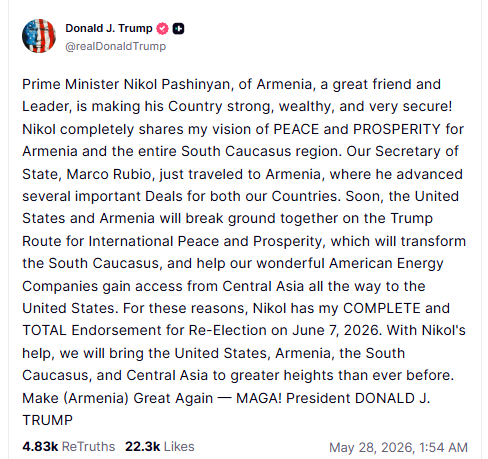
THE RESULTS OF THE ARMENIA ELECTION, JUNE 7, 2026
 [18]
[18]Source: https://truthsocial.com/@realDonaldTrump/posts/116648998520896910 [19]
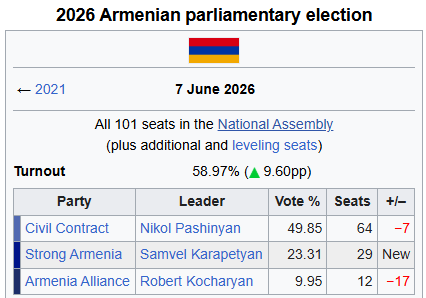 [20]
[20]Source: https://en.wikipedia.org/wiki/2026_Armenian_parliamentary_election [21]
PUTIN’S CLARIFICATION OF THE ORESHNIK STRIKE ON BELAYA TSERKOV,
JUNE 4, 2026
“To be perfectly candid, I will share a major state military secret with you: we simply struck locations where it was possible to observe the results. This applies to Belaya Tserkov and, even more so, to the DPR area within the main fortified zone. Afterwards, our drones flew into the structure we hit, and we meticulously observed how the separating warheads were dispersed, calculating everything to the millimetre. This is crucial for us to make future decisions on the full-scale employment of the Oreshnik against designated targets, including urban areas [22].”
KIRILL DMITRIEV’S REVOLUTIONS IN THE UK AND GERMANY
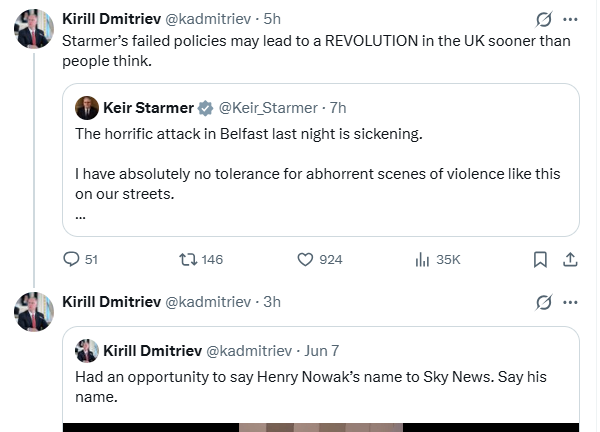 [23]
[23]Source: https://x.com/kadmitriev/status/2064307487881252972 [24]
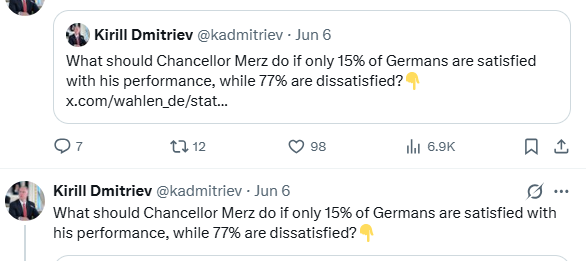 [25]
[25]Source: https://x.com/kadmitriev/status/2063361571032543314 [26]
PUTIN PRESS BRIEFING, MAY 29, 2026 – “DON’T BE ANGRY”
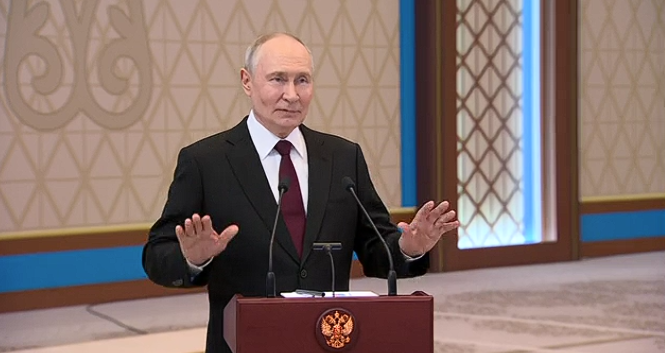 [27]
[27]Source: http://en.kremlin.ru/events/president/news/79910 [17]
“That is definitely enough now. Thank you very much, don’t be angry [17].”
FOREIGN MINISTER SERGEI LAVROV ON THE ANCHORAGE FORMULA, JUNE 8, 2026
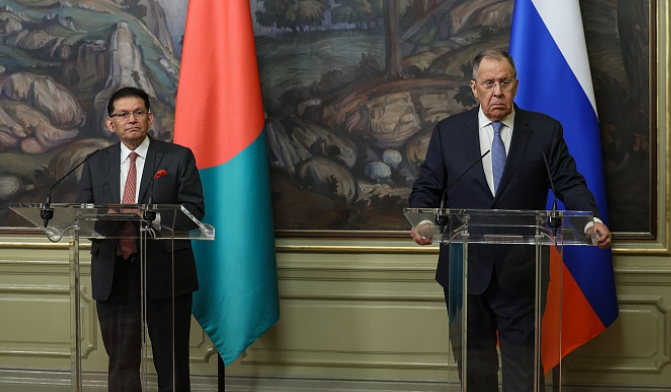 [28]
[28]Press conference in Moscow with the Bangladesh Foreign Minister, Khalilur Rahman. Source: https://mid.ru/en/foreign_policy/news/2115958 [29]
“Speaking of the most recent negotiations, almost a year ago, in Anchorage, Alaska, in August 2025, President Putin – he made a point of it as well – accepted a very specific proposal put forward by President Trump in a spirit of compromise. That is how those talks ended. I very much hope that previous failures, when the West refused to honour agreements it had itself supported, will not be repeated with regard to the understanding reached in Alaska. Unfortunately, however, our US partners have so far shown no interest in it.
President Putin recently reaffirmed, and this has been confirmed at other levels as well, that we remain prepared to be guided by the understandings clearly set out during the Anchorage summit on August 15, 2025. What does concern us, however, is a statement made recently by State Secretary Marco Rubio, who conveyed during congressional hearings that the United States was not in a position to act as a mediator because it supported Ukraine. Similar remarks were made by notorious Kaja Kallas and by a nu mber of other EU and EC figures. This is why I find it difficult to comment on prospects for negotiations.
The word I’m getting is that – I believe it was yesterday – the leaders of UK, France, and Germany, together with Zelensky, signed in London a document on the strategic support for the current regime and on preparations for the deployment of “stabilisation forces” – in other words, occupation forces – on whatever territory remains of Ukraine after the conflict comes to an end. They also reportedly agreed to provide Ukraine with additional long-range weapons to attack Russian territory, including targets deep inside our country. Against such a backdrop, I do not see how one can even mention negotiations. Everyone should probably take seriously what President Putin said in response to questions during the plenary session of the 29th St Petersburg International Economic Forum: everything now depends not on negotiations but on what our frontline heroes are doing [29].”