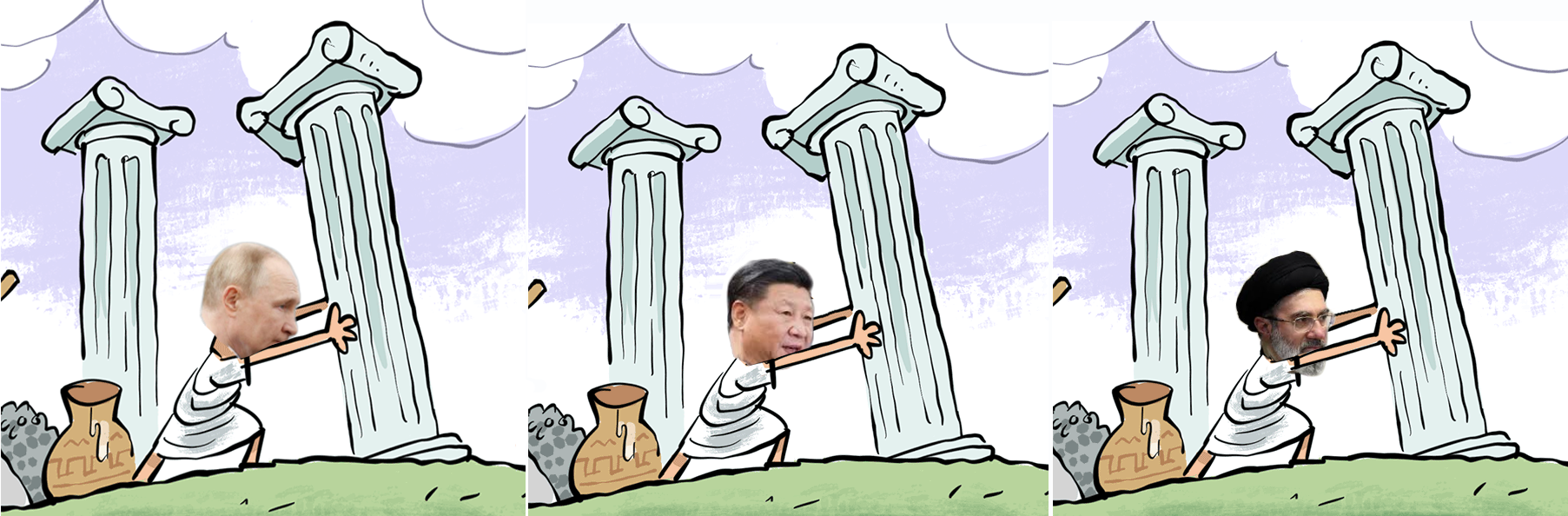
 [1]
[1]
By John Helmer, Moscow
@bears_with [2]
Two empires, one system – that’s the idea which President Xi Jinping has asked President Donald Trump to accept.
In the official Chinese version of the talks between Xi and Trump in Beijing this week, Xi declared [3]: “I have agreed with President Trump on a new vision of building a constructive China-U.S. relationship of strategic stability. This will provide strategic guidance for China-U.S. relations over the next three years and beyond.”
The reference to “three years” was Xi’s way of reminding the world that Trump’s term is coming to an end. Trump’s reply was his introduction to Xi of Eric Trump, his second son, as his successor in November 2028. Until then Eric Tump is in charge of bribe receipts.
“Constructive strategic stability,” Xi went on, according to the text [4] of the Chinese Foreign Ministry readout, “means positive stability with cooperation as the mainstay, healthy stability with competition within proper limits, constant stability with manageable differences, and lasting stability with expectable peace.”
This is the standard peaceful coexistence formula which Xi, Wang Yi, Politburo influencer and Foreign Minister, and other Chinese officials have been repeating regularly. Wang had told Secretary of State Marco Rubio by telephone on April 30 [4] the same thing “so as to achieve mutual respect, peaceful coexistence and win-win cooperation”.
But Xi added a point he has been recording for American audiences since 2015 [5]. “Can China and the United States overcome the Thucydides Trap,” Xi told Trump, “and create a new paradigm of major-country relations? Can we meet global challenges together and provide greater stability for the world? Can we build a bright future together for our bilateral relations in the interest of the well-being of the two peoples and the future of humanity? These are the questions vital to history, to the world, and to the people. They are the questions of our times that the leaders of major countries need to answer together [3].”
Xi was opening the Thucydides Trap for Trump as if Xi believes both of them believe it.
But he had closed the trap in the US in 2015 [6]. “There is no such thing as the so-called Thucydides Trap in the world,” Xi had said in a Seattle speech on September 23, 2015 [7]. “But should major countries time and again make the mistakes of strategic miscalculation, they might create such traps for themselves.”
“We must read each other’s strategic intentions correctly. Building a new model of major country relationship with the United States that features non-conflict, non-confrontation, mutual respect and win-win cooperation is the priority of China’s foreign policy [7].”
Xi has used this combination of the classic Greek text and idea of the inevitability of clash of empires from a Harvard academic backer of US empire for the purpose of appearing more conciliatory towards Trump than he appeared to be with President Barack Obama in 2015. In 2021 [5], to an Australian prime minister, Xi also referred to Thucydides, but not to the Harvard professor’s interpretation [8]. Xi spoke of the Melian Dialogue; that was the warning Athens gave the Melians, allies of Sparta, and then implemented when they refused to submit to the Athenian terms of surrender. Genocidal slaughter of the Melians followed; but after eleven years, Athens was defeated, and the Melians recovered [9].
Xi has not referred publicly to the Melian genocide during the US-Israeli wars against Gaza and the Palestinians, Lebanon, and Iran.
He did, however, repeat for Trump the warning [3] Wang gave Rubio a fortnight ago. “President Xi stressed that the Taiwan question is the most important issue in China-U.S. relations. If it is handled properly, the bilateral relationship will enjoy overall stability. Otherwise, the two countries will have clashes and even conflicts, putting the entire relationship in great jeopardy. ‘Taiwan independence’and cross-Strait peace are as irreconcilable as fire and water. Safeguarding peace and stability across the Taiwan Strait is the biggest common denominator between China and the US. The US side must exercise extra caution in handling the Taiwan question.”
In the White House readout – published [10] in a White House handout in Beijing but not on the White House website – there is no mention of Taiwan. Instead, Trump said he had discussed “expanding market access for American businesses into China and increasing Chinese investment into our industries”; “ending the flow of fentanyl precursors into the US”; and “increasing Chinese purchases of American agricultural products”. These are three of Trump’s forms of Chinese tribute payment to the US.
Trump had two more for Xi: China should reverse its support of Iran in defending against the US war, Trump’s readout says, and should buy US oil instead of Iranian.
“The two sides agreed that the Strait of Hormuz must remain open to support the free flow of energy. President Xi also made clear China’s opposition to the militarization of the Strait and any effort to charge a toll for its use and he expressed interest in purchasing more American oil to reduce China’s dependence on the Strait in the future. Both countries agreed that Iran can never have a nuclear weapon [11].”
For Xi to mean to agree to the Trump tributary system, in opposition to Iran’s position as oil supplier to China, Iran’s scheme for control of the Hormuz Strait and for strategic deterrence from US and Israeli attack, contradicts the understandings Wang gave Iran’s Foreign Minister Abbas Araghchi on April 29 [12].
For Xi the General Secretary of the Chinese Communist Party to have proposed the formulation of the Thucydides Trap as the foundation for China and the US to accept peaceful coexistence (aka “constructive peaceful stability”) is exceptional. The last senior Communist Party figure to have proclaimed as much was Mikhail Gorbachev. His overthrow followed in six years — planned, promoted and financed by successive US governments.
This has been a lesson which successive Russian governments and presidents have found it slow and difficult to learn, acknowledge, and defend themselves from. In the latest statement of Russian lesson-learning, Foreign Minister Sergei Lavrov – less influential with Putin than Wang with Xi – declared in an interview on May 13: “We appreciate the fact that President Trump initiated dialogue with us and with President Putin. We have communicated at the levels of heads of the US State Department and our Foreign Ministry, and the Aide [sic] to the President of Russia holds meetings with President Trump’s special representative. Many good words are being said about the enormous potential for mutually beneficial, modern, technological, energy-related, and other projects between Russia and the United States.”
“However, nothing is happening in real life. Aside from this regular dialogue – which is normal in relations between people and countries – everything else follows the pattern initiated by President Biden. The sanctions imposed under him have remained in force. Moreover, the Trump administration has adopted its own initiatives in order to punish Russia’s economy…their goal is entirely clear: they want to bring every significant energy supply route under their control…Pressing everyone into not buying Russian oil is a dirty tactic. You can describe it in different ways – colonial or neocolonial – but these are methods of exploitation. Deep down, they are designed to strong arm everyone into buying expensive US oil and liquefied natural gas rather than cheap Russian oil. In this way, they seek to rule the world through controlling global energy supplies [13].”
About the Hormuz control regime, Lavrov added [13]: “Now the Americans are demanding that the Strait of Hormuz be reopened. But it was never closed. It is always important to look at what lies beneath.”
Xi and Wang think that beneath the Hormuz Strait, there is Taiwan (and Japanese remilitarization) and China’s priority to maintain “stability” in its relationship with the US over the time the Chinese calculate to themselves that they expect to defeat and subjugate the US empire — without firing a shot [14].
Lavrov met Araghchi the day after his press interview. His communiqué says: “In a detailed and trustworthy manner, the ministers discussed the course of the negotiations to settle the armed conflict unleashed by the United States and Israel in the Middle East. The Russian side emphasised the importance of preserving the ceasefire regime and the fragile armistice as well as preventing disruption of the political and diplomatic efforts to achieve a comprehensive Iranian-US understanding which opens the way to a lasting and stable normalisation in the region.”
Araghchi has not issued a readout of their discussion. He said [15] in public at their BRICS conference in Delhi the next day: “To virtually everyone in this room, our resistance against US bullying is not an unfamiliar battle. So many of us encounter slight variations of the same repugnant coercion. It is high time for us to jointly step up and work towards making clear that those practices belong in the dustbin of history. Today, our nations are closer to one another than ever before, and we cannot ignore the common and dangerous challenge we all face. History has shown that empires in decline will stop at nothing to arrest their inevitable fates. A wounded animal will desperately claw and roar on its way down.”
In the new podcast with Jamarl Thomas, broadcast live on May 14, the discussion focuses on the meaning of the Trump-Xi summit for the war against Iran; click to view or listen [16]. In the second part [17] of the discussion, we discuss Russian strategizing on the Ukraine war.
 [18]
[18]Left to view Part 1: https://www.youtube.com/watch?v=D6uSBgiIVvY [16]
Right to view Part 2: https://www.youtube.com/watch?v=In6gf0g72_k [17]
Several lines of Russian strategy are described and analysed.
In one – this is the line of Kirill Dmitriev, Putin’s negotiator with the Trump family, together with Yury Ushakov, the Kremlin national security advisor — there will be an agreement with the US on the Ukraine settlement by the end of this year. “I do not think they will take all of the Donbass by force,” one Moscow veteran says. “You have to know that [Kirill] Dmitriev is also managing the relationship with MBS [Mohammed bin Salman, Saudi leader], Opec+ and on all points Moscow will align with Trump. Europeans won’t resist. Chinese have thrown Iran under the bus. Russians too, but they blame India. The reality is Xi and Putin will make deals; Russians will get a respite; pay 10% to Trump family; and get to unfreeze their monies. No one, no single European has any qualms about ditching Zelensky. So everyone will return to war better prepared in some years’ time. For now, deal making will triumph.”
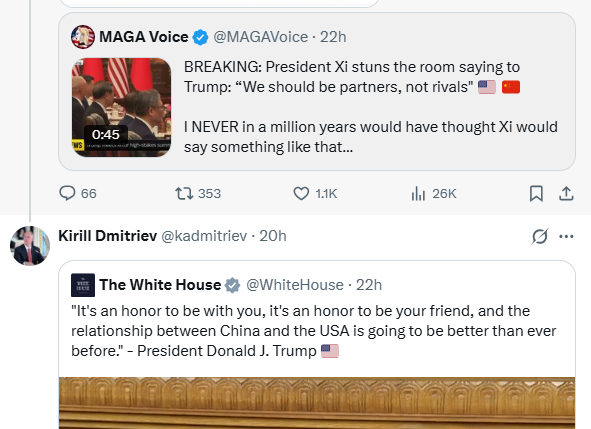
In the daily stream of Dmitriev’s tweets [19], he backs the Trump version of the summit meetings with Xi three times over in two hours. Dmitriev ignores the record the Chinese side has been making.
 [20]
[20]Source: https://x.com/kadmitriev [19]
The opposing line in Moscow is expressed by a source who acknowledges that “the point has been reached where no matter how much damage to Ukrainian infrastructure and to the front is inflicted by the [Russian] General Staff operations, there is still no deterrence to Ukrainian warfighting capacity, will, and aims against Russia — neither against Russian targets including infrastructure and shipping at sea, nor against Russian forces along the front. So the Ukraine, the Europeans and the US think they are achieving their strategy: their war is slowly bleeding and weakening Russia. Russia cannot achieve its war aims, at least not for the foreseeable future — 6 months, 12 months, 24 months. That’s exactly the US-NATO war aim, isn’t it?”
The source believes there is a military alternative – the General Staff advocate it; the Security Council debates it; Putin refuses [21] it. “Deterrence is a non-starter; Russian military threats stop nothing. Neutralization is the only option. The war cannot be ‘special’ as in the Special Military Operation. It must be ‘total’, as in total blackout, total cut-off in terms of logistics on everything between the Polish border and the front. The problem with that isn’t one of military capability. It’s Putin’s priority which he’s calling the Anchorage Formula.”
Russian sources believe the Trump regime has succeeded in turning the heavy costs of supporting Kiev into a US profitmaker at the European Union’s (EU) expense, but the EU cannot be persuaded domestically against this remilitarization for permanent war against Russia. This, the sources believe but Dmitriev refuses, is succeeding in every EU state and in the UK. All of Dmitriev’s tweets claiming otherwise are empty, one source claims, not only because the European regimes will not change their line, but because there is little incentive for the Trump regime to do so.
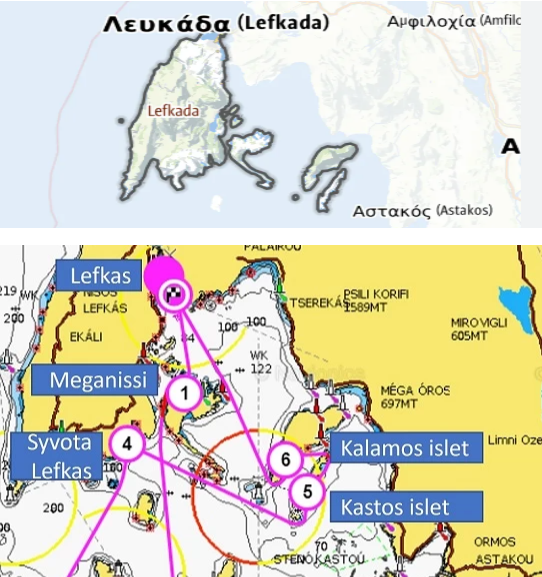
For elaboration of the latest evidence of Ukrainian, US and NATO escalation of drone warfare against Russian shipping in the Ionian and Mediterranean Seas, read this account of the Ukraine drone which ran aground last week on the west coast of Lefkada, a Greek island in the Ionian Sea – an incident which the Greek government is attempting to conceal [22].
 [23]
[23]Investigative reporting in Greece reveals that the drone operation is likely to have been launched during a NATO exercise at the Araxos air base, near Lefkada [24] port; Ukrainian controllers are likely to have been engaged under NATO operational cover; their targets include Russian-flagged, Russian oil and other cargo vessels operating in the Ionian Sea and further south in the Mediterranean.
The impact of this maritime war against Russia’s oil trade, combined with Ukrainian drone attacks on Russian oil refineries and oil export terminals on the shores of the Gulf of Finland and the Black Sea have been to cut Russian oil export volumes [25].
 [26]
[26]Source: https://energyandcleanair.org/april-2026-monthly-analysis-of-russian-fossil-fuel-exports-and-sanctions/ [25] CREA is a Finland-based think tank aimed at supporting the EU and US war against Russia.
As discussed with Jamarl Thomas, the conclusion is that the current impact of the Ukrainian drone operations would be more negative, and the strategic position of Russia would be far more difficult if not for the Iran war and the impact of the Hormuz Strait closure on oil prices. The positive revenue effect of the Iran war is thus helping the Kremlin to offset the damage which the drone war is inflicting.
Here is an analysis of these revenue impacts on Russian strategy by Vzglyad, the semi-official security analysis platform in Moscow. A verbatim translation into English follows of the May 8 publication [27]. Data charts have been added for clarification.
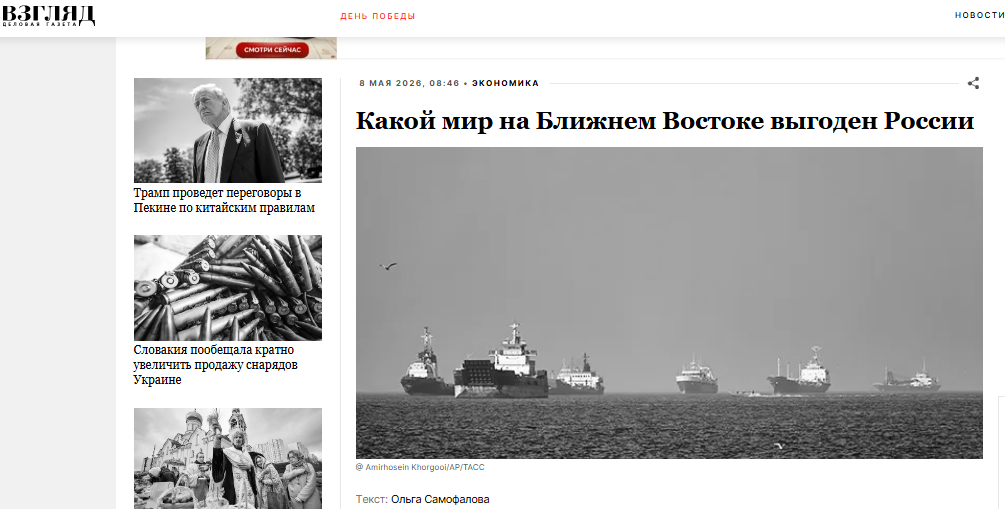 [28]
[28]Source: https://vz.ru/economy/2026/5/8/1417104.html [27]
 [29]
[29]May 8, 2026
What kind of peace in the Middle East is beneficial for Russia
By Olga Samofalova
The energy crisis due to the US military conflict with Iran has greatly helped the Russian budget to increase oil and gas revenues. Therefore, a quick peace and unblocking of Hormuz is not the best option for Russia. As well as the reverse scenario, when the war breaks out with renewed vigour. Which end of the Middle East crisis is more beneficial to Russia?
In late 2025 and early 2026, Russia’s budget faced falling oil prices. In January and February, Urals was priced at $41 and $45 per barrel, which is significantly lower than the budgeted price of $59 per barrel. It was a disastrous start to the year and created serious risks for the budget deficit to grow in 2026. But thanks to the Middle East conflict, the situation has become much easier. Already in March, the Urals tax price rose to $77 against $45 in February, and in April to $95. In May, it may be even higher. As a result, oil and gas budget revenues increased by almost 240 billion rubles in April compared with March.
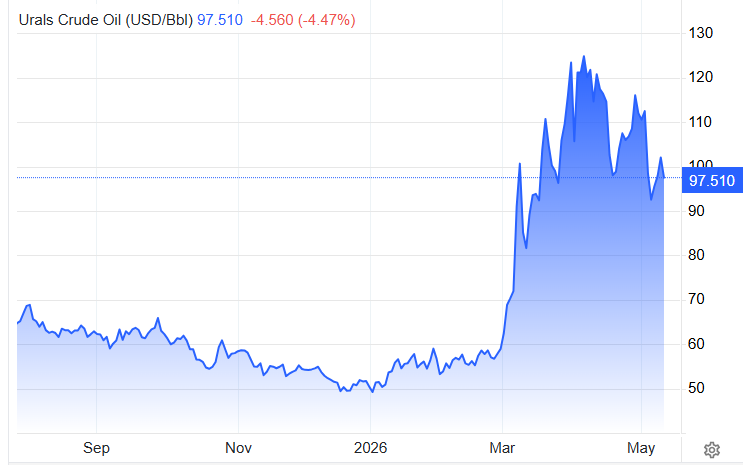 [30]
[30]Source: https://tradingeconomics.com/commodity/urals-oil [31]
However, it is still too early for the Ministry of Finance to relax, as this year the American rally may repeat. In addition, oil and gas revenues are lower compared to last year. And Russia needs oil at $95 not only in April, but throughout the year. And it strongly depends on how the Middle East conflict will be resolved. The United States and Iran are trying to reach an agreement.
Which scenario of a peaceful settlement is most beneficial to Russia in terms of oil prices and budget revenues?
There are four possible ways to end the conflict: a quick peace agreement and the opening of the Strait of Hormuz; long negotiations; escalation of the military conflict with new destruction of infrastructure; a protracted crisis with a collapse in consumption.
The first scenario means a quick interim agreement between the United States and Iran, a cease-fire and the gradual opening of the Strait of Hormuz as early as May–June. This may be a temporary arrangement rather than a final grand peace. Based on these expectations, Brent has already fallen below $ 100 per barrel, and in the case of a genuine agreement it will fall to $80-$90, says Vladimir Chernov, an analyst at Freedom Finance Global. However, he does not expect the fall of the Russian Urals brand to $41 per barrel, as it was at the beginning of the year, because even after the opening of the strait, physical supplies will take weeks or months to recover.
“If transit through the Strait of Hormuz is restored in the summer of 2026, this will lead to a gradual decrease in oil prices to $70 per barrel. But lower prices will be reached only next year, when the consequences of the conflict will be fully offset, including the restart of oil production at idle wells,” said Sergei Tereshkin, CEO of Open Oil Market.
The second scenario means long negotiations and a partial opening of the strait: formally, ship traffic will begin to recover, but insurance, inspections, military risks and queues will remain. “With long negotiations, oil may remain in the region of $95-$115 per barrel of Brent. For Russia, this is the most comfortable option in terms of money, since the Urals price in such a market can stay significantly higher than the state budget level of $59 per barrel,” says Chernov.
The third scenario is a new military escalation, attacks on infrastructure, disruption of negotiations, and maintenance of the de facto blockade of Hormuz. In this case, oil can quickly rise above $110-$120 per barrel again; gas in Europe and Asia will remain expensive, and the market for petroleum products will be even more scarce, Chernov says.
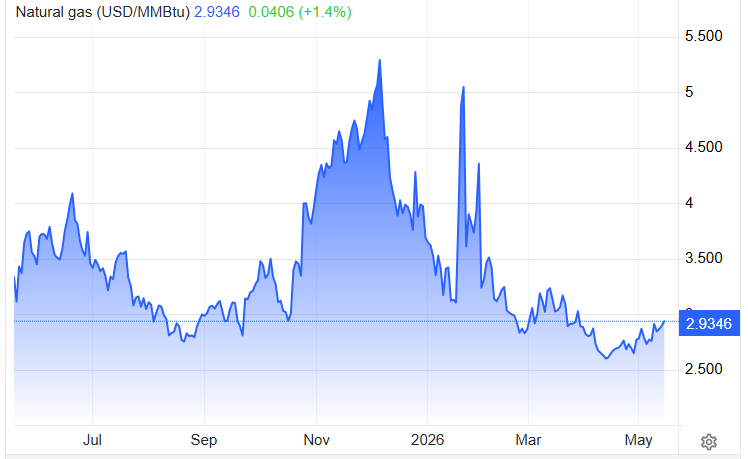 [32]
[32]Source: https://tradingeconomics.com/commodity/natural-gas [33]
The problem here is that the third scenario risks turning into the fourth – a protracted conflict when energy resources become so expensive that a global economic downturn and a sharp drop in prices begin.
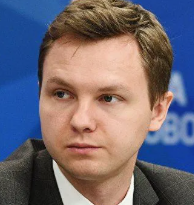
“The escalation of the military conflict and the destruction of additional energy facilities in the countries of the Middle East region are dangerous when prices rise to exorbitant levels, both for oil and gas. If the price is extremely high, it will lead to a decrease in consumption on a global scale, and then the market will recover with great difficulty and slowness, and for a long time. This is also unprofitable for us, as our sales markets will shrink,” explains Igor Yushkov, an expert at the National Energy Security Fund (NWF) and the Financial University under the Government of the Russian Federation.
Maintaining the current $100-$110 per barrel (a high price but not an extreme one), which does not reduce demand in our sales markets, is the best option, the expert adds. “The longer the Strait of Hormuz is closed, the better for Russia, the more we will have time to earn. We benefit from maintaining the status quo,” he says.
Another risk is created by the UAE, which has announced its withdrawal from OPEC. If they can increase production by the time the Hormuz opens, prices will go down; the question remains to what level they will fall, says Yushkov. If other member countries follow the example of the UAE and also want to withdraw from the OPEC+ consensus, this will hit prices even harder. “So far, everyone is silent, because there is no point in withdrawing from the deal – anyway, oil exports are limited, but with the opening of Hormuz, their position may change. Unlike the Middle Eastern countries, Russia will not be able to increase production, at least not quickly, so we will simply get low prices at current production volumes,” Yushkov argues.
 [34]
[34]The situation in the gas and related products market is better in this regard, because unlike oil, there are no reserves for gas. “When the Strait of Hormuz was closed, oil producers continued to produce a lot and pumped oil into storage facilities. But this was not the case with gas — Qatar was simply forced to stop production due to strikes on the infrastructure. Therefore, there may still be a certain shortage in gas and related products (methane, helium), and prices will remain high,” says Yushkov (left).
For oil, the deterrent to lower prices will be the fact that strategic reserves have been released, and they will need to be restored, the expert says. “But if OPEC+ collapses and everyone produces as much as possible, then even this factor will not be able to somehow keep prices down; they will still continue falling for some time, maybe for several months, until the market rebalances due to production cuts from one of the players, ” Yushkov argues.
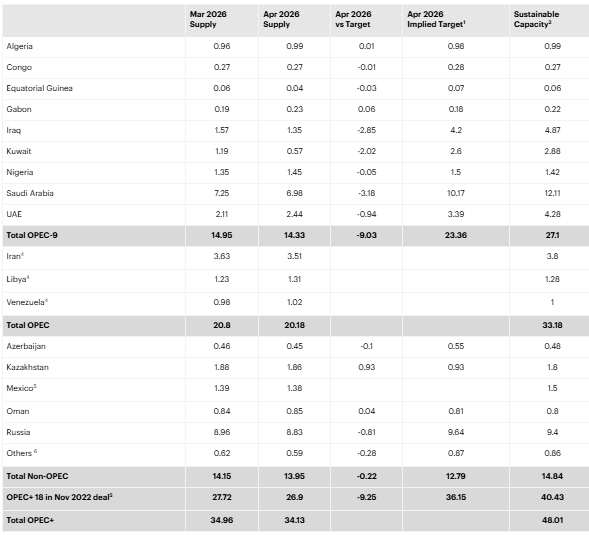
CURRENT OPEC AND NON-OPEC OIL PRODUCTION BY COUNTRY, MARCH-APRIL
 [35]
[35]To enlarge view, click on source: https://www.iea.org/reports/oil-market-report-may-2026 [36]
But even in the best case scenario (the second one) – maintaining high, but not extremely high oil prices – filling the budget will not be an easy task. According to Chernov, in the first four months of the year, oil and gas revenues amounted to about 2.3 trillion rubles, with an annual plan of about 8.92 trillion rubles. This means that for the remaining months until the end of the year, it is necessary to collect about 6.6 trillion rubles more, or about 828 billion rubles per month. In April, more than that was received – 855.6 billion rubles.
“If prices remain high and monthly revenues are around 0.9–1 trillion rubles, then the annual oil and gas plan can not only be fulfilled, but also exceeded by about 0.3–1.4 trillion rubles. If oil goes down quickly and monthly fees return to 700-750 billion rubles, the plan will be under pressure again,” Chernov has estimated.
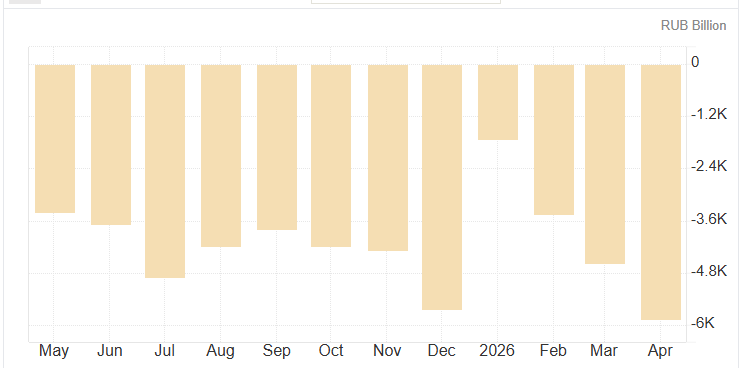
RUSSIAN BUDGET DEFICIT, MONTHLY, MAY 2025-APRIL 2026
In thousand billion rubles
 [37]
[37]Source: https://tradingeconomics.com/russia/government-budget-value [38]
“Expensive oil helps a lot, but the budget problem has not been solved. By the end of January–March, the federal budget deficit has already amounted to 4.576 trillion rubles, or 1.9% of GDP. This is above the annual plan. The scenario of Urals returning to $41 this year now looks unlikely. But it is impossible to say that there will definitely not be such a level, because the oil market is too nervous right now,” the expert adds.
According to his expectations, if Urals stays at least above $70-$75 per barrel, then the budget will be noticeably calmer for the year, and if the average price is closer to $ 85-$95, then oil and gas revenues will greatly reduce the risk of a severe budget deficit. But this will not completely solve the problem of the deficit, because there are increased military expenditures, a strong ruble and damper payments [39] to oil companies, the expert concludes.
 [40]
[40] [41]
[41]Source: https://iea.blob.core.windows.net/assets/2b89a47b-34a2-40e0-90ff-68f7ccd80715/-13MAY2026__OilMarketReport_publicversion.pdf [42] “World oil demand is forecast to contract by 420 kb/d y-o-y in 2026, to 104 mb/d, 1.3 mb/d less than our pre-war forecast. The biggest decline is in 2Q26, down by 2.45 mb/d, of which the OECD accounts for 930 kb/d and the non-OECD for 1.5 mb/d. The petrochemical and aviation sectors are currently most affected, but higher prices, a weaker economic environment and demand-saving measures will increasingly impact fuel use. Global oil supply declined by a further 1.8 mb/d in April to 95.1 mb/d, taking total losses since February to 12.8 mb/d. Output from Gulf countries affected by the closure of the Strait of Hormuz was 14.4 mb/d below pre-war levels. Higher production and exports from the Atlantic Basin provide some relief. Assuming flows through the Strait gradually resume from June, global oil supply is projected to decline by 3.9 mb/d on average in 2026, to 102.2 mb/d.”