 [1]
[1]
By John Helmer, Moscow
@bears_with [2]
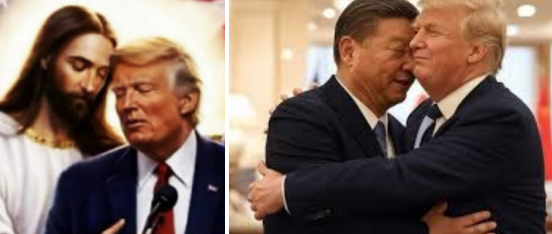
In successive tweets on Wednesday afternoon (April 15 [3]), President Donald Trump posted a new picture himself as the embodiment of God the Son on earth (lead image, left). Forty-four minutes earlier, he had announced [4] that “President Xi will give me a big, fat, hug when I get there [China] in a few weeks.”
The first tweet [5] was Trump’s method for fighting Pope Leo XIV and the US bishops and the Italian Prime Minister Giorgia Meloni by demonstrating [6] that the Irish Catholics of the US are on Trump’s side, not the Pope’s. There are roughly 20 million American Catholics of Irish origin; they are the largest ethnic community after the Catholics of Hispanic origin.
The second tweet [7] was Trump’s method for sandbagging the Chinese into acceptance of the summit meeting proposed for four weeks’ away, but not quite finalized; and for a Chinese undertaking not to intervene, openly or secretly, financially or militarily, on Iran’s side in the blockade of the Hormuz Strait and Iran’s resistance to the Trump articles of capitulation. Presented in Islamabad last weekend, Vice President JD Vance called them “our final and best offer [7].”
According [4] to Trump, “China is very happy that I am permanently opening the Strait of Hormuz. I am doing it for them, also – And the World. This situation will never happen again. They have agreed not to send weapons to Iran. President Xi will give me a big, fat, hug when I get there in a few weeks. We are working together smartly, and very well! Doesn’t that beat fighting??? BUT REMEMBER, we are very good at fighting, if we have to – far better than anyone else!!!”
This is not what Xi himself has announced at a meeting with the Spanish Prime Minister on April 14. Nor is it what Wang Yi, Politburo member and Foreign Minister, and Defense Minister Dong Jun announced ahead of Xi. However, between what all three have said, what they meant, and what they plan to do next, there is a large credibility gap; click for details [8].
This is the result of Chinese ambiguity and faction-fighting, and a western intelligence campaign to reveal covert Chinese military assistance to Teheran. “Iran used Chinese spy satellite to target US bases”, ran the April 15 headline in the Financial Times [9], the Japanese-owned and British-managed media platform in London. “Iran secretly acquired a Chinese spy satellite that gave the Islamic republic a powerful new capability to target US military bases across the Middle East during the recent war, according to a Financial Times investigation. Leaked Iranian military documents show the satellite, known as TEE-01B, was acquired by the Islamic Revolutionary Guard Corps’ Aerospace Force in late 2024 after it was launched into space from China.”
The Trump pictures of Christ’s embrace and Xi’s hug are fakes.
So are the western media claims of Chinese weapons, missile parts and fuel, and military intelligence for Iran, according to Vzglyad [10], the Kremlin-backed security analysis platform in Moscow, in a publication of April 15 by Yevgeny Krutikov, a former Russian military intelligence officer. “So far, all the accusations against China have not gone beyond rhetoric,” Kruitikov has written. “There is no evidence, especially if it is confirmed by something tangible, in the accusations against China.”
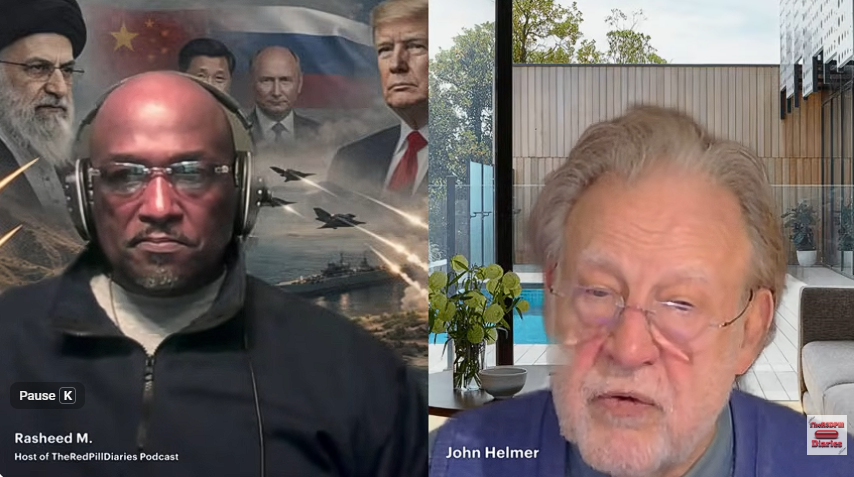
Listen or view the discussion [11] of the open and secret roles which China and Russia are playing in the Iran war in today’s podcast from the Red Pill Diaries with Rasheed Muhammad.
Here is a verbatim translation of Monday’s Vzglyad report into English. There are no illustrations or reference links in the Russian text; they have been added here for clarification and corroboration which readers may now follow up.
 [12]
[12]Source: https://vz.ru/world/2026/4/13/1410449.htm [13]
 [14]
[14]April 13, 2026
Why did the United States invent “Chinese weapons for Iran”
By Yevgeny Krutikov
The United States is threatening China again, this time with another increase in duties for “arms supplies to Iran.” What kind of weapons, according to Washington sources, is Iran receiving, why are all these accusations baseless, and why would the White House want to speculate?
The United States has threatened to retaliate harshly against China if it supplies weapons to Iran. Earlier, President Donald Trump said that China would have “big problems” if it decided to supply weapons to Iran – namely, the United States would impose an additional 50% duty on China. What are Trump’s statements based on?
Some American media outlets, in particular The New York Times, claim that American intelligence agencies have received information that in recent weeks China could send a batch of man-portable air defense systems (MANPADS) to Iran which could be used in the conflict with the United States and Israel. Trump may have a personal grudge against MANPADS – the US president has claimed that the only American fighter jet shot down by Iran was hit by this type of weapon.
 [15]
[15]Source: https://www.nytimes.com/2026/04/15/world/asia/china-iran-weapons-sales.html [16]
 [17]
[17]Source: https://www.reuters.com/world/china/iran-nears-deal-buy-supersonic-anti-ship-missiles-china-2026-02-24/ [18]
 [19]
[19]Source: https://www.uscc.gov/sites/default/files/2026-03/China-Iran_Fact_Sheet_A_Short_Primer_on_the_Relationship.pdf [20]
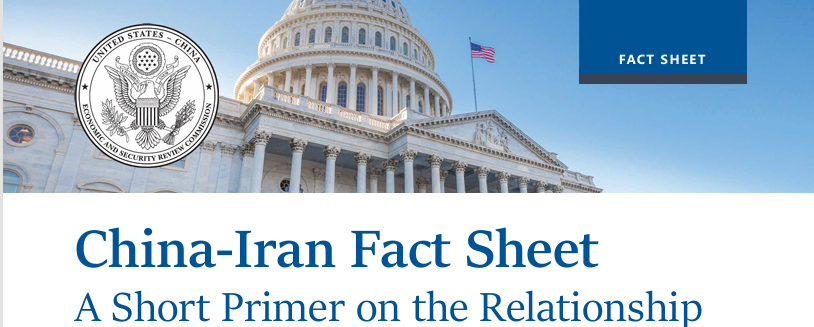
Earlier, in addition, Reuters had claimed that Iran is close to concluding a deal with China on the purchase of CM-302 anti-ship cruise missiles. This is already a much more serious weapon, because it would help Iran both in the blockade of the Strait of Hormuz and in the direct threat of hitting US Navy ships stationed in the region.
At the same time, even these media outlets admit that the intelligence information obtained on condition of anonymity does not provide a clear answer as to whether Chinese weapons have actually been sent to Iran already. The use of anonymous sources in itself casts doubt on all these accusations.
The United States claims that China could lift restrictions on arms supplies to Iran to private firms from third countries, which could send at least components by air through Afghanistan and some unnamed Central Asian countries (presumably Kyrgyzstan). American sources, most of whom are former administration officials or retired military personnel, claim that Iran is critically dependent on China for the supply of components for missiles and drones. We are talking primarily about electronic components (chips and others).
Beijing categorically rejects the very possibility of such supplies. “China has never supplied weapons to either side of the conflict; the information in question is not true,” said [21] Chinese Foreign Ministry spokesman Liu Pengyu [spokesman for the Chinese Embassy in the US]. “As a responsible major power, China consistently fulfills its international obligations. We urge the American side to refrain from baseless accusations, malicious comparisons and sensational statements.”
In China, they insist that if there are any deliveries, they are only of civil-use components and within the framework of civil transactions. Undoubtedly, a significant number of components and spare parts necessary for the production of modern military equipment are of purely civilian origin and are freely sold on the world market. Suffice it to say that the peaceful agricultural drone and the combat heavy-bomber drone have almost identical details. But still, it would be difficult to attribute anti-ship missiles and their electronic assemblies to this kind of technology.
In any case, no one can reliably claim that we are talking about dual-use components. So far, all the allegations against China have not gone beyond rhetoric. There is no evidence, especially if it is confirmed by something tangible, in the accusations against China.
From a political point of view, Beijing carefully adheres to the principle of neutrality. Moreover, the neutrality of the present, and not the hypocritical form that supposedly neutral Switzerland professes in relation to the conflict in Ukraine. Neutrality for China in any armed conflict is one of the main tenets of the foreign policy and the principles even of the existence of the modern Chinese state.
Moreover, recently, Chinese rhetoric has been more likely aimed at supporting the Arab countries, which have been the most affected party to the conflict due to the presence of American military bases on their territory. China is dependent on oil and gas coming from the Persian Gulf countries, and therefore cannot completely stand apart from involvement, but it is not going to participate in hostilities either.
According to some conspiracy theories, almost everything the Trump administration is doing is, in one way or another, a hybrid confrontation with China. And Iran, for which China is the largest trading partner, is just a collateral victim. In this context, attacks on China, especially those which are not supported by any evidence, look quite fit for purpose to Washington.
Earlier, the United States had already accused both China and Russia of providing Iran with intelligence data to launch attacks on American ships and bases (again, Russia has denied this). In fact, we are facing a single chain of accusations aimed at drawing the bigger state powers into the confrontation, at least at the level of rhetoric.
American sources regularly emphasize that “Beijing and Moscow are standing behind Teheran,” which is not only not confirmed by the facts, but also creates a negative background for the negotiations and it seriously complicates the search for a way out of the impasse that has developed in the Middle East – an impasse that is not the fault of Beijing and Moscow, but is contrary to their position. And given that Washington is aiming at a long-term confrontation with China, we are faced with a dangerous symptom indicating the inadequacy of the American perception of the situation in the world.
Of course, China is interested in the political weakening of the United States through defeat in the war against Iran. However, the implementation of this strategy cannot be called into question by such short-term steps as supplying Iran with MANPADS or even cruise missiles in the midst of a conflict with the United States. Such risky moves are generally not typical of China’s political culture.
 [22]
[22]Moreover, Donald Trump’s visit to Beijing has not been canceled, but only postponed due to the “workload” of the head of the White House in the war in the Middle East. Perhaps, on the eve of the visit, which is tentatively scheduled for mid-May, the Trump administration is making the standard move for the Americans: this is to strengthen their negotiating position by making unsubstantiated accusations. And for this kind of operation, anonymous sources and links to former officials and retired military personnel are traditionally used.
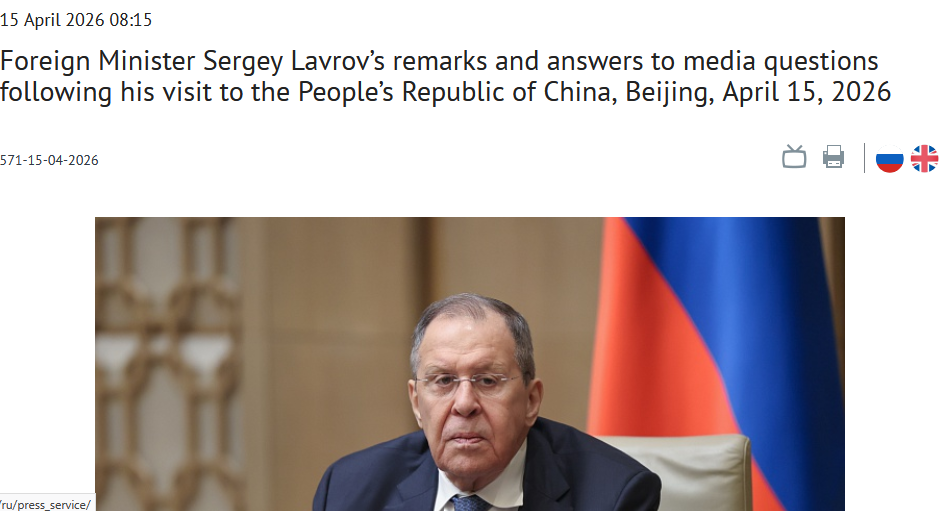
For elaboration of the latest round of Russian-Chinese talks between Foreign Ministers Sergei Lavrov and Wang Yi in Beijing on April 15, here are excerpts of the Russian Foreign Ministry record, released yesterday [23]:
 [24]
[24]“At the international level, we are interested in foiling the open attempts by the West, including the United States and Europe, to maintain or even renew their hegemony in the hope that the 500-year-long experience of controlling the world, subordinating it to their interests, and creating global control mechanisms that allowed them to live off others, in particular through slave trade, colonialism and other instruments, could be modernised and further used to continue living off others and bend them to their will. Neither China nor Russia, nor the majority of countries throughout the world, can accept this approach.
We [Lavrov and Wang Yi] talked about the situation in various parts of the world, focusing on Eurasia where more seats of tensions are developing. In Europe, NATO has been trying to find a new meaning for its continued existence, primarily by incorporating Ukraine. We are watching the EU’s militarisation against the backdrop of crises within NATO over differences between Washington and European capitals, primarily the Brussels bureaucracy.
The Middle East and the Persian Gulf zone, the site of events of concern for all sides, are a crisis knot that will not be easy to untie. I do not think that the ongoing attempt to cut that knot will succeed. Nevertheless, Palestine, the Gaza Strip and the West Bank of the Jordan River must not be overshadowed or pushed to the back burner, as we and the Chinese delegation have clearly stated today…
Question: China is experiencing energy shortages caused by the blockade of the Strait of Hormuz. Can Russia make up for these shortages? Has this issue been raised during the talks, in particular the implementation of the Power of Siberia-2 Project [25]?
Sergei Lavrov: Russia can certainly make up for the resource shortages facing the PRC and other countries that are interested in working with us on an equal and mutually beneficial basis. We have discussed this more than once. President Vladimir Putin briefly touched on this issue in connection with the European countries’ or rather the European Commission’s plans to sever all ties with Russia in the energy sector, meaning our hydrocarbon supplies.
It is no coincidence that after this crisis had erupted following the unprovoked aggression of the United States and Israel against the Islamic Republic of Iran, European officials started calling on the European Commission to have mercy on EU member states’ national sovereignty and postpone its plans to completely shut off the valve. Figuratively speaking, they are beginning to realise that if Europe were to get off, in their words, the Russian oil and gas needle now, it could automatically impaled on the wooden stake of the energy supply of another great power, which it is busy sharpening for later use on the Europeans. So, we are witnessing a captivating inflection point.
On a broader scale, though, the Power of Siberia 2 Project has been discussed by Moscow and Beijing for quite a while now. They compared its advantages over existing infrastructure and energy routes and how they will harmoniously complement each other, including with the projects being developed in Central Asia as part of the Belt and Road Initiative.
It’s a vast continent. As part of what President Vladimir Putin has called the emerging Greater Eurasian Partnership, we would prefer to avoid duplication and create a group of integration participants who, while developing their own subregional programmes, will harmonise and complement each other. The Eurasian Economic Union has such relations with the Shanghai Cooperation Organisation. The EAEU also has signed an intergovernmental agreement with the People’s Republic of China on the harmonious combination of the Eurasian Union’s integration plans with the implementation of the Belt and Road Initiative. The SCO and the EAEU cooperate with ASEAN as well. These are the three most active integration associations striving to coordinate their actions with each other and thus maximise the benefits derived from the advantages provided to us by our geopolitical and geoeconomic position as well as our being part of the vast Eurasian continent.
However, all of that took place when the rules on international markets, including energy markets, were more or less observed. As you may recall, these rules were established by none other than the West primarily as part of their globalisation model, which the United States strongly promoted after World War II bringing its other allies to heel and promoting this globalisation with the dominant role of the US dollar, ensuring in practice, as they believed, respect by all for the principles of free competition, the presumption of innocence, inviolability of property, and much more that has now been thrown onto the scrap heap….
The Strait of Hormuz has been blocked. It was never blocked before the attack on Iran, nor did it create any inconveniences for the movement of goods be it energy, oil, LNG, or food and fertilisers as well as many other things that, by the way, ensure, ensured, and I hope will continue to ensure to a large extent the socioeconomic development and trouble-free life of our close partners from the Arab monarchies of the Persian Gulf. All of that has come under great risk.
Not far away, on the other side of the Arabian Peninsula, runs a water artery that begins in the Mediterranean Sea, goes through the Suez Canal, then reaches the Bab-el-Mandeb Strait, which washes the part of Yemen that is now controlled by the Ansar Allah movement, or the Houthis, who are allies of Iran. They have been put on notice that they too will be bombed if they try to interfere with shipping in this artery that is vital for world trade. However, the question is not who will do what and who will punish whom. The question, as always, lies in the root causes.”
 [26]
[26]Click for the analysis: https://www.youtube.com/live/t_btMciV5p0 [11]