


By John Helmer, Moscow
@bears_with
Between saying something if you are a Chinese admiral and Defense Minister and meaning something if you are a Politburo member and Foreign Minister, there is a pussyfooting difference.
If you are the US Treasury Secretary and you tell the Chinese what you mean, that’s different.
And then if you are the President of China, these differences of meaning might be interpreted as “the law of the jungle”.
Might be is a conditional verb. Sometimes in grammar it connects the subject of sentences with the object. Sometimes in politics it doesn’t.
And so, on or about Monday, April 13, Dong Jun (lead image, 2nd left), China’s Minister of Defense, said: “We are committed for peace & stability in the world. We are monitoring the situation in the Middle East. Our ships are moving in and out of the waters of Strait of Hormuz. We have trade and energy agreements with Iran. We will respect and honour them and expect others not to meddle in our affairs. Iran controls the Strait of Hormuz and it is open for us.”
Where Dong said this, when, and in front of whom, were unclear in the press reports which, unusually, were not official state Chinese media or commercial media like the South China Morning Post. China experts noticed that the style of the remarks in Chinese was “very different from the official Chinese language style.” This isn’t necessarily a disqualifier. In Russian practice, sensitive official thinking can often be leaked through unofficial, even obscure sources, in part to test what happens in response.
Dong’s first two sentences were official boilerplate and obvious. The third sentence refers to the fact that in the first month of the US-Israeli war against Iran, an estimated 18 Chinese vessels transited the Strait – with Iranian permission and following a territorial route dictated by the Islamic Revolutionary Guard Corps (IRGC). On Monday, if and when Dong was speaking, a Chinese-owned tanker moved through the Strait. This was the Rich Starry which had loaded 250,000 barrels of methanol at the Emirati port of Hamriyah. The tanker is owned by Shanghai Xuanrun Shipping Co Ltd. but sanctioned by the US because it has been used to transport Iranian crude.
Dong’s fourth sentence is also boilerplate. There are many trade and energy agreements between China and Iran; the most important of them is the Comprehensive Strategic Partnership (2021–2046), signed in March 2021.
It is the Defense Minister’s fifth and sixth sentences which have drawn immediate and serious attention, especially in Teheran and Moscow, where they are interpreted as the first explicit Chinese declaration of support for Iran’s military control of the Strait and the first explicit Chinese warning to reject President Donald Trump’s naval blockade of the Strait which had begun on Monday.
Combined with the exit of the Rich Starry and another tanker, the US-sanctioned Elpis, which had loaded a cargo of Iranian methanol at Bushehr, Dong’s sentences appeared to signal that Beijing had decided to run Trump’s gauntlet and challenge the US Navy blockade.
US Treasury Secretary Scott Bessent replied that “the U.S. blockade of the Strait of Hormuz would ensure that no Chinese ships or others would be allowed to pass. ‘So they’re not going to be able to get their oil. They can get oil. Not Iranian oil,’ Bessent said, adding that China had been buying more than 90% of Iranian oil and it constituted about 8% of their annual purchases.”
As Bessent spoke, several hours after Dong’s speech and the tanker movements, both the speech and the ship courses were reversed. The Chinese Defense Ministry tweeted an official claim that the reports were “fake news” and “entirely fabricated.” The maritime tracking media reported the Rich Starry had stopped in the Gulf of Oman and then made a U-turn towards the Strait. The Elpis was reported to have stopped off the Iranian oil terminal port of Kooh Mobarak, which is located outside and east of the Strait, in the Gulf of Oman.
So now, all things said, what have the Chinese done?
Dong has been the Defense Minister since December 2023. In July 2024, however, he was not appointed to posts in the Chinese hierarchy usually occupied by defense ministers – he wasn’t appointed a State Councilor or a member of the Central Military Commission. He holds three-star general officer’s rank but he has no position in the line of combat operations, command and control for warfighting. An admiral, his face launches no ships. Instead, his job is to make public relations.
Wang Yi (lead image, 2nd from right), by contrast, is a Politburo member (since 2022) and Foreign Minister (since 2023); he was a State Councilor from 2018 to 2023. He reports directly to President Xi Jinping (right); Dong doesn’t.
On Monday, Wang told Guo Jiakun, his Foreign Ministry spokesman, to explain to the press what China’s policy is toward the Hormuz Strait regime. The question was asked by Russia’s state media correspondent in Beijing. “How does China view the issue of safe passage through the Strait of Hormuz and the related energy issue?”
The carefully prepared answer: “The Strait of Hormuz is an important international trade route for goods and energy. Keeping the area safe and stable and ensuring unimpeded passage serves the common interest of the international community. The root cause of the disruption at the Strait of Hormuz is the military conflict. To solve the issue, the conflict must stop as soon as possible. All parties need to remain calm and exercise restraint. China will continue playing a constructive role. As to the purchase of oil, China stands ready to work with others to jointly safeguard global energy security and keep supply chains stable. However, to fundamentally resolve the issue, what needs to be done first and foremost is to restore peace and stability in the Gulf and Middle East region. Venezuela is a sovereign state and has full permanent sovereignty over all its natural resources and economic activities. It has the right to choose its own partners of cooperation. Other countries have no right to dictate to it.”
Wang was authorizing a repeat of Dong’s meaning. But whereas the latter declared that the Chinese “expect others to not meddle in our affairs. Iran controls the Strait of Hormuz and it is open for us,” Wang’s spokesman appeared to say the same thing but by referring to the Trump blockade of Venezuela, not the blockade of Hormuz.
This is a Chinese distinction of geography amounting to negligible political difference at present. In the English language it is sleight of hand coming out of a Chinese mouth. Actually, two Chinese mouths. The Chinese Defense Ministry Twitter stream known as China Military Bugle, a media freshman authorized by Dong in September 2024, reported that the Dong reports were “fake news” and “entirely fabricated.” This was intentional misdirection. It was also Dong’s kowtow to Wang’s authority to do the talking at the US, especially as Trump’s scheduled visit to Beijing approaches in mid-May.
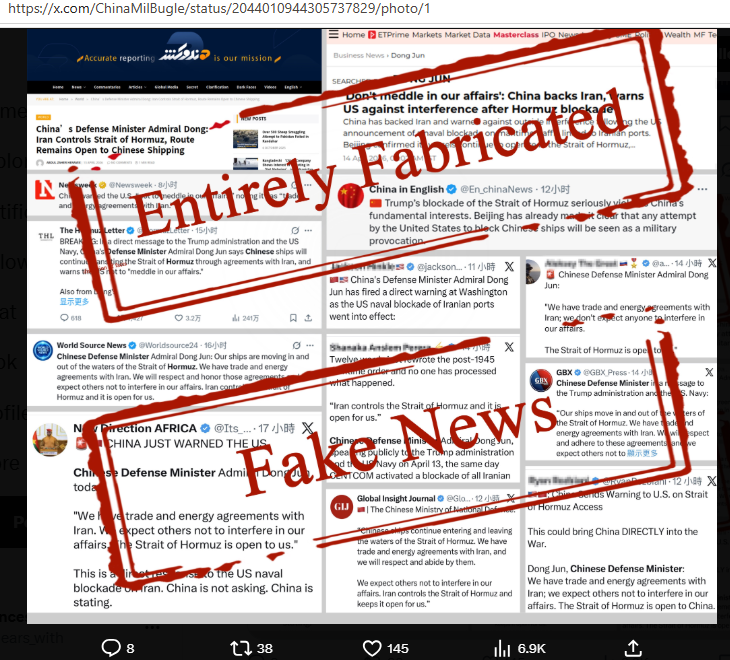
Source: https://x.com/ChinaMilBugle/status/2044010944305737829/photo/1
The Bugle having blown, Wang told his spokesman to clarify what he (and Dong) had meant on Monday. This was the Q&A in the Ministry’s Tuesday briefing. “Phoenix TV: According to reports, U.S. Central Command announced that it would begin implementing a blockade against all vessels entering or departing Iranian ports and coastal areas from 10 p.m. April 13 Beijing time. Iran’s Parliament Speaker Mohammad Baqer Qalibaf has said that the country will not bow to any threats. Meanwhile, Iran’s Islamic Revolutionary Guard Corps has warned military vessels not to approach the Strait of Hormuz. Tracking data by monitoring groups show that commercial shipping through the Strait ground to a halt on the night of April 13. What’s China’s comment?”
“Guo Jiakun: With the temporary ceasefire agreement still in place, the United States ramped up military deployment and resorted to a targeted blockade. This will only aggravate confrontation, escalate tension, undermine the already fragile ceasefire and further jeopardize safe passage through the Strait of Hormuz. It is a dangerous and irresponsible move. China believes that only a complete ceasefire can fundamentally create conditions for easing the situation. We urge relevant parties to honour the ceasefire agreement, stick to the direction of peace talks and take concrete actions to deescalate the situation so that normal traffic via the Strait will be able to resume as soon as possible.”
Now China was officially telling Trump that his blockade was “dangerous and irresponsible”. This appears to have been a boot, not a pussyfoot.
President Xi then put his mouth where Yang’s and Dong’s feet were. Reading slowly from the script on the table, Xi, with Wang beside him, addressed the visiting Spanish Prime Minister.
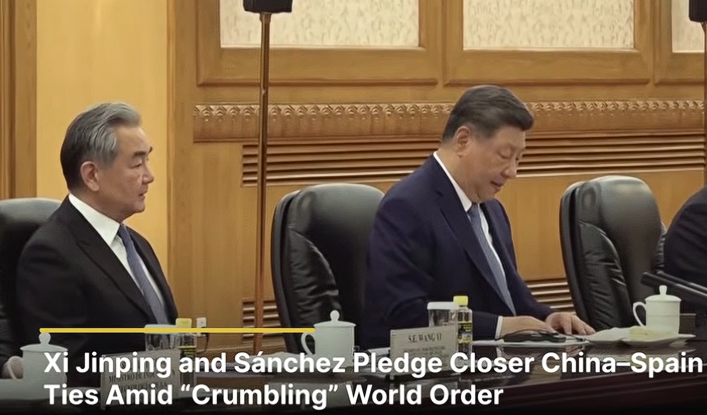
Source: https://www.youtube.com/watch?v=A8Lhy_sftvA
“China and Spain are both principled and reasonable countries,” Xi said. “We are willing to stand on the right side of history. We should oppose the law of the jungle and together maintain true multilateralism and protect world peace and development… Today’s world is in turmoil, caught in a contest between justice and power…How a country treats international law and the international order reflects its world view, its vision of order, its values and its sense of responsibility.”
What operational application have Xi, Wang and Dong decided?
The tanker movements of the Rich Starry and the Elpis have been confusing to analysts and the maritime tracking media. This has been the intention of their masters, charterers and owners.
They reportedly cleared the Strait from Sharjah and Bushehr, but then did not proceed eastwards, and turned around. In some reports they have re-entered the Strait; in others, they are reported to have reversed course, slowed, or stopped. “While some ships appear to be openly testing the US blockade, others continue to spoof AIS [Automatic Identification System] signals and in one case use false identities to transit. One tanker, signalling its name as Race, appeared to be heading east towards to the Strait of Hormuz using the IMO [International Maritime Organization] number of a previously scrapped vessel. Race is likely to be carrying Iranian cargo, but it was not immediately clear whether it loaded directly in an Iranian port or via an STS [ship-to-ship] transfer.”
“There is still uncertainty regarding the exact parameters of the blockade, which officially began on Monday at 1500 hrs UTC. A draft of the notice to mariners circulated among maritime security sources indicated a ‘grace period’ for ‘neutral’ vessels if they depart Iranian ports before 1400 hrs UTC. However, no official confirmation has been given. It was also not immediately clear whether the vessels transiting the Strait of Hormuz through the Iran-dictated lanes that traverse the Islamic Republic’s territorial waters would also be considered in violation of the blockade, as CENTCOM said it would apply to vessels departing or entering ‘Iranian ports and coastal waters’. CENTCOM did not respond to a Lloyd’s List email seeking clarification.”
Lloyds List is based in London and owned by Montagu Private Equity, a British company.
GCaptain, which is US-owned and directed, claims that “transit to non-Iranian destinations is not formally prohibited, leaving a wide—and highly discretionary—enforcement threshold for vessels operating in the region. That distinction is already being tested. Early vessel movements suggest growing hesitation near the approaches to the Strait, with some ships reversing course rather than risk interception.”
No maritime medium has reported the presence of the Chinese destroyer escort, Tangshan, in the region.
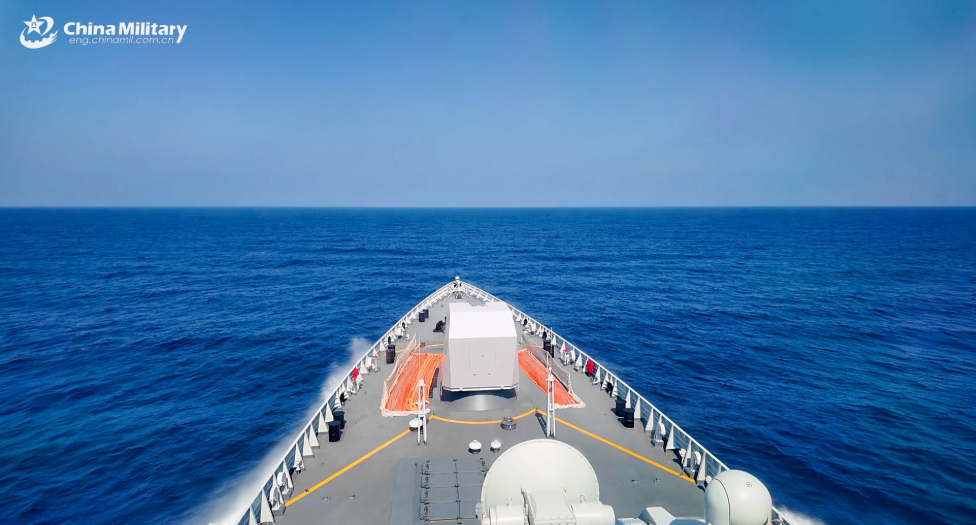
The official caption reads: “Guided-missile destroyer Tangshan (Hull 122) attached to the 48th Chinese naval escort taskforce cuts through the waves during a multi-subject training exercise in early April, 2026.” http://eng.chinamil.com.cn/2025xb/M_251449/P_251468/16454151.html
Chinese state media reported in early April that the “48th Chinese Naval Escort Taskforce trains in the Gulf of Aden.” No precise date for the exercise or location of the Tangshan was given. The movement and location of the Tangshan since the exercise have not been disclosed.
On Tuesday afternoon Reuters also reported that Treasury Secretary Bessent “declined to answer a question about whether the [Hormuz blockade] dispute would derail US President Donald Trump’s plan to visit Beijing in mid-May, but said Trump and Chinese President Xi Jinping had a very good working relationship. ‘I think the message for the visit is stability. We’ve had great stability in the relationship since last summer; that emanates from the top down,’ he said. ‘I think that communication is the key.’ But Bessent took China to task for its actions during the US-Israeli war with Iran, which has sent oil prices up by as much as 50% and triggered supply chain disruptions. ‘China has been an unreliable global partner three times in the past five years; once during COVID, when they hoarded healthcare products, second on rare earth,’ Bessent said, referring to Beijing’s threat last year to curb rare earth exports.”
That Tuesday morning in Beijing, Russian Foreign Minister Sergei Lavrov went into negotiations with Wang. “We are meeting this year for the first time,” Lavrov announced. “We have already had several telephone conversations. They are always detailed. I have no doubt that this year we will continue the opportunity to talk repeatedly and thereby prepare additional decisions for the new contacts between our leaders. These contacts are already planned. Today we will talk about this in detail.”
In Lavrov’s communiqué, he said “the foundations of international relations are being severely tested. It is enough to look at what happened at the beginning of the year in Latin America, in Venezuela, what is happening now in the Middle East. The Ukrainian crisis…In the eastern part of the Eurasian continent, too, very dangerous games do not stop: both in the issue of Taiwan and in the South China Sea, the situation on the Korean Peninsula is escalating…”
Wang’s ministry hasn’t responded publicly to Lavrov yet.
Wang’s spokesman has tweeted: “Media reports accusing China of providing military support to Iran are purely fabricated. If the U.S. goes ahead with the tariff hikes on China on the basis of these accusations, China will respond with countermeasures.”




Leave a Reply