 [1]

By John Helmer, Moscow
@bears_with [2]
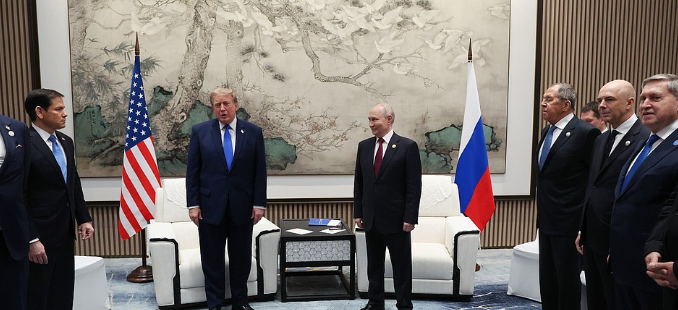
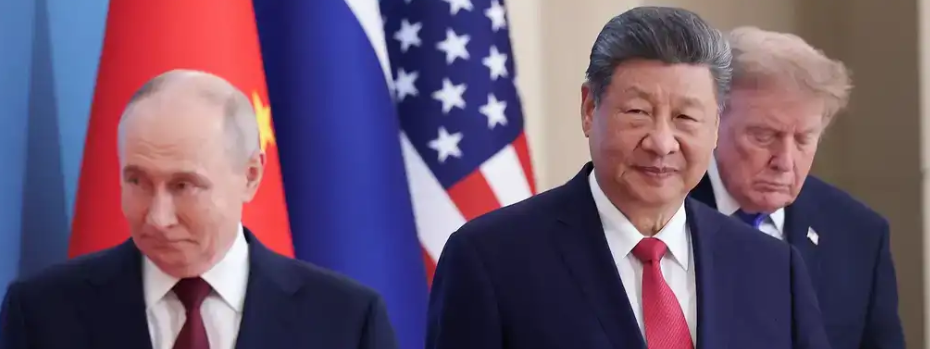
This is the Russian red interpretation of what happened at the Shenzhen meeting of the presidents of Russia, China and the United States.
Vladimir Lenin often referred [3] to the Red Army, the Red commanders, Red Moscow, Red Petrograd, and the Red Flag of the Proletariat [4]. There’s no record that he ever explained [5] what red meant to him.
Stalin didn’t explain either, but he frequently referred to the Red Army, including the extension of its military power to European politics: “The action of the Red Army is also a matter of world revolution”, he said in 1940 [6].
Mikhail Gorbachev and Boris Yeltsin didn’t refer to the Red Army in the record of their public speeches. Gorbachev was responsible for withdrawing the Red Army from Germany on the US promise that neither the reunified Germany nor the NATO alliance would move its forces eastward to the Russian border and threaten the security of Russia again — as the Germans, French, British, Americans, Poles, Scandinavians, Turks and Japanese had all tried before.
Yeltsin was responsible for dismantling the Red Army and Russia’s defences. The two of them combined to release the US and NATO to build their forward fortress lines in the Ukraine and plan for the eastward offensive into the Russian hinterland, and on the Black and Baltic Seas, which continues today.
Vladimir Putin has spoken of the Red Army several times, especially after the Special Military Operation commenced in 2022. “Let’s not forget who stormed Berlin. Have you forgotten it? The British or the French? The Red Army,” Putin said in 2025 [7]. Putin was also responsible for installing Sergei Shoigu as commissar of the Red Army and between 2012 and 2024 allowing him to rule by the most extensive scheme of corruption of the General Staff ever recorded in Russian military history.
Asked last night by a Russian reporter to compare the Shenzhen meeting with the meeting of Stalin with Franklin Roosevelt and Winston Churchill in Yalta on February 4-11, 1945, Putin replied [8]: “As for the new Yalta, you know, what was wrong with Yalta? Well, what was wrong? First of all, in Yalta …I think it’s right that it would be possible to record a victory over neo-Nazism so that we would talk about eradication of the very ideological roots of xenophobia, Russophobia and other phobias…Second…after Yalta the conditions were created under which the United Nations was established. And for 80 years thanks to these agreements, in fact, the world lives without large global military shocks. Yes, regional conflicts are many, and now they are happens, but there are no global shocks. And this is thanks to the agreements in Yalta. What’s wrong here? And finally, in Yalta nobody divided up the world. I want to emphasize this and I want everyone to understand. In Yalta there was no division of the world into zones of influence, Yalta simply recorded the realities that developed after the Second World War.”
During their meetings over eight days [9], Stalin had told Roosevelt and Churchill that within eight more weeks the Red Army would launch its final offensive to take Berlin and destroy Germany’s leadership. The Red Army fulfilled that promise; Hitler was dead on April 30, 1945. Germany surrendered a week later.
The Shenzhen meeting lasted ninety minutes.
At last night’s press conference in China, Putin did not mention the Red Army. In the closed talks with Xi and Trump, he did mention the US and NATO-guided attack on the Crimea Bridge. According to Trump’s version [10], “Putin was upset over it. That’s the sad part of war. You end up ultimately negotiating. I think he [Putin] would like to see it ended.”
Trump was implying that the Crimea Bridge operation – guided by US electronic intelligence and targeting [11] – met the US, European, and Ukrainian objective of pressuring Putin to accept their end-of-war terms. Sad for Putin, Trump said. Not sad for himself.
Three hours later, Putin was asked by Russian reporters for his reaction. He replied [8]: “following the strikes on the Crimean Bridge, there will be no negotiations. We will respond to these strikes. And I want everyone to know this. I believe that our retaliatory actions, as I have just said, will be far more painful than what the Kiev regime did to the bridge. We will, of course, restore the bridge. In fact, there are two bridges there: a road bridge and a railway bridge. The road bridge has suffered serious damage; the railway bridge, I believe, has already been restored. With modern weaponry and precision munitions, this is not particularly difficult to achieve. the question now concerns retaliatory measures. They will follow.”
Background references:
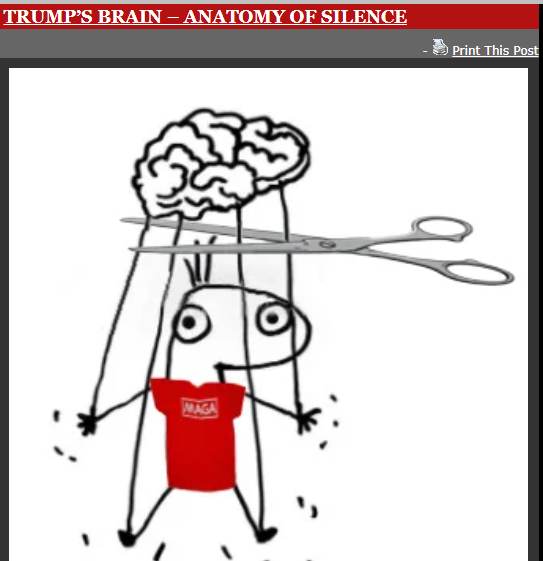
- Trump’s “missing” time in the White House calendar: https://rollcall.com/factbase/trump/calendar/ [12] Trump’s brain: https://johnhelmer.net/trumps-brain-anatomy-of-silence/ [13]
 [14]
- The 40-minute “pull aside” meeting between Putin and Trump when Stephen Miller was introduced olut of sight of the press: https://tass.com/politics/2221037 [15] On the warfighting and election succession alliance between Miller and War Secretary Peter Hegseth, read this: https://www.breitbart.com/ [16]
 [17]
Kremlin source: http://kremlin.ru/events/president/news/81302 [18]
- The Chinese read-out of Xi’s contributions to the troika summit: https://english.www.gov.cn/news/202611/20/content_WS6aff99fdc6d00ca5f9a0e7ca.html [19]
 [20]