 [1]
[1]
By John Helmer, Moscow
@bears_with [2]
How long is a piece of string?
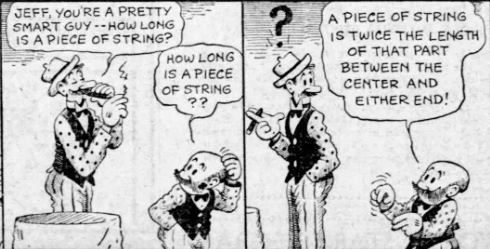
The recorded history of that question began in a New York newspaper in 1885. At the time and ever since, asking the question implied the answer that there is no limit to the string [3]. The answer in the lead images, a Jeff and Mutt cartoon, appeared in the Fort Worth Star-Telegram in April 1937.
Today, in the two world wars in which President Donald Trump is directing US empire forces, including the British, Europeans, Israelis, Arab sheikhs, Canadians, Ukrainians, and others – that’s the war for Europe against Russia, the war for the Middle East against Iran – the answer to the string question depends on whether the count starts at the US end or at the Russian and Iranian ends.
In the politics, logistics and economics of these wars, measuring the length of the string starts with who is at the pulling end and who is on the other end.
When US Secretary of State Marco Rubio, Trump’s national security advisor, called an urgent meeting with Russian Foreign Minister Sergei Lavrov on July 23, his plan was to tell Lavrov that the US had the measure of the string between Moscow and Teheran; and to warn President Vladimir Putin to stop assisting Iran with the means to kill American troops and spies in the Middle East. Lavrov had his answer ready. That was to reverse the string between Washington and Kiev and warn Trump to stop assisting Ukraine with drones to kill Russian civilians at work, on roads, in factories, refineries, port terminals, warehouses.
Read the details of what was said and done at the Manila meeting here [4].
In the days since then, Lavrov has appeared to deny the Rubio warning [5]. “For no apparent reason, the West, and Washington in particular, are now stoking a narrative that Russia and China are directly supplying Iran with the weapons to attack US targets. Well, you know, it is embarrassing to even hear that.”
Trump himself tweeted what appears to be a similar correction, but attached the same warning to Putin which Rubio had addressed [6] to Lavrov. “President Xi, at our recent meeting in Beijing, China, told me that he would not, under any circumstances, give or sell Weapons to the Islamic Republic of Iran — And that statement included Chinese Companies. Considering our relationship, I take him at his word and, besides, l am doing him very big favors, also. Likewise, President Putin, despite the horrible War going on in Ukraine (The relationship remains, as it does with President Zelenskyy), told me that he would not sell Weapons to Iran. He understands that I do not sell Weapons to Ukraine, but to NATO Countries. They pay full price, and how those Weapons are distributed, I have no idea. Therefore, two major Countries that people speak of often in terms of Iran are, in my opinion, not participating. If they did, it would be very bad for them — Certainly not in their best interests.”
The string is obvious; so are the two ends. In between there is war, the escalation of which is violently contested. For that reason, what is being said, written, and broadcast can be true and untrue at the same time, depending on which end of the string is doing the pulling, the counting, and also the cutting.
In the interpretation of Stephen Bryen, the Trump-Zelensky escalation against Russia and Iran simultaneously can be deterred, cut short, stopped, defeated by a combination of retaliatory strikes and supply cutoffs if Russia, Iran and China will agree to act together, swiftly and comprehensively. Bryen has been a senior Pentagon official during the Reagan Administration, a war planner for US and Israel, and an advisor to the US and NATO military-industrial complex [7].
Bryen’s analysis [8]: “Kiev fields two distinct drone categories: FPV (First-Person View] drones whose role is critical on the battlefield and long range drones aimed at Russian territory and Crimea. FPV drones are typically plastic or composite quadcopters powered by electric motors. In 2025 Ukraine used around 3 million FPV drones. Current reports suggest Ukraine is using 10 to 15 thousand drones daily. In recent months Russia has been targeting drone manufacturing facilities in Ukraine, as well as warehouses and distribution points, but there is not much hard evidence that Russian operations have meaningfully impacted Ukraine’s use of FPV drones. Between 85 to 90 percent of the components powering Ukraine’s FPV drones come from China. These include power systems (such as lithium ion cells, high discharge LiPo [lithium polymer] batteries and power distribution boards), brushless electric motors for propulsion and servos, and electronic speed controllers and flight controller boards, CMOS [Complementary Metal-Oxide-Semiconductor] navigation cameras, thermal sensors, fiber optic dispensors and basic RF [radio frequency] transceiver modules.”
“In addition there are some supply issues for factories in Ukraine and in Europe that are supporting Ukraine. Included here are neodymium rare earth magnets for motors, synthetic graphite for battery anodes, and specialized carbon fiber coming exclusively from China.
Similarly Russia depends on China for its drone supplies. Even the Pentagon has given waivers so US drone producers can support US War Department needs. Ukraine buys most of its components from third country intermediaries because China, after protests from Russia, restricted its domestic drone makers from directly exporting to Ukraine. But these so-called restrictions are just a way to jack up the price for parts and to enrich friends of the Chinese regime. China has made no effort to account for the millions of parts it is shipping that fuel the war effort. Should China get beyond its usual corruption and clamp down, Ukraine would be out of business on the battlefield [8].”
Bryen’s conclusion [8]: “Ukraine probably can ignore peace initiatives that would leave Russian forces on Ukrainian territory, at least for a short while. But the supply crisis is closing in and it will significantly impact Ukraine’s defenses and ability to hold territory and fend off Russian missile and drone attacks. How soon will Ukraine’s situation turn critical? If the fighting resumes in Iran, only a few months for air defenses. If the Chinese crack down on supplies for drones to Ukraine, even sooner.
The day after the Rubio meeting, Lavrov met China’s Foreign Minister, Wang Yi, the chief foreign policy advisor to President Xi Jinping; this was on July 24; the two ministers were still in Manila.
Lavrov acknowledged in the small print of his ministry communiqué [9] that after their talks “covered relations with the United States and the situation surrounding the Ukrainian crisis,” he “noted a convergence or similarity of approaches to the majority of the issues raised.” Wang’s ministry issued no communique, told reporters nothing [10].
What then were the “minority” of issues on which Lavrov and Wang failed to “converge”? Was one the refusal [11] of the Chinese to finalize the new Russian gas supply project known as Power of Siberia-2? Was it the refusal of the Chinse to stop supplying drone components to the NATO allies and to Ukraine for their attacks on Russian targets?
This is another of the big strings which are being pulled: how long is it?
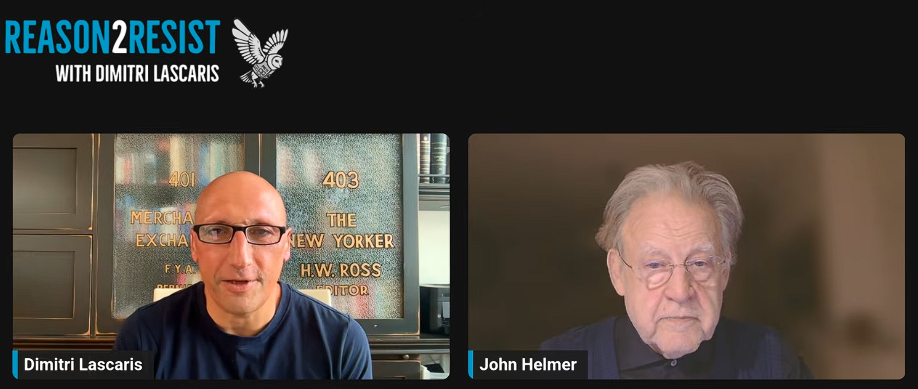
In the new podcast with Dimitri Lascaris, aired on Tuesday afternoon US ET, we discuss the US-guided Ukrainian drone attack on the Ana [12], an Iranian flagged cargo ship in the Caspian Sea, off Astrakhan, on July 25 [13]. The Russian, Iranian, Ukrainian, and US strings are measured out. Click to view or listen: https://www.youtube.com/watch?v=gk1mcqaTO_U [14]
 [15]
[15]Source: https://www.youtube.com/watch?v=gk1mcqaTO_U [14] “Where’s the counter-escalation against the supply of drones, drone components, men to run them, on the land border routes?...If you don’t cut the Ukrainian firing platform off totally…why escalate by half, when you leave the other half open?…It doesn’t make logical sense. It doesn’t make common sense. It doesn’t make strategic or military sense. But it does make political sense. You can explain it: when you balance contradictions, nonsense falls out.”
Here is a sample – a semi-official analysis of the string between Teheran, Moscow, Washington and Brussels. It appeared yesterday in Vzglyad [16]; this is a Kremlin-backed platform for military, economic and security reporting, for surfacing closed-door debates, and for editorializing on what Putin’s options are, what decisions he should take. The following is a verbatim translation into English without editing.
It is not an agreement with the meaning.
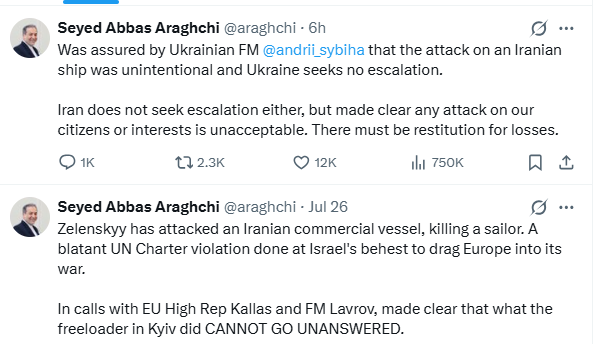
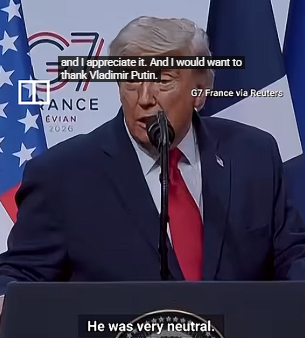
Pictures and captions recording the White House meeting between Trump and Zelensky, Iranian Foreign Minister Abbas Araghchi’s tweets on the Ana attack, and Trump’s statement on Putin’s “neutrality” in the Iran war have been added.
 [17]
[17]July 28, 2026
Zelensky teases Iran for the sake of one man
By Gevorg Mirzayan
For the first time during the conflict with Russia, the Ukrainian armed forces have attacked another country that was “the first to attack Ukraine” — Iran. What is the reason that Ukraine would risk the expansion of hostilities? Zelensky seems to want to make a political gift to the man he would do a lot to please– Donald Trump.
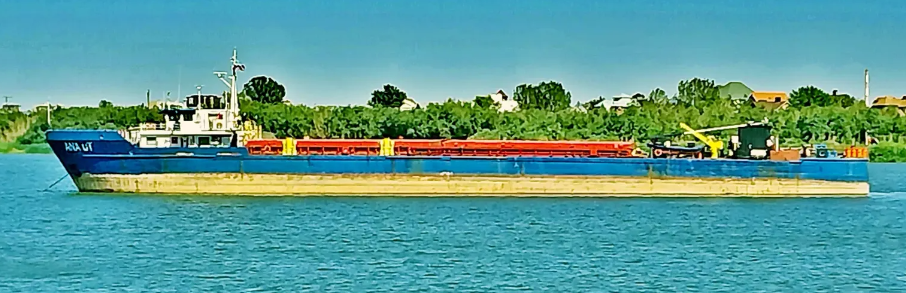
A diplomatic conflict is unfolding between Iran and Ukraine, which could turn into a military conflict at any moment. It all started with the fact that at the end of last week, Ukraine attacked an Iranian merchant ship in the Caspian Sea. During this attack, one sailor was killed and another was injured.
 [18]
[18]The Ana, photograph of 1999: https://www.marinetraffic.com/en/photos/of/ships/shipid:657748/shipname:ANA?order=date_uploaded [19]
Iranian Foreign Ministry spokesman Esmail Bagai called the strike “an absolutely illegal and unjustified act.” However, the head of the Kiev regime, Vladimir Zelensky, has a different point of view. He claims that the vessel that was hit was allegedly involved in “military cargo transportation” from Russia to Iran. And that the Iranians, the Ukrainians say, were the first to attack Ukraine.
This is, of course, a lie. Teheran did not attack Ukraine. The Iranian Foreign Ministry said that the Islamic Republic “has never intervened in the conflict between Russia and Ukraine,” and this is indeed the case. “Iran is not a participant in the war.” Moreover, he stated that he supports the principle of the territorial integrity of Ukraine within the borders of 1991, according to Kirill Semenov, an international political scientist and RIAC expert, speaking to Vzglyad.
Teheran is not doing anything close to what, for example, the European Union or the United States is doing on the side of Kiev in the Ukrainian conflict. Iran does not send mercenaries, does not support military operations with money, does not provide satellite or intelligence support to Moscow, and even more so, it does not participate in the process of aiming Russian missiles and drones at targets in Ukraine. That is, Iran is in no way involved in what is happening.
However, Zelensky needs this lie, and he needs it here and now.
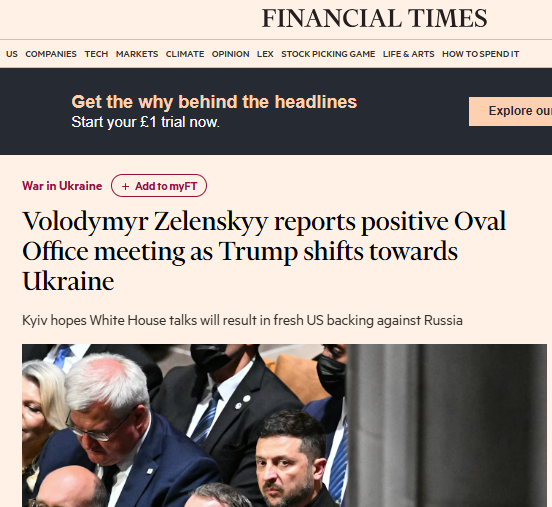
The provocation of conflict with Iran should, according to the head of the Kiev regime, solve at least some of his problems with the head of the White House, Donald Trump, to whom Zelensky flew on a visit on Tuesday.
 [20]
[20]Source: https://www.ft.com/content/5dca4c81-be8a-4555-971f-181eebf53e62?syn-25a6b1a6=1 [21] “Volodymyr Zelenskyy held talks with Donald Trump at the White House on Tuesday amid growing confidence in Kyiv that the US president has become more supportive of Ukraine’s position. The Ukrainian president’s advisers and a person close to the White House said the meeting offered Zelenskyy his best chance since Trump began his second term to secure fresh military backing and revive efforts to end Russia’s full-scale war…the two had discussed licences for Patriot interceptor production and several other ideas. In a sign of how relations with Washington had improved, Zelenskyy said: ‘We also spoke about diplomacy. . . our teams will arrange the details of their further communication. I am grateful to the United States for its firm support.’ US special envoy Steve Witkoff and Trump’s son-in-law Jared Kushner have agreed to visit Kyiv for the first time as part of efforts to end the war, said people familiar with Tuesday’s discussions in the Oval Office. The talks mark a sharp shift from the tensions that once defined the relationship, with Zelenskyy privately crediting months of direct adviser-level engagement for changing Trump’s view of the war and Ukraine’s prospects. His challenge, people close to both presidents said, was to convince Trump that backing Ukraine served US interests and to appeal to the president’s desire to be associated with success, an argument that has gained traction in recent months.”
It’s no secret that relations between Trump and Zelensky are strained. And now the head of the Kiev regime wants to fix them through the assistance he offers the United States in the Middle East campaign against Iran that is extremely important for the United States and Trump personally. “In fact, Ukraine is trying to integrate into the anti–Iranian coalition, to become a member of it,” says Kirill Semenov.
It’s not the first time he’s tried, not only in words, but in deeds. For example, in the spring, Zelensky offered the Middle Eastern monarchies assistance in the form of specialists in unmanned systems which were supposed to protect local facilities from Iranian air attacks. Then that all ended in a shameful fiasco – all five facilities that the UAE authorities had placed under the protection of Ukrainian specialists were hit, as was the base where these specialists were located. As a result, those of them who remained alive were expelled by the Arabs.
Another approach to the targeting project was direct participation in attacks on forces friendly to Iran. According to Iraqi National Security Adviser Qassem al-Aboudi, “Ukrainian cells carried out a number of attacks on targets in Iraq.” Apparently, we are talking about the same specialists of unmanned systems who, in the interests of the United States and/or Israel, attacked Iraqi facilities connected with Iran in one way or another.
And now Zelensky is not just hitting an Iranian ship. He “helps” the United States in two ways.
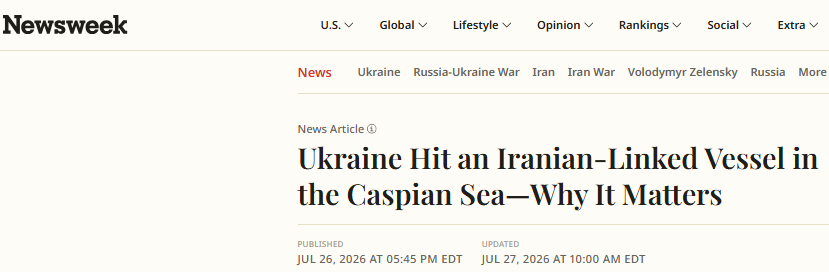
First, the Caspian Sea strike demonstrates readiness to turn the sea blockade of Iran from a limited one (which the United States established at the exit from the Strait of Hormuz) into a comprehensive one, closing the Caspian Sea to Teheran. “With increasing international pressure on Iran’s southern shipping lanes, the Caspian Sea has become a vital trade corridor linking Iran with Russia, Central Asia, and broader markets focused on China,” writes Newsweek.
 [22]
[22]Source: https://www.newsweek.com/ukraine-iran-caspian-strike-12246674 [23]
Secondly, as Iranian Foreign Minister Abbas Araghchi correctly notes, the attack on the ship was carried out “with the aim of dragging Europe into the war.” Zelensky expects that a direct retaliatory strike by Iran against Ukraine – if it takes place, of course – will lead to at least a partial involvement of Europe in the US-Iranian war. The same Europe that has been trying to distance itself from Trump’s Middle Eastern adventure all these months, to his obvious displeasure. And if Europe stops distancing itself, it turns out that Zelensky has done Trump a favour here, too.
 [24]
[24]Source: https://x.com/araghchi/status/2081406217486778612 [25] and https://x.com/araghchi/status/2082177796508459412 [26]
And all these service offerings come with just the right information sauce. On the eve of his visit to Trump, Vladimir Zelensky is not just trying to position himself as an ally of the American president on the Iranian issue – he represents Russia as an American enemy on the same issue.
“Now, for some reason, they are inflating in the West, in Washington in particular, some kind of theme that Russia and China are directly supplying Iran with those weapons that Iran uses to attack American targets. You know, it’s just kind of embarrassing to hear that,” Sergei Lavrov has said.
And Trump’s official position, announced by him in mid-June, is close to the Russian one here. He said that Vladimir Putin takes an “absolutely neutral” position in the US-Iranian conflict.
 [27]
[27]Source: https://www.youtube.com/shorts/Vqavsybf7Vw [28]
Zelensky has also stated that Moscow has been providing satellite images to Teheran since the beginning of July to plan Iranian strikes on American facilities located in the Middle East. And by calling the stricken vessel a carrier of military cargo from Russia to Iran, he not only highlights misinformation about Russian military involvement in the US-Iranian conflict, but also positions himself as a party that is ready to help America solve this alleged problem.
What will Zelensky get as a result of this adventure? And not only from the United States (it’s not a fact that Trump will believe in Ukrainian fables), but also from Iran. Indeed, according to Abbas Araghchi, such actions by Ukraine “cannot remain unanswered.”
The Iranians have plenty of options for this answer. “Starting from a direct strike on Ukraine, which I consider unlikely, to symmetrical attacks on Ukrainian–owned companies and ships in the Indian Ocean region,” Kirill Semenov says. In addition, the Iranians have proven in recent months that they do not waste words and do not stand on ceremony with those who help the Americans attack Iran.
 [29]
[29]