 [1]
[1]
By Pelle Neroth Taylor in Stockholm, introduced by John Helmer
@bears_with [2]
There is almost no point in explaining, example after example, why President Vladimir Putin is mistaken in his understanding of how to deal with the propaganda war of the western world against Russia. Click [3].
This is because he demonstrates his refusal to learn by continuing to pay and believe his chief propagandists in Moscow (no names) and those in the western media whom they pay (no names). Click again [4] and again [5].
Almost no point, I said.
What remains of the point is the human right, not just to speak, assemble and publish, but to think first. This — this is the moral duty of the free-thinking person. It’s a duty that comes before religion (including religions of national superiority, no names) because faith ought to follow after thinking, oughtn’t it? If not, faith is a childish mistake, compounded for grownups by the compelling force of state power and the beguiling subversions of class and cash [6].
There’s nothing in the US Bill of Rights and Constitution to protect thinking, let alone to require it. In fact, Article 1 of the Bill and the First Amendment explicitly put the freedom of religion first and foremost, and assign faith superiority over the freedoms to speak and to assemble [7]. This superiority is a constitutional guarantee for lying, propaganda, brainwashing, information warfare. At least in the law-abiding United States.
Incapacity to think, unwillingness to tell the difference between true and false, mental impairment – these aren’t terms required for the removal of a US president according to the 25th Amendment of the Constitution. The amendment is a political subterfuge – it has kept Ronald Reagan, Joseph Biden, Donald Trump safely in office [8].
And so we come to this analysis of the success of the Swedish lie exposed in every respect by Pelle Neroth Taylor.
Read it and think. Think and read it again because the same lie operation is succeeding against you, wherever you are.
 [9]
[9]https://pntshow.substack.com/p/manufacturing-dread-how-western-submarines [10]
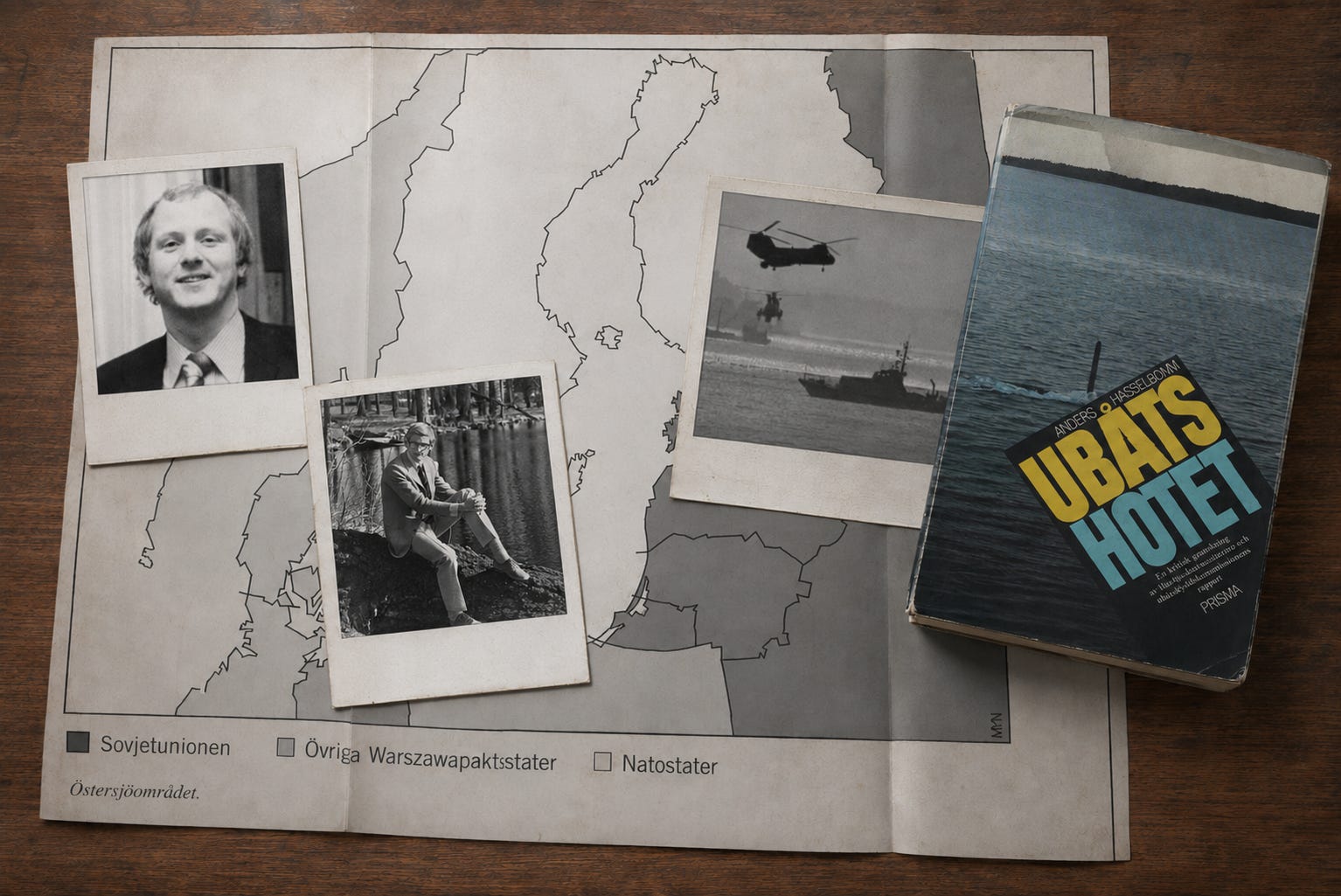
I want to begin not with a submarine but with a pub. It was a raw February evening in 2014, and I was sitting in a cramped bar in Stockholm’s Old Town opposite a lean man with a grey crew cut and a stare that could strip paint. His name was Anders Hasselbohm. Thirty years earlier he had been one of the most decorated investigative journalists in Sweden. Then he wrote a book – Ubåtshotet1 [11], “The Submarine Threat” – saying that the mysterious submarines haunting Swedish waters were not Soviet, and on that subject, in the polite Swedish way, the doors quietly closed. He kept his trade – his paper sent him abroad, and he reported for years with distinction as a foreign correspondent – but the home story, the one that mattered to him most, was no longer his to tell. By the time I bought him a beer he had had three decades to think about how a free country falls quiet without anyone ever being ordered to hush.
I had sought him out because I wanted to ask him the question that has organised most of my working life since: how do you tell a true story that powerful people have decided is not to be told? He looked at me for a while, the way old reporters look at younger ones who think they have found something new, and said something I have never forgotten. He said the bad days for press freedom in Sweden were not the days of censorship. They were the days when six hundred journalists sat in a naval mess hall, were fed coffee and sandwiches and mood music by admirals, and went home convinced they had been told the truth.
 [12]
[12]Anders Hasselbohm and his nemesis, right, Carl Bildt
I have spent years reporting from London and Brussels on exactly the kind of story that does not fit the official map of the world. This is one of the most important ones I have found. I am setting it down here, at my own length and on my own Substack, because the venues that are supposed to carry stories like this would not, and because I have finally stopped waiting for their permission.
What every Swede of my generation remembers
You have to have grown up in Sweden to understand how strange the early 1980s were. I grew up in London and spent most of my adult years there. But for a few years I lived in Sweden, with a Swedish mother. The years of 1982–85 remain vivid. I was a teen schoolboy in the high Social Democratic noon, when Sweden was rich, calm, egalitarian and faintly smug – the country that had supposedly squared the circle, combining American living standards with Scandinavian fairness, and which therefore felt entitled to lecture the rest of us on its failings. Read The Times or The Spectator in those years and you would think the place kept one foot in the Soviet Union; live there, as I did, and it was nearer to Chicago’s North Shore, the high school of the Breakfast Club movie, than to Moscow. And every few months this placid, self-satisfied country was gripped by a maritime ghost story.
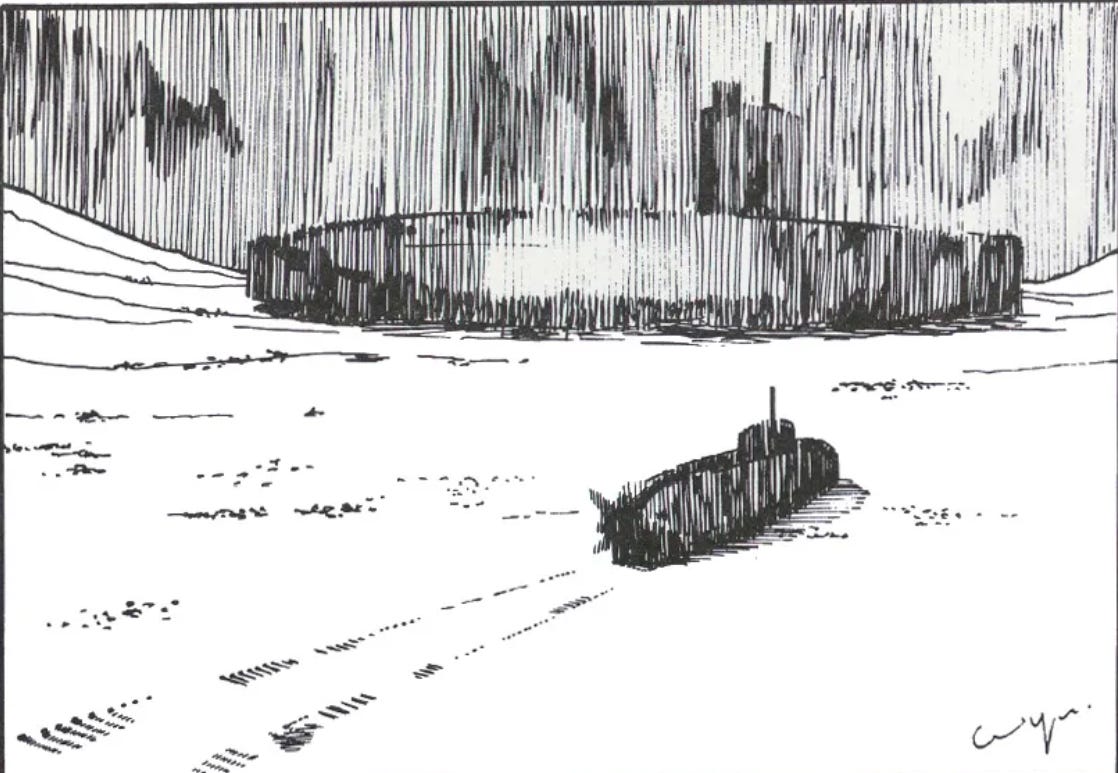
A conning tower would be sighted in some sheet of water near Stockholm. The Navy would descend with helicopters and depth charges. The television would carry daily bulletins from stern men in uniform. The tabloids would run diagrams of Soviet midget submarines creeping between the islands.
 [13]
[13]My older cousin came back from his military service with a story about a neighbouring unit that had supposedly found Soviet frogmen’s badges and an empty tin of Soviet sardines at an abandoned campsite. Every family that owned a summer cottage by the water – hundreds of thousands do – learned to look twice at a moving shadow on the surface. No schnapps party was complete without nervous jokes about Russians in the bay.
And here is the thing that should have made everyone suspicious, and made almost nobody suspicious: in all those years of hunts, with all that ordnance and all those headlines, the Swedish Navy never once brought a foreign submarine to the surface. Never identified one. Never produced a hull, a flag, a sailor. The intruders were ghosts. But ghosts, in Cold War Sweden, had a nationality assigned to them in advance. They were Soviet. The media said so, the opposition said so, and – this is the part that matters – the Swedish Navy said so. Prime Minister Olof Palme, who at first believed his own admirals, slowly stopped being sure.
It is the not-being-sure that drew me in.
The one real submarine, and the lie that grew out of it
There was exactly one genuine, undeniable Soviet intrusion in the whole affair, and it is the key to everything that followed. In October 1981 an actual Soviet submarine – a clapped-out Whiskey-class diesel boat, U-137 – ran aground on a reef deep inside a Swedish military zone near the naval base at Karlskrona. “Whiskey on the Rocks”, the foreign press called it, delighted. The Soviet captain told a transparent string of lies about broken navigation equipment; the Swedish inspectors found the equipment working. It looked, and was treated as, a smoking gun. The Russians were prowling Swedish waters. Q.E.D.
Except that the local fishermen, when an awkward, dissenting Swedish reporter named Ingemar Myhrberg finally bothered to knock on their doors – the Navy never did – were certain it was an accident. The boat had come in on the surface, in full view of radar, with its diesels making, in one witness’s phrase, the racket of two locomotives without silencers. No spy submarine behaves like that. A spy submarine comes in submerged, silent, on its electric motors. The likeliest explanation for U-137 is the dullest: a drunk and incompetent trainee crew took a wrong turning and then lied to save their skins. Other theories claim that the senior officer on board the submarine had secretly been paid by the West to create a scene and embarrassment for the Soviets.2 [14]
But the grounding did something far more useful than any successful spy mission could have done. It planted in every Swedish mind a single, unshakeable assumption: that any submarine in Swedish waters must be Russian. And once that assumption was in place, it could be exploited by anyone with a submarine and a motive. As one of my sources would later put it to me, after U-137 the Soviets had been framed in advance.
Hasselbohm’s heresy
A year after U-137 came the great hunt at Hårsfjärden, in the Stockholm archipelago, right on top of Sweden’s main naval base – and the timing was uncanny. It began in the very weeks Palme returned to power on a pacifist, pro-dialogue platform, just as the rest of Western Europe was lurching rightward into the arms of Reagan and Thatcher. For two weeks the Navy hurled depth charges into the bay in front of the world’s press. It caught nothing.
This was the hunt that Hasselbohm investigated, and what he found is the heart of the story. A senior, frightened naval officer had come to him and said, plainly: “It is not true what the military leadership are saying.” The submarines, the officer believed, were Western. Hasselbohm spent a year talking to divers, captains, engineers, admirals and submarine builders at home and abroad, and he came to a conclusion that would cost him dear: at least one NATO submarine, and probably more, had been at Hårsfjärden.
He also took apart, piece by piece, the supposed forensic proof of Soviet guilt that the official Submarine Defence Commission and its young star, Carl Bildt, had waved at the public. They said the seabed keel-marks proved a Warsaw Pact boat, because “only Warsaw Pact submarines had keels”. A glance at Jane’s Fighting Ships – had any Swedish journalist bothered to look – showed keels on British and French boats, and no keel on the Soviet Whiskey. They said two propellers meant Soviet; British, Dutch and French boats had two propellers too. They said the electronic signals were on Soviet frequencies; the head of Sweden’s own signals-intelligence agency later admitted to the Defence Ministry that no such evidence existed. Every plank of the case pointed, if anything, the other way.
For his trouble Hasselbohm was made to pay. Bildt mocked him in print for “making mountains out of molehills” and, more woundingly, questioned his purpose – the insinuation, never quite stated outright, that a Swedish reporter whose findings pointed west rather than east must be serving some interest other than Sweden’s. He was not driven out: his paper kept him on, posting him abroad, where he spent five years as its Middle East correspondent and three more in Norway. But the submarine story – the one closest to home, and to him – was effectively no longer his, and he knew it. When I met him three decades on he was calm about it, in the way of a man who has had a long time to make his peace, but he wanted me to understand the mechanism. It was not that anyone was ordered to lie. It was that the entire press corps had been flattered, fed and embedded by the Navy at the Berga naval base, and a flattered press does not investigate its hosts. “These were bad days for press freedom in Sweden,” he wrote. They did not feel like bad days. That is the point.
The professor in Oslo
 [15]
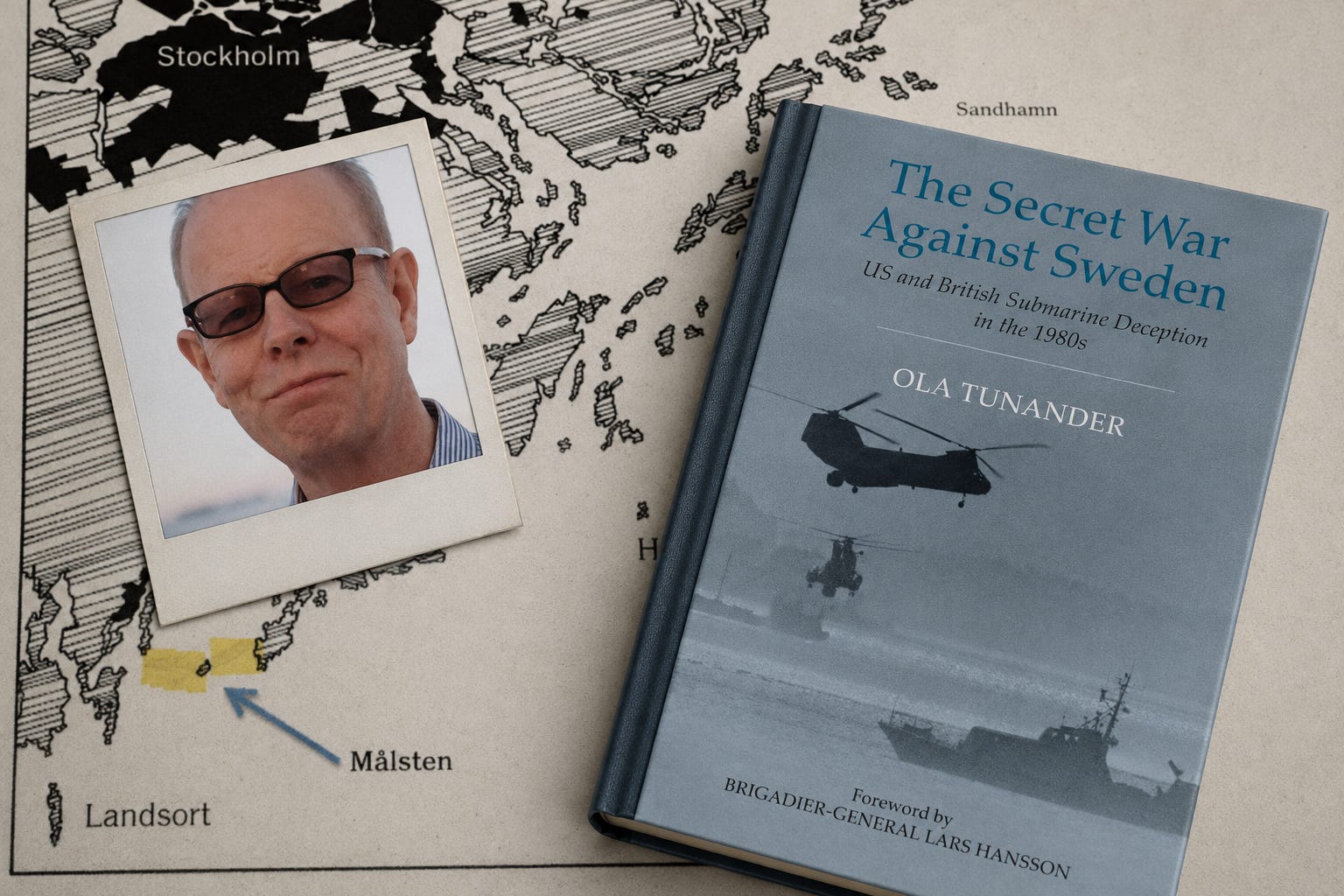
[15]Professor Ola Tunander
Hasselbohm pointed me up the chain to the man who had picked up his fallen baton: Ola Tunander, a Swedish professor at the Peace Research Institute in Oslo. I went to see him too. He looked like central casting’s idea of an absent-minded academic – nervous laugh, spectacles, a rapid blink – and he had spent a career being called a conspiracy theorist by the Swedish naval establishment for saying out loud what Hasselbohm had found.
What I liked about Tunander is that he had been wrong first. As a young scholar he had written the standard textbook stating that the intrusions were Soviet; he had taught it at the US Naval War College and lectured on it at the Pentagon. He came round slowly, and against his own professional interest, which is the opposite of how a crank behaves. The hinge moment, he told me, came in 1993, on a long car ride back from a conference in Norway with James Schlesinger – former US Secretary of Defense, former Director of Central Intelligence. In the loosened, after-dinner mood of old enemies who have outlived their war, Schlesinger admitted to him that a US submarine had been damaged at Hårsfjärden in 1982.
From there Tunander pulled the thread. He talked to British former submarine captains, who told him it was not only the Americans but the Royal Navy, and that British boats were the boldest and most secretive of all. One senior officer said to him, cheerfully, “We had good fun in your waters!” Another, the former fleet commander Admiral James Eberle, looked at him and said, in a tone you could not quite read, “Don’t people fall in front of a bus sometimes?” – and turned his back. Tunander’s reading, after years of work, is that the intrusions were an Anglo-American psychological operation, run with the connivance of a faction inside the Swedish Navy that loathed Palme: a deliberate campaign to terrify the Swedish public, discredit the Soviet Union, and destroy a prime minister who wanted to talk to Moscow rather than fight it.
I could have written all this up as “Swedish professor makes startling claim” and left it there. Plenty of journalists would have. But a claim is only as good as the questions you are willing to put to the other side. So I went to the other side.
I went to London and started knocking on doors
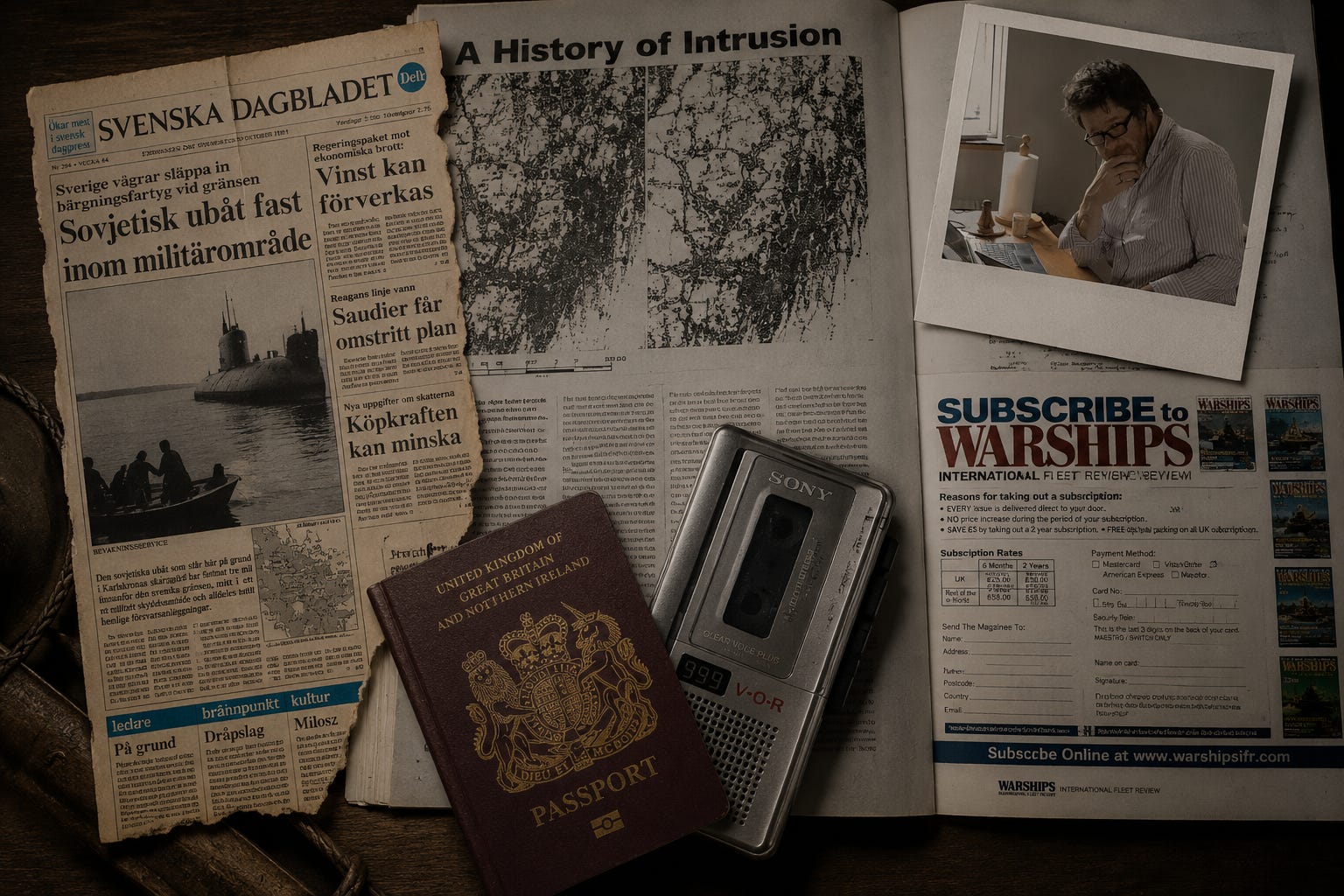 [16]
[16]Yours Truly
I started with the on-the-record admissions, because they already existed and almost nobody in Sweden had taken them seriously. In 2000, Swedish television had interviewed Caspar Weinberger, Reagan’s Secretary of Defense, who said plainly that US submarines had operated in Swedish waters as a matter of “routine, regular, scheduled” testing, with prior agreement. A month later the same programme interviewed Sir Keith Speed, Margaret Thatcher’s Navy Minister, who confirmed it without a flicker: the sort of thing Weinberger described was the sort of thing he, Speed, “was enabling to happen too”. Asked directly whether the testing had been done in Sweden, he said yes. And yes again when pressed.3 [17] The Swedish establishment’s response had been to announce that two senior Anglo-American defence ministers were confused, senile, or misquoted.
So I picked up the telephone and called Sir Keith Speed myself.
He confirmed every word. British submarines, he told me, had operated in Swedish waters under orders from Margaret Thatcher personally. “Every single operation was approved by Margaret Thatcher.” They were, he said, “the most secret operations the UK ever carried out”. When I asked why the Swedish officers kept insisting he and Weinberger had been misquoted, he gave me the truest sentence in this whole saga: “Everyone is trying to cover their backs.”
I tried to reach Thatcher herself; she was ailing, and her office declined. I went to the National Archives at Kew to read the British diplomatic file on Anglo-Swedish relations for 1982 – the very year of the intrusions – and found it withheld. Sit with that.
Routine diplomatic correspondence with a peaceful Nordic neighbour, sealed for national security, decades on. I rang the Ministry of Defence press office to ask about Royal Navy operations to destabilise Sweden, and a cheerful press officer laughed and told me it sounded like “something from a spy movie”. Listen carefully: this is not actually a denial.
I interviewed David Owen, the former Foreign Secretary, in his elegant Mayfair office. He had sat on Palme’s own disarmament commission, in the very year of the intrusions, and he told me the submarines had never once been mentioned around that table – though, he said, they must have hung over it unspoken. Who did he think was behind them? He didn’t know. But he allowed himself a guess: a “rogue MI6 operation”. He gave me a trademark wolfish grin. I have wondered since what Owen meant by a “rogue” operation. In the years of writing about intelligence services that followed, I learned how much work that one word is made to do. Plausible deniability runs in a chain: governments pretend they give no orders to the agencies, and the agencies pretend they give none to their operatives. “Rogue” is the term of art at the end of it – the word that lets a minister disown what was authorised all along. I have come to suspect that the grin meant exactly that: not that the operation had slipped its leash, but that it had been planned from the centre, and that Owen knew it.
I chased the submariners’ own chroniclers. I met Jim Ring, who had written a warm history of the Royal Navy’s Oberon-boat captains, some of whom were said to be Baltic veterans. Over coffee at the British Library he was intrigued and promised to ask his old contacts who had manned the “O-boats”. At our third meeting he asked, “How far have you got?” – and then admitted his sources had given him nothing. “They all said, ‘Not me, guv.’” Perhaps they had told him nothing. Perhaps he had decided not to pass it on, out of love for a service he revered. I emailed the son of the NATO Northern Flank commander whose headquarters in Oslo had overseen the relevant years; he was writing his father’s biography, and his reply tacitly acknowledged the operations while making clear that none of it would be going in the book. Everywhere I went I met the same thing: not denial, exactly, but a soft, clubbable, infinitely polite refusal to let the story breathe.
What happened when I tried to publish
Reporting a story is one thing. Printing it is another, and this is where I learned how the machine actually works – not through censorship, but through the quiet management of what counts as a serious subject.
I placed a careful article in a British naval magazine, Warships IFR, whose editor was genuinely intrigued and who knew, as naval men do, how clannish and secretive the submarine service is. It ran. It sank without a ripple. I wrote a more high-profile piece for the Sunday Times, on Tunander’s work, under the headline “Margaret Thatcher told Navy to raid Swedish coast”. Before it appeared, an ally of Carl Bildt – a man I will call Erik – got in touch to offer me a helpful counter-narrative about Russian intrusions, sourced from his naval contacts.
I knew exactly who he was. He was Bildt’s old mate and fixer, the heavy brought in for delicate PR problems. In the small duck pond of Stockholm, his voice carried the easy authority of a man long accustomed to deference. Carl Bildt had done very well indeed since sitting on that Submarine Commission, as a young MP. He became Prime Minister for one term from 1991-1994 and then a Foreign Minister for two terms from 2006-2014. I knew what taking Erik’s dictation would commit me to: the whole elaborate architecture of the official theory, the improbable miniature submarines, the Soviet octopus – the very picture Bildt had laid before the Royal Swedish Academy of War Sciences, which duly inducted him. By then I knew his method: state a thing with complete confidence and not a shred of evidence, and by the time the contrary case had been gathered, simply brazen it out. He was, in that one narrow respect, a kind of Swedish Boris Johnson. What Erik was offering me was a turn at the same game, and I wanted no part of it.
He rang off in a huff and lobbied the paper to spike the piece. It ran anyway. And then: nothing. No follow-up was commissioned. The story did not “have legs”, as editors say, for the simple reason that nobody with the power to give it legs wished to.
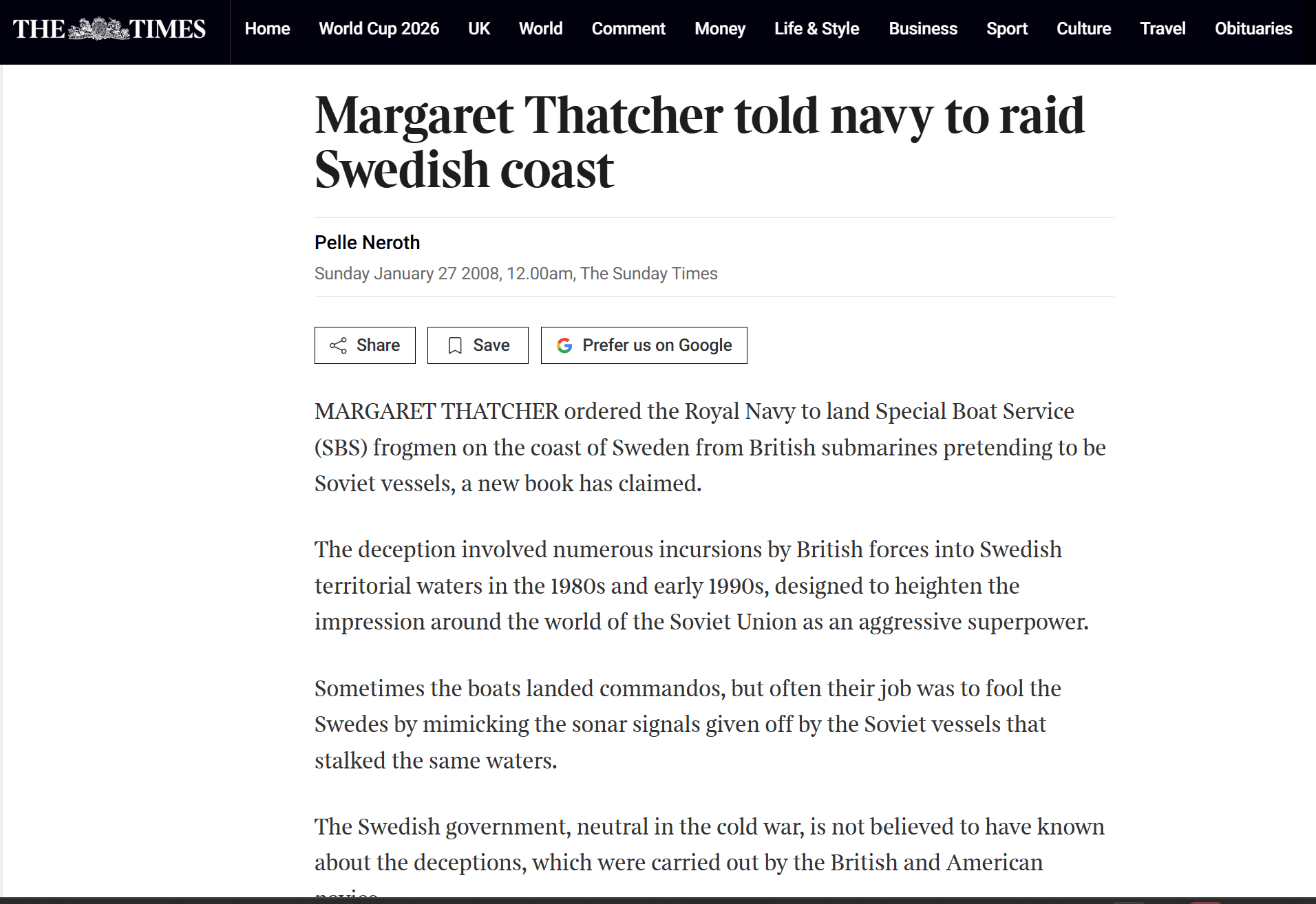 [18]
[18]The article [19]that kicked it all off (by Pelle Neroth Taylor writing as Pelle Neroth)
This is the texture of the thing, and it is worth dwelling on because it is so much more effective than crude suppression. In Sweden, the serving naval officer Göran Wallén, who had publicly branded Tunander an idiot and a conspiracy theorist, declined to be interviewed by me on the grounds that he was “busy decorating the house”. A younger academic colleague had agreed to talk to me; minutes after Wallén’s refusal, he too discovered he was unavailable. Tunander has told me that academic and security journals reject articles on this subject as simply not up for discussion – one editor told him so in 2016, thirty-five years after the events. Conferences on the submarine question at Swedish universities have a way of being cancelled by the administration. Another researcher had a piece pulled at the last minute in a German security journal on “orders from the top”. Incredibly, even a video game on the topic of submarine hunts was cancelled. The young Swedish software team were given some impossible conditions to complete their project and it died. You are never told no. You are told that this is not a serious subject for serious people, and that you would do well to write about something else, and the message is delivered with a smile.
I have come to think this is the most important thing I have to report – more important, even, than the submarines. A free society does not need a censor if its journalists have already agreed, among themselves, what the respectable opinions are. The Swedish press did not have to be told to call the submarines Soviet. They wanted to. It flattered their self-image as plucky little Sweden standing up to the Russian bear, and it spared them the far more uncomfortable thought: that their real patrons, the Americans and the British, might be the ones in the water.
But surely it was the Russians?
Here I have to be fair to the other side, because the other side has a case, and its most respectable version is not a tabloid scare but a book by General Bengt Gustafsson, the man who was Sweden’s Supreme Commander from 1986 to 1994. If anyone was placed to know, he was; and he spent his retirement arguing, at length and with evident sincerity, that the intruders really were Soviet. His case deserves to be put at its strongest before I explain why I think it fails.
It runs like this.4 [20] The Soviet Union plainly had the kit – fleets of midget submarines, some fitted with caterpillar treads for crawling along the seabed, and dedicated naval Spetsnaz and GRU units (the “Delfin” formation, stood up in 1970) whose whole purpose was covert reconnaissance and sabotage against foreign bases. It had the motive – training, intelligence, and the wartime sabotage of NATO’s nuclear and undersea-cable infrastructure. And there is testimony: defectors, a handful of Soviet reservists interviewed on Swedish television in the 1990s, the odd ministerial half-admission that no more submarines would be sent. The grounding of the Whiskey-class U-137 outside Karlskrona in 1981, Gustafsson argues, was no navigational blunder but a deliberate incursion that went wrong. Add the long Russian and German habit of lurking in Swedish skerries through two world wars, and you have a coherent story in which the obvious suspect is also the guilty one.
It is a serious case and I do not wave it away. But notice what it is made of. It is an argument from capability, motive and pattern – they had the means, they had the reasons, it fits – and almost none of it is forensic. There is no recovered hull, no photograph of an intruder in Swedish water, no captured craft save U-137, whose nationality was never in dispute. The physical evidence Gustafsson leans on – the seabed caterpillar tracks, the cut anti-submarine nets – he does not show you; he reports, second-hand, that Swedish forensic scientists distinguished them from anchor-drags, while conceding that much of the relevant material has gone missing. (And caterpillar tracks as such are not determinative of nationality.) He is honest enough to admit that the navy’s underwater recordings were so unreliable that the service eventually realised some of its “submarines” were swimming mink, and honest enough to admit that no commission ever proved the nationality of a single deep intrusion except the one that ran aground. This is a man defending the verdict of the institution he led, against the researcher who accused his own admirals of treason. He is not a neutral witness, and he does not pretend to be.
Which brings me back to the quieter puzzle. If the Soviets really were gadding about the inner archipelago all those years, why, after the Cold War, did not one of them come forward to say so? In the 1990s the old Soviet navy was broke, humiliated and gloriously indiscreet; men sold far darker secrets than this for the price of a dinner. Yet the testimony is thin and second-hand, and the most precise thing anyone on the Western side will say cuts the other way: Bobby Inman, the former deputy director of the CIA, told a Swedish researcher the Soviets breached the twelve-mile limit but never the inner archipelago – the very waters the British boats, by his account, were running around in.5 [21] The dog that does not bark is the Soviet submariner with a story to sell. The men who did, in the end, talk – cheerfully, over coffee, “We had good fun in your waters” – were British.
Why a Great Power would do such a thing
The obvious objection, the one I have heard a hundred times, is: why? Why would the West run a dirty operation against a peaceful, friendly Western democracy?
The answer is that Sweden, under Palme, was not as harmless as it looked, and Palme was not as marginal as the West pretended. In an age when the Reagan administration’s whole project was to defeat the Soviet Union – not coexist with it, not reform it, defeat it – Palme stood for the opposite. He was the last prominent standard-bearer in Western Europe of the policy of dialogue and trade with the East, the policy the West Germans called Ostpolitik. His friend and ally Helmut Schmidt, who carried the same banner in Bonn, had just been levered out of office in the same month Palme returned to power. Palme ran an independent disarmament commission whose ideas, carried into the Kremlin by a Soviet member who became one of Gorbachev’s closest advisers, helped furnish the vocabulary of “common security” that Gorbachev later used to end the Cold War – on terms of reconciliation rather than surrender.
To a certain kind of Cold Warrior, that was the nightmare. Not a Soviet victory, but a Soviet survival – a reformed, humane, social-democratic USSR that could take its place in Europe and remain, indefinitely, a great-power rival to the Anglo-Americans. Palme was the man building the bridge to that future. And Sweden sat on NATO’s strategic northern flank, its long Baltic coast the perfect neutral shield for the Soviet soft north-western Baltic flank the US Navy was, just then, rewriting its war plans to attack in the event of war. A neutral Sweden was excellent for Moscow and a problem for Washington. A Sweden frightened into anti-Soviet hysteria, with its peacenik prime minister discredited and its public clamouring to rearm, was very much better. What London could not abide was never Swedish dialogue with Moscow in itself – plenty of allies traded with the East – but dialogue pursued on Sweden’s own account, without Britain conducting the orchestra.
Submarines were the instrument. You cannot see them; you cannot prove who sent them; and after U-137 everyone already knew, in their bones, that they were Russian. They were, as Tunander put it to me, a way of sending a signal to a whole nation. The signal was: “Be afraid of the Russians.” And it worked beautifully. The Soviets, baffled and furious, denied everything and offered to withdraw every submarine they had from the Baltic; the offer was dismissed as a trick. Palme, against his own better judgment, was forced to hand Moscow a formal protest over an aggression that Moscow claims it never committed. His authority bled away. Six weeks before he was due to fly to Moscow, in February 1986, he was shot dead in a Stockholm street. The murder has never been solved (the 2020 naming of a dead man was overturned in 2025)6 [22]. I make no claim here about who pulled the trigger. I only note that the man who had spent his last years building a bridge the great powers did not want built did not live to cross it.
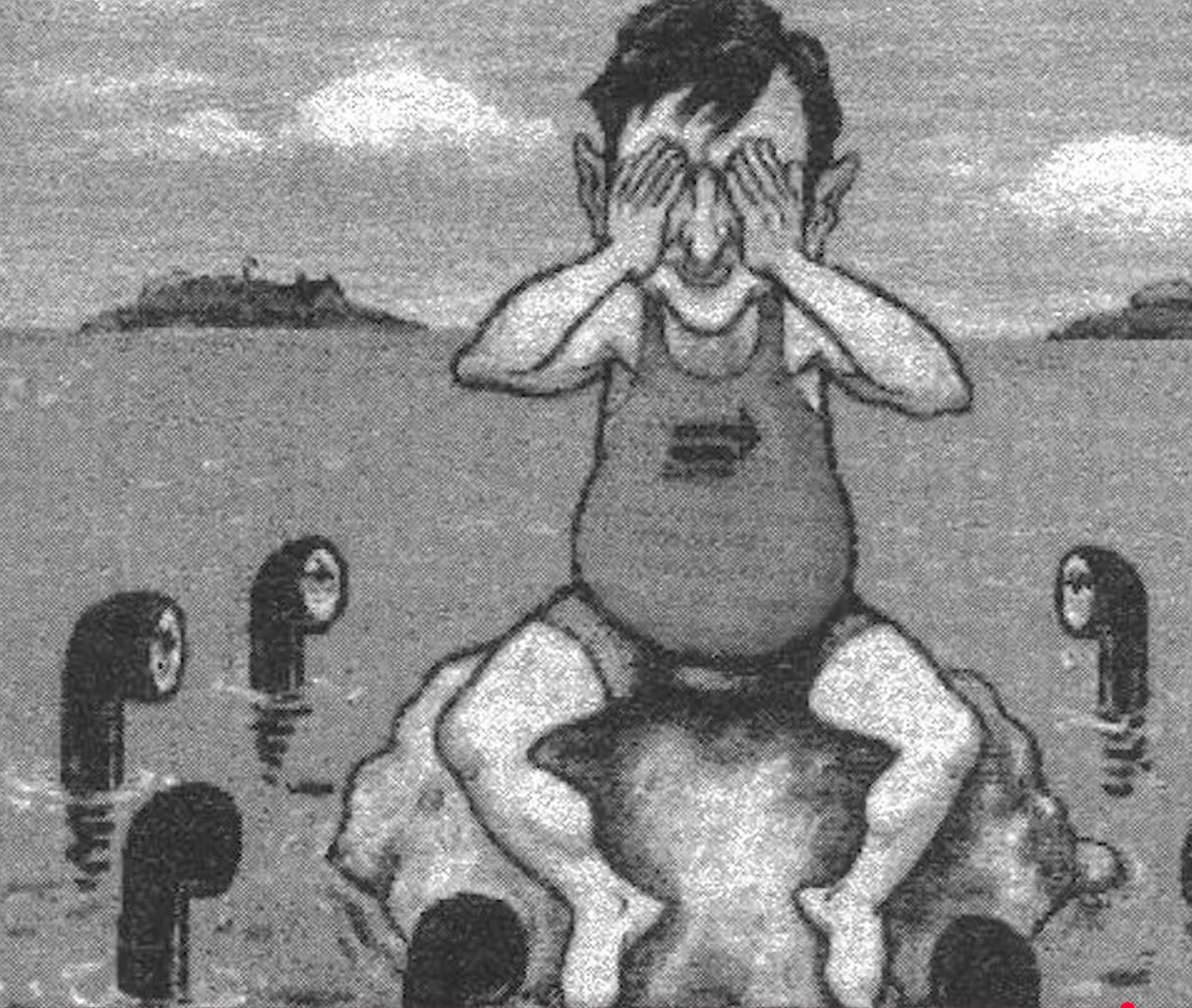 [23]
[23]Olof Palme seen as traitor
The last Household Ghost
Looking back, the whole episode has the shape of a ghost story – and like the best ghost stories its power lay in the fact that you could never quite see the thing in the room with you. I have come to suspect it was something colder than a haunting: a proving ground for the psychological operations of a later age, and the cement of a quiet intimacy between the British and Swedish militaries that survives, unadvertised, to this day. It is how Britain has always handled its smaller partners – soldier to soldier and spy to spy, over the heads of the elected and the independent-minded, who are made to feel naïve for wishing to run their own affairs. If there was to be détente, it would be on London’s and Washington’s terms, or on none.
It helped that Swedes live close to nature, in a vast and thinly peopled country where the dark does much of the work unaided. Their farming ancestors had filled the long winter nights with gnomes and trolls – the household spirit to whom every mislaid object, every good harvest, every scratch at the pane that was only the cat, could be assigned. The Russian submarine was merely the modern tomte: with a benign land turned suddenly malign with intent, the snap of a twig imagined as the first frogman of a Spetsnaz landing. There was no late-night television to talk one down; the broadcast day ended soon after the evening news, and the admirals had the broadcasts at dusk to themselves.
None of it felt quaint to a teenager whose schoolfriends played American football on the beaches outside Malmö, drove themselves to school, listened to Depeche Mode and the Cure and read whatever London’s The Face and i-D youth magazines printed that month – a country, in other words, Californian to its bones and nobody’s satellite. That is the cruelty of it. The submarines that no one ever caught was the great event of my Swedish childhood, an ambient dread like the nearness of death – and it was, I am now certain, conjured.
Why I am telling it here
The mechanism I’ve described – the quiet management of what counts as a serious opinion – is not a Cold War relic. It is how the security state has always operated, and it is alive today in every editorial meeting where a story is gently steered away from inconvenient truths.
I could pretend this is ancient history. It is not. In 2022 Sweden tore up two centuries of neutrality and applied to join NATO, with no referendum, almost no debate, and almost no opposition – a country sleepwalking, it seemed to me, into the very alignment that an earlier generation of Swedes had fought so hard to avoid. Four months later, somebody blew up the Nord Stream pipelines in the Baltic, an act of industrial sabotage against Germany’s economy, and Sweden and Germany conducted the kind of desultory investigation you conduct when you would rather not know the answer. The strong suspicion points west, not east. The pattern is old. A great power consults its own interests, not those of its clients, and the clients are encouraged not to notice.
I am a realist, in the old and unfashionable sense. I think small nations have interests of their own, that peace is generally better than war, that the men who run intelligence services are not wiser or more honest than the rest of us, and that a journalist’s first loyalty is to the reader and not to the club. None of these opinions is welcome in the present climate, in which to question the Western security consensus is to be filed, instantly, under “Kremlin talking points” – the modern version of Carl Bildt’s insinuation against Hasselbohm – the questioning of a man’s purpose when his findings point the wrong way. It is a lazy slander and an effective one, and I have decided to stop being intimidated by it.
So I am writing it here, in the open, where no editor can spike it.
Hasselbohm was eased off the story for telling it, and focused on a career abroad. Tunander has spent thirty years being called a crank for it. The submarines that terrified my childhood were ghosts, and the more I have learned, the more convinced I have become that they were our ghosts – and that the people who conjured them are still, to this day, counting on the rest of us not to look too closely at the water.
NOTE: Pelle Neroth Taylor is a British-Swedish journalist, historian, and documentary filmmaker based in Sweden. He is the author of works on Olof Palme [24] and Dag Hammarskjöld [25] and co-hosts the geopolitics podcast Capitals Uncovered [25]. Subscribe directly to the substack [26].