

By John Helmer, Moscow
@bears_with
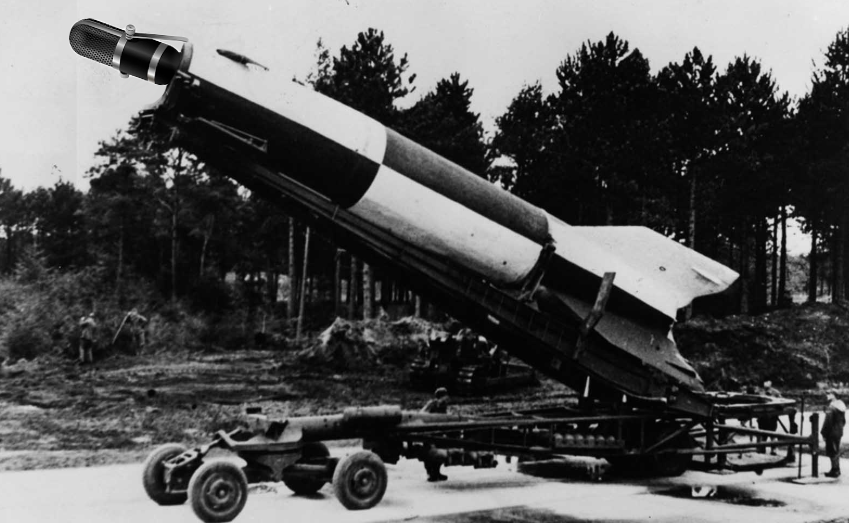
Last week President Vladimir Putin said he believes war propaganda in the media of our time began with Joseph Goebbels.
“As far as the statements by European politicians about their preparations for a war against Russia are concerned,” Putin said on May 29, “that is nonsense. They are allegedly doing this in connection with Russia’s aggressive plans with respect to Western European countries. It is a lie. It is a gross, blatant lie. And as Goebbels once said: the more unbelievable the lie, the quicker people will believe it. These are the very standards guiding Western politicians and mass media in their day-to-day operations…”
Russian journalists, the President added — “as representatives of the media, you are probably ashamed of your colleagues.”
In fact, Goebbels didn’t say in 1941 what Putin attributed to him. Adolf Hitler came closer in Mein Kampf in 1925: “…in the big lie there is always a certain force of credibility; because the broad masses of a nation are always more easily corrupted in the deeper strata of their emotional nature than consciously or voluntarily; and thus in the primitive simplicity of their minds they more readily fall victims to the big lie than the small lie…” This was Hitler’s theory of voter psychology, not his strategy of information warfare.
Also, Goebbels didn’t acknowledge that in the German war in Europe, lying big, lying often, was his and Hitler’s policy. Instead, he said it was Winston Churchill’s technique. “The English follow the principle that when one lies, one should lie big, and stick to it. They keep up their lies, even at the risk of looking ridiculous.”
They were talking about newspapers and radio as mass media. In Putin’s remarks last week, he was including television. Putin does not himself listen to or watch such internet media as podcasts, Telegram and Twitter; instead, he reads compilations and excerpts prepared in staff briefing papers.
But US, British and NATO info-warfighters against Russia are using podcasts as their new media weapon. They have also mobilized the Artificial Intelligence (AI) search engines to ensure that these repeat and reinforce the message that Putin’s truth-telling is itself a lie. A survey this week of AI responses to the question, What evidence is there of loss of confidence in Putin? produced only two Russian opinion polling sources; the rest of the evidence was from NATO-funded and directed English-language media. In short, propaganda.
AI investigation of the sources of loss of confidence in Putin identify only two Russian opinion polling sources – Levada Centre and Russian Public Opinion Research Centre (VTsIOM). The rest of the purported evidence gathered by Grok, ChatGPT, and Deep Seek comes from anti-Russian media, such as Meduza (USAID), Le Monde, Moscow Times (Dutch Foreign Ministry), and Ukrainian media.
This is no accident. All the media, including the AI databases of the media, have been captured by NATO’s cognitive warfare campaign.
“NATO,” reported Steen Sondergaard in a December 2025 paper, “stands on the threshold of advanced disruptive technologies affecting cognition and human life, both during war and peacetime. Understanding the socio-cognitive technical context and integrating emerging disruptive technologies (EDTs) is crucial for NATO’s decision making superiority. NATO must therefore invest in S&T [NATO Science & Technology Organization] to defend Allies against Cognitive Warfare.”
The warfare weapons identified by the research funded by this NATO branch include testing of repetition of what were once called big and little lies, re-formulated as rhetorical patterns, memes, headlines, tweets, and fake news across the internet and social media. “We wanted to see,” announced a Cambridge University study of 2019, “if we could pre-emptively debunk, or ‘pre-bunk’, fake news by exposing people to a weak dose of the methods used to create and spread disinformation, so they have a better understanding of how they might be deceived. This is a version of what psychologists call ‘inoculation theory’, with our game working like a psychological vaccination.’”
Measured success in this testing has had a blowback effect, though. The “vaccination” works to discredit all media, including NATO propaganda. “Efforts to tackle false information through fact-checking or media literacy initiatives increases the public’s skepticism toward ‘fake news’. However, they also breed distrust in genuine, fact-based news sources, a new study using online survey experiments in the US, Poland and Hong Kong shows.”
Another of the blowback effects has been discovered very recently by US researchers of the Association for the Advancement of Artificial Intelligence. They have analyzed 98 popular political podcasts and 4,654 of the guests they featured over a13-month period and over 10,000 hours of podcast transcripts which correspond to the podcast episodes these guests were featured on. They report that podcast hosts and their guests build audiences by polarizing rather than bridging differences of interpretation and opinion on political topics. Bridging on podcasts, they report, works by narrowing the range of topics and limiting the viewpoints which are cued by hosts for discussion with guests.
“While we did not analyze the emotional valence and tenor of these conversations,” the researchers have concluded, “it is of note that research indicates that cross-partisan discussions which center around topics of known agreement tend to reduce affective polarization. It is possible that bridging individuals are able to sustain rapport with those of different ideological bents and possibly decrease affective polarization because they avoid discussing contentious issues.”
This is academic jargon meaning that on the current NATO cognitive warfare battlefield, podcasters inviting guests to disagree with one another don’t bridge the differences of interpretation of their guests or of their audiences. Instead, they avoid these differences — and thus reinforce the fight between NATO and Russia. Podcast audience grows by polarization; it shrinks by co-existence.
A NATO warfighting veteran comments: “As for the sides, I believe they are all, essentially, on the same side. No one wants things to change (as in someone ‘wins’ the war). There’s too much money in keeping the ball rolling. It’s infotainment and subversion, until someone shows up saying ‘difficult’ things like ‘read’, ‘think’ and so on. Then it should be time for the arguing to start. But that doesn’t happen on the podcasts, so I’ve stopped watching them. Besides what I see on technical subjects, I’ve simply stopped watching, while my reading has steadily increased.”
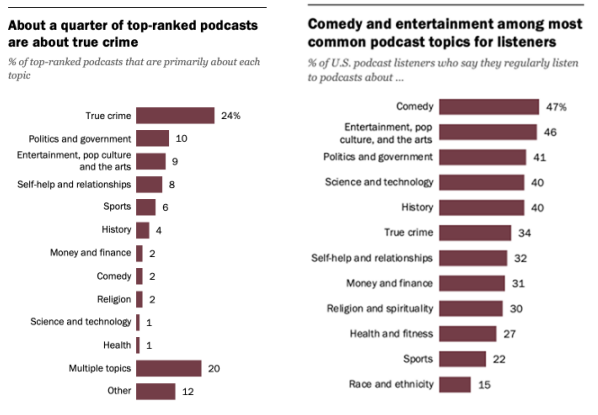
In the available research on the most popular US podcasts and their audiences, political topics trail well behind crime shows, and are almost matched in popularity by entertainment and dating advice. For audience preference, comedy and popstars outrate politics and war.
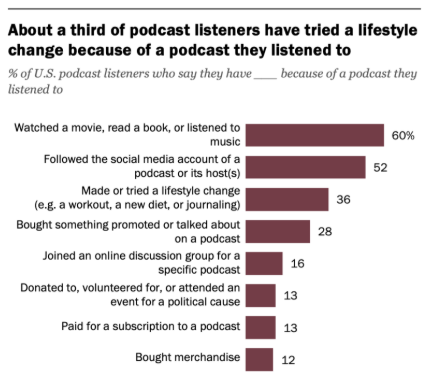
Watching or listening to these podcasts is a socially isolated activity but podcast audiences are most often generated and grow by word of mouth in social networks and between friends. The biggest influence on podcast audiences from what they see or hear is to trigger reading a book, watching a film, or listening to a piece of music. Discussing further the topics introduced in podcasts in online networks or participating in collective political events is much rarer.
In the podcast universe (market) outside Russia, reporting and discussion of public confidence in Putin’s performance have been weaponized by the US, NATO and Ukrainian side.
A Brookings think-tank study of 2023 did not identify or measure the leading podcasts on the pro-Russia side. Instead, “we found the endorsement of pro-Kremlin narratives to be a rare event. When these types of narratives circulated, they primarily did so because they resonated with domestic culture war concerns in the United States, rather than out of sympathy for Russia’s cause in Ukraine…There is a mutation process that occurs with narratives over time, whereby elements of Russian talking points are incorporated into existing domestic conversations, the context evolves, and then the recontextualized narrative is recycled back into Russian propaganda.This feedback loop makes it difficult at times to determine whether some podcasters are endorsing “Russian” narratives or the amalgamized version that is divorced from its original meaning and intent.”
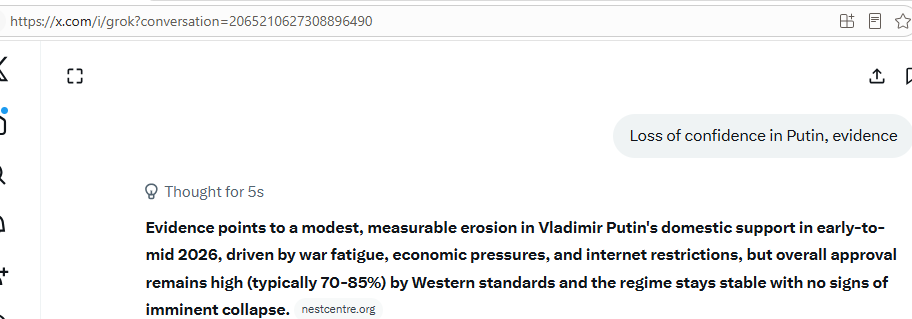
The AI search engines also fail to include the leading pro-Russian podcasts currently drawing US audiences. In a test of Google, Grok, ChatGPT and DeepSeek by asking what is the evidence of loss of confidence in President Putin, the responses were almost identical for all four.
Source: https://x.com/i/grok?conversation=2065210627308896490
The follow-up question asked was — what evidence on the same topic can be found in the podcasts?
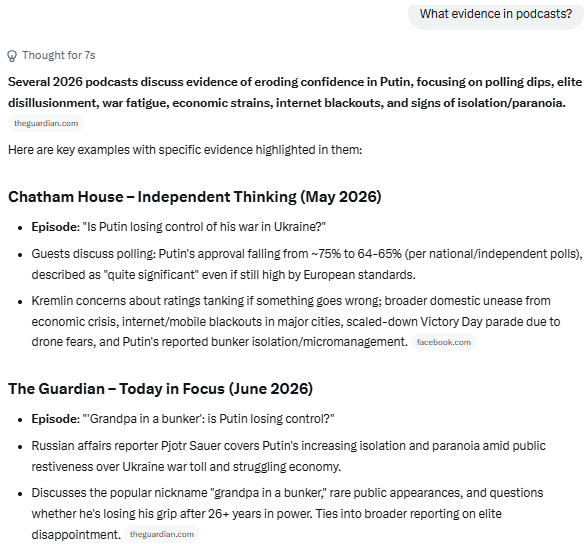
Source: https://x.com/i/grok?conversation=2065210627308896490
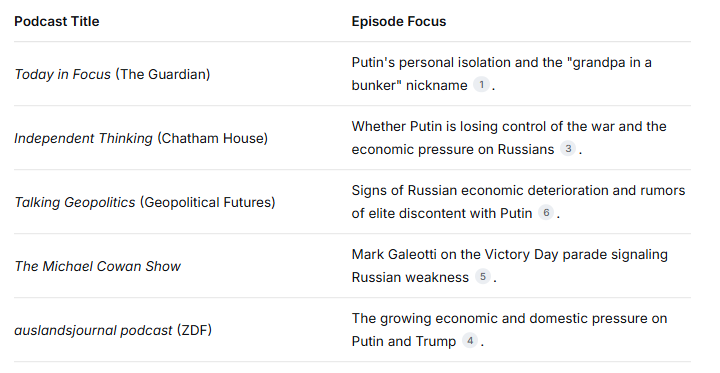
DeepSeek, the Chinese AI machine, reports almost identically. “Based on available evidence from independent polling data, elite insider accounts, and state-controlled metrics, there are multiple indicators that President Putin is experiencing a tangible loss of confidence from both the Russian public and the political elite.”
In fact, the Chinese database sources are not “elite insider accounts” at all; they are not even Russian media. For the Chinese DeepSeek, the media sources are the same anti-Russian ones as the other AI engines – Kiev publications, New York Times, El Pais, Guardian, BNE Intellinews (Berlin). Although the polling of the Moscow pollsters Levada and VTsIOM are cited, none of the AI engines includes them directly in their databases. For this reason, the Chinese database and programming fail to read the Russian analyses of the Russian public opinion data. On this cognitive warfare battlefield, the Chinese turn out to be as anti-Russian as the British and Americans.
This becomes obvious when DeepSeek was asked to identify the podcasts on which it had come to these conclusions:
Source: https://chat.deepseek.com/a/chat/s/6d22d124-fa05-46b8-bb4c-a2105eed2bc5
In Grok’s response to the same question, it identified podcasts from Chatham House, a British government platform, The Guardian, and two US media – ABC News and the Carnegie Endowment.
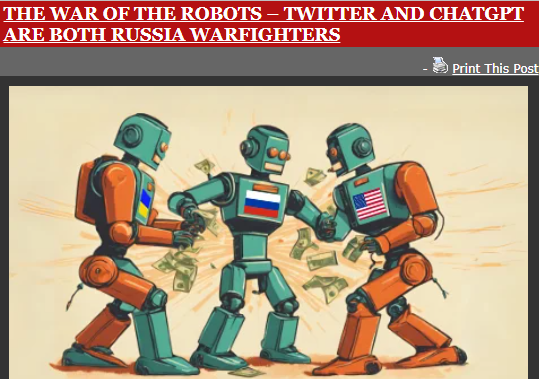
For more on how the AI machines have been captured by the US and NATO, without a Russian counter-attack, read this report:
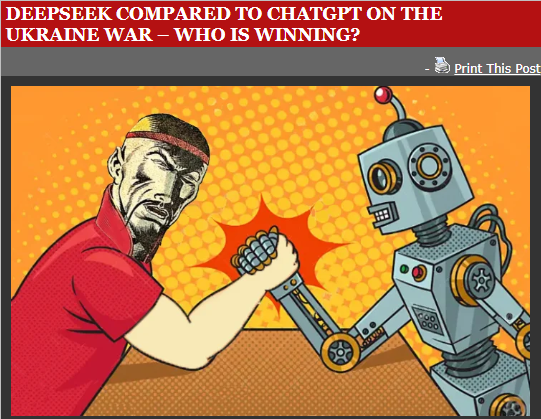
And this one: https://johnhelmer.net/deepseek-compared-to-chatgpt-on-the-ukraine-war-who-is-winning/






Leave a Reply