-  Print This Post

By John Helmer, Moscow
The Ukrainian revolution has been very bad for business in the country. But for Igor Kolomoisky’s Privatbank there has been compensation of almost a billion dollars in state funds: publicly, rival Ukrainian commercial banks call that favouritism; privately, Ukrainian business as usual.
Privatbank is Ukraine’s largest commercial bank. Since the replacement of the Ukrainian Government in February, and the start of the International Monetary Fund’s (IMF) financial aid programme in April, Privatbank has been the largest beneficiary of what the IMF and the Ukrainian Ministry of Finance are calling Emergency Liquidity Assistance (ELA) to the country’s banks. Published measurements of Privatbank’s share of ELA range from 36% to more than 40% of the additional financing which has flowed out of Ukrainian state funds into the commercial banks. Just how much Kolomoisky benefits, along with related companies to which Privatbank lends much of its loan book, is one of the control operations being performed this week, as the IMF’s Ukraine mission starts its first inspection since the IMF transferred $3.2 billion to the National Bank of Ukraine on May 7.
(more…)
by John Helmer - Tuesday, June 24th, 2014
No Comments »
- Print This Post

By John Helmer, Moscow
In March, when he thought it was safe to speak his mind at the Amber Restaurant in Warsaw, Poland’s Foreign Minister Radoslaw (Radek) Sikorski (lead image, left) used a racial expletive to refer to the Polish relationship with the US government, which is so unpleasant, noone outside Poland has been willing to translate it into English. That was on top of an expletive describing what Sikorski said Poland’s metaphorical mouth has been doing with the US government’s metaphorical sexual organ.
Sikorski was talking with Jacek Rostowski; like Sikorski, Rostowski is a British-educated, British national, and a recent finance minister in Donald Tusk’s current Polish government. They were dining just after Crimea had voted to join the Russian Federation, and as the US government announced the first round of sanctions. The tape-recording, which has begun to be published by the Polish weekly Wprost, also reproduces jokes Sikorski told Rostowski, including one about a man with multiple sclerosis who over-exerts himself at a brothel.
(more…)
by John Helmer - Monday, June 23rd, 2014
No Comments »
- Print This Post

By John Helmer, Moscow
In the New York and London markets brokers and bankers explain that they are being discreetly called by US Treasury officials with this message: buying Russian equity or debt paper is legal, but in the event there is a new round of sanctions, it will be illegal to re-sell them, so there can be no profit in Russian assets. The market is calling this campaign “stealth sanctions”. It is an attack on the international market for Russian corporations, and on the international currency and security clearance systems on which the market depends.
According to the highest UK and European courts — reported here on March 25 — the type of formal sanctions which the US and the EU have already introduced are likely to be found illegal, if they are challenged in court. Stealth sanctions are more difficult to substantiate in court -– and also financially much more damaging. Until now, there has been no Russian retaliation for the sanctions, and no litigation.
(more…)
by John Helmer - Friday, June 20th, 2014
No Comments »
- Print This Post

By John Helmer, Moscow
Putting money where the mouth is, the value of Russian artworks has reached a record high this month at auctions of Christie’s, Sotheby’s and MacDougall’s. Bad mouthing by the US State Department daily briefer is cheaper, as the US Government endorses Ukrainian government hate speech in referring to Russians in general as “subhuman”, and the president in particular as a “dickhead”. But for the heads of the Russian art departments at Christie’s and Sotheby’s, neither US sanctions nor the Russophobia of the London press have made any impact on cultural sentiment.
If anything, Russian art buyers are bidding against each other to recover and return to Russia works which have been on the walls of American and European collectors who acquired them before the revolution, or in the fire sales just after. Not exactly for patriotic reasons, Russian art buyers are doing this because they are confident the London market is securing new asset value, ensuring that even in the short run, Russian art will enjoy a lucrative resale price.
(more…)
by John Helmer - Thursday, June 19th, 2014
No Comments »
- Print This Post

By John Helmer, Moscow
Two months after South Africa’s (SA) President Jacob Zuma appeared to drop Russia in favour of a Chinese-American combination for the country’s $50 billion nuclear reactor programme, the head of the SA National Nuclear Regulator, Bismark Tyobeka, appeared in Moscow last week to be favouring the Russian bid over the competition.
Tyobeka, who was attending a nuclear industry convention, AtomExpo-2014, was reported in the Russian press as saying that now that South Africa’s May 7 parliamentary elections are out of the way, Zuma intends to announce his choice for the first two reactors from among the competing bids of China, Russia, South Korea, and France. Tyobeka reportedly was negative towards the Chinese bid, which is coordinated with Westinghouse of the US. “All these countries also have a chance to become the contractor, but the main thing is whether they have sufficient experience of building nuclear power plants abroad. In that sense Russia has the best experience, and its chances [for the procurement award] are very high.”
(more…)
by John Helmer - Wednesday, June 18th, 2014
No Comments »
- Print This Post

By John Helmer, Moscow
Victor Boyarkin, the former lieutenant-colonel of Russian military intelligence and special operations chief for United Company Rusal, returned to the company on Monday after an absence of fifteen months. In Conakry, the capital of Guinea, his arrival is anticipated shortly for a fresh attempt by Oleg Deripaska, Rusal’s chief executive, to relieve new pressure on Rusal to reopen the Friguia (Fria) alumina refinery and bauxite mine, and spend several hundred million dollars committed earlier to investment in Guinea.
The Guinean President, Alpha Conde (image, right foreground), has started to prepare his presidential election campaign for the poll, which is due in less than a year’s time. In Friguia, where Rusal is the principal source of employment, the alumina refinery has been closed since 2012, and according to local sources, the city is “dead. People are starving, and only a heavy military presence can keep things quiet. Conde has nothing to show for his presidency, and unless he can persuade Rusal to reopen the refinery, he must persuade the Russians to make a large compensation to help the city.”
(more…)
by John Helmer - Tuesday, June 17th, 2014
No Comments »
- Print This Post

By John Helmer, Moscow
The holes in Emmental cheese are so characteristic of the Swiss brand, their diameters are officially fixed by the US Food and Drug Administration. The reason for the holes is that in fabrication of the cheese, the addition of the Propionibacterium shermani causes the release of carbon dioxide. When the wheels of emmental are broken, the bubbles burst, leaving behind the holes. The Swiss call it the jolly bacterium (P. freudenreichii).
Didier Burkhalter, President of Switzerland, and also Chairperson-in-Office (CiO) of the Organization for Security and Cooperation in Europe (OSCE), hasn’t been feeling so freudenreich lately with these two titles, whose tenures run out, both of them, on December 31.
(more…)
by John Helmer - Monday, June 16th, 2014
No Comments »
- Print This Post

By John Helmer, Moscow
Backstage at the Theatre du Chatelet on May 9, 1909, the curtain had come down on Vatslav Nijinsky’s performance of the Polovtsian Dances, an adaptation to Alexander Borodin’s music of the Tatar warrior dance. The Tatars flaunt their prowess, and their alluring slave girls, before their captive, the defeated Prince Igor. He’s in a low-libido Slavic mood, dismissing the Khan’s offer of his choice of the girls, or boys. The last words the chorus sings to Igor are: “There is more freedom for you there, song…And so, fly away!”
Nijinsky was asked by a visitor if it was difficult to stay in the air during his stage jumps. “No, no. Not difficult,” he answered. “You just have to go up and then pause a little up there.”
by John Helmer - Wednesday, June 11th, 2014
No Comments »
- Print This Post
By John Helmer, Moscow
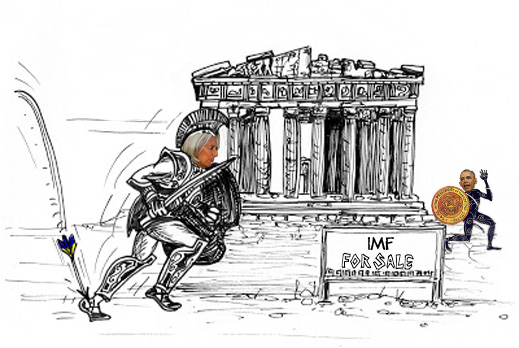
The International Monetary Fund’s senior officials have known that Stepan Kubiv, Governor of the National Bank of Ukraine, was removed six years ago for his involvement in a massive bank loss and loan diversion, when Kubiv was in charge of Kredobank, a west Ukrainian bank owned by PKO Bank Polski, the leading bank of Poland. The affair cost Bank Polski at least $350 million in 2008 and 2009. Another $144 million was provided by Bank Polski to save Kredobank from insolvency. At the time, Kubiv’s management performance led to his replacement by the chief executive of Bank Polski, Jerzy Pruski. The bank scandal was discussed officially, Bank Polski has reported, with the National Bank of Ukraine (NBU) and with the Central Bank of Poland.
The Kubiv dossier resurfaced in Warsaw after February 24, when Kubiv was named by the new Ukrainian Government to head the National Bank of Ukraine (NBU). In that role, Kubiv has been identified by the head of the IMF Ukraine Mission, Nikolay Gueorguiev, as the key Ukrainian official, under President Petro Poroshenko, who will decide what audits will be conducted of Ukraine’s commercial banks, and how much IMF money will be requested to bail them out.
(more…)
by John Helmer - Monday, June 9th, 2014
No Comments »
- Print This Post
By John Helmer, Moscow
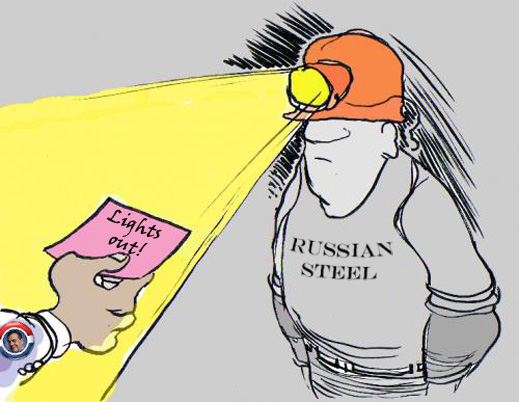
Last year Russia’s six major steelmakers cut 33,500 jobs from their payrolls, because, they explain, they are struggling to reduce losses and cut bank debt. That amounted to a loss of almost one in ten jobs in the Russian steel sector. At the end of 2013, the headcount of steelworkers was 355,900, down 9.4% from 2012.
Government officials and sector analysts acknowledge that five years ago during the collapse in steel trade in the last months of 2008 and first half of 2009, such a job cull would have been impossible because the Kremlin warned the mill proprietors against mass layoffs. Magnitogorsk Metallurgical Combine (MMK) announced it was reducing its steel output by 15% in October 2009 after earlier claiming the cutback would be 25%. Alexander Mastruev, head of personnel at MMK, said at the time: “It is not necessary to dramatise the situation, and to panic.” MMK was considering a furlough of employees, not dismissal and job cuts, he added. At Mechel, it was claimed at the time there was no plan to review production plans “for now” but the length of the working day might be cut. According to Mechel, “we are making all effort to save all working places and our employees.”
(more…)
by John Helmer - Monday, June 9th, 2014
No Comments »