Estonian politics are being turned upside down because of a leaked report into the diversion of defence spending.
The timing is not an unlucky coincidence. It is the result of the country’s leaders claiming kudos for leading the NATO alliance in lifting the military proportion of their Gross Domestic Product (GDP) from 3.4% to 5.4%.
This increase was enacted in April when the Estonian government and parliament approved a four-year €2.8 billion additional defence funding bill in order to meet the NATO target dictated by President Donald Trump. The increased spending will lift Estonia from the 19th rank of the global defence/GDP ratio, four ranks behind Poland (4.15% as of 2024 ) and one rank behind the US (3.42%), to lead the NATO member states.
“I really, from this podium, in this building, want to applaud your leadership on meeting the five percent defense spending target, not years down the road but in all of your countries in 2026,” US Defense Secretary Peter Hegseth announced at a Pentagon meeting with Hanno Pevkur, the Estonian defense minister on July 25; beside Pevkur were his Latvian and Lithuanian counterparts. “It underscores your dedication to the Alliance’s security and sets a very clear example for others to follow.”
Pevkur replied: “Our meeting today is a testimony to the strong and trusted partnership between the Baltic States and the United States…We stand up for one another and we defend each other when it’s needed. This is what brotherhood in arms truly means.”
In the Estonian language, that last sentence of Pevkur’s means brother’s hands in each other’s pockets.
According to official announcements in Tallinn late last month, Pevkur has agreed to spend $4.73 billion on new US HIMARS artillery systems and ammunition. More than €10 billion ($12 billion) in defence spending is now planned for the four-year period, 2026-2029. The Estonian media report that “procurement accounts for 37 percent of the budget, ammunition for 25 percent, personnel costs for 14 percent, operating expenses for 13 percent, intelligence and early warning for 3 percent, support for the Defense League [citizen mobilisation] for 3 percent and infrastructure investments for 5 percent.”
More than half of this total is expected to go directly to the US military-industrial complex and a Ukraine-sized percentage of 10% to 15% return to Estonian middlemen as commissions. US and European military companies are also being invited to invest in new production of weapons and security technology in Estonia itself. “Estonia also plans,” the government says, “to invest €50 million in defence industry and innovation, including the establishment of a Future Capabilities and Innovation Command and a new defence industry park in Pärnu County.” The list of Russia warfighting allies to supply – sell to Tallin — was published in this Estonian government report, issued before the Trump increase was implemented.
This is the greatest boondoggle in the history of Estonia since the country pinned its hopes on Adolf Hitler and German military investment between 1941 and 1944.
Since Chrystia Freeland (lead image) was dismissed from her Canadian Cabinet ministry on September 16, she has become the “Special Representative for the Reconstruction of Ukraine.” This is a camouflage uniform.
According to the official filing in parliament on November 5 by the Privy Council Office (PCO) on behalf of Canadian Prime Minister Mark Carney, Freeland has no staff for her post, no office, no budget, no travel expenses, and a pay cut of $79,700. The Privy Council Office, reporting to the House of Commons, says it has “searched its financial records and did not find any costs, start-up or otherwise, related to the role of the Special Representative for the Reconstruction of Ukraine.”
As the longest-serving warfighter against Russia in Canadian government, Freeland is now a full-fledged foreign mercenary on the Ukraine battlefield.
For the time being, the Trump Administration has put its strategy for regime change by obliteration on hold in Iran and Venezuela, where Russian-backed defences are increasingly deterring and US voters hostile. Instead, as Trump has signalled himself, the US is focusing instead on covert operations with the same goal – kill targets, topple resistance, risk no US military casualties, make money.
“Sometimes people have to fight it out a little bit longer,” Trump said last week of the war in the Ukraine as he abandoned his demand that President Vladimir Putin accept an immediate ceasefire.
“I don’t think we’re going to necessarily ask for a declaration of war,” Trump had said of his campaign against Venezuela on October 23. “We’re just gonna kill people that are bringing drugs into our country, OK. We’re gonna kill them. You know, like they’re gonna be, like, dead.”
“The US is not currently planning to launch strikes inside Venezuela and doesn’t have a legal justification that would support attacks against any land targets right now, according to sources familiar with the briefing conducted by Secretary of State Marco Rubio, Defense Secretary Pete Hegseth and an official from the White House’s Office of Legal Counsel.”
The Trump officials were responding to the joint House and Senate resolution, introduced on October 16, ordering “the removal of United States Armed Forces from hostilities within or against Venezuela that have not been authorized by Congress.” The text declared as a finding that Trump had issued an “authorization for the Central Intelligence Agency to conduct covert lethal operations within Venezuela”. There was no objection to this, nor was there a finding that Venezuela did not pose a threat to the US. Instead, the resolution declared that under the war powers provision of the Constitution, Congress should decide “the question of whether United States forces should be engaged in hostilities within or against Venezuela should be answered following a full briefing to Congress and the American public of the issues at stake, a public debate in Congress, and a congressional vote as contemplated by the Constitution.”
Covert operations could continue without any of that, but if land targets were to be attacked, that would require “full briefing” in Congress and the press, public debate, and a vote. If Trump attacked with the naval, air and Marine forces currently in the Caribbean, Congress proposed to stop the money.
To head off this direct challenge, Rubio, Hegseth, and a White House lawyer promised to stick to covert operations against President Nicolas Maduro, and restrict military operations to alleged drug-running at sea. On November 6 the resolution drew 49 Senate votes, but it was defeated by a majority of two, 51 to 49.
“The Trump administration is seeking a separate legal opinion from the Justice Department that would provide a justification for launching strikes against land targets without needing to ask Congress to authorize military force, though no decisions have been made yet to move forward with an attack inside the country, a US official said. ‘What is true one day may very well not be the next,’ said that US official when discussing the current state of the policy, pointing out that Trump has not decided how he will handle Venezuela.” Trump was uncharacteristically silent in his press gaggles and tweets after the Senate vote on November 6. He has reverted to covert operations against “drug cartels”; for details click here and here.
This is not the first time in Trump history that he has been compelled to retreat by greater force than he dares to risk engaging directly. The sustained crowd booing against Trump in Landover, Maryland, on November 9 shows that the smokescreen is also failing. Click to listen.
In the new podcast with Nima Alkhorshid, the discussion focuses first on Trump’s covert operations goals in Syria, following the Washington visit of acting Syrian President Ahmed Al-Sharaa (Al-Jolani); in the Ukraine, as threats to the Zelensky regime mount on the battlefield and in the Kiev government itself; and in India, following a terror group bombing in the centre of Delhi, as the Indian Government prepares for President Putin’s visit on December 6.
In the last segment, we discuss the only covert US operation for regime change for which the White House has explicitly apologized*, and then continued to implement – so successfully that no further US intervention has been needed because the government is totally subservient. This is Australia on the 50th anniversary of the November 11, 1975, dismissal of the Australian Labor Party government of Gough Whitlam, followed by the 1977 plot to appoint a new head of state, Governor-General Zelman Cowen.
Russians are crying over the milk they can no longer afford to buy. The reason is that their income isn’t keeping up with the rapid rise in the price of milk, butter, and cheese.
Elvira Nabiullina (lead image, left), Governor of the Central Bank of Russia (CBR), is to blame.
The explanation, according to the National Association of Milk Producers (Soyuzmoloko) and dairy industry experts, is that Nabiullina’s policy of keeping the CBR’s key interest rate high is driving the economy into loss of demand and supply, falling investment, output and income, and at the same time rising prices combining altogether into a recession spiral.
“A slight reduction in the interest rate in question will not solve the problems in the industry,” says Sergei Blum, chief executive of Agromilk, publisher of the industry bible Dairy News. “The profitability of milk production has dropped significantly, and the current rate, which is essentially prohibitive, cannot affect this in any way. At a rate of 10%-11%, we will see stagnation in the industry. Recovery is possible only between 5% and 7%. The current level of the key rate has had a very negative impact on the leasing market, as well as on the secondary market of [used] agricultural machinery. Obviously, no one will give much clarity about how the key rate will change — this is not practiced anywhere in the world.”
In fact, accompanying the October 24 reduction of the key rate to 16.5%, Nabiullina issued CBR forecasts for three years – stagnation this year, and in 2026-27 recession with negative GDP growth rates between 2.5% and 3.5%. “The upward deviation of the Russian economy from a balanced growth path is narrowing,” Nabiullina reported this euphemistically and then admitted the truth. “The Russian economy’s potential and its growth rates will both decline. GDP will be contracting during two years. A significant decline in supply will be fuelling inflation.”
In the farmyard, at the dairy, and on the grocery store shelves, what this means is the slaughter of more cows, lower production of raw milk, higher processing costs, jumping retail prices, growing stocks of unsold products. They are not combining to reduce price inflation, as Nabiullina insists her monetary policy must do.
Instead, this is the recession which Russia should have, as Nabiullina’s protégée and former first deputy governor of the CBR, Ksenia Yudaeva, has assured the US Treasury and the Executive Board of the International Monetary Fund (IMF) since November of last year, when Nabiullina sent her to Washington to fill Russia’s IMF seat. In April 2022 the Treasury sanctioned Yudaeva; Nabiullina wasn’t sanctioned until five months later in September 2022. Now, however, Yudaeva is the highest ranking Russian Government official to enjoy US sanctions relief.
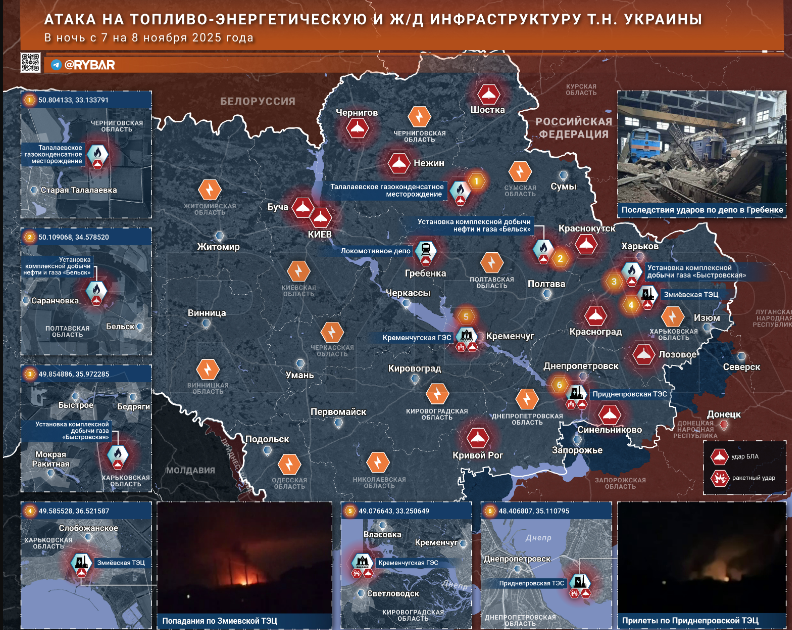
Over the last three days the General Staff’s electric war strikes have continued to intensify on their targets and extend right across the Ukraine, with local utility companies announcing blackouts from Kharkov in the east to the western regions (lead image).
In itemizing the targets on the map, Mikhail Zvinchuk, chief of the Rybarmilitary blog, reported that “Ukrainian sources stated that the night raid on gas production and processing facilities was the largest since the start of the special military operation. This is indirectly confirmed by the estimated number of munitions fired. The gas infrastructure in the east…has already been the target of massive attacks multiple times and has suffered significant damage. Therefore, it is quite likely that the consequences of the new raid could indeed be very severe for the enemy. It is also worth noting that the Russian Armed Forces have concentrated on sensitive nodes of electricity generation and transit of the enemy. On November 8, the state company Centrenergo announced the shutdown of all thermal power plants in the country.”
“Contrary to fears,” Zvinchuk commented, “the campaign of strikes on the fuel and energy complex of the so-called Ukraine is only gaining momentum.” He means that Russian military analysts are well aware and are now reporting that since the electric war campaign first began in October 2022, the number of strikes has been limited in duration, firepower, and damage effected, and the momentum of the campaign stopped short.
But not this time, military sources in Moscow believe.
Some of the sources have claimed the General Staff did not have the capacities to fully implement the electric war in the first two years, and that they still need more time and more resources to sustain the momentum to achieve the full countrywide blackout they are aiming at. Click to read the archive of the campaign here. For an all-source timeline, read this.
Other sources believe the military resources, logistics pipeline, targeting intelligence, and weapons accuracy and survivability were not as available to the General Staff in October 2022 when the campaign began, as they have been since October of this year — and this is the reason momentum has been suspended in each of the earlier years.
One source says that President Vladimir Putin imposed restrictions on the extent and duration of the campaign but gradually he has been persuaded to relax them; although even now, the source points out, the Defense Ministry’s daily bulletin continues reporting the electric war strikes, not as war strategy but as tit-for-tat operations responding to Ukrainian “terrorism” – that is, Ukraine drone and missile attacks on civilian infrastructure in the Russian hinterland. “In response to the terrorist attacks by Ukraine on civilian targets in Russia, from November 1 to November 7,” the Ministry bulletin announced on Saturday, “the Armed Forces of the Russian Federation carried out seven group strikes with precision weapons, as well as unmanned aerial vehicles, as a result of which enterprises of the military industry of Ukraine and facilities of the gas and energy complex that provided their work, the transport infrastructure used in in the interests of the Armed Forces of Ukraine…”
A source in a position to know says the restrictions on the electric war have been political, not military, and for the time being Putin appears to have lifted them.
“I have a tough time believing that the General Staff did not have the intelligence, let alone the weapons accuracy and survivability necessary to prosecute the electric war from the start,” the source comments. “First, as the vast majority of the Ukrainian electrical grid, especially the 750kV backbone, was, and still is, more than fifty years old, Soviet-era equipment. Information on the Ukrainian electrical generation, transmission, and distribution network was, and still is, widely available in open source. There is no way that the electrical or civil engineers employed by the General Staff could not know what to target and what firepower was necessary. In terms of weapons, the Russian forces had then, as they do now, stocks of cruise, ballistic, and other air-dropped weapons, not to mention sabotage capabilities, to destroy the critical Ukrainian electrical nodes. There are approximately 35 major Ukrainian substations — so again, the available information for targeting is open source. Looking at the data provided in these sources, the General Staff have had more than enough ordnance to take them all out. They didn’t. Moving forward from this line of thinking, I am curious to know why Ukrainian electrical laydowns [storage areas] and service vehicles have not been targeted. Are we to assume these could not be seen? This defies rudimentary understanding of enemy logistic and repair capabilities. Quite obviously, the delay to date in achieving the complete collapse of the Ukrainian grid was and is the product of political decision-making, not any lack of capability on the Russian military’s part.”
The new frankness from the Moscow sources follows what they believe to be language from President Donald Trump encouraging the Kremlin to speed up its military operations. “Sometimes people have to fight it out a little bit longer,” Trump told Hungarian Prime Minister Victor Orban last Friday, “ but I think we agree that the war is going to end in the not too distant future.” At their meeting, Trump said his phrase, “not too distant future”, three times over.
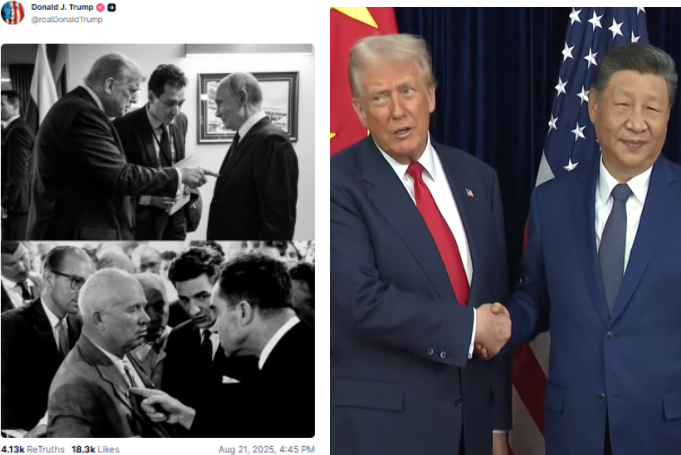
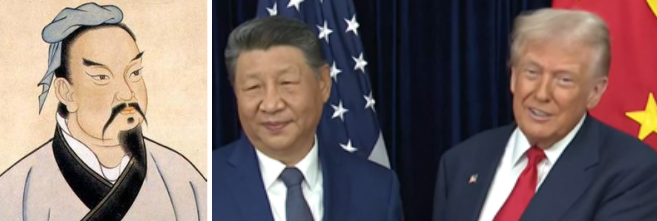
Did Xi Jinping demonstrate escalation dominance over Donald Trump at their meeting in Busan on October 30 (lead image, right) in a way which Vladimir Putin failed to do with Trump at their meeting in Anchorage on August 15? Has the Zhongnanhai strategy been more effective in deterring US escalation of trade war and of military measures against China than the Kremlin strategy has managed against the US and NATO?
Listen to the new podcast with Nima Alkhorshid for the answers which aren’t publicly acknowledged but vigorously debated in private in Moscow, Beijing, and Washington.
Question: Did a new RAND report recommending the US moderate its escalating conflict with China influence President Donald Trump’s backdown in Busan? Answer: No.
Question: Does the Russian escalation of words in defence of Venezuela and the Chinese silence deter Trump from launching his plan to kill Nicolás Maduro?Answer: not much.
Question: Do the hacked emails between Jeffrey Epstein and former Israeli prime minister and defense minister Ehud Barak reveal untold influence on the Kremlin? Answer: Not likely.
Question: Does Russian Central Bank Governor Elvira Nabiullina hold President Vladimir Putin’s purse strings to finance the war? Answer: Yes.
ByStanislas Balcerac, Warsaw, translated and annotated by John Helmer @bears_with
In the one hundred-year old Czech satire of the simpleminded conscript in the Austro-Hungarian army of World War I, Jaroslav Hasek’s hero, the good soldier Schweik, has come to display through his stupidity what the Czechs today say goes “further in defining the Czechs in the 20th century than perhaps anyone else.”
Thinking aloud, Schweik says things like: “All along the line, everything in the army stinks of rottenness. Up till now the wide-eyed masses haven’t woken up to it. With goggling eyes they let themselves be made into mincemeat and then when they’re struck by a bullet they just whisper, ‘Mummy!’ Heroes don’t exist, only cattle for the slaughter and the butchers in the general staffs. But in the end everybody will mutiny and there will be a fine shambles. Long live the army! Goodnight!” That last line wasn’t wishful thinking. It was sarcasm and satire of the propaganda of 1921.
The Czechs are still kidding themselves: when it comes to fighting their war against Russia, Schweik is no longer a conscript private, he’s a well-paid volunteer General Staff officer commuting between Prague, Rzeszów, and Lvov.
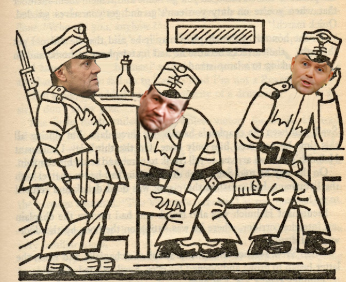
In Poland today, ruled by the Civic Coalition (formerly Civic Platform, Platforma Obywatelska, PO) party of Prime Minister Donald Tusk and Foreign Minister Radosław Sikorski (lead images, left and centre), there is no shortage of propaganda from them; no lack of satirical laughter at what they say. The more of that there is, however, the more desperately Tusk and Sikorski crave attention, especially abroad where the dynamics of Polish politics are unknown and both of them ignored.
The good soldier Tusk says things like: “We must be aware that this is our war, because the war in Ukraine is only part of this ghastly project that appears in the world from time to time. And the goal of this political project is always the same. How to enslave nations, how to take away freedom from individual people, what to do to make authoritarianism, despotism, cruelty, lack of human rights triumph. If we lose this war, the consequences will affect not only our generation, but also future generations. In Poland, throughout Europe, in the United States, everywhere in the world.”
Bad joke — cue recorded applause, spontaneous laughter.
In a conversation lasting one hour and forty minutes according to the Chinese stopwatch– “a long meeting” on President Donald Trump’s clock — President Xi Jinping first knocked the stuffing out of Trump’s warmaking threats, then forced him to beat a retreat behind a 12-month ceasefire with the man the Pentagon has designated its principal enemy but whom Trump praised effusively as “a great leader, great leader of a very powerful, very strong country…a tremendous leader of a very powerful country and I give great respect to him.”
“Uh,” Trump told reporters on board his aircraft as it rocked in crosswinds flying eastward, “a lot of things we discussed in great detail. A lot of things we brought to finalization. A lot of finalization.” This was false.
Worse for the Trump warfighting strategy, the Chinese have retained escalation dominance by making Trump’s concessions their pre-condition for China’s temporary suspension of their sanctions on rare earths exports and imports of US computer chips. For this, Xi offered to buy US soybeans slowly for $34.2 billion over four years – roughly half in tonnage, half in price over twice the interval that China had agreed to in the past.
In General Sun Tzu’s ancient manual for warfighting, “the supreme art of war is to subdue the enemy without fighting”. The old man also confessed his limitation: “there is an intelligent way to eat a live frog – I just don’t know what it is.” Xi just demonstrated the way to do it. Trump went down smiling.
Xi has not yet telephoned President Vladimir Putin to brief him on what happened. After Putin’s meeting with Trump in Alaska on August 6, Putin telephoned Xi on August 8. “So far,” said Putin’s spokesman Dmitry Peskov, ”there is no such conversation in the schedule, but it can be quickly agreed upon if necessary,”
The Russian state media have interpreted the outcome of the talks to be a “temporary ceasefire” achieved by not discussing the key economic and territorial war issues at all. “There have been no joint statements yet,” Tass noted, “and some of the most important issues of bilateral relations, such as Nvidia chips and advanced products, have remained unresolved.” Nothing was achieved, the official Moscow commentators think, in the US attempt to split Xi from Putin, and secure Chinese pressure on Russia to end the Ukraine war on US and NATO terms. “Ukraine came up, uh, very strongly,” Trump told reporters as he flew back to Washington. “We talked about it for a long time and we’re both gonna work together to see if we can get something done. Uh, we agreed the, the sides there, you know, locked in, fighting, and sometimes you have to let him fight, I guess. Crazy. But he’s gonna help us and we’re gonna work together on Ukraine.”
The Russian state media have yet to notice that Trump is abandoning his attempt, through the Rosneft and LUKOil oil trade sanctions of October 25, to stop China buying Russian oil. “There’s not a lot more we can do,” Trump replied to a reporter who asked if he and Xi had discussed his threat to sanction Chinese companies for buying Russian crude oil and petroleum products. “Uh, you know, he’s been buying oil from Russia for a long time. It takes care of a, a big part of China. And, you know, I, I can say India’s been very good, good on that, uh, front. Uh, but, uh, we, we didn’t really discuss the oil. We discussed working together to see if we could get that war finished. You know, it doesn’t affect China.”
The four-term (2013-2027) Governor of the Central Bank of Russia (CBR), Elvira Nabiullina, has assured the State Duma this week that the biggest enemy Russia faces is not the combined military and economic forces of the US and NATO, but over-heating in the domestic economy as it mobilizes to defend itself.
That, Nabiullina said, is not the impact of drone, missile, and bomb attacks on Russian targets inside the country, at sea, and along Russia’s international oil and gas pipelines; nor of the sanctions aimed at destroying Russian exports of energy, Russian tankers, and the fleet’s access to world markets through the Danish Straits, the Suez Canal, and the Bosphorus.
In Nabiullina’s report of her strategy for 2026-2028, drafted last month and released on October 27, the words “war” and “defence” are not mentioned. The only “geopolitical conditions” the CBR report acknowledges are “deglobalisation processes” and “new sanctions and second-round effects of enacted sanctions”. About them, Nabiullina and her advisors have concluded that the Trump Administration’s “tighter sanctions will lead to an increase in the discount for Russian exports as well as a moderate decline in oil production and exports. Oil prices will notably drop in 2026 and will not bounce back to the level of the baseline scenario even by the end of the forecast horizon.”
The forecast of the CBR, the report says, is that “if the world economy faces a financial crisis in 2026 and sanction pressure increases, the Russian economy’s potential and its growth rates will both decline. GDP will be contracting during two years. A significant decline in supply will be fuelling inflation. Fiscal policy is assumed to prop up the economy owing to a structural primary deficit. To offset a reduction in oil and gas revenues, the economy will be extensively using the resources of the National Wealth Fund, which involves the risk of depletion of its liquid part as of the end of 2026.” Nabiullina’s response, the report concludes, will be to fight the sanctions war by raising the Central Bank’s key rate from 16.5%, as it was fixed last week, to between 18% and 20%. “To prevent inflation from spiralling out of control, the Bank of Russia will be forced to pursue tighter monetary policy in 2026–2027. This will decelerate inflation to 4.0–4.5% in 2028.”
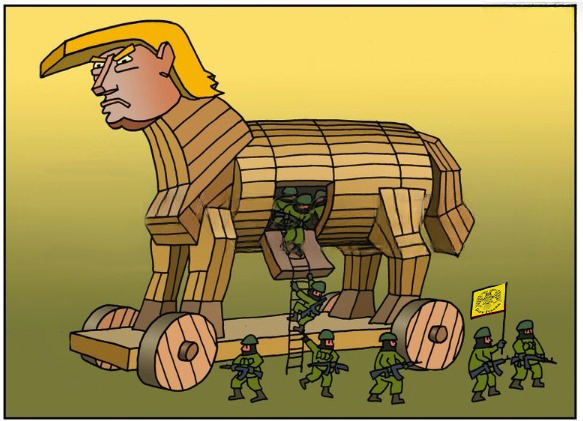
This is Nabiullina’s Trojan Horse for the Russian economy at war. The CBR projection is for two years of recession from now through 2026 and 2027; that is, close to zero growth this year to be followed by negative growth rates predicted from minus 2% to minus 3.5%.
Nabiullina admits that “considering its actual dynamics, we have lowered the GDP growth forecast for 2025 to 0.5–1.0%.” This, Russian economists point out, is within the standard margin for statistical error from zero.
Nabiullina doesn’t admit that the recession forecast in the Bank’s risk scenario for 2026-2027 is the consequence of the CBR’s key rate policy. But she does blame other government policies, including military spending, the budget deficit, and increased taxes. “Significant pro-inflationary risks have materialised since the previous meeting,” Nabiullina claims. “They are primarily associated with an increase in the budget deficit in 2025 and higher fuel prices. In September, a decline in underlying inflation measures paused. The expected increase in taxes will help bring inflation down over the medium-term horizon, but will also lead to a one-off rise in prices in the short term. We have factored this into our decision, first, by reducing the pace of monetary policy easing, and, second, by revising upward the projected key rate path required to bring inflation back to 4%.”
“As these [state spend and tax] factors fade, disinflation will continue. This will be supported by tight monetary conditions. The upward deviation of the Russian economy from a balanced growth path is narrowing.” This last sentence is the CBR euphemism for squeezing the economy with a high key rate at the same time as the government increases the tax burden. For zero to negative GDP, for growth to recession, Nabiullina’s euphemisms are “slowdown” and “cooldown”. “‘All decisions on the key rate,’ she told the State Duma this week, are based on the need to end the period of high price growth as quickly as possible while preventing the economy from overcooling. A hasty reduction in the key rate would undo all the progress achieved. ‘We would have to start all over again,’ Nabiullina said.”
Nabiullina’s promotion of “necessary recession” to cure inflation has triggered widespread but silent dismay – silent because it is understood she is protected by President Vladimir Putin.
Last month, in a session with government ministers Putin repeated Nabiullina’s line. “Last year we agreed,” the President said, “there was need to take the necessary measures to curb inflation and to strengthen macroeconomic stability. We agreed that this would inevitably cool the economy and, as we said back then, ensure its soft landing. The general opinion was also that we must walk this sharp edge and not to undermine the macroeconomic policy, not to overcool the economy, and not to freeze it.”
Putin then defended the outcome. “According to the Ministry of Economic Development, in July, gross domestic product added 0.4 percent in annual terms and in the seven months of this year GDP grew by 1.1 percent. The question is whether this is enough. Is that what we wanted? Are we succeeding in achieving the goal that we set for ourselves? Or, do we need to act differently at a faster pace, naturally, while ensuring macroeconomic, inflationary stability and taking into account the balanced policy of the Central Bank. The inflation trend is quite clear: in July, consumer prices grew by 8.8 percent and in August by 8.1 percent. The inflation drop trajectory is below the forecasts provided by the Government and the Bank of Russia. In other words, the efforts to lower inflation are effective. It is very important for moderate prices to have a positive impact on business and investment activity, allowing for more dynamic and sustainable growth.”
Vocal criticism has come from economists in the opposition seats in parliament. They say Nabiullina’s policy is stimulating financial speculation on the rouble, stocks, and commodity trade futures, boosting bank profits to record highs but crushing the real economy, and increasing poverty. According to Mikhail Delyagin, a well-known critic and deputy head of the Duma Committee on Economic Policy, the Central Bank is deliberately following the policy of Russia’s enemies, starting with the US-controlled International Monetary Fund (IMF).
“The IMF continues to act as the senior management structure for the Russian Central Bank,” Delyagin reported this month. “The Central Bank regularly — and very clumsily — tries to declare that this control is purely formal. However, these attempts are refuted by the regulatory documents of the Central Bank itself (https://t.me/EvPanina/15113 )…It turns out that a high-ranking official of the globalist structure, which oversees the Central Bank of Russia, is actively lobbying for the confiscation of Russian assets. Which has been the work of the Central Bank of Russia! The [CBR reserves] have ended up exactly where they can now be removed. An amazing coincidence…Everything is going to be fine for those who serve the West against Russia.”