

By John Helmer, Moscow
@bears_with
President Vladimir Putin will not run the gauntlet President Donald Trump has established around Cuba with the Russian Navy to escort Russian-flagged tankers delivering crude oil and petroleum products to Havana.
When Cuba’s Foreign Minister Bruno Rodriguez Parrilla sat down in the Kremlin on Thursday to ask for more “solidarity, firmly demonstrated by you, the Government of Russia, and the Minister for Foreign Affairs, in the face of the tightening blockade of Cuba and the recent energy siege,” Putin responded enough is enough.
He meant that solidarity with Cuba is one thing, but not at the risk of military conflict with the Trump Administration and its naval forces in the Caribbean.
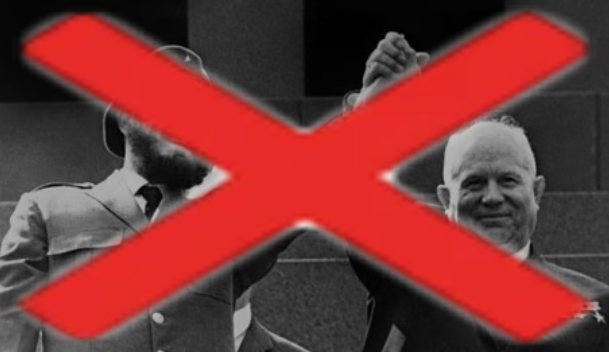
This is Mikhail Gorbachev talking, responded the Kremlin security analysis medium, Vzglyad, not Nikita Khrushchev.
“Please convey my best wishes to the President of Cuba and Army General [Raul] Castro,” Putin told the foreign minister. “This year we will mark the centenary of Fidel Castro’s birth, and we will do so together.”
It is not the first time Putin has said there is nothing but historical memory to share between Russia and Cuba; and that he would trade Russia’s military positions in Cuba for its interest in business with the US. In a meeting with President George W. Bush on October 21, 2001, Putin had said he would remove the Russian military intelligence base in Cuba. “I don’t want to horsetrade or nickel and dime this thing or argue about who gets what,” Putin said to Bush in a recently declassified record. In the outcome that is exactly what Putin did – and the trade failed because Bush did not reciprocate.
In his meeting with Rodriguez, Foreign Minister Sergei Lavrov was clearer in public what the Russian line means. “We call on the United States to show common sense and take a responsible attitude,” he said – “refraining from implementing its plans for a naval blockade of the Island of Freedom. We categorically reject the far-fetched allegations regarding Russia and Cuba, and cooperation between them, which is presumably threatening the interests of the United States or any other countries. All disputes should be settled exclusively through dialogue based on mutual respect and a balance of interests. We know that our Cuban friends are always ready for honest negotiations… All issues should be resolved solely through a mutually respectful dialogue aimed at finding a balance of interests. We know that Cuban friends are always ready for such honest negotiations. In turn, we will consistently continue to support Cuba, the Cuban people in protecting the sovereignty and security of the country.”
“I would like to reiterate our complete solidarity with our Cuban friends. I fully share the views on our relations and strategic partnership, which you [Rodriguez] have stated. I would also like to reaffirm the complete unacceptability of actions by the United States, which, as you have reminded just now, has adopted an executive order designating Cuba as a threat to US national interests. At the same time, the document says that this alleged threat is exacerbated by Cuba’s cooperation with Russia, which has been described in the document as a ‘hostile’ and ‘malign’ actor. We are confident that all states should define their national interests in a way that will include recognition of and respect for the national interests of all other countries.”
Between the lines of what Lavrov and Rodriguez know to be ironical and untrue, the intended Russian message is for the Castro family to negotiate the best terms it can from the Trump Administration; and for the Trump family, and also Secretary of State Marco Rubio’s family, to be confident that they can continue their blockade of the island without Russian military challenge until the Cubans agree to the US terms.
In Putin’s references to Fidel and Raul Castro, he was hinting at the Russian endorsement of grandson Raul Guillermo Rodriguez Castro, Raulito’s semi-secret negotiations with Rubio. Details of these talks “for the next Delcy in Cuba” were reported by Axios at the same time as the Foreign Minister’s meetings in Moscow. The Miami Herald has confirmed the details according to “a source with knowledge of the matter who asked for anonymity to discuss the sensitive issue.”
Repeating these details to confirm that Russian intelligence believes the Axios report to be accurate, Vzglyad has editorialized that so long as there is no US invasion of Cuba, Russia is telling the Cuban government to accept the “Delcy” solution. “The possible support that friendly countries, primarily Russia and China, can provide to Cuba is extremely important,” reported Yevgeny Krutikov. “Even if we assume that the transformation of the regime is inevitable, then in any case it is vital to ensure its painlessness and safety.”
The Axios publication can be read in full here.
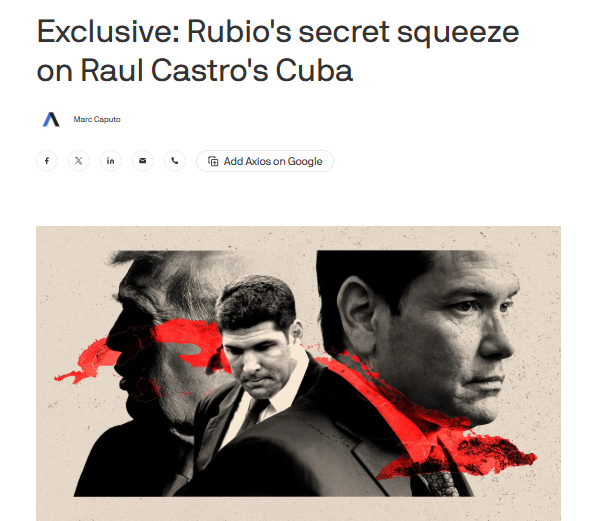
Source: https://www.axios.com/2026/02/18/marco-rubio-cuba-secret-talks “The talks between Rubio and Raul Guillermo Rodriguez Castro are bypassing official Cuban government channels. They show that the Trump administration sees the 94-year-old revolutionary as the communist island's true decision-maker. ‘I wouldn't call these negotiations as much as discussions about the future,’ a senior Trump administration official said. ‘Our position — the US government's position — is the regime has to go,’ the senior official said. ‘But what exactly that looks like is up to [President Trump] and he has yet to decide. Rubio is still in talks with the grandson.’… the US decision to keep Maduro's governing partners in power —notably his Vice President Delcy Rodriguez, who's now acting president — signaled to Cuban insiders that Trump and Rubio are willing to make deals with rivals… ‘He's [Rodriguez] the apple of his grandfather's eye, served as the dictator's bodyguard, and also has allies running the mammoth military-business conglomerate known as GAESA, said one source who described the Rubio-Castro conversations as ‘surprisingly’ friendly. ‘There's no political diatribes about the past. It's about the future,’ the source said, noting their common Cuban heritage and accents that are the lingua franca of Miami and surrounding cities. ‘Raulito could be straight out of Hialeah,’ the source said. ‘This could be a conversation between regular guys on the streets of Miami.’…Trump hasn't decided on a course of action with Cuba.”
Here is a verbatim translation of the Vzglyad response, written by Yevgeny Krutikov, a former GRU field agent and grandson of a Soviet trade commissar.
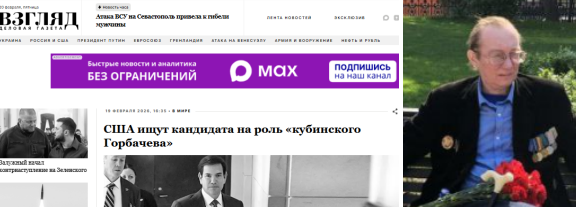
Source: https://vz.ru/world/2026/2/19/1396113.html Right: Yevgeny Krutikov in a recent photograph.
February 19, 2026
USA is looking for a candidate for the role of the Cuban Gorbachev
By Yevgeny Krutikov
The American media claim that the United States is secretly “discussing the future” of Cuba with one of the grandchildren of Raul Castro. What kind of person is this, what are Washington’s real goals in such secret negotiations, and why is the White House’s bid to find a “Cuban Gorbachev” likely to fail?
US Secretary of State Marco Rubio is holding secret talks with Guillermo Rodriguez Castro, the grandson and bodyguard of former Cuban President Raul Castro, according to the American media. It is noted that such negotiations are taking place bypassing the official channels of the Cuban government and show that the administration of US President Donald Trump considers the elderly Raul Castro to be the one who actually makes decisions on the island.
Rumors about Rubio’s negotiations with Raul’s grandson appeared almost immediately after the US attack on Venezuela and the kidnapping of the country’s leader, Nicolas Maduro. Many experts have also begun calling Cuba Washington’s next target. The “Cuban issue” in the United States is the prerogative of Secretary of State Marco Rubio, a descendant of representatives of the “old” wave of Cuban immigrants, that is, those who moved to Florida before the revolution on the island.
The nephew of Fidel Castro’s first wife, Mario Diaz–Ballart, a member of the House of Representatives from Florida, also has serious influence. His older brother, Lincoln Diaz-Ballart, was a long-time congressman from Florida.
The sources of the Axios portal believe that this is not so much about “negotiations” as about “discussing the future.” The United States insists that the regime in Cuba must be changed. But it is still unclear by what methods this will be carried out and what will happen after the regime change, if it happens in one form or another. It is believed that Donald Trump has not yet made a decision, but he himself assures that there is no need for a military operation against Cuba. In addition, there is no specific person in Havana who would cause Trump the same idiosyncrasy as Maduro, and by kidnapping/eliminating whom the American president could “solve the problem” for himself.
So far, Washington has followed the path of economic, financial and energy strangulation of Cuba, while at the same time starting complex behind-the-scenes negotiating games on the notorious “discussion of the future.” There is reason to believe that this strategy looks advantageous in the medium term, and the “countdown” has already begun for Cuba.
At the same time, Castro Jr. himself, although considered Raul’s favorite grandson, can hardly be considered even as a political figure in transition.
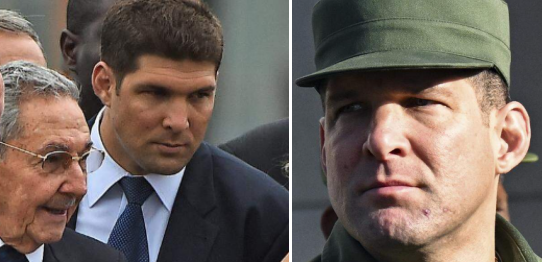
Left: Rodriguez Castro as the bodyguard of his grandfather Raul Castro in 2015; right, Raulito in uniform more recently. According to the Cuban exile version reported by the Miami Herald, he is “the Castro family member who oversees the family interests in the Cuban military’s sprawling business empire…and oversees the family interests in GAESA, the military conglomerate that controls much of the country’s economy and most of the sources of foreign revenue. Rodriguez Castro is the son of the late Gen. Luis Alberto Rodriguez Lopez-Calleja, who was the head of GAESA until his sudden death in 2022…Rodriguez Castro does not hide his love for a luxurious lifestyle. He has made headlines in Miami for appearing in yachts and luxury hotels. He was a regular at Havana’s nightclubs and was a fan of Cuban reggaeton group Gente de Zona.”
He is little known in Cuba itself, and has no political or managerial experience. He is not a member of the Central Committee of the party or a member of parliament. He’s not even a high-ranking officer.
However, he is close to the military-industrial conglomerate GAESA [Grupo de Administración Empresarial S.A.] And in Cuba, this is much more than just a military-industrial complex. As a unit of the Revolutionary Armed Forces of Cuba, GAESA controls up to 37% of the country’s total GDP, including through the Gaviota group, the state tourism sector, which is the most important for the country, as well as import/export, banking, and shops. Perhaps that is why Washington believes that Castro Jr. is inclined to entrepreneurship, and this is considered a virtue in the United States and the basis for the beginning of a great friendship.
Apparently, in the near future we will be talking about the search for some kind of transitional figure within the leadership of the Communist Party. More recognizable than Castro Jr., and capable of playing the role of “Cuban Gorbachev.” But Castro Jr. may be standing behind him, as a guarantee that the United States will not physically interfere in events in Cuba.
This is not even the “Venezuelan option,” but rather the strategy that Washington chose in relation to the Soviet Union in the 1980s.
In general, the situation in Cuba now resembles the situation in the USSR in the last years of its life – from the economy to the ideology and to social conditions. Unfortunately, the development forecast is about the same, except for the disintegration of the country into national “units”, which Cuba simply does not have.
The economic and consumer crisis is approaching disaster. The generation that was raised on revolutionary ideas has passed away naturally. There is no reason to believe that the Cuban army has the ability to resist the US army in any effective way.
At the same time, direct invasion can be almost completely eliminated. The fact is that here we can also draw another direct analogy with the crisis in the Soviet Union. The Cuban population as a whole seems morally ready for change, but with respect for their own dignity. From the point of view of the Cuban elites, negotiations with the United States are possible, even major concessions, but only if these negotiations with Washington are conducted on equal terms, and not from the position of the humiliated and defeated.
Political changes, economic reforms, and normalization of relations with the United States cannot be achieved at the cost of national humiliation. Cubans may be ready to abandon ideology, government, and regime, but they are not at all eager to destroy totally their own country, which was the widespread phenomenon among Soviet citizens in the 1980s.
The reforms on the island may well be led by representatives of the army, the GAESA concern, and the special services, who, perhaps better than many, are aware of what is happening and what it can lead to. Some of the military and intelligence elite are already involved in the business sector, which can become the foundation for the country’s transformation without fundamentally abandoning its basic social achievements, including free education and medicine.
In this regard, the possible support which friendly countries, primarily Russia and China, can provide to Cuba is extremely important. Even if we assume that the transformation of the regime is inevitable, then in any case it is vital to ensure its painlessness and safety.
Noteworthy in this regard is the recent visit to Havana by Russian Interior Minister Vladimir Kolokoltsev, who discussed “topical issues on the anti-crime agenda” with relevant officials of the island. The parties also assessed the state and prospects of cooperation in the law enforcement sphere. At the same time, it should be understood that in Cuba, the Ministry of the Interior unites almost all special services, except for foreign intelligence — this is a super agency responsible for all areas of security, not just the criminal police. And the Russian experience certainly doesn’t hurt here.
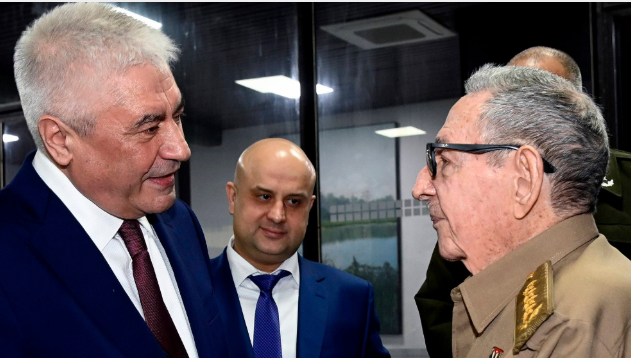
Interior Minister Vladimir Kolokoltsev meets Raul Castro in Havana on January 21, 2026
Cubans had to learn another lesson from the collapse of the USSR. If one of the tools of regime transformation in Cuba is the complete abandonment of the state economy and the discrediting of the security forces, the country will quickly return to the state in which Russia was in the 1990s. A significant part of the economy will fall into the hands of underground dealers and criminals. There will be a lot of armed people on the streets, gangs will appear. Cuba may slip into the typical Latin American criminal chaos, which will not greatly increase public confidence in the United States nor those who will carry out these reforms.
Any intervention will only unite Cuban society, and that is why Trump emphasizes the absence of plans for a military overthrow of the ruling regime in Havana. Hatred of the interventionists and gringos will be more important to Cubans than empty store shelves. The White House is looking for a split in the Cuban elites, those who are ready for rapprochement with the United States, possibly also for personal gain. Not necessarily money– but a career, a name, and the glory of the “new Gorbachev.” And the price of this career will be the new establishment of an American protectorate over Cuba.
But we dare to assume that it will be impossible to find a “Cuban Gorbachev” in any comparable guise. For Cubans, the perception of themselves as a people is directly related to the revolutionary ideology. The Soviet people separated themselves from socialism, but Cuban socialism is part of the national identity.
The revolution that brought Fidel Castro to power was not primarily a communist or Soviet revolution, but the result of the struggle for the national liberation of Cubans from American oppression. Even the collapse of the communist ideology cannot change this. Whoever is in power will inevitably defend the island’s independence in one form or another so that it remains an Island of Freedom.




Leave a Reply