

By John Helmer, Moscow
@bears_with
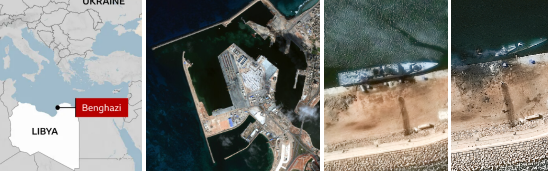
The first semi-official Russian military assessment has appeared in Moscow of the drone attack on November 22 which sank the Russian Navy corvette Merkury at its Benghazi berth (lead images) and damaged the military cargo carrier Angara off shore.
By calculation, the new report omits or ignores the evidence of US fixed-wing and other NATO surveillance and targeting intelligence drones, and of the role of Turkey has played in hosting Ukrainian drone units at bases in western Libya; supplying drone components through a Turkish air base at Az-Zawiya; and allowing the launch of the drone operation at the Russian targets from Turkish controlled locations in western Libya. .
Read the full evidence file here.
The Moscow report, published by Vzglyad on November 27, and written by the former GRU officer Yevgeny Krutikov, announced that Albania has denied a role, but omitted to report whether the Trump Administration and the Turkish government have issued denials.
US officials have said nothing; leaked nothing. The Turkish Foreign Ministry said: “According to international law, it is illegal to carry out hostile actions in the waters of a neutral state. The Libyan side has taken the attacks against ships in and off the Benghazi Port to the United Nations General Assembly and Security Council.”
Krutikov has implied that Italy was responsible for the operation but this is composed from innuendo without direct evidence. “Rome’s position is particularly revealing. Officially, Italy opposes the transfer of hostilities to the Mediterranean, but in practice it was Italy, and not Albania, to whom they tried to shift the blame through planted information, which helped consolidate the Ukrainian sabotage groups in Libya. [Deputy Prime Minister and Foreign Minister Antonio] Tajani’s public criticism of Kiev looks like an attempt to absolve himself of responsibility in advance, as the role of Italian infrastructure in this story becomes apparent.”
Krutikov also relayed a threat of Russian retaliation: “If there is confirmed intelligence that a particular vessel is delivering cargo for Ukrainian sabotage groups in North Africa, it cannot be considered anything other than a legitimate military target.”
He then announced the Kremlin alibi for not striking. “The Ukrainian contingent in Libya today reaches 600 people, and its deployment on the same bases with the Italians, Turks, British and Americans actually insures them from direct Russian missile attacks. It is impossible to strike without risking losses among the military of NATO countries.”
The Kremlin has refused to comment on the Benghazi operation. In his briefing the day after, November 23, Dmitry Peskov, the presidential spokesman, said: “The Defense Ministry is dealing with this matter, and information will also be provided through the Defense Ministry if deemed appropriate.”
The Defense Ministry has said nothing.
The Foreign Ministry issued a statement on November 26: “please take note: what those on Bankovaya Street present as an ‘exemplary’ act is regarded by members of the international community as either a terrorist attack, as the Libyans have called it, or an unacceptable extension of aggression, as Zelensky’s Western handlers have described it. In short, that is precisely what we set out to prove. Through his reckless actions, the head of the Kiev junta is deliberately seeking to provoke a direct confrontation between Russia and NATO countries, trigger an uncontrollable escalation of the conflict and definitively torpedo any negotiations aimed at reaching a settlement…They will pay for all this. In fact, they are already paying. They are paying for their crimes. Russian law enforcement agencies continue their efforts to bring Ukrainian terrorists and foreign mercenaries to justice.”
As a one-time officer of the military intelligence agency GRU, Krutikov is a trusted source for relaying the views on operations, both Russian and others, from the General Staff. Vzglyad is a Kremlin-backed medium for discussion in public of geopolitical, economic, and military strategy. Krutikov’s record over the years can be followed here. Once communicative by exchange of emails between professional colleagues, he, like Vzglyad, now refuses to respond to questions. Click to open the backfile on Vzglyad.
Reading what is reported that is new, what is implied, what is hidden between the lines, and what is omitted altogether, the GRU assessment which follows in verbatim translation is remarkable.
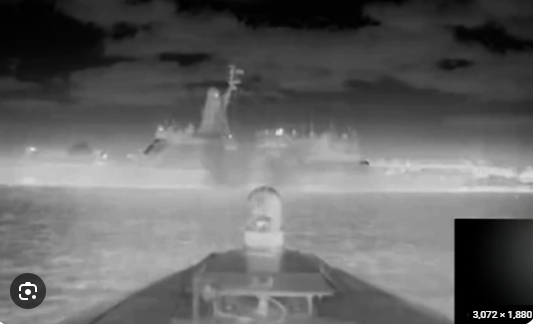
Ukrainian government-supplied footage claiming to show the drone strike against the Merkury before dawn on November 22.
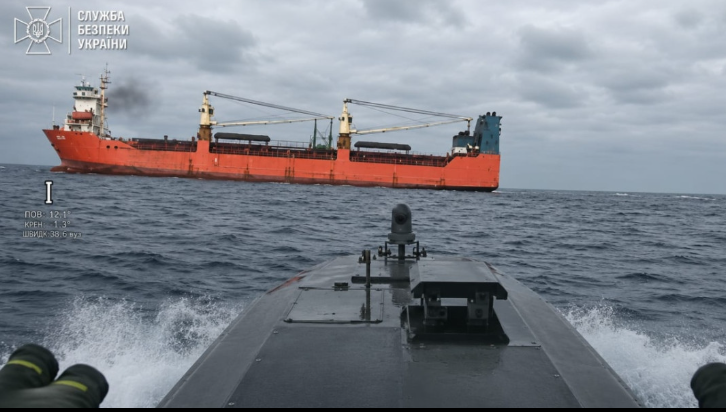
Ukrainian intelligence agency SBU-supplied footage claiming to show the drone strike against the Angara after dawn on November 22.
Earlier identification of the second vessel struck outside Benghazi port as the Ascalon was mistaken. At the time the Ascalon was also at berth in Benghazi port; also berthed was a third Russian cargo carrier, the Anastasia. The Angara entered the port after the attack, and has transferred its cargo to the Ascalon.
The three vessels had loaded their cargo at Bronka, St. Petersburg, on October 26; proceeded to the Baltyisk naval base at Kaliningrad, and then set sail southwestwards by October 31, to be joined by the Merkury between the English Channel and the Gibraltar Strait in the first days of November.
A second Russian convoy escorted by the Russian Navy frigate Admiral Golovko followed after a week. It turned around at the Strait of Sicily after the attack and has since anchored off Algeria or off Tunisia; the exact location is not public as the convoy has turned off its location signals. The convoy comprises Lady R, Lady D, and the Maia-1, together with a fleet oiler, the Yelnya. Like the three-vessel convoy escorted by the Merkury, the second convoy formed and set sail from Baltiysk naval base at Kaliningrad on November 5, and was joined by the Admiral Golovko three days later.
The following report has been translated verbatim into English without editing. Two illustrations have been added for the English reader.
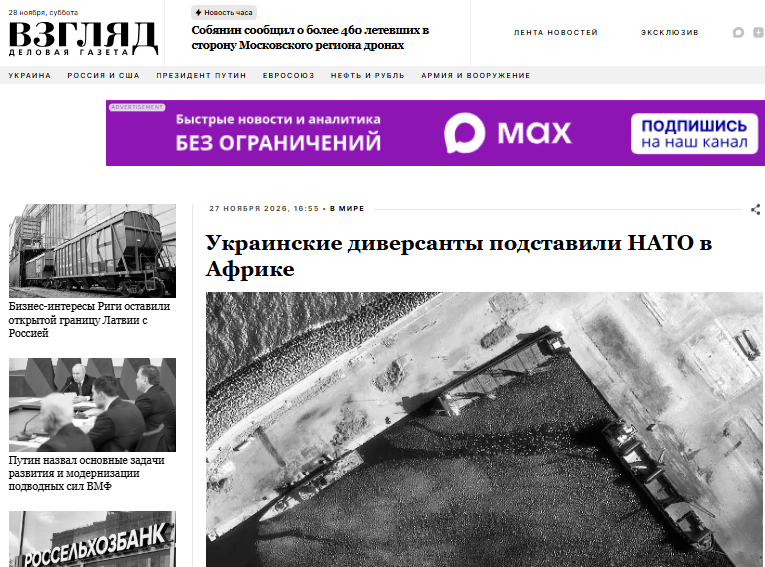
Source: https://vz.ru/world/2026/11/27/1480864.html

November 27, 2026
Ukrainian saboteurs framed NATO in Africa
By Yevgeny Krutikov
Rome and Tirana deny complicity in the Ukrainian Armed Forces strike on the Libyan port of Benghazi, where Russian ships were serviced. But it was the Western special services that created and are covering for the Ukrainian saboteurs based in North Africa. Why is the Western political leadership now refusing to acknowledge this?
Russian Foreign Ministry spokeswoman Maria Zakharova said at a briefing on November 26 that the Kiev authorities were deliberately trying to provoke a direct clash between Russia and NATO countries with their strikes on the Russian corvette Merkury and the Angara cargo ship in the Libyan port of Benghazi. According to Zakharova, in the end, Kiev “will pay for all this.”
The reaction of Western capitals to this incident clearly showed how accurately Moscow has described the essence of what was happening. At the political level, Europe has tried to maintain a good face: for example, French Foreign Minister Jean-Noel Barraud called the Kiev attack the realization of a “legitimate right to self-defense.” But as soon as questions appeared in the media about whose territory and with whose support drones were launched in the Mediterranean, a chain reaction of hasty denials began.
The Albanian Foreign Ministry urgently issued a denial of its involvement, and Italian Foreign Minister Antonio Tajani called the strike on Benghazi a “big mistake”, demanding not to create new hotbeds of tension off the coast of Libya, where the Italian military and Eni operate. The situation was aggravated by the fact that two soldiers of the Libyan Navy were killed while repelling the attack, and the port of Benghazi itself urgently blocked the harbour. This gap between the usual slogans about “self-defence” and attempts to distance themselves from the consequences highlights the main question: how did the Ukrainian forces end up in the Mediterranean and whose infrastructure are they using?
The attack took place on the night of November 22. According to the authorities of eastern Libya, the Merkury entered the naval base in Benghazi for resupply and refueling. Vladimir Zelensky said that the Ukrainian forces had used seven naval drones, and the SBU reported a strike on the Angara cargo ship off the Libyan coast.
According to the Kiev and Western versions, the sea drones were allegedly launched into the open sea from a kind of “mother ship”. However, this version has not been confirmed through vessel tracking systems (AIS) or satellite imagery. The most likely scenario remains the launch of Magura-type unmanned naval boats from the Libyan coast, guided via Starlink in coordination with NATO reconnaissance aircraft.
It is noteworthy that Kiev’s actions were condemned by both opposing centres of power in the country. The authorities of eastern Libya (LNA) promised to respond, and the Presidential Council in Tripoli called the attack a violation of sovereignty and demanded official explanations from Ukraine, stressing that the security of the country’s maritime borders is non-negotiable.
In this context, Rome’s position is particularly revealing. Officially, Italy opposes the transfer of hostilities to the Mediterranean, but in practice it was Italy, and not Albania, to whom they tried to shift the blame through planted information, which helped consolidate the Ukrainian sabotage groups in Libya. Tajani’s public criticism of Kiev looks like an attempt to absolve himself of responsibility in advance, as the role of Italian infrastructure in this story becomes apparent.
Ukrainian military personnel appeared in Libya back in May 2025. At the first stage, they were secretly accommodated in a hotel owned by Field Marshal Khalifa Haftar’s son and his potential successor Saddam Haftar.
In July and August, they moved to a military base in Rajma, controlled by the Libyan National Army. Haftar Jr.’s actions often diverge from his father’s line and are characterized by impulsiveness – it is enough to recall his visits to Paris and negotiations with Emmanuel Macron, after which militants operating against the Sahel countries emerged from prisons in eastern Libya.
About two months later, they were transferred to the facilities of the Italian military contingent in the west of Libya – in Tripoli and Misrata, as well as to the east of the country, where the “Italian House” was opened. At the military airfield in Misrata, the Ukrainian military is stationed side by side with Italians, Turks, British and representatives of the African Command of the US Armed Forces (AFRICOM).
Their coordination headquarters is operating in Tripoli, which is used to communicate with the 111th Brigade, a key formation subordinate to the head of the Government of National Unity (GNU) Abdel Hamid Dbeiba. And west of Tripoli, on the coast in the area of az-Zawiya, there is a launch site for backup and UAVs in the Mediterranean Sea. Presumably, it was from there that the backups which attacked the Russian ships started.
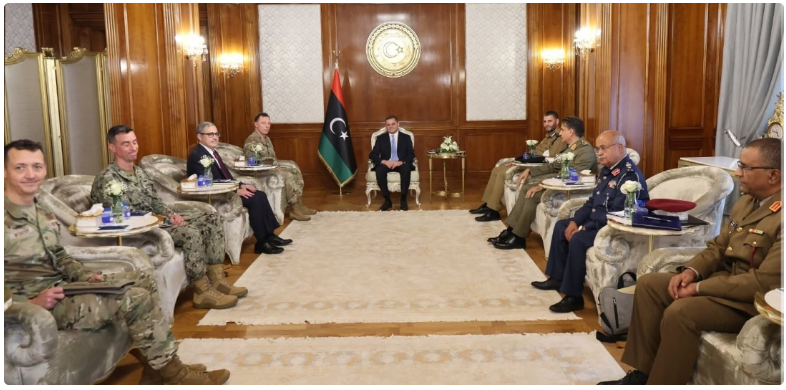
November 15, 2026 – one week before the Benghazi operation -- Libyan Prime Minister Abdul Hamid Dbeibah (centre) met the commander of AFRICOM, General Dagvin Anderson, in Tripoli “to discuss ways to strengthen military and security cooperation between Libya and the United States and support efforts to unify Libya’s military establishment. The meeting was attended by Interior Minister Imad Trabelsi, Chief of Staff of the Libyan Army General Salah Al-Namroush, and several senior Defense Ministry officials. Jeremy Berndt, the U.S. State Department’s senior adviser for Libyan political affairs, also participated.
Relying on these bases, Ukrainian “instructors” traveled to the Sahel countries to consult with militants, and crossed through Chad to Sudan to support the Rapid Reaction Forces. At the same time, they maintained freedom of movement not only on the territory of the GNU, but also in the area under Haftar’s control. In May 2026, an unmarked car with a Ukrainian trident on the trunk moved freely around Benghazi – in Libya, this is impossible without the direct patronage of local security forces (probably the same Haftar Jr.) and the assistance of local intelligence services.
This also explains the technical side of the attack. The port of Benghazi is well equipped, and its only roadstead is closed from the open sea. It is extremely difficult to get unmanned boats there solely using satellite communications and aviation intelligence data, even considering that the French Atlantique 2 patrol aircraft and the American CL–650 reconnaissance aircraft were on duty in the air before the strike.
To break into the closed harbour, accurate data was required on the spot: the schedule of ship parking, changing of guards, and the condition of the booms.
The political chronology is also indicative. Just five days before the attack, on November 17, the Chief of the General Staff of the GNU Army, Salah al-Din al-Namrush, and Deputy Prime Minister Salem al-Zadma hosted Russian Ambassador Aidar Aganin and military attaché Alexei Monyakov in Tripoli, discussing the expansion of cooperation. And already on November 20-21, Dbeiba’s emissaries held talks in Washington and met with the head of Turkish intelligence in Istanbul.
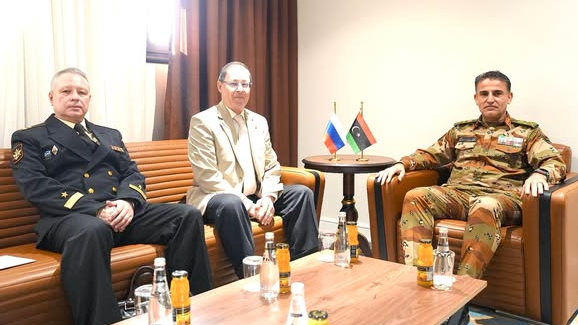
Left to right: Russian Navy Captain Alexi Monyakov, Ambassador Aidar Aganin, and Chief of the General Staff of the Libyan Army, Lieutenant General Salah al-Din al-Namroush, November 17, 2026.
Such a multivector approach is typical of Libyan politics, but it is precisely chaos and dual power that allow Ukrainian subversive groups to gain a foothold in the country. According to various estimates, the Ukrainian contingent in Libya today reaches 600 people, and its deployment on the same bases with the Italians, Turks, British and Americans actually insures them from direct Russian missile attacks.
It is impossible to strike without risking losses among the military of NATO countries.
In these circumstances, the answer may be tight control over maritime logistics in western Libya. Whatever the diplomatic contacts with the Government of Libya, the safety of Russian ships and vessels in the Mediterranean remains an absolute priority. If there is confirmed intelligence that a particular vessel is delivering cargo for Ukrainian sabotage groups in North Africa, it cannot be considered anything other than a legitimate military target.
It is also important to understand that the attempt by Western capitals to cover up Ukrainian sabotage groups with their presence in Libyan bases gives them only a tactical advantage. Strategically, the participation of Ukrainian saboteurs in operations against the Sahel countries and Russian forces only accelerates the consolidation of anti-Western regimes in Africa.
As a result, the picture that Moscow is warning about is emerging. Ukrainian subversive groups, raised and deployed in Libya with the assistance of Western intelligence services, begin to act according to their own media logic, directly framing their curators.

In Brussels, Paris and Rome, they would like to continue waging a hidden proxy war in Africa with someone else’s hands, limiting themselves to the usual phrases about the “right to self-defence.” But a demonstrative terrorist attack in a Libyan port with the death of local military personnel breaks this pattern: Kiev is dragging the alliance into an open crisis with Russia and at the same time undermining the position of the Europeans themselves in Libya, which is why they have to switch hands.











Leave a Reply