


By John Helmer, Moscow
@bears_with
How not to lose the drone war?
This question, published on July 4, has been put bluntly by Dmitry Rogozin — former Russian ambassador to NATO, former deputy prime minister for the military-industrial complex, former chief of Roskosmos, and currently senator for the Zaporozhye region and front-line commander.
Rogozin, 62, also a veteran of Russian presidential election campaigning, is still campaigning. “The winner is not the one who can shoot down more drones. The winner will be the one who will be able to make each subsequent enemy strike less effective and more expensive, and his own defense will become cheaper, more massive and automated. That’s what the real technological race is about today.”
This question-and-answer should be interpreted in the current Russian political context; that’s to say, the one led by President Vladimir Putin and the answers Putin is making public to one of the questions which all Russian voters are asking just nine weeks from Election Day.
When he telephoned President Donald Trump on July 4, according to the Kremlin’s version of their conversation, Putin omitted to identify US military and intelligence engagement in the escalation of the Ukrainian drone war on the front, in the Russian hinterland, and on the high seas. Instead, Putin said: “Kiev and its Western sponsors rely on drawing out and even escalating the conflict and terrorising civilians. Moreover, the European ‘party of war’ proceeds from a false perception of the overall situation and developments on the frontline. Our President [Putin] has outlined the real situation on the battlefield, where the Russian Armed Forces are confidently advancing, liberating one settlement after another.”
Putin — said his spokesman Yury Ushakov — was trying to persuade Trump not to sign a statement of unified warfighting strategy against Russia at the NATO summit meeting; this will be held later this week in Turkey.
With the Europeans at the G-7 summit meeting in France on June 16-17, Trump had already signed his backing for escalation of the drone war. “We commit to increase the pressure on the Russian war economy,” Trump signed with the Europeans. “In this context, we will strengthen our sanctions, including those on the oil and gas sectors. We consider this the right moment to proceed with additional measures.”
To Putin, according to Ushakov, Trump replied that “his special envoys – Steve Witkoff and Jared Kushner – will carry on their mediation efforts and are ready to come to Moscow at our convenience.” Putin’s answer to that has not been reported.
Putin did remind Trump of the bribes Witkoff and Kushner have been discussing with Putin’s representative, Kirill Dmitriev. “There is colossal potential for mutually beneficial cooperation between our countries,” Putin reportedly said. Trump replied: “for these prospects to be realised, it is necessary to put a stop to the Ukrainian conflict as soon as possible.”
A Moscow source in a position to know claims the Russian bribes have not yet been paid to the Americans.
Dmitriev interrupted his Twitter stream on the UK turning “communist” and gay to announce: “JUST IN: President Putin calls President Trump to congratulate him and the US on Independence Day.” Reposting a Trump tweet on the immigration to Europe of “Third World criminals”, Dmitriev added: “Hopefully learning. Europeans understood this some time ago, but their bureaucrats are either slow learners or crave self-destruction.”
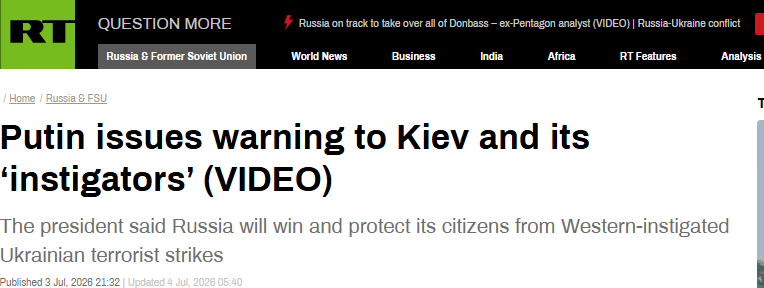
Putin had nothing to say on the escalation of the drone war during his visit on Friday (July3) to a command post at the front. Instead, he claimed: “The establishment of a security zone in the border areas of the Kharkov, Sumy, and Dnepropetrovsk regions of Ukraine is also progressing according to plan.” In his report on the military situation, General Gerasimov said that Russian missile and drone strikes on Ukrainian targets have “substantially reduced Ukraine’s industrial capacity to manufacture long-range weapons, including cruise and ballistic missiles, which has also increased the Kiev regime’s dependence on Western supplies of components, explosives, and fuel.”
Putin added: “The more strikes the enemy attempts against our civilian infrastructure – and, of course, our foremost priority is to do everything necessary to protect these facilities and the civilian population – the more such attempts they make, the larger the security zone we will be compelled to establish in the adjacent territory. Especially since this area, like the other territories we have discussed today, is historically Russian land.”
The depth of this “security zone” – the extent of the demilitarized zone (DMZ) westward across the Ukraine — has become a controversial sensitivity for the Putin-Dmitriev negotiating terms with Witkoff and Kushner as the range of the US, NATO and Ukrainian drones is now almost twice the 1,300 kilometre distance between the eastern and western borders of the Ukraine.
At the command post on Friday, referring to “the purported European so-called peace makers, whose genuine objective is not peace but continuing the war with Russia to the last Ukrainian”, but not to the Trump Administration, Putin told the officers: “We must also continue analysing the involvement of each instigator of the continuation of the war in Ukraine, the analysis of the involvement of each of them in real combat actions. We need this analysis for taking responsible decisions in the future.”
The General Staff and the Foreign Intelligence Service (SVR) understand that “each instigator” includes Trump and his officials. Putin and Dmitriev refuse to acknowledge this.
For combatting the drone war –“certain actions of a sabotage and terrorist nature”, Putin claimed in a separate interview: “We are currently seeing certain shortages, although they are not critical…There are several tasks we need to address… The first is to rapidly and significantly increase production of the air defence systems that are most in demand. We must also continue improving them in line with the requirements of combat operations and the protection of key facilities, taking into account the capabilities the enemy is deploying, including the new unmanned aerial vehicles with advanced technologies being supplied from Europe. We already have these defensive systems. The challenge is to accelerate their production and delivery, whether to the armed forces or for the protection of critical infrastructure… We also need closer coordination among all the agencies and levels of government involved in repelling drone and missile attacks on our infrastructure. ”
Putin continues to hold Trump blameless. He continues to insist “the problems that arise are not critical”. The criticism of his performance inside Russia, Putin has added, is “an information operation as part of the broader confrontation with Russia. At a minimum, its purpose is to undermine our confidence in ourselves and our capabilities and, ideally, to create divisions within Russian society, force Russia to suspend, even temporarily, the advance of our forces along the line of contact and create conditions for launching negotiations on terms favourable to our adversary.”
Source: https://www.rt.com/russia/642563-putin-konstantinovka-russia-ukraine/
Source: https://www.ft.com/content/13687b48-9e54-44a1-bd4d-600bbc052baf?syn-25a6b1a6=1
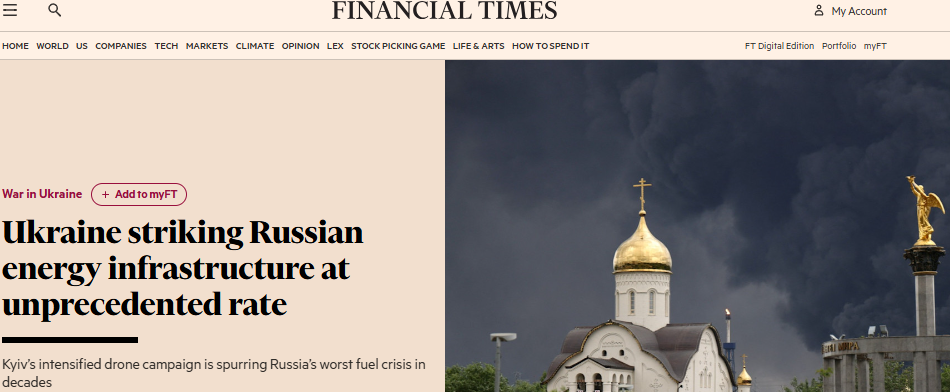
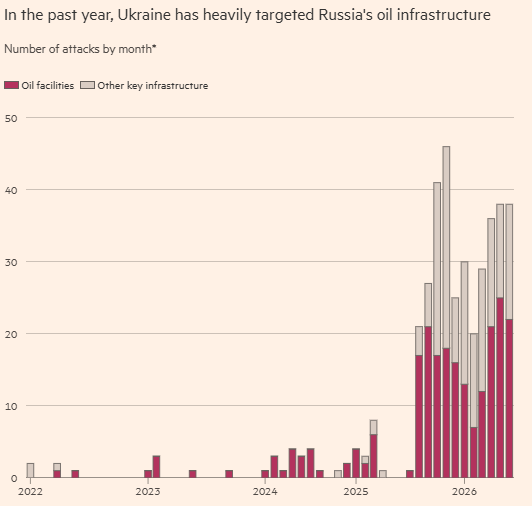
The London Financial Times, a Japanese-owned propaganda platform in London, claimed in an unusually detailed report over the weekend that “Ukraine is not simply conducting more strikes than it did a year ago. The campaign has evolved from a relatively narrow effort against oil infrastructure into a broader strategic interdiction campaign aimed at degrading Russia’s energy, logistics, industrial and export systems simultaneously.”
Ukrainian media indicate that in June there was a substantial increase in Ukrainian drone and missile attacks on Russian targets. “2,359 deep-strike missions targeting sites 500-2,000 kilometers behind the front line, damaging 172 military-industrial and fuel-energy facilities during the month…The SBS [Unmanned Systems Forces] said its operators also flew 3,406 middle-range strike missions (150-300 km), hitting or destroying 1,682 targets, and 2,747 front-line strike missions (25-150 km), destroying or damaging another 1,265 targets. Priority targets included Russia’s defense industry, fuel and energy infrastructure, logistics hubs, fuel and ammunition depots, command posts, military equipment, and troop concentrations. The force said occupied Crimea remains a separate, sustained focus of the campaign.”
According to US, NATO and Ukrainian estimates, “the frequency of Russian large-scale drone and missile strikes against Ukraine lessened in June 2026 for unclear reasons. Russian forces likely retain the ability to conduct large-scale drone and missile strikes against Ukraine several times per month, as they have in recent months. Russian forces intensified their large-scale strike series in mid-January 2026, conducting strikes with at least 300 drones and missiles three times in mid- to late-January; six times in February; four times in March; five times in April; and six times in May. Between January and May 2026, Russian forces typically launched one to three of these large-scale strikes within roughly a week of each other, then conducted much smaller strikes for a week or two, likely in part to stockpile strike vehicles, then resumed large-scale drone and missile strikes in the same pattern to maximize damage. Russian forces only conducted two drone and missile strikes consisting of over 300 strike vehicles in June 2026, however, on June 2 and June 15. It is unclear why Russian forces reduced their large-scale strikes in June. Russian forces may be stockpiling drones, particularly for a higher frequency of large-scale strikes at a later time of the Kremlin’s choosing, especially if Russia believes it can further exhaust Ukrainian air defenses. Russian forces may also have shifted manufacturing patterns, such as seeking to decentralize Shahed-type drone production or shifting to prioritize drone variants that may be more difficult to manufacture, such as drones with jet engines.”
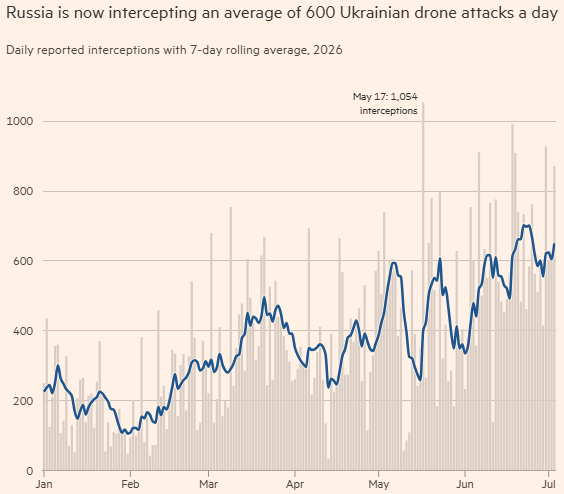
ESCALATION OF UKRAINIAN DRONE & MISSILE ATTACKS ON RUSSIA BY RATE OF RUSSIAN INTERCEPTIONS, JANUARY TO JULY 2026
Source: https://www.ft.com/content/13687b48-9e54-44a1-bd4d-600bbc052baf?syn-25a6b1a6=1
UKRAINE TARGETING ON RUSSIAN ENERGY INFRASTRUCTURE
Source: https://www.ft.com/content/13687b48-9e54-44a1-bd4d-600bbc052baf?syn-25a6b1a6=1
RUSSIAN DRONE & MISSILE STRIKES ON THE UKRAINE, JULY 2, 2025, TO JULY 2, 2026
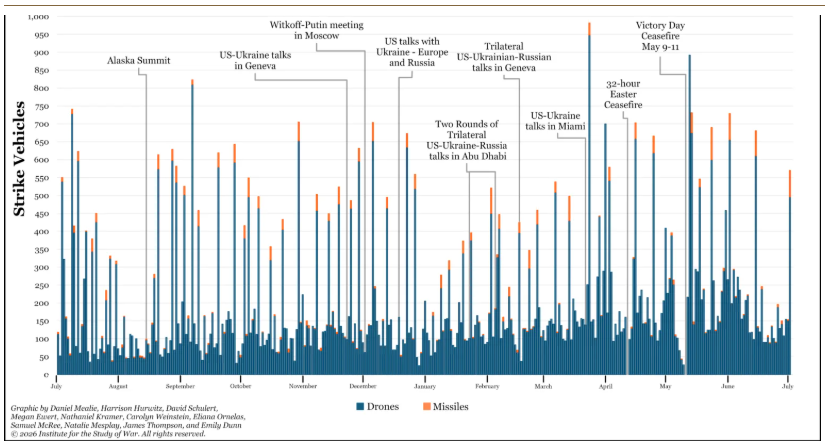
Click to enlarge view: https://understandingwar.org/research/russia-ukraine/russian-offensive-campaign-assessment-july-2-2026/
This is Rogozin’s answer:
“The military use of drones seems cheap only at the level of an individual product. An FPV [First-Person View], a copter, or a simple aircraft UAV [Unmanned Aerial Vehicle] can cost disproportionately less than the target they hit and the means by which they have to be shot down. But at the system level, the opposite is true: drones dramatically increase the cost of war for both sides.
The attacker buys a cheap entrance ticket: housing, motor, camera, communications, warhead. But then operator training, reconnaissance, retransmission, logistics, repairs, batteries, ground stations, losses, failed launches, defects, modernization and a constant change of tactics begin.
The defender pays even more. He needs a continuous loop: detection, confirmation, communication, duty shifts, electronic warfare, optics, thermal imagers, radars, mobile groups, ammunition, training, redundancy, exercises, false alarm analysis, situation centers and interaction with air defense. A cheap goal forces you to build an expensive counteraction environment. And all this happens symmetrically.
This is how the war economy spirals. The problem is not that the drone cannot be shot down — the problem is that it is often too expensive to shoot it down. You can technically win every single interception and economically lose the war. An expensive rocket versus a cheap FPV plane is bad math. But an interceptor drone without a detection, classification, and guidance system loop does not work either.
Therefore, the main question now is not just ‘how to shoot down?’, but ‘at what cost to disrupt the enemy’s task?’. A massive cheap threat cannot be countered with massive expensive interception. It is necessary to transfer the struggle from destroying the apparatus to disrupting its function (ideally, the functions of its operators). The real answer is a layered defense economy: first, the cheapest sufficient measures, then the more expensive ones, and only as a last resort, the most technically complex and expensive means. But we must act decisively, systematically and without delay.
The winner is not the one who can shoot down more drones. The winner will be the one who will be able to make each subsequent enemy strike less effective and more expensive, and his own defense will become cheaper, more massive and automated. That’s what the real technological race is about today.”
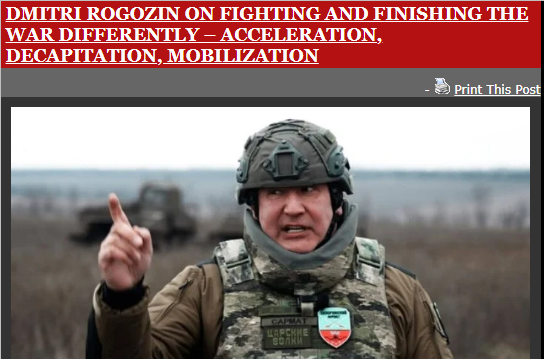
Click for more on Rogozin’s military strategy: https://johnhelmer.net/dmitri-rogozin-on-fighting-and-finishing-the-war-differently-acceleration-decapitation-mobilization/
NOTE: for analysis of plans to cut the Russian military budget by Putin’s protected Central Bank governor, Elvira Nabiullina, read more.








Leave a Reply