

By John Helmer, Moscow
@bears_with
“I hope I am not revealing any great secret,” Russian Foreign Minister Sergei Lavrov (lead image, left) said at his press conference following the BRICS ministerial meeting in Delhi on Friday (May 15).
But he did just that:
By hint towards China on its voting to approve loans for the Ukraine at the International Monetary Fund (IMF); and towards India for its failure to allow a collective BRICS statement in support of Iran’s defence in the US-Israel war; and by explicitness towards the US, particularly towards negotiator Steven Witkoff for his duplicity in the Anchorage Formula negotiations.
Lavrov was answering press questions. One of them was — “Do the BRICS countries share the view that the Ukrainian crisis is coming to an end, and can they contribute to this in any way?”
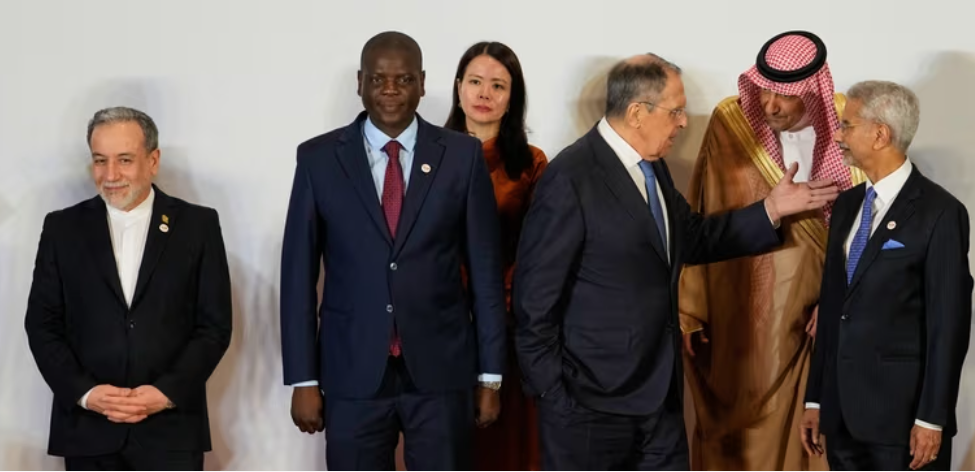
Foreign Minister Lavrov, third right, talks to Vice Minister of Foreign Affairs of Saudi Arabia, Waleed bin Abdulkarim, second right, as Indian Foreign Minister Subrahmanyan Jaishankar, right, South African Minister of Foreign Affairs Ronald Lamola, second left, Iranian Foreign Minister Abbas Araghchi, left, and and Vietnam Deputy Foreign Minister Nguyen Hang, third left. For full video presentation by Lavrov, click to view. Notably absent from picture and the conference was the ranking Chinese Foreign Minister Wang Yi, or a government representative of comparable status. Instead, China’s Ambassador to India replaced him as Beijing signaled its downgrade of BRICS behind the summit meeting with President Donald Trump.
Lavrov’s answer went directly to the role the leading BRICS states are playing when it comes to financing Ukraine’s war. “I briefed my partners in considerable detail at today’s and yesterday’s meetings on our assessments of the current situation around Ukraine. This included issues on the BRICS agenda, such as the reform of the global governance system. If we look at the Bretton Woods institutions from this angle, consider the statistics over the last three to four years. I don’t recall the exact figure off the top of my head, and I wouldn’t swear to the precise number, but look at which countries have received loans and how those loans compare. Over the last three to four years, Ukraine has received loans from the International Monetary Fund (I’m afraid I may be slightly off) of roughly 600 percent of its quota, in other words, six times its quota. This is several times higher than the loans received by all African countries taken together over the same period. This is a clear illustration of how the Bretton Woods institutions are currently being run, and in whose interests. It is certainly not in the interests of fair global governance.”
Unmentioned here, but well understood, was that Lavrov was pointing at China for voting in favour of IMF support for the Ukraine war budget. And among the BRICS member states, not only China – Saudi Arabia also votes for the IMF’s Ukraine loans and has issued a $400 million grant to Kiev directly. The UAE, by contrast, another BRICS member, does not vote for the IMF loan programme for Ukraine.
The last IMF Executive Board vote for Ukraine war financing took place on February 26. A fresh transfer was approved for $8.1 billion over four years, with immediate disbursement of approximately $1.5 billion.
IMF data indicate that at present a total of Special Drawing Rights (SDRs) of 10.9 billion or about US$15.6 billion in loans and obligations are outstanding for the Kiev regime as of March 31, 2026. The official IMF quota for Ukraine is SDR 2011.8 million ($2.9 billion). The former thus exceeds the latter by 5.4 times – 540%. That is close to Lavrov’s estimate. However, the IMF explains the giveaway (“preferred creditor status” in IMF speak) as supported by the majority of the shareholding country votes on the board.
In the February 26 voting of the board directors to grant the new $8.1 billion, the Bulgarian managing director of the IMF, Kristalina Georgieva, said: “A significant group of Fund shareholders reaffirm their recognition of the Fund’s preferred creditor status in respect of the amounts currently outstanding to the Fund by Ukraine, plus any purchases under the new extended arrangement. These shareholders comprise the following countries: Austria, Belgium, Canada, Denmark, Estonia, Finland, France, Germany, Greece, Iceland, Ireland, Italy, Japan, Lithuania, Luxembourg, the Netherlands, Norway, Poland, Portugal, Spain, Sweden, the United Kingdom, and the United States. They further undertake to provide adequate financial support to secure Ukraine’s ability to service all of its obligations to the Fund, in accordance with the Fund’s preferred creditor status and complementing the Fund’s multilayered risk management framework.”
Counting votes on the Fund board, Georgieva’s list amounts to a majority of roughly 57%. Against them, China has 6.08%, India 3.05%, and Russia 2.68% — altogether 11.81% if they were to vote as a bloc. Because the IMF Board rules preclude for-and-against voting, Russia has officially registered its abstention in the Ukraine money votes; likewise in abstaining, India has registered its policy of neutrality towards states in active conflict.
However, China has regularly voted to approve the Ukraine money supply. When pressed by reporters to explain, the Chinese response in 2014 from Vice Finance Minister Zhu Guangyao was: “We hope that events of geopolitical risk won’t cause a big shock for the global economy, particularly for … Europe’s economy. That’s why we support any action necessary to calm down the tension and to stabilize the economy, including Ukraine’s economy.”
No explanation for its continuing IMF vote of approval for the Ukraine since 2022 has been found from a Chinese government official.
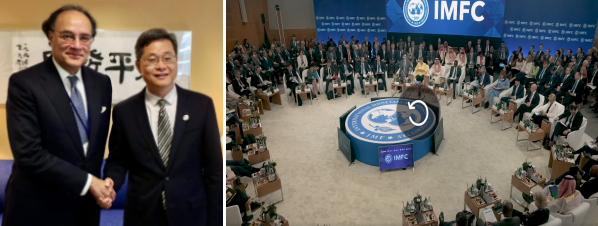
Left: China’s Finance Minister Lo Fo’an (right) meeting Pakistan’s Finance Minister Muhammad Aurangzeb at the Executive Board meeting on February 26. Right, the formal photo record of the board meeting has omitted Lo.
In Friday’s press conference, Lavrov was asked several questions about BRICS support for Iran in the current war. “Indeed, contradictions have manifested themselves,” he said, “between these two countries [Iran, United Arab Emirates]. In discussions of this kind, as in the discussion of any other conflicts, one must bear in mind the need to concentrate on matters of paramount importance… I do not think that the [BRICS] group must necessarily lay claim to the role of moderator, but individual BRICS members could take this on, especially those who are, one way or another, interested in ensuring that there are no problems in the Strait of Hormuz and in the Persian Gulf. For example, India, in its capacity as chair, is directly dependent on oil supplies, including from this region. Why not offer its good offices, including as the country chairing BRICS, and invite Iran and the UAE, to begin with, to talk to each other and ascertain how to prevent enmity. And this enmity is being instigated from outside. I have not the slightest doubt that one of the tasks of the aggression against the Islamic Republic of Iran was precisely to prevent the normalisation of relations and even to create new problems in these relations, to antagonise Iran and its Arab neighbours. We must pursue precisely the opposite objective. Pakistan is currently helping to establish a dialogue between Iran and the United States. This aims to resolve the immediate problem – the ongoing crisis. In the long term, the role of such an intermediary, a mediator between Iran and its Arab neighbours, could well be played by India, given its considerable diplomatic experience and standing.”
Lavrov’s question was rhetorical. India has refused to play a mediation role because Prime Minister Narendra Modi has supported Israel and the US in their war from the beginning. For detailed analysis, read this and this.
What exactly did India do as the presiding chairman of BRICS for this year, and leader of the foreign ministers conference, to include mention of Iran in the concluding statement, Lavrov was asked. His response was telling but discreet. “I mentioned earlier and as the foreign minister [Jaishankar] assured us, a statement by the Indian chairmanship will be issued later today.” As Lavrov already knew, the Indian statement was fulsome but also empty.
In the official Indian chairman’s statement, there are 63 paragraphs, 8,148 words. Not one of them referred to Iran. Neither was the United States mentioned. Israel was identified for attacking Gaza, the West Bank of Palestine and Lebanon, and told by BRICS: “Israeli forces from the Gaza Strip and all other parts of the Occupied Palestinian Territory, the release of all hostages and detainees held in violation of international law, and sustained and unhindered access and delivery of humanitarian aid… and to withdraw its occupying forces from all of the Lebanese territory, including the five sites in Southern Lebanon in which they remain.”
In this fashion, Foreign Minister Jaishankar had taken the side of the US, Israel and the UAE against Iran, just as Modi had done in Israel on February 25. That, as Lavrov was revealing, was the reason his proposal for India to act differently had been rejected.
Lavrov had been more explicit two days earlier in an interview with Indian journalists. “If our Indian friends are interested, I think we would only welcome if BRICS could play a proactive role in helping overcome the crisis in the Strait of Hormuz. We are not chairing BRICS, but as participants in BRICS we suggested drafting a statement. However, irreconcilable differences emerged between Iran and the UAE while we worked on coordinating the draft, which prevented this statement from materialising. I think that at the Ministerial Meeting, which is scheduled to open the day after tomorrow in New Delhi, if the chair [Jaishankar] proposes to come back to the topic and discuss it on its merits while setting emotions aside by focusing on the root causes of the current developments, we would support an initiative of this kind.”
Jaishankar didn’t.
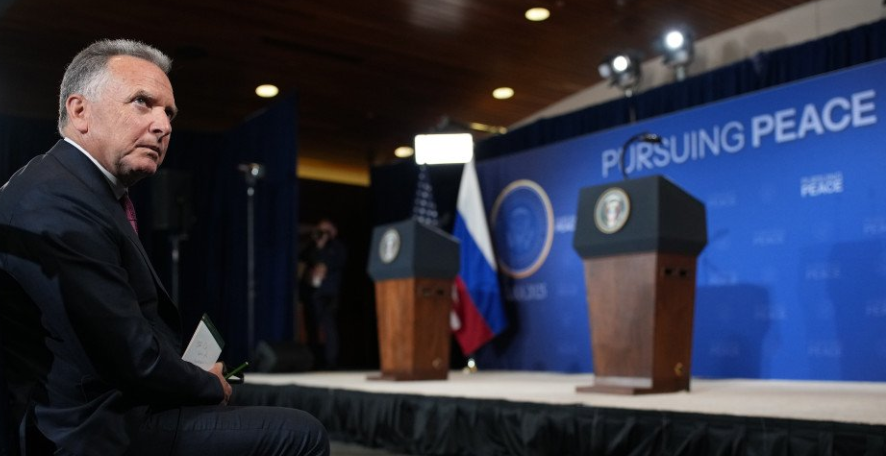
Steven Witkoff sitting in the front row at the press conference of Presidents Trump and Putin in Anchorage, August 15, 2025, before the session began. “We’re on the path for the first time. We are seeing accommodation more than we’ve seen in the past, certainly more than we saw in the last administration. And that’s encouraging. Now we have to build on that,” he claimed to the US press at the time.
Lavrov also went further than any Russian official in explaining what exactly had been the Anchorage Formula which President Vladimir Putin and his Kremlin supporters claim the Trump Administration agreed to at the Alaska summit meeting of August 15, 2025; for detail on the Anchorage Formula, read the backfile.
“We have always said,” Lavrov said, “that we have clear understandings following the talks held in Anchorage, Alaska, on August 15, 2025. As a reminder – we have discussed this repeatedly, and President Putin has mentioned it – a week before that summit, President Trump’s special envoy, Steve Witkoff, visited Moscow. He brought with him American ideas on how to achieve a long-term, sustainable resolution to the conflict in Ukraine. Those ideas were based on the US understanding of the root causes of the current crisis, including, as President Trump has repeatedly stated, the view that Ukraine’s involvement in NATO is unacceptable, as well as the recognition of the realities on the ground resulting from the referendums held in the relevant territories. Based on that understanding, Mr Witkoff brought the relevant proposals to Moscow. We took them into consideration.”
“A week later, during the meeting in Alaska, President Putin said he was prepared to support this American initiative – all of these American proposals. I should mention (I hope I am not revealing any great secret) that our President listed all the American components of these proposals one by one. After each component, Mr Putin turned to Mr Witkoff, who was present at the talks, and asked whether he was accurately presenting what the special envoy had brought. All these questions were answered in the affirmative, and so the Alaska meeting concluded with an understanding.”
Two days earlier, in an interview with Indian reporters, Lavrov had explained what had followed the “understanding”: “We have communicated at the levels of heads of the US State Department and our Foreign Ministry, and the Aide to the President of Russia holds meetings with President Trump’s special representative. Many good words are being said about the enormous potential for mutually beneficial, modern, technological, energy-related, and other projects between Russia and the United States. However, nothing is happening in real life…”
Was Lavrov saying there is an Anchorage Formula still, or nothing but Witkoff’s say-so, backtracking, change of mind and terms, and cover-up?
“I just want to reiterate,” Lavrov added on May 15: “this never meant that we would publish the Anchorage decisions and everything would be settled overnight. The basic principles were agreed there. But there remain many issues that require more detailed consideration. Such consideration will become possible as soon as we confirm the Alaska agreements. I hope this happens sooner rather than later. As Russian President Vladimir Putin has stated, we will achieve the goals of the special military operation under any circumstances. Preferably through diplomatic means, but if not, we will continue to do so within the framework of the special military operation.”




Leave a Reply