


By John Helmer, Moscow
@bears_with
During the Battle of Bến Tre, Vietnam, in February 1968, a US Army major was quoted as telling a reporter for Associated Press after an artillery barrage and air bombing of the provincial capital and its 75,000 inhabitants: “it became necessary to destroy the town to save it.” Because the soldier was never named, and the reporter who made the quote famous is dead, it isn’t certain the words were ever said.* The American warfighting intention, however, was certain. Also certain is that in seven more years of war, the US was defeated by the Vietnamese whom it aimed to kill at Bến Tre.
The Governor of the Central Bank of Russia (CBR), Elvira Nabiullina, is certain that if the war against the US and Europe continues on the Ukrainian battlefield, Russia will be destroyed. Nabiullina is certain because she will destroy it in order to save it. She declared her intention in a speech to State Duma policy committees on Monday, November 9.
“Attacks on our oil refineries, other industrial facilities, data centers, and logistics hubs,” Nabiullina said, according to Tass excerpts of her speech, “have constrained production capacity. We believe this is a temporary situation, as both the business sector and the government are making tremendous efforts to restore the affected facilities. As long as this recovery process remains incomplete, demand should grow at a moderate pace. There is no question of a decline in GDP, but excessive growth in demand under current circumstances could accelerate inflation, which is necessary to avoid… The period of tight monetary policy that we are currently experiencing is a necessary step toward low inflation and moderate interest rates…this path must be followed to the end…It is too soon to rush into cutting the key rate [14%]. That would lead to the opposite of the intended result: an increase in interest rates across the economy, rising prices, and new difficulties for our businesses.”
There is no record of the questions asked by Duma deputies. The CBR has not published the full text of the speech.
Instead, a press release of November 5 acknowledges that the war against the Russian economy may continue beyond “temporary”, and that if spending on the military budget grows in the meantime, Nabiullina will react by raising the key rate above 14%. “Proinflationary risks associated with a long period of wage growth outpacing productivity growth as well as with a deterioration in the global economic outlook and rising global price pressures amid geopolitical tensions are still in place. Disinflationary risks involve a more significant slowdown in domestic demand. The Bank of Russia takes into account the announced parameters of fiscal policy. On the medium-term horizon, fiscal policy will help slow down inflation. Changes in the fiscal policy parameters may require an adjustment in the monetary policy pursued.”
In CBR-speak, “geopolitical tensions” means the war against Russia in the hinterland and , on the high seas. “Changes in the fiscal policy parameters” means a growing state budget deficit as tax revenues from the shrinking economy fall, and the expenditures required for defence and security rise.
This isn’t new. Nabiullina has been attacking the military budget, and by implication the war, since the Special Military Operation began in February 2022.
For the time being, there is almost no public Russian criticism of Nabiullina, not even as the end of her third term approaches and the Kremlin must decide soon what to do with her post at the CBR. The polls show Nabiullina’s line is unpopular. However, her name is generally unrecognized: it is off the bottom of the current list of state officials whose performance voters say they approve. Her name was last recognized in voter polling of trust and distrust in 2020, almost at the bottom of the list. In earlier polling, Russian women don’t recognize her for “Woman of the Year”.
After hearing Nabiullina at parliament on Monday, Mikhail Delyagin, a Duma Economic Policy Committee deputy chairman, has responded guardedly: “sometimes there is a feeling that this control [of the economy] is carried out on the basis of methodical and consistent trampling of common sense. And from ignoring reality. You can ignore reality in some local matters. For example, thinking ‘what is the reason for the price increase in Russia?’ You can turn a blind eye to the arbitrariness of the monopolies, continuing to lament some ‘inflationary expectations’. But if ignoring reality becomes something that isn’t episodic, if the desire to vigorously pursue reality leads you, in catching up, to trample it, and this becomes an everyday habit, then it penetrates into all spheres of your activity. Then you start explaining with Orwell.”
Delyagin called on the CBR to “limit financial speculation. Tomorrow we [should] make the credit available. Affordable credit is a 2% key rate. Otherwise, money will all go to the currency market…and to other speculative markets.”
In Nabiullina’s defence, Vzglyad, the Kremlin-supported internet publication on national security policy, has now published a report in which experts from the Moscow money and credit markets are quoted to repeat and endorse the CBR line, without demurring on the CBR’s calculations of economic recession and stagnation – and also without referring to the war.
The timing of Nabiullina’s declaration on the eve of the Abdu Dhabi talks with the US and the Ukraine is not accidental. Nabiullina is attempting to provide President Vladimir Putin with an alibi for terms of agreement, including territorial concessions and the policing of security arrangements inside Ukraine by NATO and the US, which are intended to convince (override) criticism from the General Staff and Defense Ministry, and from the sceptical media. Sources in Moscow believe, as one says: “At this stage this is mathematical and not a matter of wish and will. All the sides are exhausted. Everybody needs a deal to last for two to five years.”
This is the Kremlin Wall alibi. It is saying the terms of agreement which the US has drafted with European and NATO agreement, and tabled in Abu Dhabi this week, should be accepted now so that the economic recession and pauperisation which Nabiullina is promising for the next two years can be avoided.
The run-up to the Abu Dhabi negotiations is discussed in the Reason2Resist podcast with Dimitri Lascaris, recorded late last Saturday evening, Montreal time: https://www.youtube.com/watch?v=DaIsGp3flyU There is more elaboration of the war weariness factor on Russian, European and US decision-makers in Jeff Rich’s Burning Archive podcast, record on Monday morning, Eastern Australia time: https://www.youtube.com/watch?v=AdVgVFyybBI
The Vzglyad defence of Nabiullina was written by its senior economic analyst, Olga Samofalova, and published on Monday morning, Moscow time (November 10). It has been translated verbatim into English without cuts or edits. Charts have been added to clarify for readers what Vzglyad expects its readers to know already.
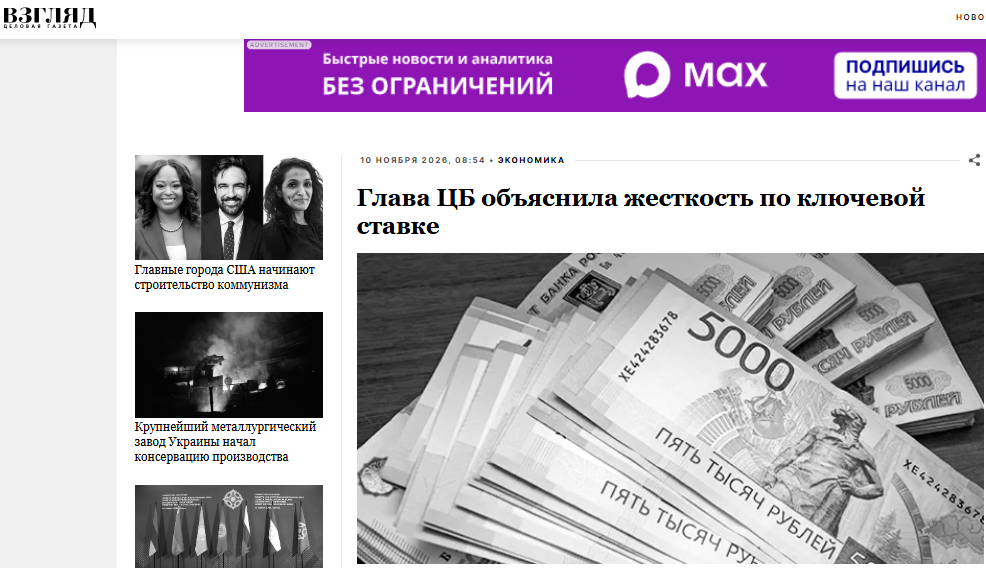
https://vz.ru/economy/2026/11/10/1445857.html

November 10, 2026
The head of the Central Bank explained the rigidity of the key rate
By Olga Samofalova
The situation with the Central Bank’s key rate this year did not go according to plan, inflation deviated too much from the desired one. In 2027, the rate should continue to decrease, at least in the baseline scenario, said Central Bank Governor Elvira Nabiullina. However, it is impossible to completely rule out the situation when the rate will have to be raised again. What is the forecast for 2027?
The key interest rate in 2027 will decrease in the baseline scenario, but it will remain in double digits throughout the year, the head of the Bank of Russia, Elvira Nabiullina, said in the State Duma. According to her, if you hurry up with a rate cut, it can harm the economy.
NABIULLINA’S KEY RATE AS WAR WEAPON
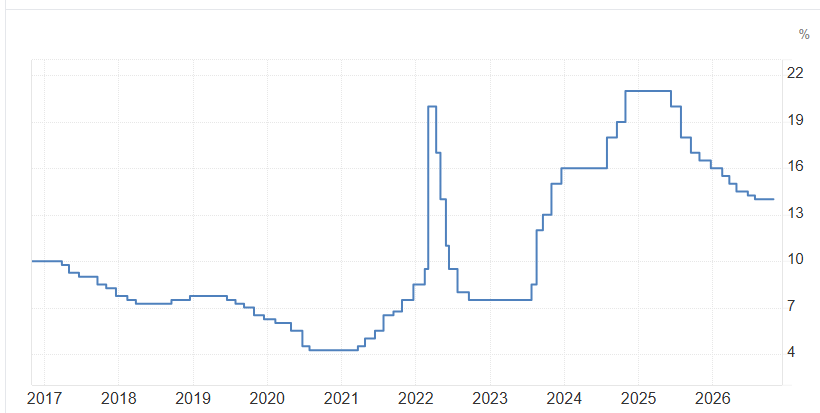
Source: https://tradingeconomics.com/russia/interest-rate
The head of the Central Bank called for making preferential mortgage programs targeted, citing the example of a family mortgage, which will help increase the share of market mortgages and reduce inflation faster than massive non-targeted preferential programs. “The period of tight monetary policy that we are currently going through is a necessary stage on the path to low inflation and moderate interest rates,” Nabiullina said. According to her, it is important to go “this way to the end,” especially if we can no longer rely on funding from abroad. “Of all possible taxes, a high price increase is the most unfair tax, it hits the most vulnerable people. Therefore, we are determined to reduce inflation and end the period of high inflation,” Nabiullina said.
In order to reduce the key rate faster, it is necessary that there be an accelerated increase in the supply of goods and services. As capacity is restored and labour productivity increases, there will be room for a reduction in the key rate, Nabiullina says.
We are talking about the return of a positive output gap: demand is greater than supply, which leads to inflation. To prevent this from happening, demand growth must be contained for now, explains Olga Belenkaya, Head of the Macroeconomic Analysis Department at Finam. Therefore, the Central Bank’s base forecast for the key rate for next year has been raised to 12.5-13.5% from 10.5%-12.5%. This means that the rate may approach 10-11% by the end of the year. But for this baseline scenario to work, it is necessary for inflation to return to the 4% target as early as 2027. If inflation at the end of 2027 is higher and amounts to 4.5-5.5%, then the average rate will not decrease from the current level of 14%, but may even rise to 16%, Belenkaya notes. This is an unfavourable scenario.
In total, in addition to the baseline scenario, the Bank of Russia is considering one more favourable and two unfavourable ones. “In a disinflationary (favourable) scenario, with faster productivity growth, high return on investment and lower price pressure, the average Central Bank rate may reach 10-12%, and drop below 10% within a year. In the first pro-inflationary (unfavourable) scenario, due to stronger budget demand, wage growth faster than productivity, and supply constraints, the rate may be in the range of 14-16%,” says Pavel Zholobov, Associate Managing Director of the NRA rating service.
NABIULLINA’S UNFAVOURABLE SCENARIOS FOR STAGNATION, RECESSION
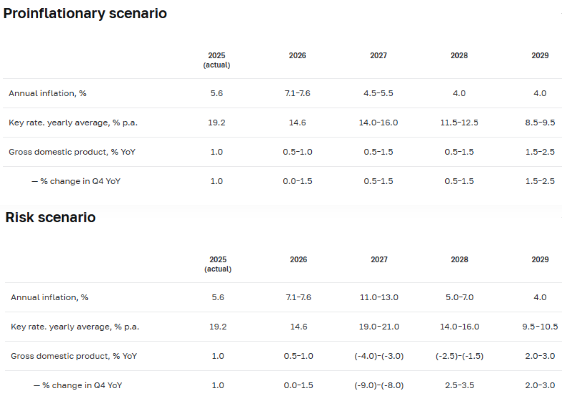
Source: https://www.cbr.ru/eng/about_br/publ/ondkp/on_2027_2029/ -- released on October 30, 2026
For the second unfavourable scenario to work, a severe external crisis must break out, oil prices must go down, and sanctions against Russia must intensify. In this case, the Bank of Russia allows for an acceleration of inflation to 11-13% and an average key rate of 19-21%, Zholobov notes. “Elvira Nabiullina’s main signal is that the regulator does not intend to lower the rate in order to support lending and economic growth,” Zholobov says. Because the Central Bank’s main goal is to bring inflation to the target 4%. In 2026, according to the regulator’s forecast, it will amount to 7.1-7.6%. “Low-income households spend most of their budget on current consumption and have fewer opportunities to protect savings from depreciation. Inflation in Russia remains high due to a combination of steady demand, supply-side constraints, rising costs, fiscal momentum, and elevated inflation expectations,” says Zholobov.

“One of the Bank of Russia’s concerns is the rate of credit growth and money supply growth above values consistent with sustained inflation near 4%, which shows a slowdown in October, although it is difficult to call this a stable trend so far”, says Belenkaya. According to her, the restraining factors for inflation in October were the corrective decline in gasoline prices, a slight strengthening of the ruble in October and the continued decline in prices for travel services. However, food products are increasing in price at an accelerated rate, given that food products are the largest part of the consumer basket, this may hinder a decrease in inflation expectations from levels close to their maximum in two years, the expert adds. Therefore, there is a chance of slowing inflation, but there are also factors for its growth.
[*] According to a variant of the US Army version, the Vietnamese victims of the US destruction were to blame for the outcome. US Air Force bomber pilot, Major James Gibson, told the press: "The way we selected these targets was determined by the VC. They chose the battleground and we really had no choice where we put the target." Targeting has a slightly different meaning in Nabiullina’s speech to the Duma. To reduce inflation by suppressing demand in the economy, she said proposed further “targeting” of the state subsidized home mortgage programme, restrictive measures for which came into effect last month. Nabiullina has not proposed ending the dual system of preferential credits which has not only benefited the traditional oligarchs, but has also siphoned cheap money to war-related manufacturing and financial speculation out of the real economy.
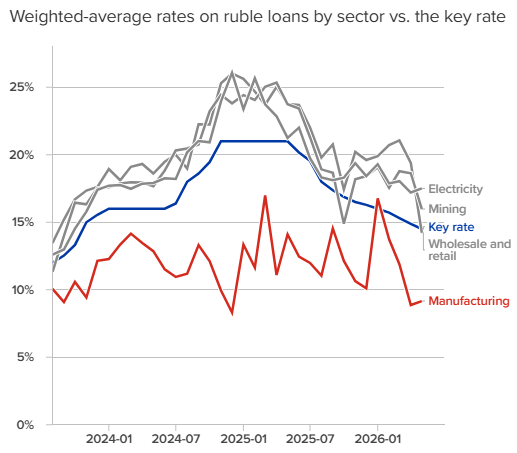
“High key interest rate affects only the part of the market where market rates apply. Loans subsidised in one way or another by the state are not sensitive to the key rate level. The larger the share of non-market loans, the higher the rates need to be for others. Preferential loans may even have a more inflationary effect compared to direct budget injections, due to the creation of financial leverage, agree analysts from Raiffeisenbank. For example, by taking out a preferential loan, a company can use it as part of collateral to secure a new loan.”







Leave a Reply