

By John Helmer, Moscow
@bears_with
As they study the record of the US negotiations for an end to the Iran war, Russian and Chinese intelligence reporters have recently concluded that President Vladimir Putin should now refocus his talks strategy on Vice President JD Vance; ignore Steven Witkoff and Jared Kushner, discredited by their performance in Israel and Iran; and put an end to the role with the Americans of Kirill Dmitriev.
Russian sources with direct knowledge say the Chinese assessment of Dmitriev, leaked through Hong Kong and Singapore, is even more scathing than Foreign Minister Sergei Lavrov’s. His private condemnation of Dmitriev’s performance has surfaced in publicly expressed scepticism towards the trust-in-Trump (TiT) interpretation of the Anchorage Formula which Dmitriev promotes.
The trust-in-Trump line was put on display on Sunday (June 14) when Putin claimed to be the first foreign leader to telegraph Trump with 80th birthday wishes, and an hour later elaborate in Putin’s fluent English over the telephone with Trump for forty-five minutes.
According to Putin’s spokesman Yury Ushakov, Putin “highlighted the exceptional character traits of the man he was honouring – traits that contribute to his success both as a person and as a politician. Donald Trump was touched by the remarks and thanked Vladimir Putin, noting that he was the first foreign leader to call him at the White House… I will even let you in on a secret: Donald Trump is not entirely thrilled by the number 80, as he is full of energy and vigour.”
Asked by a knowing Russian journalist if Putin had sent “birthday gifts” to Trump, Ushakov said no on the line, yes below the line: “No gifts were sent but, as I have already said, the greetings were quite warm and reflective of the relations between the two presidents.”
“Relations between the two presidents” mean the bribery schemes through which Dmitriev, Witkoff and Kushner have been negotiating their version of the Anchorage Formula since the presidents’ summit meeting in Anchorage, Alaska, last August. They have included a scheme to convert the $300 billion of Russia’s frozen Central Bank foreign currency assets into a fund for investment in the Ukraine and in the new Russian territories – a fund to be co-managed by nominees of Dmitriev, Witkoff and Kushner.
The consensus of Russia’s Security Council, however, including the General Staff, military intelligence chief Admiral Igor Kostyukov, deputy Council chairman and former president Dmitry Medvedev, and Foreign Minister Lavrov is that the bribery schemes have come, will come to nothing.
In the assessments of foreign officials to whom these Russians have confided – the Hong Kong and Singapore sources now claim – the trust-in-Trump (TiT) strategy has failed because Trump cannot deliver the US security guarantee for Russia in Europe. The alternative is the Vanchorage strategy at the White House, which, the sources expect, will gain in domestic strength after the Congressional elections in November, and in the race for the presidential succession to follow.
Likewise, the announcements of the memorandum of understanding for the staged end-of-war with Iran — initialled by US and Iran officials, scheduled for official signing on Friday — reveal that the Iranians and Americans have tacitly agreed it will be Vance, not Trump’s men, Witkoff and Kushner, who is now relied upon to finalize the terms during the 60-day ceasefire stage.
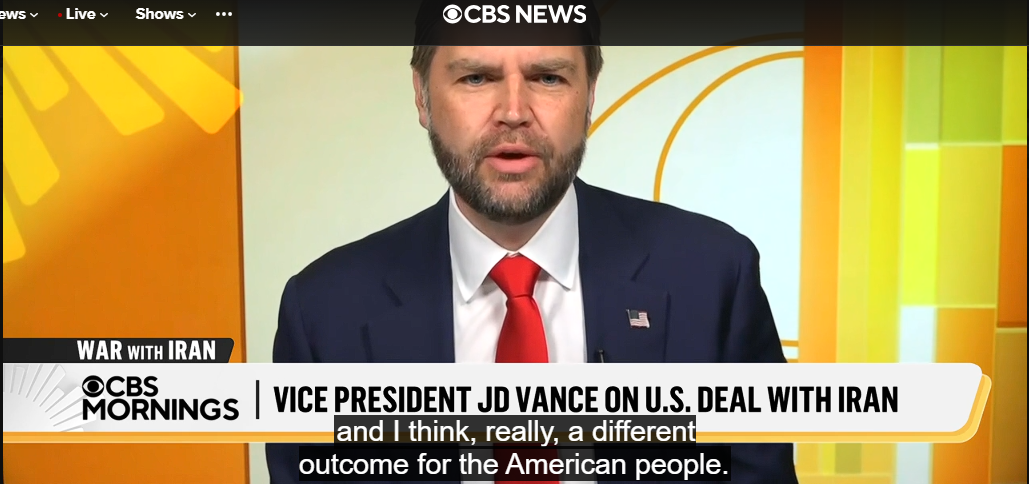
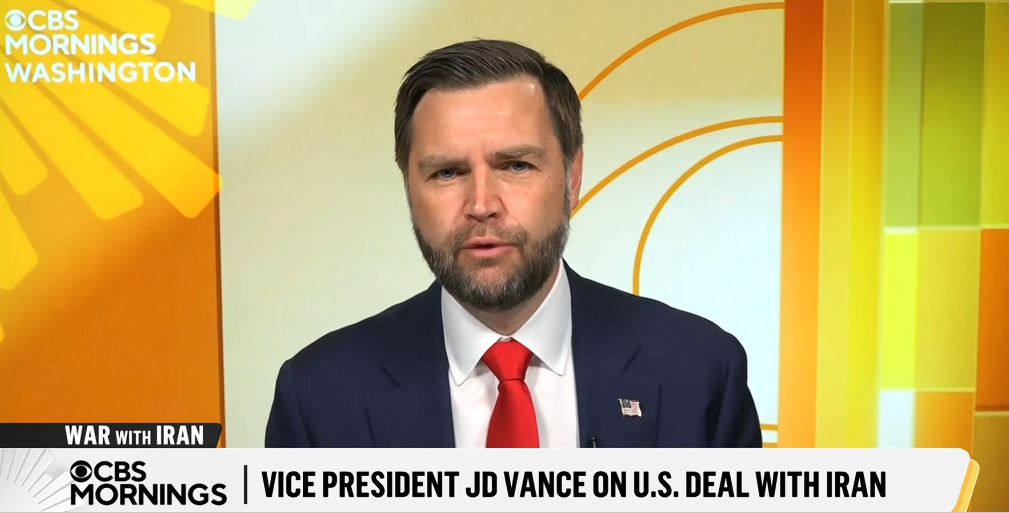
Vance signalled he is taking this lead in a seven-and-a-half minute briefing televised by CBS on Monday. This is the Vanchorage Formula he agreed with Trump during the birthday celebration at the White House over the weekend. Vance agrees on the concession terms between the two sides; Trump has accepted the risk of deal failure but is claiming the public credit for deal success. Trump, in the Vanchorage Formula, is also responsible for pacifying the regime in Tel Aviv and the Jewish community in Washington.
“We certainly expect the Israelis will be a participant in this process,” Vance told CBS. “But we think it’s going to be good for them. It’s going to be good for us. It’s going to be good for the Gulf Coast coalition…and if the Iranians comply with their end of the bargain, it’s going to be good for Iran.”
According to the confidential sources, the European leaders who promise continuity in the war against Russia “see and understand Russia and Putin’s system far better than Dmitriev and Putin can acknowledge, and so they are hitting at it. Putin’s best chance now is to follow the Iranian lead on military escalation and Vance’s lead on negotiation.”
Here is Vance’s briefing on the terms of the Memorandum of Understanding with Iran, and the US end-of-war strategy: “Look, if you guys are willing to honour your obligations…if you are willing to allow real inspections of your nuclear program, then we will welcome you back into the world economy. I think what the President of the United States wants to do is to turn over a new leaf after 47 years of failed relationship between the United States and Iran.”
Here is Lavrov’s first statement of the Vanchorage Formula at a press conference in Minsk on Monday afternoon:
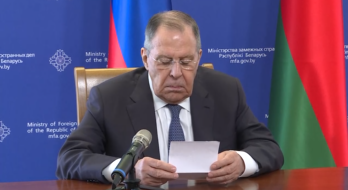
Excerpt: “Yesterday, a telephone conversation took place between Russian President Vladimir Putin and US President D. Trump. They were concerned with this topic. Trump confirmed that he was interested in promoting the search for fair long-term solutions to the Ukrainian crisis. Let’s now see what concrete steps the United States will take. We still expect that the agreement between the two presidents, reached on August 15, 2025 in Alaska, will be implemented. Moreover, its key components were proposed by US President Donald Trump and adopted by Russian President Vladimir Putin. This would be the first major stage in ending the conflict and would allow many other details to be agreed upon. The U.S. 27-point plan was also mentioned. We had and still have questions to him, but we were ready to take it as a basis as soon as the Alaskan agreement came into force. If that happens.”
“As Russian President Vladimir Putin has noted, developments are unfolding in a situation where the West is failing to honour its commitments and where agreements reached in Alaska are being undermined by the policies pursued by the European Union and the United Kingdom. Under these circumstances, President Putin emphasised that the outcome is being determined on the frontlines by our servicemen, in whom the entire country places its hopes… over the past almost six months, Trump has been absorbed primarily by the crisis in the Strait of Hormuz. May God grant that the arrangement that has just been announced will be implemented. We hope that, as announced by the Assistant to the President of Russia Yu.V. Ushakov, S. Witkoff and J. Kushner are again going to come to us. We hope that they will somehow explain how Washington sees the prospect of implementing the agreement in Alaska, which will soon celebrate its first anniversary.”
And here is the bribery scheme in the US-Iranian Memorandum of Understanding, as leaked to the Financial Times:
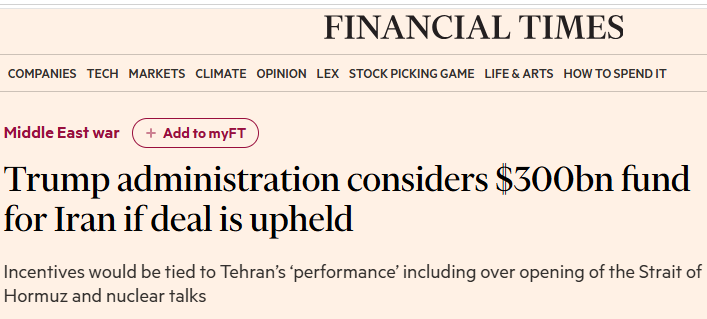
Excerpt: “A senior US official said Washington had discussed the possibility of sanctions relief and ‘a big $300bn fund to rebuild their country’. The incentives would be connected to Iran’s ‘performance’ adhering to the memorandum of understanding that is to be formally signed in Switzerland on Friday. A person briefed on the talks said the establishment of the fund would be contingent on a final settlement that is part of the MoU and would follow an extension of the ceasefire by 60 days, the reopening of the Strait of Hormuz and further negotiations on a nuclear deal. They added the fund would not come from governments and instead would be created for companies keen to invest in the nation of 90mn with abundant energy resources. The structure and management of the fund were not immediately clear. ‘There is interest from a lot of businesses in Europe, a lot in Asia, South Korea, Japan etc, and American companies and businesses as well,’ the person said. ‘If the sanctions are lifted, this fund would be a significant amount and it will be huge.’ The $300bn reconstruction fund would be ‘the sort of thing [Iran] could have access to . . . so long as they honour their end of the obligation,’ vice-president JD Vance told CBS News.”


Leave a Reply