-  Print This Post

By John Helmer, Moscow
At your peril, the one thing you must never say to a ranking Israeli intelligence officer, even one in mufti or retirement, is that he is suffering from a superiority complex. For the clinical symptoms of the affliction include conceptual deafness, ideological blindness. These stem from the frontal-lobe idea that the victim earned victory over his adversaries by his own wits; that those wits are unbeatable; and that accordingly he can never be bested or made to look stupid or act the fool.
In strategy, this leads to the first law of Barnum (of American circus fame) – there is a sucker born every minute. The second Barnum law is that the first starts with yourself.
(more…)
by John Helmer - Sunday, January 20th, 2013
No Comments »
- Print This Post
By John Helmer, Moscow
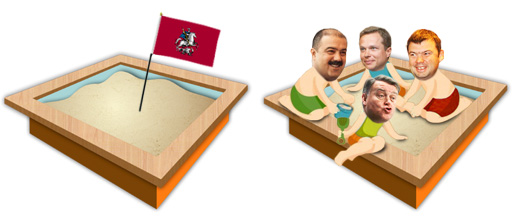
The old oligarchs, and several new aspirants, have a new playground in the Russian transportation sector, where their profits are guaranteed by the state budget. Carrying cargo from mine and wellhead to plant and port, and back again from port to market, is already profitable in conventional terms, and so the state assets, once part of the state railways monopoly, are the target of active lobbying for special favour. Carrying passengers around the biggest conurbation in the country – Moscow – is another target. But because passenger fares are regulated and subsidized by the state, the profitability of transporting them is more restricted than cargo transportation. It is also better hidden. Still, the game rules for privatization are the same as they were in the natural resource, energy and mining sectors – buy cheap (corruptly), sell dear (offshore).
In general, purchasing assets from the state on the cheap means the acquiescence of state officials in low-ball privatizations, or non-competitive “strategic placements”, paid with state bank loans on soft securization terms, subsidized interest rates, non-market repayment guarantees: everyone knows these are administrative measures requiring extras.
(more…)
by John Helmer - Thursday, January 17th, 2013
No Comments »
- Print This Post

By John Helmer, Moscow
Last month Oleg Deripaska authorized a Washington lobbyist he employs to submit to the US Department of Justice the claim that Deripaska meets with American “businesspeople to assess economic development in the United States in connection with his role as an economic advisor to the President of the Russian Federation.”
The lobbyist Adam Waldman is paid $40,000 per month, plus expenses, from the offshore revenues of United Company Rusal to make this claim part of a case Deripaska has advanced in Washington for several years, trying to overturn the US Government ban on his receiving a regular visa for entry to the country.
(more…)
by John Helmer - Thursday, January 17th, 2013
No Comments »
- Print This Post

By John Helmer, Moscow
The Russian tactic of giving an adversary an exit through which to escape was coined by Marshal Mikhail Kutuzov (left) during the war against Napoleon. He called it the “pont d’or” (golden bridge). The meaning was that Napoleon and his army should be allowed to retreat out of Russia, harassed, starved, diminished, but not annihilated. Kutuzov’s reasoning was strategic. It was not worth the risk and cost to the Russian army of a struggle to the death with the French. Worse, Kutuzov thought, if Napoleon were totally destroyed, there would be nothing to stop the British from emerging to threaten Russia more powerfully than the French had been capable of.
“You don’t realize,” Kutuzov talking to a subordinate in November 1812, as Napoleon and his stragglers crossed the Dnieper river, “that circumstances will in and of themselves achieve more than our troops.And we ourselves must not arrive on our borders as emaciated tramps.” And in a put-down of Sir Robert Wilson, a known English spy at the tsar’s field headquarters: “I am by no means sure that the total destruction of the Emperor Napoleon and his army would be of such benefit to the world; his succession would not fall to Russia or any other continental power, but to that which commands the sea, and whose domination would then be intolerable.”
Is the golden bridge still a doctrine of Russian strategy, and if so, who will express it?
(more…)
by John Helmer - Tuesday, January 15th, 2013
No Comments »
- Print This Post

By John Helmer, Moscow
A donation of $2,500 to the “Obama Victory Fund”, the US president’s election campaign fund, was made on October 12, 2012, by an American lobbyist engaged by Russia’s Foreign Minister, Sergei Lavrov. This is according to a filing last month by the US agent acting for Lavrov named Adam Waldman. He reported the payment to the Foreign Agents Registration Act Unit, a branch of the National Security Division of the US Department of Justice on December 19. Direct or indirect political donations by foreign nationals are illegal under US election financing law and its regulations.
The money trail which linked Lavrov to Barack Obama’s campaign treasury goes through a company registered on the Channel Island of Jersey. That in turn conceals secret shareholders of United Company Rusal, the Russian aluminium monopoly controlled by Oleg Deripaska. At least one of those shareholders may be another Russian government official of higher rank than Lavrov’s.
(more…)
by John Helmer - Monday, January 14th, 2013
No Comments »
- Print This Post

By John Helmer, Moscow
Patrick Leigh Fermor (d. June 11, 2011) was to travelogues what Christopher Hitchens (d. December 15, 2011) was to journalism – a race to show off. Veracity was always a scratching if verisimilitude would run better – and if serious money was at stake. Heiresses made the best mounts, and once in the saddle, Leigh Fermor’s grip, compared to Hitchens’s, was the firmer; though their prolix charm had the same finishing line. Leigh Fermor, according to Somerset Maugham, was “a middle class gigolo for upper class women”.
Between the legs of princesses there may not be much a British hero can learn that he can’t acquire by galloping his horse and discharging his weapon at common or garden beasts – pheasants, rabbits, foxes, and Transylvanian crayfishes. Leigh Fermor did all of that. But in spite, or perhaps because of, his entire five-year war against the Germans, he fired only once, killing Yannis Tsangarakis, a Cretan member of the partisan unit Leigh Fermor, a junior officer in the Special Operations Executive (SOE), was supposed to be leading. The shooting is now accepted as an accident.
(more…)
by John Helmer - Monday, January 14th, 2013
No Comments »
- Print This Post

By John Helmer, Moscow
When it comes to laughing at satire and caricature, tastes change. Laughable drunkenness in one generation is as hilarious as the comedians Yury Nikulin, Georgiy Vitsin, and Yevgeny Morgunov were on the Soviet screen together. Nowadays the display of alcoholism is sad – take the Russian movie actor Gerard Depardieu, for example. Likewise, it hasn’t encouraged the current generation of book readers that Mikhail Saltykov-Shchedrin used to make Vladimir Lenin laugh; and that when they were students, Lenin’s brother Alexander and sister Anna used to visit the writer in his old age at home in Tver. Russian interpreters these days warn against reading the old man because the social conditions he made fun of have long ceased to exist.
(more…)
by John Helmer - Sunday, January 13th, 2013
No Comments »
- Print This Post
By John Helmer, Moscow
“I can promise to say nothing that is untrue”, wrote Giuseppe di Lampedusa, the Sicilian prince, the Italian writer, when introducing a chapter of his brief memoirs. “But I shall not want to say all; and I reserve the right to lie by omission. Unless I change my mind.”
If somebody wants it badly enough, the Russian government can still be induced to ban writers, exile them, or allow them to be beaten up or killed without recourse. So there are things that cannot be written, because the risk and the threat are too great. For that reason, no differently from the Soviet period, there remains much that must be understood by omission, between the lines. This past year wasn’t different in this respect from the previous one, and on the present signs, it isn’t likely the new year will see much change.
(more…)
by John Helmer - Saturday, December 29th, 2012
No Comments »
- Print This Post

By John Helmer, Moscow
Russians have an uninhibited good humour at this time of year, but Alisher Usmanov aims to be the spoiler, holding his nose over all the treats. According to Usmanov, the transaction “has the smell of the 90s and oligarch conspiracies. It’s not acceptable for us.”
Usmanov is referring to the transaction, confirmed on December 11, by which Roman Abramovich’s Millhouse holding acquired control of 25.87% of Norilsk Nickel’s shares for the price of 5.87%; Vladimir Strzhalkovsky received $100 million in cash; and Oleg Deripaska as the trustee with the control stake in United Company Rusal will receive a 48.13% share of Rusal’s 27.8% share of $10.9 billion in dividends to be paid out of the Norilsk Nickel treasury over the next three years – that’s $1.46 billion.
(more…)
by John Helmer - Friday, December 28th, 2012
No Comments »
- Print This Post
By John Helmer, Moscow
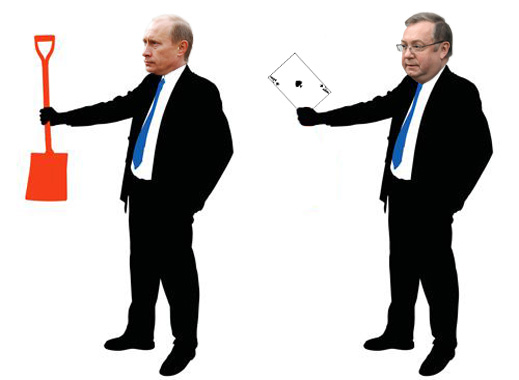
Sergei Stepashin (right) was the prime minister of Russia for three months before Vladimir Putin (left) was appointed to the job in August 1999. Before that, Stepashin was the head of the Federal Security Service, Minister of Justice, and Minister of Interior. He also has a doctorate; a professor’s rank in civvies; and in the military the rank of Colonel-General. For a while in 2005 he was Boris Yeltsin’s preferred candidate to succeed him as president. He is now in his third term as the head of the Accounting Chamber, having been nominated by the Kremlin and accepted by the State Duma in 2000, 2005, and 2010.
The chamber’s job is to scrutinize the spending of public funds and where possible uncover and expose abuses and corruption. It’s the Russian equivalent, in constitutional duty at least, of the Government Accountability Office in Washington, or the National Audit Office in London. Unless he jumps or is pushed, Stepashin is in office until the end of 2017. By the standard of officials of the post-communist period, Stepashin has the right stuff.
(more…)
by John Helmer - Thursday, December 27th, 2012
No Comments »