On Sunday afternoon the Russian Defense Ministry confirmed that a massive strike of air and sea-launched missiles and drones have struck and destroyed parts of the Ukrainian electricity grid in the western regions of the country, as well as in Odessa and Nikolaev in the southeast.
The Mukachevo interconnector station in southwestern Ukraine has also been hit, damaging the import of electricity from Slovakia and Moldova.
The electric war in the west by the Russian General Staff has been put on pause by President Vladimir Putin since the last major raid on August 26, while back-channel negotiators for the Kremlin exchanged armistice terms with the Biden Administration and with Donald Trump.
The resumption of Russian missile strikes on west Ukrainian electricity infrastructure follows the disclosure in Washington on Sunday that the US has agreed to allow American and Ukrainian crews to fire long-range Army Tactical Missile Systems (ATACMS) on Russian territory.
Russian military sources comment that threats to escalate the war unless Putin agrees to extend the pause and to limit the westward offensive of Russian forces along the Donbass front have come from both Biden officials, and from Trump himself when he spoke with Putin by telephone last week.
“The electric war strikes are coordinated with the ground offensives,” a military source comments. “We’re seeing the General Staff calling the bluff of both Biden and Trump with the counter threat to wind up the war before the inauguration [January 20]. That the Ukrainians in the western regions are bracing for power blackouts tell us, again, that [Chief of the General Staff Valery] Gerasimov’s staff are monitoring the Ukrainian electrical repair and replacement efforts, the weather, and the political situation in Washington. The strikes have been timed accordingly.”
Yulia Skripal communicated from her bedside at Salisbury District Hospital on March 8, 2018, four days after she and her father Sergei Skripal collapsed from a poison attack, that the attacker used a spray; and that the attack took place when she and her father were eating at a restaurant just minutes before their collapse on a bench outside.
The implication of the Skripal evidence, revealed for the first time on Thursday, is that the attack on the Skripals was not perpetrated by Russian military agents who were photographed elsewhere in Salisbury town at the time; that the attacker or attackers were British agents; and that if their weapon was a nerve agent called Novichok, it came, not from Moscow, but from the UK Ministry of Defence chemical warfare laboratory at Porton Down.
Porton Down’s subsequent evidence of Novichok contamination in blood samples, clothing, car, and home of the Skripals may therefore be interpreted as British in source, not Russian.
This evidence was revealed by a police witness testifying at the Dawn Sturgess Inquiry in London on November 14. The police officer, retired Detective Inspector Keith Asman was in 2018, and he remains today the chief of forensics for the Counter Terrorism Policing (CTPSE) group which combines the Metropolitan and regional police forces with the Secret Intelligence Service (MI6) and the Security Service (MI5).
According to Asman’s new disclosure, Yulia Skripal had woken from a coma and confirmed to the doctor at her bedside that she remembered the circumstances of the attack on March 4. What she remembered, she signalled, was not (repeat not) the official British Government narrative that Russian agents had tried to kill them by poisoning the front door-handle of the family home.
The new evidence was immediately dismissed by the Sturgess Inquiry lawyer assisting Anthony Hughes (titled Lord Hughes of Ombersley), the judge directing the Inquiry. “We see there,” the lawyer put to Asman as a leading question, “the suggestion, which we now know not to be right, of course”. — page 72.
Hughes then interrupted to tell the witness to disregard what Skripal had communicated. “If the record that you were given there is right, someone suggested to her ‘Had you been sprayed’. She didn’t come up with it herself.” — page 73. Hughes continued to direct the forensics chief to disregard the hearsay of Skripal. “Anyway the suggestion that she had been sprayed in the restaurant didn’t fit with your investigations? A. [Asman] No, sir. LORD HUGHES: Thank you.”
So far in in the Inquiry which began public sessions on October 14, this is the first direct sign of suppression of evidence by Hughes.
Hearsay, he indicates, should be disregarded if it comes from the target of attack, Yulia Skripal. However, hearsay from British Government officials, policemen, and chemical warfare agents at Porton Down must be accepted instead. Hughes has also banned Yulia and Sergei Skripal from testifying at the Inquiry.
The lawyer appointed and paid by the Government to represent the Skripals in the inquiry hearings said nothing to acknowledge the new disclosure nor to challenge Hughes’s efforts to suppress it.
Anthony Hughes, the retired judge (titled Lord Hughes of Ombersley) directing the Dawn Sturgess Inquiry in London, opened the questioning of a senior British Government chemical warfare agent on Wednesday by telling him “you’re not bound by your statement, but by all means use it to refresh your recollection” — page 5.
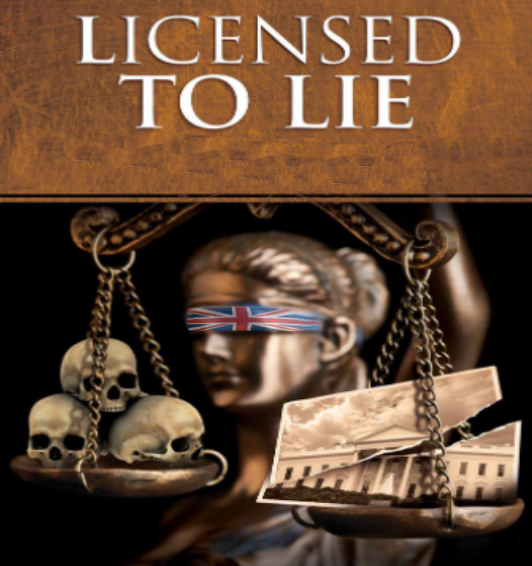
This is a licence to lie. The head of chemical and biological analysis at the Defence Science and Technology Laboratory (DSTL) at Porton Down was given the cipher MK26 to conceal his name — his face screened from view in the videotape of the hearing — to do just that.
Hughes also arranged for his assisting counsel, Andrew O’Connor KC, to give the government official this version of the witness oath. “May I ask you,” O’Connor said, “whether you have had an opportunity to read through this statement before giving evidence today? A. Yes, I have. Q. Are its contents true to the best of your knowledge and belief? A. Yes, they are. Q. Thank you.”
As Hughes and O’Connor know very well, the official oath in British courtroom practice is that witness swears his testimony “shall be the truth, the whole truth, and nothing but the truth.” In this case, the judge and his lawyer gave the witness a licence not to tell the whole truth.
Just in case these licences to lie and to evade the truth were spotted by the public, O’Connor told MK26 that he and Hughes accepted his “statement does not contain everything that you can say about these matters because there are some further issues, further material that is covered by the restriction [secrecy] orders. A. Yes, that’s correct. Q. As a result, it’s right, is it not, that you will be coming back when the Inquiry sits in its closed sessions to give further evidence and on that occasion you will be able to provide the Chair with the information which you cannot provide today? A. Yes.” — page 6.
According to the exhibits MK26 had signed for the Inquiry, of the two pages of witness statement he had signed to the police on July 16, 2018, everything has been blacked out except one short paragraph giving the official accreditation of the workshops MK26 headed at the DSTL Porton Down. A second witness statement MK26 signed for the Coroners Court on August 20, 2019, comprises five pages, but they have all been censored. The only lines which remain say: “I have complied with, and will continue to comply with, my duty to the court to provide independent assistance by way of objective unbiased opinion in relation to matters within my expertise.” At the Bar this is recognized as the Queen Gertrude defence for lying; it comes from “the lady doth protest too much, methinks”, the well-known line from Shakespeare’s Hamlet. A Defence Ministry employee cannot be independent, or objective, or unbiased in relation to his official work orders.
The political significance of the Porton Down lying has been international. It was the foundation of the claim the British Government made to its NATO allies five weeks after Sergei and Yulia Skripal’s collapse that the UK was the target of a Novichok attack by Russia.
According to a letter sent to the NATO headquarters by Sir Mark Sedwill, then the Prime Minister’s national security advisor and supervisor of intelligence operations, “I would like to share with you and Allies further information regarding our assessment that it is highly likely that the Russian state was responsible for the Salisbury attack. Only Russia has the technical means, operational experience and the motive. The OPCW’s. [Organization for the Prevention of Chemical Weapons] analysis matches the Defence Science and Technology Laboratory’s [DSTL Porton Down] own, confirming once again the findings of the United Kingdom relating to the identity of the toxic chemical of high purity that was used in Salisbury. OPCW have always been clear that it was their role to identify what substance was used, not who was responsible… of course, the DSTL analysis does not identify the country or laboratory of origin of the agent used in this attack…We therefore continue to judge that only Russia has the technical means, operational experience and motive for the attack on the Skripals and that it is highly likely that the Russian state was responsible. There is no plausible alternative explanation.”
Sedwill was lying. Porton Down was lying. OPCW repeated the lies it was given by the British. There was, there still is, a plausible alternative explanation.
In his appearance at Hughes’s hearing this week, MK26 tried to conceal this with what an independent British organic chemist with comparable expertise to MK26 describes as “camouflage science – faulty assumptions, missing chemical names, speculative findings, a day of witchcraft.”
This week’s announcements of emergency electricity rationing and scheduled power supply cuts in the farwestern Ukrainian regions of Volyn, Ivano-Frankivsk and Transcarpathia indicate that pinpoint drone targeting by the Russian General Staff is a new stage in the electric war since President Vladimir Putin put on pause long-range missile attacks on western Ukrainian power generation plants since August 26.
On Tuesday, the regional Ukrainian media reported “restrictions will apply to businesses in the Ivano-Frankivsk and Volyn oblasts starting on 13 November, in five phases, and will be scheduled from 07:00 to 20:00. The restrictions are being implemented due to damage to critical infrastructure by Russian forces and decreasing temperatures.” The national utility Ukrenergo announced that from November 13 “GOPs [power limit schedules] are being introduced due to a shortage in the energy system in the Carpathian region”.
The deficit in the current demand-supply balance for electricity has also been compounded by the decline reported in the Ukrainian press of imports of power from cross-border sources in Poland, Slovakia, Hungary, Romania, and Moldova. The reported cutback this week defies the European Union (EU) agreement at the end of October for “an increase of the export capacity limit to Ukraine and Moldova to 2,100 megawatts (MW) during this winter. It represents an increase of 400 MW from the previous value [1,700 MW]…The 2,100 MW export capacity limit will apply from 1 December 2024.”
“This is a temporary situation,” Ukraine’s energy minister Herman Halushchenko announced on Wednesday. “ ‘Unfortunately, restored generation facilities can occasionally fail. This has happened, but all these issues will be resolved, and the situation will stabilize,’ he stated. The minister also pointed to a significant reduction in electricity imports to Ukraine, which are currently down to about 100 MW.”
A military source comments: “The damage from the August attacks has not been repaired – just patched up. There have been strikes on transformer stations since. They’ve been smaller in scale but indicative of the [Russian] General Staff’s knowledge of the [Ukrainian] distribution grid vulnerabilities. The General Staff’s moves have complicated Ukrainian efforts to keep the power on. The Ukrainians are hiding how bad the situation is, including in terms of getting spares. The temperature is dipping below freezing at night, the daylight hours are shorter, the electrical lighting and heating loads are going up. The jury-rigged grid is unable to handle it without curtailments.”
Between wishful thinking and delusional thinking in normal life, there can be the psychiatrist’s couch and prescription of Prozac capsules swallowed once a day.
In politics – Russian politics are no exception – there can be media debate so that in between plan, action, and outcome it is possible to calculate the costs of wished-for success and the risks of defeat and disaster. Often, however, there is nothing in between at all — wishful turns into delusional.
In wartime, media debate is severely curtailed when the combatant states legislate to restrict information likely to aid the enemy. In the Anglo-American media, for example, the current defeat of the US and NATO forces on the Ukrainian battlefield continues to be reported as success – if not now, then soon; or in twenty years when President Vladimir Putin will have retired, and when the Ukraine will have been rearmed and ready to reopen the NATO war against Russia without end.
In the wartime media in Moscow, Vzglyad stands out as a sounding board for debate over Russian national security, military strategy, and foreign policy. This online medium, and the think tank which is its proprietor, the Expert Institute for Social Research, have been reported in the West as financed and supervised by Kremlin figures like Chief of Staff Anton Vaino and First Deputy Chief of Staff Sergei Kirienko.
Notwithstanding, on the published line and between the lines Vzglyad reports, represents, analyzes, and also opposes the main lines of current policy decision-making. Just as in the US, it is convenient for government officials to express themselves through individuals of professor’s rank employed to teach at universities or research at think tanks. Just so, the way to read professors in Vzglyad is as weathervanes. They point in the direction the wind is blowing.
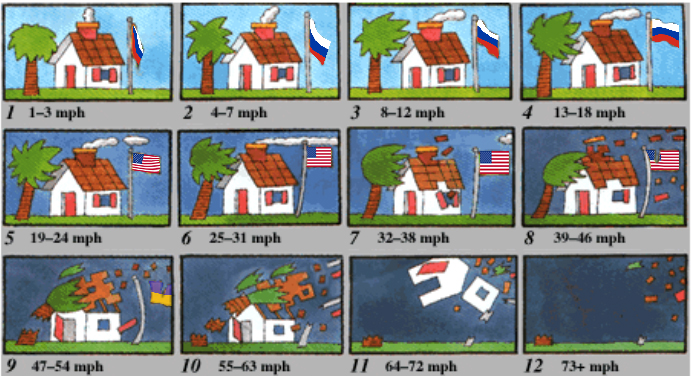
Sometimes this is wishful thinking, registering 1 to 4 on the Beaufort Wind Force Scale (lead image). Sometimes it is delusional, mistaking a storm at Force 10, 11 or 12 for a breeze at Force 6.
Here then is the first major analysis Vzglyad has published of official thinking about the coming lines of President Donald Trump’s new administration. “First, the United States will refuse to export liberal democracy,” writes Gevorg Mirzayan, a Vzlgyad editorial regular, professor and research fellow at state universities and think tanks in Moscow. “This approach has actually been overdue for a long time – after all, moralizing no longer works…Under Trump, moralizing is generally impossible. After all, it implies demonstrative loyalty in exchange for the material benefits provided by America – in particular, access to the American market.”
“[Second], following moralizing, another important principle of Western globalist diplomacy will be thrown into the trash — ‘whoever is not with us is against us.’”
Mirzayan’s argument follows in full. It has been translated verbatim without subtractions or additions, except for photographs. Mirzayan himself does not acknowledge nor dispute the accuracy of the English version.
Vladimir Putin, September 5, 2024: “As for my preferences, it is not up to us to decide. After all, the American people will have to make their own choice. As I have already said, we favoured Mr Biden, the current President, but they took him out of the race. That said, he advised his supporters to support Ms Harris. So, we will act accordingly and lend her our support.”
Donald Trump, September 7: “I have a feeling. I don’t know. I don’t know what to say exactly about that. I don’t know if I’m insulted or he did me a favour.”
To reflect upon, today’s Sabbath reading comes from two Russian texts.
One was a prepared script followed by impromptu elaboration which took place in Sochi on November 7. The second text followed in Moscow after the notorious football match in Amsterdam which happened later on the same day.
The first reading is from President Vladimir Putin, some of whose friends are Jewish. The second reading is from Yevgeny Krutikov, whose grandfather was a Soviet trade commissar during the Stalin administration and who has himself served in the GRU, before becoming a regular essayist for the semi-official Vzglyad publication.
Forcing Sergei and Yulia Skripal into artificial coma, intubating them so that they could not speak, and barring them from public testimony are now revealed in the Novichok show trial under way in London.
Resuscitating Dawn Sturgess from cardiac arrest and brain death in order to make her a victim of a Novichok attack delivered by a perfume atomiser, when the laboratory evidence now shows Sturgess had consumed a lethal cocktail of cocaine and fentanyl – this too is revealed in the hearings directed by former judge Anthony Hughes, Lord Hughes of Ombersley (lead image, left).
Listen to the one-hour discussion just recorded and broadcast from Victoria, British Columbia. Chris Cook asks the questions.
The single most important witness in six years of investigations into the cause of Dawn Sturgess’s death, the pathologist appointed by the government to conduct her post-mortem, has testified that he failed to discover Novichok in his eleven-hour long autopsy. Instead, his official reports from 2018 reveal that he was told to find Novichok by the Defence Science and Technology Laboratory (DSTL), the UK chemical warfare centre at Porton Down. But he didn’t sign his name to that for more than four months after the autopsy, until November 29, 2018.
The witness is Guy Rutty (lead images). He appeared in a state-censored format at the Sturgess Inquiry hearing on November 5, chaired by retired Appeal Court judge, Anthony Hughes (titled Lord Hughes of Ombersley).
In the official document releasing Sturgess’s body to her family, Rutty wrote: “The provisional cause of death following the autopsy examination is: 1a Awaiting further tests.” Rutty signed that two days after the autopsy on July 19, 2018. Sturgess’s body was then kept at Porton Down for another eleven days; evidence from the undertaker, Chris White Funeral Directors, reveals it was collected for the funeral ceremony and cremation on July 30.
In Rutty’s report dated November 29, 2018, he revealed that blood testing of Sturgess on July 2, 2018, identified that she had taken a combination of illicit, potentially lethal drugs before her collapse. Rutty says these included cocaine and fentanyl. Rutty avoided disclosing the precise reports of the toxicology testing so that the dosage Sturgess had consumed of cocaine and fentanyl has been concealed.
In his official reporting Rutty used circumlocutions to conclude he couldn’t tell what drugs may have been the cause of her death. The toxicology, he said, “identified a number of therapeutic and non-therapeutic drugs to be present. Although I have not been provided [sic] with the levels of the drugs identified, I am not aware [sic] that there is any indication [sic] to suggest that the deceased’s collapse was a direct [sic] result of the action of either a therapeutic or illicit drug.” .
Sic marks the evasions. In the Anglo-American law and court practice for suspicious death cases, this is the point at which evidence is either inadmissible for the prosecution’s case or short of the required standard of beyond reasonable doubt for the judge and jury.
Rutty also qualified his conclusion on the cause of Sturgess’s death by saying: “I am of the opinion that these observations, although reported organophosphate toxicity, are not necessarily specific in their own right to organophosphate toxicity.” — line 901.
In his testimony this week Rutty referred to what he had been told by the DSTL Porton Down, claiming it was “independent”. Independent of Hughes’s proceeding, Porton Down is. Independent of the UK Ministry of Defence (MOD), it is not.
“I understand,” testified Rutty, “that there is independent [sic] laboratory evidence that the deceased was exposed to Novichok and that it is considered [sic] that this was through a dermal route. Thus, I am of the opinion that the clinical presentation in terms of the signs and symptoms, as well as the in-lift laboratory tests and the tests and reports received following the autopsy examination all support that Dawn Sturgess did not collapse or die from a natural medical event, an assault or the result of a therapeutic or illicit drug overdose but rather due to the complications resulting from a cardiac arrest caused by Novichok toxicity. Having been exposed to the nerve agent Novichok…appears from the information I have been provided [sic] to have occurred through a dermal exposure…”
Apart from this hearsay, the only evidence made public of what Rutty was told by the DSTL Porton Down is a 2-page, partly censored summary report from Porton Down attached as an appendix to Rutty’s report. According to Porton Down, its testing of blood samples taken from Sturgess on July 2, 2018, found no specific Novichok evidence. Instead, the summary claims the finding was of “a characteristic marker for exposure to a particular nerve agent of the Novichok class”.
The state laboratory kept repeating the blood testing for two days until on July 4, 2018, when the report claims “these analytical results confirmed that Dawn STURGESS was poisoned with a specific Novichok agent”. The specificity of the identification – that’s to say, reliable biochemical evidence — has been omitted from the report.
The Porton Down laboratory then tested samples of blood and tissues Rutty had taken from Sturgess at the autopsy. The blood test results turned out in the Porton Down report to have been negative and contradictory. The conclusion was inconclusive: “In addition, the Novichok-acid metabolite was also detected in a sub-sample of PTN/18/1379, this is characteristic [sic] for the Novichok in question.”
Porton Down kept trying to deliver the government’s order for Novichok, and so liver, kidney and brain tissues were then tested. The outcome was inconclusive. The Porton Down agents admitted in small print at the bottom of their report: “Note – Dstl has not undertaken analysis of human tissue samples previously. Therefore, while some method optimisation [sic] has taken place, these methods should be treated as developmental [sic].”
In British state speak, “method optimisation” means assumption; “developmental” means uncertain, ambiguous, inconclusive. As evidence in the British courts, it is inadmissible.
Rutty was accompanied by an academic colleague, also a Home Office-registered pathologist for suspicious death cases, Dr Philip Lumb. According to Rutty’s summary report, Lumb “was instructed by HM Senior Coroner to be present throughout the autopsy examination and to provide a second independent report concerning the autopsy findings and death of Dawn Sturgess. I can confirm that Dr Lumb and I undertook the examination together, and that 1 have not had sight of his independent report.” — line 149.
Lumb has been excluded by the judge, Lord Hughes, from the Inquiry investigations. Lumb’s “independent report”, along with what Rutty has identified as Lumb’s “autopsy contemporaneous notes”, have been kept secret.
It is also unclear whether Lumb had been engaged by the Wiltshire coroner to investigate Sturgess’s death days earlier than the post-mortem which Rutty says took place on July 17.
Also accompanying Rutty and Lumb at the July 17 autopsy were police, Porton Down officials, British Army officers, and “by a team of independent international scientific observers from the Netherlands.” In another document, Rutty reported there was no team – just one individual, code named “QM73 from the Organization for the Prohibition of Chemical Weapons [OPCW].”
The British Government’s narrative that Russian military agents, on orders from President Vladimir Putin, used Novichok in Salisbury in March 2018 continues to collapse. A secret chemical warfare agent revealed last week that two tests for Novichok, using special machines provided by the Porton Down chemical warfare laboratory, failed to confirm an organophosphate poison in either Dawn Sturgess or her boyfriend, Charles Rowley.
The agent described himself in his witness statement and in a guarded appearance at the Dawn Sturgess Inquiry last week as a qualified medical doctor and pharmacology expert. “I currently work at Dstl [Defence Science and Technology Laboratory] Porton Down within the Chemical, Biological and Radiological (CBR) Division, and provide medical advice to the Ministry of Defence and other government Departments on CBR related threats… I was Chemical and Biological (CB) Medical Advisor to Dstl and the Operational teams in support of the investigations into the attack on the Skripals (Operation WEDANA) and the investigation into the poisoning of Dawn Sturgess and Charlie Rowley (Operation READ).”
The agent’s name was ordered to be kept secret by the Inquiry chairman and commercial consultant, Anthony Hughes (titled Lord Hughes of Ombersley). This is despite Hughes’s ruling that he would not keep the names secret of “those who were already sufficiently identified publicly in connection with the events of 2018.”
FT49 is the cipher used for the Porton Down agent, although sources claim he has advertised his engagement in the Skripal, Sturgess and Rowley cases in several academic publications accessible on the internet.
In his witness statement dated September 16, 2024, the Porton Down agent revealed that he had organized with doctors at the Salisbury District Hospital (SDH) to test the blood of Sturgess and Rowley, after their admission to the hospital on June 30, 2018, using special biochemical assay machines provided by Porton Down. One of the machines had been installed at SDH during the hospitalisation of Sergei and Yulia Skripal in March of 2018. A second Porton Down machine was in operation at a Birmingham toxicology laboratory.
Agent FT49 reported these machines had failed to detect evidence of the Novichok organophosphate in blood samples of Sturgess and Rowley. Government officials then ordered Porton Down itself to take over the blood testing to confirm the presence of Novichok. This is the first leak from an official source that Porton Down may have rigged the blood testing in order to fabricate the existence of Novichok and of the Russian attack.
According to FT49, after “an unexpected failure to identify the organophosphate compounds by Birmingham’s analytical laboratory I suggested to Dr Jukes [Stephen Jukes, SDH doctor in charge of treating Sergei Skripal] that Dstl [Porton Down] should also receive a blood sample. Late morning of 2nd July 2018 I was made aware via a phone call from the ITU [Intensive Treatment Unit at SDH] that the Birmingham results were back; there was no evidence of a pesticide, despite cholinesterase inhibition, and the two patients [Sturgess and Rowley] did not have the same non-prescribed drugs in their blood other than a trace of cocaine.”
What this reveals is that both Sturgess and Rowley had been taking cocaine before their collapse. FT49 is also revealing – without expressly saying so — that on the day of their hospitalisation, Rowley had taken the heroin substitute methadone on prescription; Sturgess had not.
Presiding judge Hughes and the lawyers assisting him in their questioning of FT49 failed to acknowledge the new evidence. Michael Mansfield KC, lawyer for the Sturgess family and Rowley, attempted to neutralize the disclosure by asking FT49: “Were you ever informed that the police in fact had no information about the use of drugs by Dawn Sturgess? Did you know that?” FT49 replied non-committally.
The lawyer appointed by the British Government to represent Sergei and Yulia Skripal, Andrew Deakin (also spelled Deacon), asked FT49 no questions. Deakin has not opened his mouth at the hearings since making an 88-second announcement at the commencement. The Skripals, he claimed then, “look forward to better understanding the circumstances of the Salisbury attack, to considering the Inquiry’s conclusions as to who was responsible for that attack and to being able to move on with their lives.”
The revelations in plain view remain invisible. No British mainstream media and none of the alternative media podcasters in the UK have noticed and reported the Porton Down disclosures.