

By John Helmer, Moscow
@bears_with
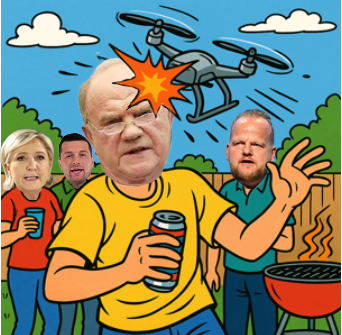
A new drone has appeared on the European battlefield.
With lightweight warhead and jet propulsion, it has almost unlimited range, and Circular Error Probability (CEP) of less than 10 millimetres. When it strikes the brain, it doesn’t kill or maim. It preserves the target’s motor functions but renders it senseless. That’s the battlefield medicine term for BS – brainwashed stupidity.
In statements just issued by Gennady Zyuganov (lead image, front), leader-for-life of the Communist Party of the Russian Federation (KPRF), and by Marine Le Pen (rear left) and Jordan Bardella (rear centre), leaders of the Rassemblement National (RN – National Rally), the leading opposition parties of Russia and France have announced to their voters that they should abandon their minds before they too are hit by new drones.
In his briefing on Monday on the results of the Russian parliamentary election, Zyuganov also warned Communist voters against skepticism and criticism — “not to distort the election results with shoddy work.”
In a declaration to French voters which Le Pen and Bardella issued on Saturday, September 19, they attacked Russia for escalating drone incidents in Germany, Poland and “several European countries”; for disinformation operations “seeking to make support for Ukraine appear as the cause of the escalation they themselves are orchestrating”; for “hostile action” “against the interests of France and the nations of Europe”, and “to directly or indirectly dictate our country’s policy through intimidation, threats, destabilization or psychological pressure”.
This is the first such declaration by RN, which leads the current polls for the French presidential election next April with about 34%. This is ten percentage points ahead of the French left coalition of socialists, communists, and greens, known as the Nouveau Front Populaire (New Popular Front, NFP).
The switch to support remilitarization of Europe for permanent war against Russia is also taking place inside Germany’s leading vote-getter, the Alternative for Germany (AfD) led by Sven Tritschler (rear right), now deputy party leader.
In the new podcast with Pelle Neroth Taylor in Stockholm, the discussion provides headgear protection against the new drone attacks and a brain health check for viewers and listeners. Click to start.
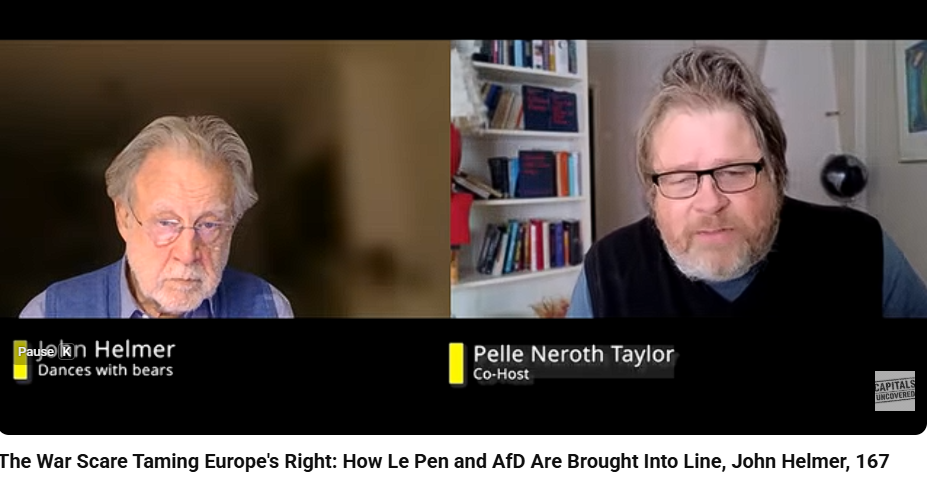
Source: https://www.youtube.com/watch?v=GNDJPI7TC4w
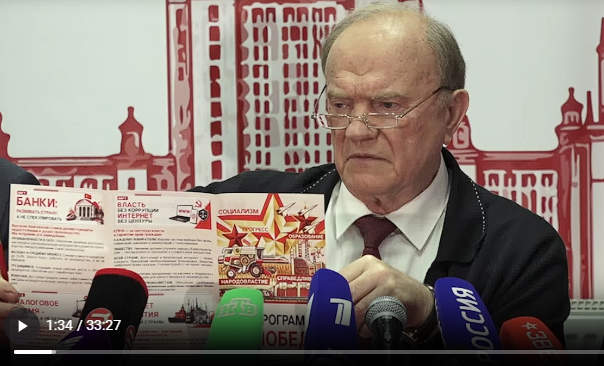
Gennady Zyuganov displaying the KPRF’s voter brochure in his briefing for the Moscow press on September 21.
KPRF leader Zyuganov, now 82 years old, has been a party apparatchik for a half-century. In his last run for the presidency against Vladimir Putin in 2012, he polled 17.2%, down from 29.2% in 2000. The KPRF candidate in the presidential election of 2024 drew 4.4%.
In Zyuganov’s post-election report, he was addressing one in seven of the electorate which voted for the KPRF, according to the official vote count; more than one in five if protesting non-voters are counted. That’s between 15 and 22 million people. In the new State Duma they will be represented by 40 deputies, 17 fewer than represented them in the outgoing parliament.
United Russia (Единая Россия, ER), the ruling party which has won 355 of the Duma’s 450 seats – a gain of 31 — will now hold the two-thirds majority needed to push legislation through committees whose chairmen ER will no longer share with the opposition, and if the Kremlin decides, to enact changes in the constitution. The next national election will be the presidential one in March 2030. Zyuganov will be 86.
In the present outcome, ER won about 57% of the vote. In the state polling organization VTsIOM’s pre-election survey, it had been forecasting 20 percentage points less for ER at 37.4%. If the past ratio of communist to ruling party voters had remained constant this time, the KPRF should have recorded between 20% and 22%. That was also VTsIOM’s August poll estimate for the KPRF. It was the number reported by exit polls taken on each of the three voting days, September 18-20.
Technical explanations for the gap in the proportional party vote and the heavy losses in single constituency races include the disappearance of young urban voters who in 2021 followed Alexei Navalny’s “smart voting” tactic of voting for anyone except ER.
In the 2026 campaign, vote fraud in the electronic voting system has been probably less influential in the outcome than district gerrymandering, repressive measures and candidate purges by local and federal authorities, and a campaign advertising ban on displaying images of Lenin and Stalin.
Source: https://kprf.ru/activity/elections/247657.html
On September 20, the leadership of the KPRF held a briefing on the results of the voting in the State Duma. Chairman of the Central Committee of the Communist Party of the Russian Federation Gennady Zyuganov, First Deputy Chairmen of the Central Committee of the Communist Party of the Russian Federation Ivan Melnikov, Yury Afonin, Deputy Chairmen of the Central Committee of the Communist Party of the Russian Federation Vladimir Kashin and Dmitry Novikov spoke at the briefing.
“We fully understood that elections under wartime conditions are fundamentally different events, requiring maximum cohesion, personal responsibility, and thorough work with the country’s citizens — those who demand a shift to a new policy, who insist that prices should not rise exorbitantly, that the housing and utilities sector should not oppress them, and who have taken a closer look at our programme — the Victory Programme,” Gennady Andreyevich stated in his address.
The Communist Party leader noted that the KPRF’s proposals have been tested in practice by people’s enterprises and are aimed at forming a development budget, increasing the rate of economic growth, and consolidating the successes achieved at the front. “We insist on the need for a left centrist course,” he said.
Speaking about the election campaign and work with the population, Gennady Zyuganov noted that for the first time there were no empty seats at the meetings with voters. According to him, the party has accomplished the tasks it set for itself, making every effort to convey its program to the citizens. The Chairman of the Central Committee of the Communist Party of the Russian Federation also noted the great work done by the Communist candidates.
Gennady Andreyevich advised those who intend to distort the election results during the vote counting not to engage in shoddy work. He emphasized that the ruling parties would still have to take the Communist Party’s position into account, study its program, formulate a new budget aimed at developing production, and curb their appetites regarding prices and tariffs.
“We will have to implement the program that the people have given us a mandate for,” said the Communist leader. “Our party, faction, and the entire deputy hierarchy will pursue this political line.” It is both salutary, victorious, and absolutely relevant to everyone.”
Gennady Zyuganov thanked the members of the Communist Party, all allies and friends, as well as the voters who supported the Communist Party in the elections for the work done. The Communist leader particularly noted the representatives of the leadership of the Communist Party who actively participated in the election campaign, and all those who represented the Communist Party at the televised debates.
“We continue to work. Our task is to win together,” concluded Gennady Andreyevich.
An alternative analysis of the KPRF’s performance from the Russian left appeared in March 2026 by Ksenia Smolyakova: “in 2021 KPRF delivered its strongest performance—in both genuinely collected votes and campaign visibility to voters. A major factor was Alexei Navalny’s Smart Voting project, which overwhelmingly recommended KPRF candidates. Thanks to this, the party managed to consolidate not only its traditional electorate but also a significant portion of the urban protest vote, forming a rare opposition coalition ranging from Stalinists to liberals.”
“The full-scale war that began in February 2022 effectively erased KPRF’s 2021 gains, shrinking its support back to the boundaries of its core electorate. The coalition that had formed around the communists quickly fell apart: the party leadership’s unconditional support for the war alienated a large share of protest voters. Moreover, some Soviet-nostalgic voters drifted to United Russia, which in practice pursued the hardline foreign policy that the most radical communist supporters had long dreamed of.”
In March Smolyakova was predicting: “Despite all the restrictions, KPRF remains the most capable of pursuing an independent political line among Russia’s legally existing parties and displays a certain resilience to pressure. For those managing domestic politics, it continues to be an outsider: the party relies on its own internal resources, is not dependent on a single leader or narrow circle of close associates and retains elements of internal democracy in decision-making. CPRF’s main asset is its most developed and genuinely operational network of regional branches among all political forces (excluding United Russia, which, after more than 20 years of existence, remains essentially an appendage of the bureaucratic apparatus and survives solely on administrative resources). With sufficient will, this infrastructure could enable KPRF to rapidly launch effective public campaigns in the regions, centered on the increasingly acute socio-economic agenda.”
This month, just ahead of the vote, Smolyakova acknowledged that repression had succeeded, particularly in halting the apparent swing of voter protest to Yabloko which was removed from the race by a court ruling in August.
“Judging by social-media reactions, society again appears to want a discussion of what is happening in the country and a more active form of political participation. The political system, however, is moving in the opposite direction: toward the maximum constriction of that conversation. Similar processes were already visible in 2011−2013, only to be interrupted by the annexation of Crimea. They gathered force again in 2017−2019 and were then halted once more — first by the pandemic and constitutional reform, then by a new war.”
Riddle, the publisher of these analyses, was proscribed by the Russian Prosecutor-General in 2022, and is based in Lithuania. Smolyakova’s whereabouts are not known.
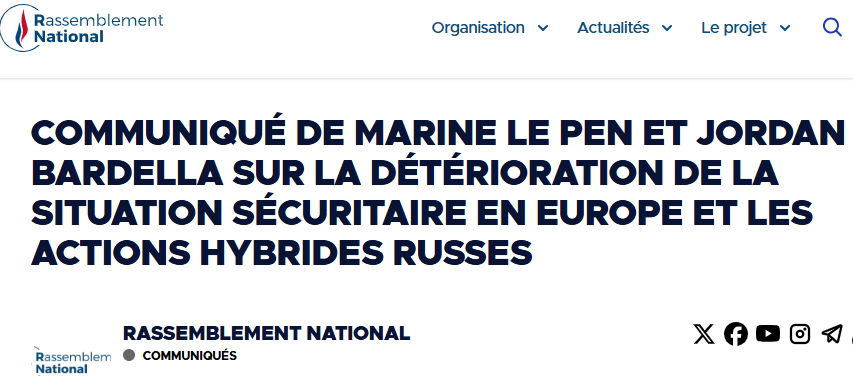
Source: https://rassemblementnational.fr/communiques/communique_rn The RN’s defence of Swiss corporation Nestlé and French corporations Auchan, LeRoy Merlin, and Le Monlid ignored that the Kremlin decree of September 18 was retaliation against the sanctions in which the French and Swiss companies have participated against the Russian economy. Tass reported the details of the Kremlin decree on temporary and conditional administration; it can be read here. Kremlin spokesman Dmitry Peskov explained: “At this point, we are talking specifically about the introduction of external management. No other decisions have been made so far. [These are] companies are from unfriendly countries. These are unfriendly nations that are most actively involved in military actions against our country and states that have been engaged in strikes by the Kiev regime on our civilian and economic infrastructure." The LePen-Bardella statement positions them squarely within the Russia war line of the French presidency and its mainstream media supporters.
The decision taken by the Russian authorities to place the subsidiaries and assets in Russia of several French and European companies under temporary administration constitutes a hostile act against the interests of France and the Nations of Europe. This decision, which directly affects the interests and rights of our companies, must be strongly condemned.
Moreover, for several weeks, the acts of hostility committed in Europe by agents operating on behalf of Russia have multiplied and worsened.
At Leipzig airport, in Germany, a drone loaded with explosives targeted Ukrainian transport aircraft. The investigation made it possible to link the perpetrators of this operation to the Russian intelligence services. France is not spared by these actions, which are aimed in particular at our economic interests and companies in our defense industry.
At the same time, in recent days, the highest authorities of several European countries, in particular those of Poland, have warned of a risk of escalation of operations aimed at the states supporting Ukraine. This deterioration in the security situation was confirmed by our intelligence services to French political formations on the occasion of the meeting of party leaders held at the Elysee Palace on September 18 around the President of the Republic and state services.
These facts must be considered with the utmost seriousness. If no one can predict today, nor exclude in the more or less long term, the occurrence of operations of a higher intensity, the threat we are currently facing mainly comes from hybrid actions and campaigns targeting our societies and our public opinions.
For sponsors linked to Russian intelligence, who use in particular so-called “disposable” agents of various nationalities to conduct their operations, it is a question of trying to make support for Ukraine appear as the cause of the escalation that they are orchestrating themselves.
This situation, of particular gravity, requires us to reaffirm our position with the utmost clarity.
Questioning France’s diplomatic and strategic orientations legitimately has its place in the democratic debate, especially in the context of a presidential election. It should be able to focus, in particular, on the level of financial support granted to Ukraine and on the conditions of this support, as well as on the inadequacy of initiatives aimed at searching for formats of diplomatic exchange likely to contribute to a way out of the conflict.
These debates are legitimate. Foreign pressures are not.
We will never tolerate that a foreign power, in this case Russia, can hope to directly or indirectly dictate the policy of our country through intimidation, threat, destabilization or psychological pressure.
No provocation, no clandestine operation and no destabilizing action can lead France to facilitate Russia’s achievement of its war goals in Ukraine. France’s foreign policy is decided in Paris, sovereignly, based solely on the interests of the Nation. It cannot be determined in Moscow, any more than in any other foreign capital.
Moreover, France cannot leave unpunished any hostile action taken on its territory, against its infrastructure, its strategic interests or its people. Any operation of this nature must be the subject of a proportionate response, in compliance with our law, our national interests and our international commitments.
In these circumstances, we support all the measures necessary to strengthen the security of our strategic infrastructures, our sensitive installations and the companies directly participating in our national defense. The protection of the territory, our industrial and technological capacities and our fellow citizens constitutes a primary responsibility of the State.
Likewise, we reaffirm our strongest solidarity with the allied European countries that have been the subject of hostile acts or destabilization campaigns.
Firmness in the face of hostile actions and the search for a diplomatic way out of the war are not contradictory. They proceed from the same requirement: to preserve the security of the French, to defend the sovereignty of our country and to prevent Europe from being dragged into an uncontrolled escalation.
In this period of tension, our responsibility is not to give in to intimidation or overbidding. France must remain in control of its decisions, ensure the protection of its territory and its interests, keep its commitments and retain all its freedom of diplomatic initiative.
It is a requirement of sovereignty. It is also a condition of national security and independence.



Leave a Reply