


By John Helmer, Moscow
@bears_with
From which direction does the sun come up each day?
That was one of the questions in the battery of tests which was used on patients to diagnose the onset of Alzheimer’s Disease. An answer confusing east and west was a symptom of that brain disease.
The question comes up today as a test of that other brain disease, equally terminal, known as brainwashing.
Israeli mappers, assured that their god placed them in his chosen land in the middle of the world, are uncomfortable with the regional term “Middle East” because it places them uncomfortably surrounded by their enemies, the Arabs, the Iranians, and the Turks. The alternative term, “West Asia”, is also discomfiting because it places god’s holy land offside — as if the Jewish god were residing in Beijing, Delhi or Washington, DC, and was looking askance when the wars were fought that put, and continue to keep, Israel on the map.
For the time being, the gods who reside in those imperial cities insist on keeping the term “Middle East” in English, 中东 (Zhōngdōng) in Chinese, and मध्य पूर्व क्षेत्र (Madhya Poorv Kshetra) in Hindi.
In this month’s declaration by BRICS, there is only one reference to the “Global South”. On the map for global southerners that should replace the Middle East as the Midcentre – that is, east of the Mediterranean (this “Middle Earth” term hasn’t been replaced yet); south of Central Asia, north of Africa, equidistant between Europe and America. Instead, the BRICS declaration in English presented the Middle East and West Asia as equivalents: “We express deep concern over the continued escalation of tensions in Middle East/West Asia .”
The Russian geopolitical term, Ближневосточный регион (blizhnevostochny region) means the near east, as distinct from the far east (Дальний Восток, Dalniy Vostok), which for Russians includes India, China, Japan, Vietnam, Korea. At the summit meeting of the Shanghai Cooperation Organisation (SCO), a fortnight before the BRICS summit, the Russian for “Near East” was used in the final declaration reference to the Middle East. “West Asia” (Западная Азия) is nowhere in Russian.
Everyone is agreed that the sun continues to come up in the east, but the gods of the empires don’t agree. On September 1, President Vladimir Putin called them, not gods, but “sharks of imperialism”. But not even the Russian Communist Party, which originated the term in the expressions of Lenin and Stalin, has quoted or discussed Putin’s mention since he said it.
Still, if it’s the sharks who are trying to change the map of the war fronts, then Russian resistance, self-defence, and allied defence against the geographical expansion of the exterminating armies and navies of the US and Israel — “knocking the teeth out of the sharks”, as Putin recommended — should refer to the sharks of the Middle East and the Blizhny Vostok (Ближний Восток).
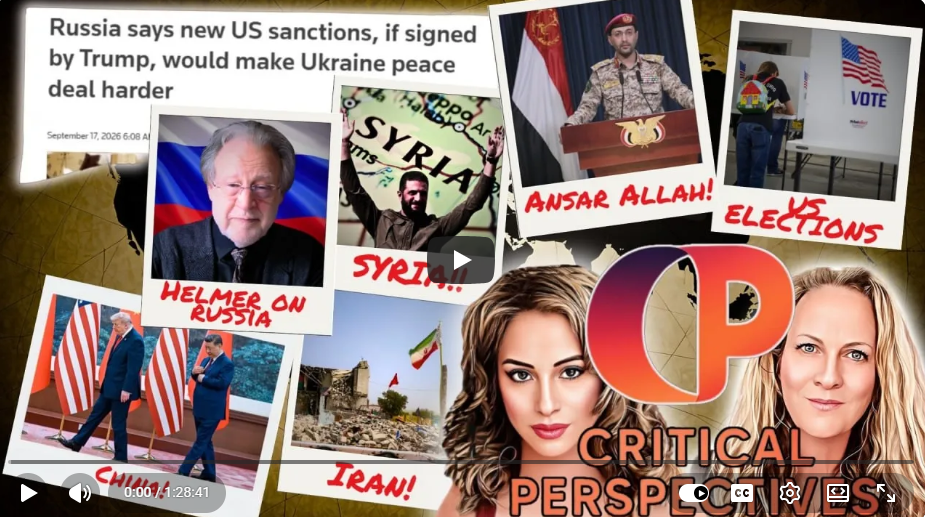
In the new podcast with Fiorella Isabel and Vanessa Beeley, recorded on Friday morning Middle East time, we plot the shark tracks on the map, and discuss what is to be done to knock their teeth out.
Click to listen or view: https://www.youtube.com/watch?v=eG3mKBiAvP8



Leave a Reply