

By John Helmer, Moscow
@bears_with
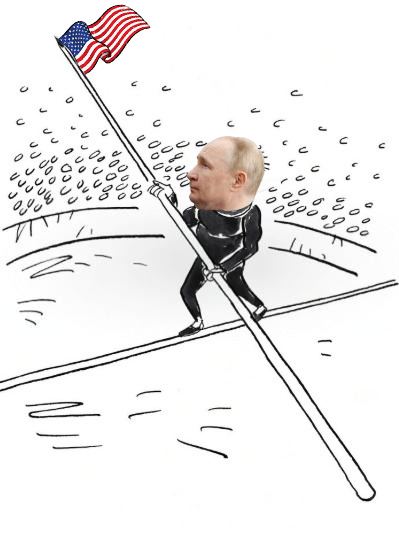
“Your Excellency, I would like to also thank you,” Shehbaz Sharif said to President Vladimir Putin (lead image) last September, “for supporting Pakistan and trying to have a balancing act in the region.”
Sharif is his country’s spokesman prime minister. Marshal Asim Munir, Pakistan’s military ruler, was sitting in the third protocol seat on Sharif’s right side, opposite Putin’s foreign policy spokesman, Yury Ushakov.
Munir is one of President Donald Trump’s closest Asian allies and personal supporters. If he said anything in the meeting with Putin, it has not been reported publicly. Putin was briefed to understand, nonetheless, that inside Pakistan, there can be no balancing act for Sharif – he is under Munir’s control; and that between Pakistan and the US, there can be no balancing act for Munir – he is under US control.
This was explained discreetly by Putin’s Defense Minister, Andrei Belousov, in April last year. The Americans, Belousov said, “are seeking to transform the regional security system into an American-centric one by strengthening Washington-controlled military and political structures. Such actions provoke tension, undermine regional stability, and increase the risks of armed conflicts…We are closely monitoring the attempts of extra-regional states to ensure military presence and logistical missions in Central Asia. We consider this unacceptable.”
Unacceptable at the table is one thing – Belousov didn’t say what Russia is going to do about it in the field. Last March, for example, just after the US and Israel had launched new attacks and resumed their war on Iran, Russian and Pakistani officials confirmed Sharif was about to make his first visit to Moscow. Following US consultations Munir ordered the visit cancelled.
Sergei Shoigu – Defense Minister until he was removed in 2024 for corruption and now Secretary of the Security Council – said more last month: “Our fundamental approach is that the United States and its allies must acknowledge full responsibility for their 20-year presence in Afghanistan and assume the main burden of its post-conflict reconstruction. We consider the return of third-country military infrastructure to Afghanistan or the deployment of new military facilities in neighbouring states unacceptable.”
Shoigu meant that at Munir’s direction, the US is planning to deploy “new military facilities” in Pakistan. By that, Russian military intelligence means covert and overt US war capacities and operational plans in Pakistan to target Afghanistan and Iran in the west, India and China in the east. .
Meaning this much at the table is one thing – what Putin is doing, according to the Pakistanis, is trying to perform a balancing act.
Putin, Belousov, Shoigu, the intelligence chiefs, and the General Staff were all educated to understand that because the material world is dialectical, it is impossible to balance between contradictions – they will always resolve themselves one way or another. Putin’s balancing act, interpreted on the Russian side dialectically, is to make sure he is either on the winning side or never on the losing side. When Putin has put himself on the brink of the latter, the General Staff have told him “We told you so” (MVG — Мы же вам говорили). Starting at the US putsch in Kiev in February 2014 and the threatened capture of Russia’s naval base at Sevastopol, the MVG is message has been delivered many times, and continues to be delivered.
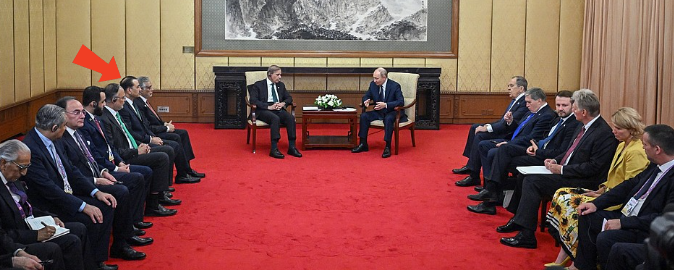
Meeting in Beijing on September 2, 2025, between President Putin and Prime Minister Sharif (centre). Marshal Munir (arrow) is second in the Pakistan rank on left, behind Foreign Minister and Deputy Prime Minister Ishaq Dar. Source: http://en.kremlin.ru/events/president/news/77904 In the Kremlin record, Putin said: “Pakistan remains our traditional partner in Asia. We value our relations. I would like to point out that during our previous meeting, we agreed to step up our relations, and indeed, some progress has been made. However, unfortunately, due to a number of objective circumstances, our trade is down albeit by a very small margin. Nevertheless, this is a telling sign for us to address this matter and to work on it.”
What balancing act does Putin think he is trying with Munir?
Publicly – that’s to say, cosmetically — according to Foreign Minister Sergei Lavrov and his subordinates, Pakistan is independent enough of the US to act as a genuine mediator between the US and Iran. “We commend the vigorous and effective efforts taken by the Pakistani and Qatari intermediaries to settle difference between the sides through negotiation,” a Foreign Ministry communiqué claimed on June 18. “Minister Lavrov expressed support for the understandings reached through the effective mediation efforts of Pakistan and Qatar aimed at de-escalating tensions in the region,” declared another the day before.
However, when asked by a reporter for specifics of “Pakistan’s mediating role in contacts between Iran and the United States amid the ongoing conflict between Iran and Israel”, Lavrov’s spokesman was evasive. “First of all, I would like to clarify: this is not a conflict between Iran and the United States or Israel. This is an unprovoked attack on Iran by the United States and Israel. We welcome and support any international efforts aimed at de-escalating tensions and resolving the situation while taking into account the legitimate interests of countries in the region. We highly value Islamabad’s active mediation efforts and have repeatedly emphasised this.”
Last month Lavrov was almost as uninformative himself : “We call for the resumption of dialogue on establishing a collective security system in the Persian Gulf, with the participation of all interested regional states and bona fide external players, including Russia, China and other permanent members of the UN Security Council. This concept is consistent with the idea of a quadrilateral format of interaction involving Pakistan, Egypt, Saudi Arabia and Türkiye – an initiative aimed at long-term post-conflict normalisation.”
Note that Lavrov is labelling Pakistan as “bona fide” in the war against Iran for control of the Persian Gulf but he is omitting the US, Israel, and India.
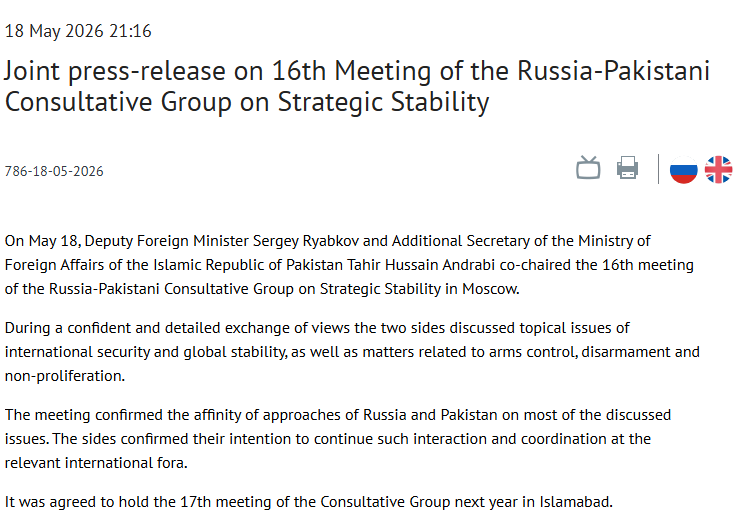
However, when Russian and Pakistani officials met for detailed talks on military and strategic issues on May 18, the ministry communiqué was empty.
Source: https://mid.ru/en/foreign_policy/news/2110364/
When Moscow sources were asked to clarify what “topical issues” may have been discussed but kept secret for the time being, the sources claimed this is business. “The North South Land Corridor is now working mainly for Pakistan. For three years now, Pakistani trucks with TIR [Transports Internationaux Routiers ] registration travel all the way to Moscow carrying fruits, vegetables, rice and other products. Azeris are investing in the Pakistan trade through Iran and through the North South Corridor and taking Pakistan cargoes direct to Chechnya and Dagestan. Armenian vendors have been excluded from the Moscow city markets (now almost 100% owned by God Nisanov ) on orders of [Mayor Sergei] Sobyanin and replaced by Azeris selling Pakistan produce. The Russian bureaucracy is not getting in the way.”
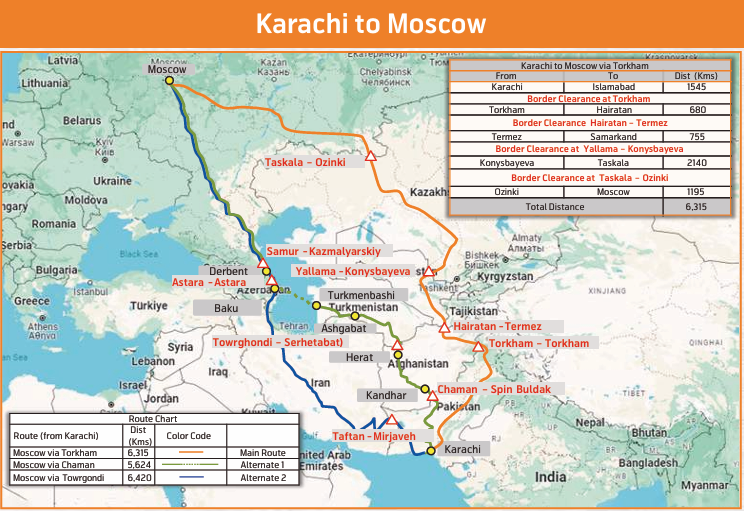
Source: https://www.nlc.com.pk/wp-content/uploads/2023/5/TIR%20Map%20Brochure%20English%20Version.pdf While the fresh fruit and vegetable trade from Pakistan to Russia is growing, it remains a small proportion of aggregate Pakistani exports to Russia. By contrast, Indian exports to Russia have grown to almost $5 billion in 2025-26; they are ten times larger in value than Pakistan’s total export value at $66 million.In that figure, Pakistan’s food exports totalled less than $10 million last year; Indian food exports were over $800 million in the same period. A Moscow source has qualified these, the official trade data, as misleading. "The actual export volume is now more than $1.8 billion. The reasons for the difference between the official and actual trade record are that the Pakistanis sell through and take money in Dubai, and because the use of the Azeri system shows the origin of the TIR deliveries to be Azeri. The ability to send refrigerated cargo is major triumph and it beats forty years of Indian plans for the North South Corridor."
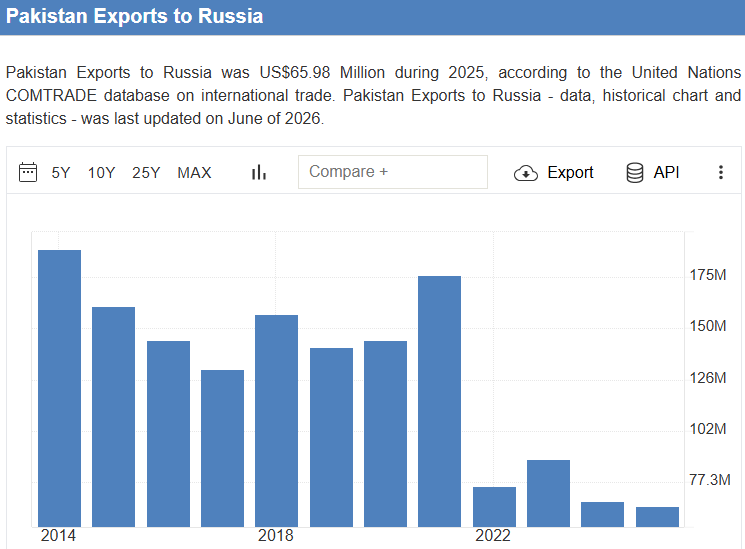
Source: https://tradingeconomics.com/pakistan/exports/russia
The Moscow source added: “I do not see Americans giving up on Pakistan again. It’s a cheap maintenance mistress to keep. Chinese tried the more expensive Belt & Road approach – investing in nation building and infrastructure for China. Pakistan is a loss and a problem for the Chinese too. They treated Pakistan like a real country – they did not understand the nature of khans and their khanates. Pakistani generals are Central Asian khans. Brits know how to deal with them and buy them. Chinese do not. The Americans simply pay the generals as they always have, and they get the biggest bang for their buck. That way they also keep the Indians all riled up, and the Russians nervous and unsure what to do.”










Leave a Reply