

By John Helmer, Moscow
@bears_with
The Ankara Summit Declaration is vague enough and precise enough to mean everything and nothing to President Donald Trump (lead image) and those he regards as his subordinates, clients, and marks in the North Atlantic Treaty Organization (NATO).
In White House politics, it balances between the party for escalation of the war against Russia and the party for de-escalation and peace; that’s to say, pause in the war against Russia.
In Kremlin politics, it tips the balance between the party for escalation dominance in the war and the party that trusts in Trump to deliver terms for de-escalation; that’s also to say, pause in the war against Russia.
The difference between the White House and the Kremlin is that President Vladimir Putin is running out of options and time to strike a balance between his two parties while Trump calculates he has plenty of time and doesn’t care to help or hinder Putin in his predicament because the war in Europe doesn’t count with US voters, and will make no difference to the outcome of the November 3 Congressional elections.
Putin’s predicament is that he has no more balancing options between the opposites, escalation dominance to victory and escalation loss to defeat. Any further delay will signal Putin’s uncertainty and prevarication — or weakness in the face of the enemy. To Russian voters who will decide the outcome of the September 20 State Duma elections, that signals loss of confidence, defeat. Moscow sources in a position to know claim Putin now realizes Trump will not save him from having no choice.
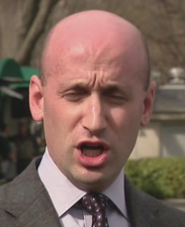
The White House parties are Stephen Miller (left), Deputy Chief of Staff for Policy, and Marco Rubio, National Security Advisor and Secretary of State, for continuing escalation; JD Vance, Vice President, Donald Trump Jr, the dynastic candidate for president in 2028, and several of the Joint Chiefs of Staff, for de-escalation and pause.
The Kremlin parties are the General Staff under General Valery Gerasimov, the intelligence services under Admiral Igor Kostyukov, and Sergei Lavrov, the foreign minister, for escalation; Yury Ushakov and Kirill Dmitriev, Putin’s negotiators with the White House, and the Central Bank Governor Elvira Nabiullina, for whatever end-of-war terms Trump promises. Between them now is the “nuclear choice” – that’s not the option of striking with tactical nuclear warheads on Oreshnik missiles at NATO targets outside the Ukraine, but the combination of operations to cut the Ukraine’s warfighting command and control capacities from NATO suddenly and destroy them comprehensively, irreparably. This includes all rail, road and bridge links with the surrounding NATO states.
Moscow security sources say the General Staff has multiple options which include weapon systems not used in war yet nor even tested except for simulations. These include under-sea weapon systems and space weapons which can eliminate SpaceX Starlink systems and GPS satellites. Putin, the sources say, has not been convinced even now, despite the attacks on Russian oil and gas infrastructure, that he needs to match the destructive nature of the US attacks through Ukrainian drones. As he is considering his options, he is said to have cut himself off from communicating personally with Beijing and Delhi.
The six paragraph, page-and-a-half paper which Trump agreed with the NATO heads of state and government in Ankara on July 8 commits him “to counter the long-term threat Russia poses to Euro-Atlantic security and stability” and obliges the NATO members to pay Trump and the US for protection from this Russian threat — “more than $50 billion in new procurements and…collective manufacturing capacity”.
Trump’s public tongue-lashing of Spain, Denmark, the UK, and the Italian Prime Minister Giorgia Meloni, has been resolved in “unity, solidarity and collective strength” with “our ironclad commitment to our collective defence under Article 5 of the Washington Treaty”.
As for the Ukraine, whose drone warfighting against Russia is now being integrated within NATO strategy, plans, and staffs, Trump has extracted the new promise for this year and next of €140 billion of British, European and Canadian state budget spending in the US: “€70 billion in military equipment, assistance and training for Ukraine and…sustaining at least equivalent levels in 2027”. This is the NATO strategy of two more years of war to bring down Putin and Trump profiteering from the first war on Russian territory fought by the allies since their seven-year regime change operations between 1918 and 1925.
In exchange, Trump has promised to curb his tongue and tweet: “Allies underscore that this support must be equitable, predictable, and sustainable in the long-term.”
To exemplify what Trump thinks this means for himself, he told Vladimir Zelensky on the summit sidelines: “with respect to Ukraine. Well, we’re going to talk about that [Patriot missile systems]. Look, it’s a defensive weapon, which I like better than an offensive weapon. It’s the best… those companies that make the Patriot and make all of the great stuff, the Tomahawks, all of the great stuff. We have the best stuff, many things… one of the things I think we’re going to be talking about today, just a little birdie told me this, about the fact that we’ll give them [Ukraine] the right to make Patriots. We’ll show them how to do it. It’s very complex, actually. But you’ll figure out the complexity quickly. And we’re talking about that and we’ll — the company that makes them, which is building now four plants. You know, all of our companies will be able to do this in two to three months. If you order a Patriot now, you have to wait a long time for them. Same thing with Tomahawks. We have a lot of certain equipment, but with, they call it the elite equipment. And you don’t need elite equipment necessarily for a war, but — so, one of the things we’re going to be talking about is we’re going to give a license to you to make Patriots. That’s pretty cool, right? This way you can’t complain that we’re not giving them enough. I say make them yourself. We haven’t informed the company [Raytheon, Lockheed Martin] of that yet, but that’ll work out all right. I’m sure they’ll be thrilled.”
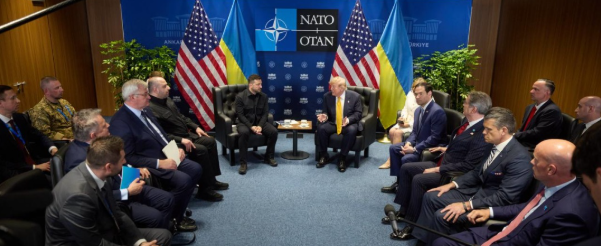
June 8, 2026: https://rollcall.com/factbase/trump/transcript/donald-trump-remarks-bilat-volodymyr-zelenskyy-ukraine-ankara-july-8-2026/
Trump was repeating to Zelensky what he had agreed at the G-7 summit meeting in France on June 17. Then he signed: “We agree to increase the delivery of air defence capacities, additional systems and interceptors, and long-range capabilities. We are also ready to consider extending to Ukraine the benefit of licenses to allow for an increase in Ukraine’s military production…We commit to increase the pressure on the Russian war economy. In this context, we will strengthen our sanctions, including those on the oil and gas sectors.”
To Zelensky, Trump also repeated the escalation of war line: “Well, we have a lot of pressure. We have a lot of pressure on President Putin. You know, I don’t think he likes what’s going on. I don’t think he likes — I don’t think he’s thrilled with what’s happening. There’s a lot of pressure on President Putin to get it done.”
Sources in Moscow report tight-lipped silence in the offices of the Security Council. This, they say, means Putin hasn’t made up his mind on the escalation options, but must do so within days. The last meeting of Putin with the Security Council was on July 1, when the agenda, according to the Kremlin communiqué, was “matters concerning the socioeconomic development of the Kaliningrad Region.” The sources believe Putin understands that delay in decision is a white flag to Russian voters, as well as to the war party in the White House and Europe.
In Ankara Trump insisted on a show of support for his right to escalate his war against Iran – and got it: “Allies reiterate,” Paragraph 5 of the Declaration says, “that Iran must never have a nuclear weapon and call on Iran to fully respect freedom of navigation in the Strait of Hormuz.”
He added in press remarks: “I’m not happy with them. It’s like — for instance, we’ll have a meeting and we’ll talk about the denuclearization of Iran because that’s what the war is. It’s not a war; it’s really the denuclearization of Iran… my whole thing is not about regime change, it’s not about — although I think it’s regime change when you knock out the first group, the second group, and now you’re the — I think that’s maybe the ultimate regime change. But that’s not what it’s about. It’s about we don’t want them to have nuclear weapons and its denuking or denuclearization and I think we’ve made a lot of progress. And they’ll get out of the room — we’ll talk about it like we’re here. They’ll agree on everything, and then they’ll go and have a news conference and say, we never even talked about it. They’re cuckoo. There’s something wrong with these people. And for 47 years, they’ve been the bully of the Middle East. And they’re not the bully anymore. They’re not the bully any more, and all we want, it’s very simple, they can’t have a nuclear weapon. That’s what I’m there for because if they did, they’d use it and we’re not going to let that happen.”
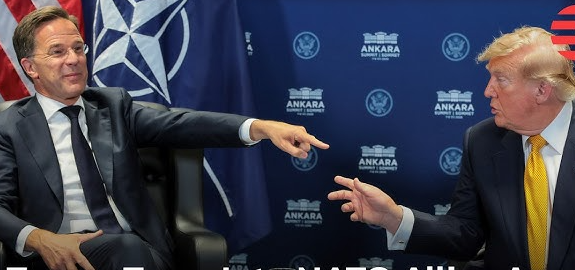
NATO Secretary-General Mark Rutte in press appearance with Trump, Ankara, July 8. Speaking of the Iran war negotiations, Trump said: “They're bad people. And, uh, frankly, I don't wanna waste my time with them. Now, I'll let our wonderful negotiators keep talking if they want, but I don't see it. Uh, I don't like these people, you know that?.. I don't want to deal with them anymore. They're scum. You know what scum is? They're scum. They're sick people. They're led by sick people. And, uh, they're vicious, violent people. And if they had a nuclear weapon, they'd use it. As far as I'm concerned, it's over.”
When Trump and Putin spoke by telephone on July 4, Ushakov claimed: “Regarding the situation around Iran, Vladimir Putin has expressed hope that the negotiation process based on the memorandum of understanding between the United States and Iran will help find mutually acceptable long-term solutions to the key aspects of the settlement. We have confirmed our readiness to provide practical assistance with the de-escalation and stabilisation efforts in the region. On his part, Donald Trump thanked the Russian side for our balanced stance and constructive proposals.”
One source comments on the atmosphere around the Kremlin: “Putin is a lost cause. The generals are the ones in need of testing.”



Leave a Reply