

By John Helmer, Moscow
@bears_with
There is nothing phoney about this stage of the permanent war against Russia, Iran, China, and Cuba, not if you are under the US empire’s guns at the front, in the rear, or on the high seas.
At this stage there is good news to report, and also some not so good news.
There is also a question the General Staff has for President Vladimir Putin. Theirs is a quiet conversation. The substance of it, however, is publicized in the editorials of the western media this week. They are saying that none of Putin’s nuclear war threats is credible, even as they insist that for the planning, operational and strategic purpose of responding to those threats, they are militarizing their economies and mobilizing their forces at a price of up to 5% of their Gross Domestic Products.
To them, Putin is replying that he isn’t threatening anyone and Russia is not intending to escalate to the next stage of the war.
“The word ‘escalation’ is often used now to describe and forecast various global conflicts, meaning unwillingness to use real diplomacy based on reality and respect for the interests of all sides, a desire to aggravate the situation, raise the stakes and even bluff, crossing red lines in the hope of suppressing and intimidating the opponent, and breaking their will. There is nothing new in the escalation of hostilities and sanctions; this practice has been used in many conflicts, and it is never unilateral, because one side’s provocations inevitably trigger a response from the other side. Therefore, the spiral is tightening, and the devastating consequences are growing…The more uncompromising a response, and the more clearly the goal of the opponent’s ‘strategic defeat’ is declared, the greater the chances that the battle will escalate into the most violent phase. The survival of the fittest applies not only to the natural world but also to social communities, if they are faced with the possible loss of their independence, dignity and the very right to exist.”
This is what Putin said aloud last week. Quietly, behind the Kremlin Wall, the General Staff has asked: What will be our strategic victory?
The General Staff is saying to the Commander in Chief: Look, we are achieving our tactical battlefield objectives on the front of the Ukrainian battlefield, and also our operational objectives in the west and south of the Ukraine – from Kiev to Lvov and the Polish border, as well as Odessa and the Black Sea ports. However, our intelligence reports indicate we are still quite far from achieving our strategic end-of-war objectives – demilitarizing Ukraine so that Russia will be secure from drone and missile attack in the future; and denazifying the Ukrainian regime in Kiev so that it will not remain the fascist gun platform against Russia which it has been for more than a hundred years.
Between asking the question inside the Kremlin and answering it in fire orders to the command-and-control line, there is a pause for reflection, debate, decision, change of mind, more pause (aka temporizing, vacillation, equivocation, indecision, dithering, shilly-shallying).
“How can we counter an aggressor?” Putin said aloud on October 1. “We are not threatening anyone. We are simply stating that we do not have all that many means of defending ourselves. And, incidentally, neither that letter nor the Foreign Ministry’s statement mentions the use of nuclear weapons. They speak, as I have just put it, of employing all the forces and means available to our country. As for how that would actually happen, we will decide that ourselves…We are not threatening anyone. We have no intention of attacking anyone, whether in 2029, 2030 or 2050…Who needs this? No one needs it. But this, too, is one of the elements of aggressive behaviour towards Russia. It must stop. We do not do this; we do not attack anyone; we do not seize anyone’s ships. It must stop.”
Must stop is a strategic imperative for Russia.
How now?
That is the question of today’s podcast with Nima Alkhorshid, aired at afternoon tea time in Moscow, breakfast time in Washington, DC.
THE NO-THREAT WARMONGERS
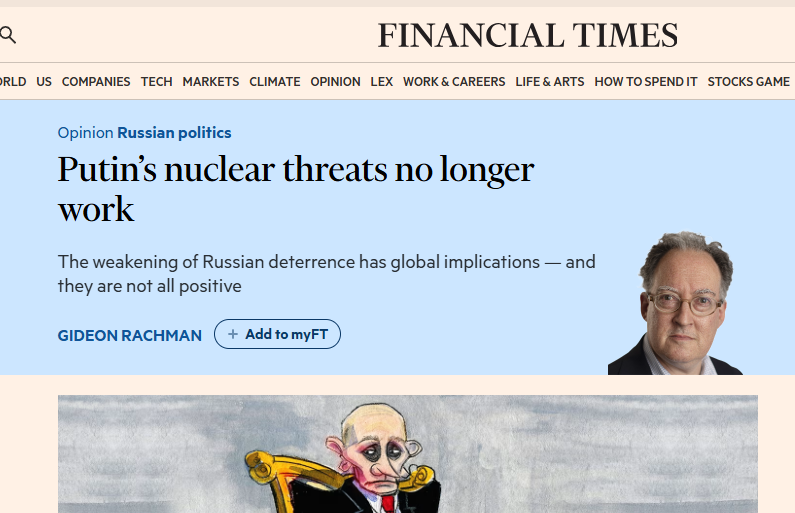
Source: https://www.ft.com/content/b49f5459-92fc-4b91-92c4-d8f2a6f87893?syn-25a6b1a6=1
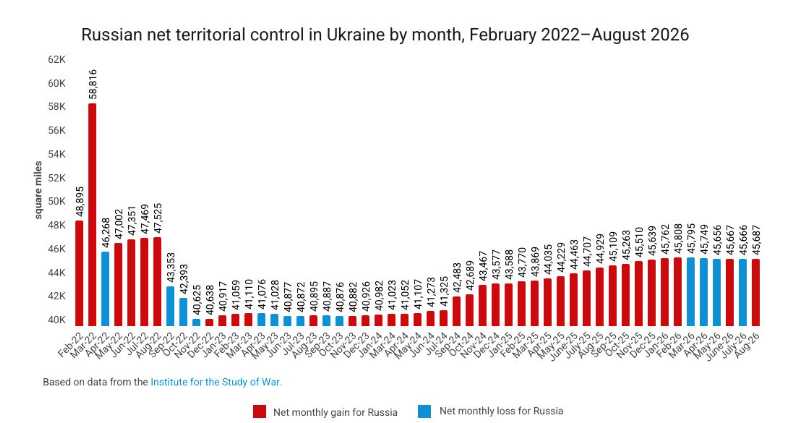
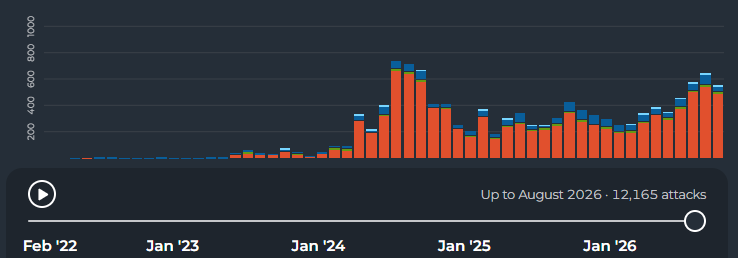
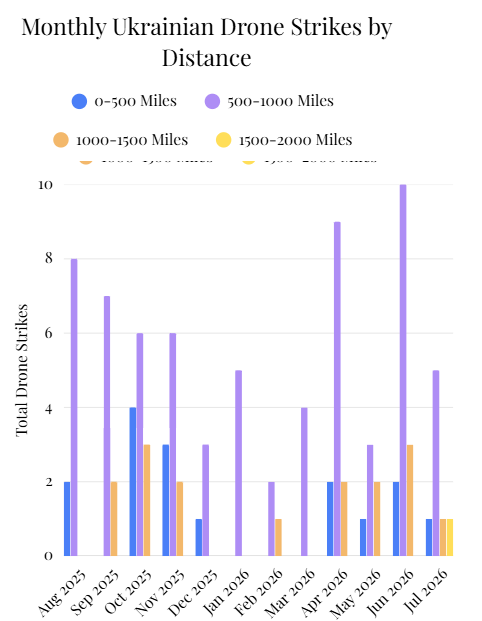
THREE TIME CHARTS OF UKRAINIAN ATTACKS AS A MEASURE OF RUSSIAN OPERATIONAL SUCCESS




Leave a Reply