


By John Helmer, Moscow
@bears_with
Marshmallow imperialism is that view of American warmaking against Russia, Iran, China and Cuba which tastes sweet at first bite, but then melts in the mouth with nothing to chew on. That’s when the sugar addiction starts – this is wanting to taste more but never getting enough.
Chemical engineers in China reported a year ago that opium is a medically appropriate antidote for this condition. Hopium, I mean.
In hour-long podcasts – that’s more than six thousand words of text — it’s one thing to serve the audience marshmallow; it’s quite another to present something to chew on, like beef. The two cannot be combined because the political podcast is a polarizing medium; it’s for one or the other. Debating between fundamentally opposed viewpoints drives as many audiences away as it attracts, and so that’s not for podcasters.
There can therefore be no debate in podcast format with the twin ideas that the evil US empire is being defeated in war, and that the sweet US empire – that’s the imperialism of American professors, CIA veterans, military experts, and podcasters – is now capable of overcoming the evil empire if they will be listened to in large enough numbers.
There are, however, Artificial Intelligence (AI) tools that allow the impossible — a debate on the US empire between marshmallow and beef.Here then is John Mearsheimer debating his views with mine on the US war against Iran and against Russia.
Google Notebook was given podcast links and instructed to generate reports summarizing what was presented. Not all prompts generate the reports requested, so experimenting with different prompts is recommended. A Russian cyber expert comments on the efficacy of the tool: “Google and OpenAI have their ‘ethical’ barriers, so they do not always do the job honestly. They certainly do not write without a bias; sometimes they completely ignore something, block it out, or refuse to report some views. Still, as a tool for summarization, categorization, and extracting highlights, they are useful.”
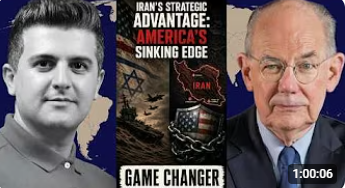

In a detailed discussion regarding the current state of conflict inthe Middle East as of July 2026, Professor John Mearsheimer argues that the United States has effectively lost its war against Iran and lacks a viable strategy to reverse this outcome. Despite recent reports of the Pentagon sending advanced weaponry, including F-16s from Germany and F-35s from the United Kingdom, to the region, Mearsheimer characterizes the memorandum of understanding (MOU) signed on June 17th as essentially a “surrender document” in which the U.S. recognized Iran’s upper hand. He asserts that while President Trump initially signed this agreement, he subsequently violated it by attempting to establish an American-dominated channel through the Strait of Hormuz, triggering a continuous “tit-for-tat” campaign that began on July 8th.
Mearsheimer contends that Iran possesses “escalation dominance” in this conflict, meaning the U.S. cannot win a tit-for-tat strategy. Evidence of this shift is seen in the destruction of American military installations in traditional Gulf strongholds like Kuwait, Bahrain, and the UAE, which has forced the U.S. to relocate key assets to Jordan. However, even these installations in Jordan are now being systematically “torn apart” by Iranian missiles and drones, potentially forcing a further retreat of U.S. forces into Israel. Paradoxically, Israel is reluctant to host these forces, as they act as a “giant magnet” for Iranian strikes—a reality already recognized by Jordan and the Gulf States.
The escalation of the conflict has now moved toward civilian infrastructure. Trump has threatened to target Iranian power stations, bridges, and oil facilities, yet Mearsheimer argues this will fail because Iran can retaliate by wrecking the oil, gas, and desalination plants of U.S. allies like Saudi Arabia, Kuwait, and the UAE. Furthermore, the geopolitical situation has worsened with the Houthi blockade of the Red Sea to Saudi traffic. Because Iran controls the Strait of Hormuz, Saudi Arabia had relied on a pipeline to the port of Yanbu to ship oil through the Red Sea; with the Houthis shutting down the Bab el-Mandeb, the global flow of oil is severely threatened, leaving the U.S. with no effective cards to play.
This military reality is forcing a fundamental re-evaluation of alliances in the region. Before the conflict escalated in early 2026, it was widely assumed that the U.S. possessed a formidable basing and alliance structure. However, the success of Iranian drone and missile technology has undermined this structure to the point where Gulf States are now likely to seek a “modus vivendi” (a working arrangement) with Tehran. Both Iran, whose economy is “wrecked” from years of sanctions and a previous 12-day war in 2025, and the Gulf States have significant incentives to stabilize relations and potentially see the U.S. military depart the region.
A primary obstacle to this stabilization is Israel, which Mearsheimer claims wants the U.S. to “wreck Iran” and is exerting immense pressure through the Israel lobby and domestic hawks to keep the U.S. in the fight. The Israelis oppose any agreement resembling the June 17th MOU, yet they simultaneously lack a “war-winning strategy” and prefer to stay on the sidelines (“buck passing”) to avoid becoming a direct target for Iranian missiles. Mearsheimer notes that the U.S. goal of regime change in Iran, encouraged by Israeli leadership, was “delusional” from the start, as air power alone cannot achieve such an ambitious goal against a country of 93 million people.
Furthermore, the U.S. is facing a critical depletion of munitions. The “40-day air war” (February to April 2026) and the earlier 2025 campaign against the Houthis both stalled in part because the U.S. was running out of precision weaponry. This logistical failure makes the prospect of an “endless war” unlikely; Mearsheimer predicts Trump will eventually be forced back to the negotiating table, though he will find that the hardliners now in control of Iran will demand even more favorable terms than before.
On a global scale, the conflict is a strategic windfall for China and Russia. There is evidence that both nations are assisting Iran with intelligence and weaponry to help them hit American targets, viewing a humiliating U.S. defeat as being in their national interests. Most significantly, the war has forced the U.S. to pivot away from East Asia, diverting the very resources and munitions needed to contain China. Consequently, while the U.S. finds itself mired in a “categorically depressing” regional conflict, China emerges as the bigwinner in the broader global power struggle.



In his analytical discourse from June 2026, John Helmer presents a stark and “realist” assessment of the global geopolitical landscape, arguing that the United States and its NATO allies are engaged in a permanent war designed to weaken and destroy Russia and Iran. Helmer’s thesis centers on the idea that despite tactical shifts or changes in leadership, the underlying “capital and economic interest structures” of the West remain committed to an attritional strategy that treats diplomacy not as a path to peace, but as a mechanism to achieve a strategic pause.
The Ukraine Conflict: The “Firing Platform” and Deterrence Failure
A central pillar of Helmer’s analysis is the transformation of Ukraine into a “firing platform without people”. He argues that the rapid advancement of drone warfare has rendered traditional military objectives—specifically Russia’s goals of “demilitarization” and “denazification”—virtually impossible. Even as Russian forces move westward and gain control of regions like Donetsk, Luhansk, Zaporizhzhia, and Kherson, they remain vulnerable to constant drone attacks on their rear and the Russian hinterland.
Helmer contends that Russian escalation has lost its deterrent capability. Because NATO is, in his view, “Nazified” and committed toa long-term conflict, Russian air strikes and deep-penetration attacks have failed to reduce the volume of drone production or precision targeting coming from the West. Furthermore, he asserts that any Russian escalation against NATO territory, such as the limited nuclear strikes suggested by some hawks, would be counterproductive, as it would only serve to mobilize and consolidate Western military resources against Russia.
The Resilience of the US Empire in Europe
Contradicting popular narratives of American decline, Helmer argues that the US Empire is winning in Europe. Despite the loss of cheap Russian energy and the massive costs of militarization, the US has successfully coerced European states into “buying American” and following the “underlying US empire strategy of destroying Russia”. He notes that changes in European leadership—such as the potential replacement of Keir Starmer with Andrew Burnham in Great Britain—do not signal a policy shift, as these leaders remain equally committed to the permanent war against Russia and the support of Israel against Iran. For Helmer, the US is more powerful in Europe now than in recent memory, as European voter resistance has weakened and political leaders have been sidelined by Washington’s directives.
Domestic Fragility and Russia’s Internal Crisis
Helmer identifies a growing internal vulnerability within Russia that the West is actively exploiting. He points to a rise in “psychological insecurity” among the Russian population due to nightly drone attacks and disruptions to infrastructure. This is compounded by significant gasoline shortages and rationing in Western Russia, which affect everything from truck deliveries to harvests.
Crucially, Helmer links this instability to a breakdown in the social contract between President Putin and the Russian people. He argues that Putin’s refusal to challenge the high interest rate policies of Central Bank Governor Elvira Nabiullina, combined with a perception that the government remains too tied to the Russian oligarchy, is eroding public confidence. With elections approaching in September 2026, Helmer suggests the Kremlin may face a “loss of confidence” that cannot be easily solved by military victories in Ukraine, potentially leading to desperate measures like vote rigging or postponing the elections altogether.
The Middle East: Partition and the Liquidation of Resistance
Turning to West Asia, Helmer views the negotiations between the US and Iran in Doha as a series of short-term accommodations rather than a path to a long-term settlement. He characterizes the US approach tothe Memorandum of Understanding (MOU) with Iran as inherently deceptive, noting that figures like J.D. Vance and Donald Trump have already signaled their intent to violate the spirit of the agreement by refusing to release frozen Iranian assets.
Helmer sees a similar pattern in Lebanon, where he analyzes the MOU between Israel and Lebanon as a roadmap for the “liquidation of Hezbollah”. He describes the strategic situation as a “war of attrition” where the US has effectively partitioned the Strait of Hormuz into American and Iranian corridors, much like the earlier partitioning of Syria. In Helmer’s view, the US objective remains the destruction of any form of Arab or Iranian resistance to its regional hegemony. While Iran continues to negotiate from a position of relative military strength, it faces significant domestic pressures and a US administration that believes it is negotiating from a position of strength ahead of its own elections.
Conclusion
John Helmer’s analysis paints a bleak picture of a global order defined by permanent attritional warfare. He rejects “delusional” optimism regarding a US defeat, instead arguing that the US Empire is effectively managing its alliances and utilizing technological proxies (like Ukraine’s drones) to keep its rivals off-balance. For Helmer, the primary challenge for Russia and Iran is not just surviving the military onslaught, but addressing the internal economic and social contradictions that the US-led permanent war is designed to exacerbate.










Leave a Reply