- Print This Post Print This Post

By John Helmer in Moscow

The two well-known controlling shareholders of the Evraz steel group, Russia’s largest steelmaker, are to pay at least $400 million into the cash reserve of the company to help reduce its current debts, and avoid a breach of bankers’ covenants governing Evraz’s loan position. Through an announcement yesterday by Evraz, Lanebrook — the Cyprus-registered vehicle through which Abramovich and Abramov hold an estimated 78% of Evraz’s shares — has undertaken to subscribe to the group’s public offering of $600 million in convertible bonds and $300 million in shares. The Lanebrook group will subscribe $200 million for the bonds, and $200 million for the shares. The balance will be sought from the market in an offering that is being managed by Goldman Sachs, Morgan Stanley, and Deutsche Bank.

The bonds, with a coupon of 7.25 % annual interest, mature in 2014, but they can be converted before then into the company’s general depositary receipts (each comprising three shares). This conversion will be allowable sixty days from placement at $21.12, 28% above the placement price. That price, according to Moscow brokerage reports on Thursday morning, was $16.50 per share, about 10% below the Tuesday closing price. By the end of Russian trading on Wednesday, Evraz’s share price had dropped 11.4%.

Until now, no Russian proprietor of a major steel company has paid out of pocket for the company’s debt obligations. The stock markets have failed to see the generosity in Lanebrook motive, however, interpreting in the move a dilution of minority shareholders, and pressure on the minorities to sell back to the controlling shareholders at a discount to the market price. Industry reports in Moscow have suggested that behind the Lanebrook facade, Abramovich and his Millhouse partners hold 36% of Evraz; Abramov’s stake amounts to 24%; chief operating officer Alexander Frolov, 12%; the Privat group of Ukraine, 10%; with a remaining freefloat of the London-listed stock at more than 17%.
(more…)

- Print This Post Print This Post

by John Helmer in Moscow

A revival of government accusations in Moscow about Belarus milk exports was dismissed by Belarus officials on Friday. The government in Minsk has accepted a temporary cut-off of the dry-milk trade, but it continues resisting Russian pressure to sell its dairy production plants.

The Belorussians charge the Russian government with playing the cat’s paw in a scheme by Russia’s dairy giants, Wimm-Bill-Dann (WBD) and Unimilk, to buy out milk plants across the border at the lowest possible price. To get the asset price down, the Russian dairy giants have lobbied the Kremlin to arrange a cut-off of revenues for their Belarussian targets.

As Agriprods.com has reported, over the month of June, the two governments traded public barbs over the milk trade, one of Belarus’s major exports worth more than $1 billion per annum. They then agreed to cool the rhetoric, but Belarus has been obliged to accept an agreement on an export quota for this year. This requires an immediate halt to new shipments for several months. In turn, that will enable the Russian producers of fresh milk to recover market share and charge more for their products.
(more…)

- Print This Post Print This Post

By John Helmer in Moscow

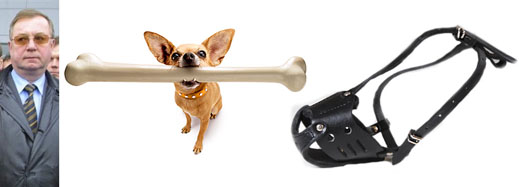
When it comes to investigating, Sergei Stepashin, the former prime minister, is like a small dog with a big bone. Transfer pricing, tolling, and related metal trading schemes that evade huge sums of tax are his bone. Stepashin’s problem is that no sooner does he get his teeth into something, than much bigger dogs than he is bark in his ear — and he drops it.

In January, for example, when Stepashin got his teeth into Oleg Deripaska’s aluminium trading business.

At the end of that month, the Accounting Chamber completed its first-ever investigation of the cashflow and trading sheets of United Company Rusal, headed by Deripaska. Letting the Chamber audit his books was one of the conditions Deripaska was forced to accept when he agreed the previous November to a $4.5 billion loan bailout by Vnesheconombank (VEB); that saved him from forfeiting his 25% shareholding in Norilsk Nickel to a syndicate of foreign banks.

The Accounting Chamber has investigated tax avoidance schemes used in Russian aluminium trading before; the Chamber has directly and publicly challenged aluminium tolling contracts, which allow offshore companies to claim arm’s length ownership of Rusal metal in trade, and avoid domestic and export taxes.
(more…)

- Print This Post Print This Post

By John Helmer in Moscow

Silvio Berlusconi, November 6, 2008:
“I don’t see problems for Medvedev to establish good relations with Obama who is handsome, young and suntanned.”

Russian anecdote: “The driver of a heavy tanker-truck, covered in mud and slush, is stopped in the centre of Moscow by a traffic policeman eager for a bribe. Citing the rule against dirty vehicles, the cop says: “That’s a fine of three hundred roubles!” The driver replies: “That’s not my dirt. It’s my suntan.”

Barack Obama, July 2, 2009:
“It’s important that even as we move forward with President Medvedev that Putin understand that the old cold war approach to U.S.-Russian relations is outdated — that it’s time to move forward in a different direction. I think Medvedev understands that. I think Putin has one foot in the old ways of doing business and one foot in the new.”

Vladimir Putin, July 3, 2009:
“Russians don’t know how to stand so awkwardly with their legs apart. They stand solidly on their own two feet and always look into the future.”

- Print This Post Print This Post

Visit The Cat’s Paw Page here.

- Print This Post Print This Post

By John Helmer in Moscow

Vladimir Gusev was a surprise new member of the 7-man board of directors, voted by Mechel shareholders at their annual general meeting on Thursday. The controlling stake is held by Igor Zyuzin, who has reported to the US Securities & Exchange Commission (SEC) that he holds 66.76%. J.P. Morgan holds another 5.7%; Mechel management less than 1%; and the remainder of 26.34% comprises the free float, including no individual stakeholder with more than 5%.

The board remained as it was in 2008 at seven. Independent Alexander Yevtushenko was elected the new chairman, replacing Valentin Proskurnya. Yevtushenko comes from coalmining, and has served in both corporate and government positions in the sector. Proskurnya is also from the coal-mining sector. Altogether, counting Zyuzin, four of the new 7 directors are coalminers. The only steel veteran left on the board is Valentin Polin, the senior vice president and chief operating officer.

Gusev replaced the Mechel and Glencore veteran, Alexei Ivanushkin, a trader by background, who was recently shunted out of the central group management, and into the chief executive’s post at the ferroalloy division (formerly Oriel Resources). Gusev is described by the company as an independent. From 20005 to 2008, he served as deputy director of the Federal Tax Service (FTS).
(more…)

- Print This Post Print This Post

picture

By John Helmer in Moscow

Russia’s resources tsar, Deputy Prime Minister Igor Sechin, is considering a new plan to award the mining right to Sukhoi Log, one of the largest unmined gold deposits in the world, to a special-purpose company backed by Russian Technologies, the state metals and minerals conglomerate run by Sechin’s old ally, Sergei Chemezov. Operator and goldminer in the proposal is Lenzoloto. If Sechin approves the plan, it would become independent of controlling shareholder, Polyus Gold.

Chemezov’s group already owns and operates VSMPO-Avisma, the titanium and magnesium monopoly in Russia; to which the group has been looking to add additional alloy minerals, such as molybdenum. Chemezov’s Russpetsstal (“Russian Special Steel”) unit currently operates several plants for special steels and alloys used in the aviation and aerospace industries, and is planning to add more. Chemezov is also a development partner in the large unmined Udokan copper deposit. Although gold is not thought of in Moscow as a strategic mineral for military purposes, a move by Chemezov to put the long-delayed Sukhoi Log deposit into development would confirm the trend towards state sponsorship of resource projects, which the commercially owned, publicly listed Russian mining companies cannot afford right now.

Lenzoloto is based in the Irkutsk region, and held the Sukhoi Log mining licence in a joint venture with an Australian junior, Star Mining, between 1993 and 1997. A Russian listed company (LNZL:RU), 64% of the shares are held by Polyus Gold (PLZL:RU), which bought up Lenzoloto’s shares in 2004 and 2005. Another 25% stake is held by the Westway Alliance Corporation, a British Virgin Islands holding. Financial reports by Polyus Gold indicate that, after paying a total of $199.3 million for its takeover — a price Polyus sources later acknowledged to have been pushed up by competitive positioning among several Russian mining groups – it wrote down the value of the asset by $114.6 million.
(more…)

- Print This Post Print This Post

By John Helmer in Moscow

A fresh bid has been launched in the United States to prevent De Beers from liquidating its Russian affiliate, Archangel Diamond Corporation (ADC), and calling off legal proceedings in Denver, Colorado, and in Stockholm to recover ADC’s mining right from two Russian companies charged with fraudulently expropriating it.

Also exposed to the scrutiny of the US court for the first time is the text of a proposal by De Beers to compel the ADC board of directors to block shareholder vote and approval on terms for paying ADC’s debts and restructuring the company; to accept the elimination, without compensation, of ADC’s minority shareholders; and to make ADC appear to be responsible for halting the litigation.

Documents filed in the US Bankruptcy Court in Denver on June 26 identify James Passin, Bruce Marks, and Clive Hartz. Passin represents the Cayman Island-registered Firebird Global Master Fund, which says it is owed €76,547 ($107,709) for a business loan to ADC. After De Beers, whose Luxemburg subsidiary Cencan holds 59% of ADC’s shares, Firebird is the next largest shareholder of ADC with about 18%. In the filing, Marks, whose lawfirm Marks & Sokolov is based in Philadelphia and Moscow, has been ADC’s lead attorney in the US litigation, and is owed $135,000. Hartz, a property developer in Western Australia, claims that ADC owes him $50,000 in unpaid director’s fees. Hartz is a small shareholder in ADC, and has served for many years as an independent on the ADC board, which is dominated by De Beers’s placemen. None of the three would respond to requests for comment on the record.
(more…)

- Print This Post Print This Post

picture

By John Helmer in Moscow

South of the Sahara desert, the Kremlin doesn’t have a strategy so much as a checklist of commercial interests. These days it can ill afford even those. But when it was decided in the spring that President Dmitry Medvedev would make his first presidential visit to the region, he was assigned the two African countries, whose economic resources make them more valuable to Russian corporations than anywhere else in Africa.

They are Nigeria and Angola. Medvedev stopped in each for less than 24 hours last week.

Nigeria is much the more important, commercially, of these two, because Gazprom, Russia’s largest company and the world’s dominant producer and exporter of gas, wants to bring the Nigerians, with the 7th largest gas reserves in the world and a major exporter of gas to the US, in line with the marketing strategy being developed by the Gas Exporting Countries Forum (GECF), led by Russia, Iran, and Qatar.

Gazprom would have started working on the Nigerians much earlier, had it not been for an unpleasant hostage-taking in 2004 and 2005, when Nigerian officials were suspected by the Kremlin of aiming to profit from the ransom demand for 12 Russian seamen, taken off the Greek-owned oil tanker, African Pride.
(more…)

- Print This Post Print This Post

picture

By John Helmer in Moscow

The Russian and Azeri governments have taken the air out of a scheme to provide Europe with an alternative source of gas supply to Gazprom, which signed an agreement on Monday with the State Oil Company of the Azerbaijan Republic (SOCAR). When it comes to putting the gas into high-priority political schemes for Europe’s energy needs, the Kremlin proves once again that it is prepared to put money where its mouth is, while the European Union raises hot air in think-tanks and editorial columns.

The new deal, signed in Baku during a visit by President Dmitry Medvedev, provides for Gazprom to begin purchasing gas from Azerbaijan from the start of next year. The initial volumes are very small — just 500 million cubic metres per annum. But they give Gazprom the option to increase them, as Azeri production from the Shah Deniz field, in the Caspian, ramps up. “All things being equal among potential buyers, priority will be given to Gazprom,” Gazprom CEO Alexei Miller said at the signing ceremony. “Other buyers would have to offer conditions that are more financially attractive.”

According to unidentified sources cited in the press, Gazprom is going to pay some $350 per thousand cubic metres, a substantial premium to the current market price, and roughly in line with the $340 price paid by Gazprom to Turkmenistan in the first quarter of this year. From the point of western brokerages and western shareholders, this is costly for the company’s bottom-line, and thus for its dividends and share price. So long as gas prices remain low on low demand, there is the potential, argues a report from Unicredit Securities, “to force Gazprom to cut its own production while replacing it with virtually zero-margin Central Asian gas.”
(more…)