In a country which is collaborating in genocide, an ancient story of God-ordained slaughter, heroic soldiers, and pitiless blood lust is bound to be required reading in schools and universities, quoted by politicians, even churchmen, and celebrated as one of the greatest epics ever told.
Robin Lane Fox, an ancient Greek historian at Oxford University and the horticulture columnist for the Financial Times, has just published his 400-page proclamation that Homer’s Iliad is just so. This is a stunning defiance of the world around Fox which no gardener worth his salt would dare to claim about his garden.
Now that the English, Americans and others (including the Greeks) are about to commence their third year of attempting to annihilate Russia on the battlefield, supplying the weapons, troop training, special forces, money, and propaganda; and the same alliance is assisting Israel in its attempt to do the same thing to the Palestinians, it’s time to ask how Homer’s Iliad is to be interpreted – and then if correctly understood, whether it is uncivilized, brutish and immoral to think like Fox urges his readers to do.
From the Greek siege of Troy and their total destruction of the city and the Trojans, there is not so far to travel to Gaza – in geography and morality.
Since the start of Israel’s genocide of Gaza, it has been the claim of the Israelis, their lawyers, and allies that there are no innocent civilians in Gaza, so they say that killing them all is neither a genocide nor a war crime.
Israel’s President Isaac Herzog said it in India in October. US Congressman Brian Mast said it, following the Israeli lead. The US Navy analyst who spied for Israel and served half a life in US prison for his treason has declared it in print. A French-Israeli lawyer has argued the legality on French television.
The reply the Arab militaries fighting against Israel have made is that there is no innocent oil tanker or container ship moving within missile or drone range of Israel, the Red Sea or the Indian Ocean unless it can prove it. This answer by the Ansar Allah government of Yemen, aka the Houthi military, is that they will attack any vessel which they know to be owned or controlled by Israel through its shipping families, companies, and their cutouts.
As a result, Houthi drone and missile attacks have exposed the elaborate scheme of corporate camouflage and false-flagging which Israel has been employing to conceal the vessel identities and movement of its international shipping operations. The Anglo-American maritime industry media, privy to these secrets, have not published them. The mainstream western press remains in the dark.
In today’s Gorillla Radio podcast, this isn’t dark any longer. Not genocide in Gaza but money in shipowner pockets is blowing the gaff.
There is much more at stake. The effectiveness of the Houthi ship targeting campaign has so threatened the movement of vital cargoes into and out of Europe that shipping, port, and military officials in France, Italy, Spain, and Greece are now trying to avert a commercial disaster for themselves by arranging secret safe-passage deals with Yemen and Iran in exchange for which they are applying a blockade on Israel’s cargoes, vessels and ports.
This is the secret which is torpedoing the Pentagon’s multinational Red Sea naval escort plan, called OPERATION PROSPERITY GUARDIAN. As the secrecy of Israeli shipping companies spills out, along with the secret dealmaking of the international shipowners with the Houthis, American shipowners are already complaining bitterly at being cut out of the profits. “If the main beneficiary of the operation,” editorializesgCaptain of California, a leading US maritime platform, “is one of the largest shipping corporations in the world [Denmark’s Maersk], then there is a question of whose prosperity is Operation Prosperity Guardian truly guarding?”
The message delivered last week to French President Emmanuel Macron was a dramatic one: Never mind Israel throttling the Palestinians, Macron was told, the Houthis and their Arab and Iranian allies are capable of throttling France.
Macron shot the messenger.
Bernard Émié was fired last Wednesday, December 20, and Nicolas Lerner put in his place. The announcement — the first time there’s been such a switch between the traditionally competing foreign and domestic intelligence chiefs — was made in a tweet by the French Defense Minister Sébastien Lecornu. Émié has been the head of France’s foreign intelligence agency, the DGSE (Directorate-General for External Security), since 2017. His replacement is Nicolas Lerner, head of France’s internal security agency, the DGSI (Directorate-General for Internal Security), since 2018.
By coincidence on the very same day of Émié’s sacking, Lecornu took a telephone call from Washington.
US Secretary of Defense General Lloyd Austin told Lecornu “the Red Sea is vital for global commerce, noting that the scale and increasing frequency of these attacks constitute a significant international problem that must be addressed. The United States and France are both making significant contributions to stability in the region and seek further collaboration on bilateral and multilateral solutions. Secretary Austin thanked France for its support to the 44-nation joint statement condemning the Houthis’ illegal attacks on international shipping.”
This is the Pentagon “readout”. The meaning is the opposite.
France is pulling its naval forces in the Red Sea and Gulf of Aden out of Austin’s military operation and of targeting by the US and Israel of Houthi units on the Yemen shore, as well as of the Iranian intelligence vessels, MV Behshad at anchor in the Red Sea, and the MV Saviz in the eastern Indian Ocean (Arabian Sea).
In fact, the elimination of Émié, according to French intelligence sources, signals that US backing for Israel’s genocidal operation against the Gaza Palestinians, and the expansion of the war by the Houthis of Yemen and Hezbollah of Lebanon, are driving French national interest calculations in the opposite direction from the Americans and Israelis. Émié is a former French ambassador to Jordan, Lebanon, Turkey, and Algeria, and the French Foreign Ministry’s chief policymaker for the Arab world for several years before he was appointed to run the DGSE in 2017.
Lerner, by contrast, has no direct Arab experience. A university classmate of President Macron’s, his career has been limited to police operations in the south of France, Corsica, and Paris, and then in the private office of the Interior Minister as Macron chopped the ministry’s head three times in eighteen months.
The French press are struggling to explain what has happened to the heads of their intelligence services. According to the state press agency AFP and Le Monde, “Emié launched reforms within the DGSE and saw the agency’s budget increase. He is said to have improved relations with the domestic security agency. But many have criticised the DGSE under him for failing to foresee the 2022 Russian invasion of Ukraine and a string of military coups in former French colonies Mali, Burkina Faso and Niger.” A rightwing, bank-owned regional newspaper, L’Est Républicain, claims: “Bernard Emié and his successor Nicolas Lerner contributed to improving the often tense relations between the DGSE and the DGSI, the replacement of the former by the latter confirming links described in the intelligence community as very regular and professional.”
Defense Minister Lecornu has been struggling with Macron’s pro-US, pro-Israel, anti-Russian line as the war in Gaza has been escalating. Towards Israel, Lecornu said the week after the Hamas operation began in October, “the bulk of the support we’re providing today is intelligence. The intelligence provided is provided as part of the regular partnership between our two countries. Unfortunately, we have a long history in the fight against terrorism, and our intelligence services have particularly powerful resources and sensors…Iran poses undeniable security challenges, both in its support for Russia in the war in Ukraine and on the issue of nuclear proliferation. Today, the priority is to avoid escalation. Israel has the right to defend itself and its people from these atrocities. However, this response must be proportionate and consistent with the laws of war. We emphasize that no other actor hostile to Israel should seek to take advantage of the situation…There is a very difficult situation in the Gaza Strip. France has nothing to be ashamed of, it has always been one of the most reliable countries in terms of aid and support.”
Since October, French intelligence sources have been trying to pacify the deeply distrustful Hezbollah; devise a seaborne aid plan for Gaza over Israeli objections; and protect French shipping lines and export-import interests now suffering from the Houthi cutoff of the Suez Canal and the Red Sea. If the sea war escalates to the Gibraltar Strait, the risk to France is that Marseille would be cut off from its Arab and African oil sources simultaneously; the port of Marseille accounts for more than a third of France’s crude oil import supply and petroleum refinery capacity.
And not just oil. Most of France’s container imports originate from China, South Korea, Japan, India and the United Arab Emirates, which unload in Marseille from vessels moving across the Indian Ocean, the Red Sea, and the Suez Canal.
An oil cutoff from all directions during 2024, accompanied by a container blockade in the east, would be a fresh disaster for the rightwing succession assembling to replace Macron in the 2027 presidential election.
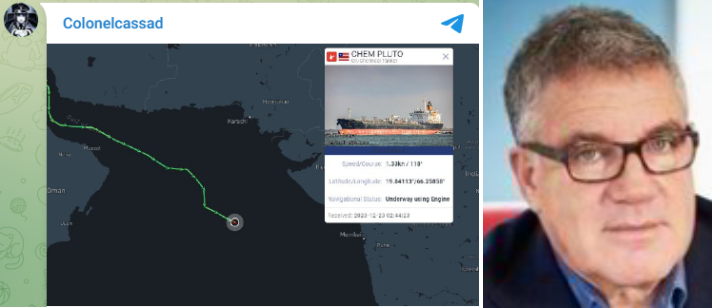
From the minute after the US Central Command (CENTCOM) and the UK Maritime Trade Organisation (UKMTO) learned that the oil tanker MV Chem Pluto had been hit by an exploding drone in the Indian Ocean 1,600 kilometres east of the Red Sea and Yemen coast (lead image, left), they also knew why. Through a joint venture between a Japanese and a Singapore holding company operating through a Dutch management cutout, the vessel is owned by Idan Ofer, an Israeli shipping magnate (lead image, right).
The Chem Pluto strike is the second by a drone against one of Ofer’s vessels in the Indian Ocean. The first strike was on November 24, when the container carrier CMA CGM Symi was targeted in the northeastern sector of the Indian Ocean. The Symi is owned by Ofer’s Eastern Pacific Shipping in Singapore.
On December 18, drone strikes were reported by CENTCOM against the Swan Atlantic oil tanker and the bulker MV Clara. The first vessel is owned by a Norwegian company but management, with hidden equity, belongs to the Israeli Zodiac group, owned by Idan Ofer’s brother, Eyal Ofer. The second vessel, the Clara, is owned and managed by a German company, Johann MK Blumenthal; no Israeli trace has been found to date, but the Houthis have yet to make a mistake in spotting and hitting Israeli ships.
On November 19 they did more than that. On that day an Israeli-owned car carrier, Galaxy Leader, was captured by Houthi commandos in the Red Sea. Follow their operation as they filmed it; here is the vessel now receiving tourists at anchor off Al-Salif port, Yemen. Ownership by the Israeli Abraham Ungar was concealed behind a Japanese ship management entity and a company registered under the Isle of Man-headquartered Ray Car Carriers, which in turn is owned by a Tel Aviv company called Ray Shipping.
Houthi political and military spokesmen have repeatedly made clear they are attacking Israeli shipping, as well as vessels of any nationality trading in and out of Israel’s ports. “Israeli ships are legitimate targets for us anywhere… and we will not hesitate to take action,” Major General Ali Al-Moshki, a Houthi military official, said on the group’s television station on November 20, following the capture of the Galaxy Leader.
“If Gaza does not receive the food and medicine it needs, all ships in the Red Sea bound for Israeli ports, regardless of their nationality, will become a target for our armed forces,” a Houthi press statement declared on December 9.
CENTCOM and Pentagon releases to the press have also claimed to have intercepted Houthi drone and missile attacks on US warships in the Red Sea attempting to protect the Israeli-owned or Israel-bound shipping.
Less successful in hitting Israel’s Red Sea port of Eilat, the Houthi campaign has been effective in cutting off the port by striking at vessels in the Red Sea, and then extending the range of strikes to the eastern Indian Ocean. Eilat accounts for 45% of car imports to Israel and 5% of all the goods imported to Israel by sea. The Houthi campaign has cut Eilat’s port revenue by 80% since October 7.
The impact has expanded to all shipping in the Red Sea, Gulf of Aden, and Indian Ocean if their management and ownership are based in the US and the European states allied with Israel in the Gaza war, and also with the US in the war against Russia in the Ukraine.
It is this coalition of states which US Secretary of Defense General Lloyd Austin attempted to rally for naval convoy and counter-threat operations on December 18, calling the plan OPERATION PROSPERITY GUARDIAN.
This operation is now coming apart in recriminations because commercial vessel owners in France, Spain, and Italy have accepted that if they negotiate Israel-boycott deals directly with the Houthis, they can continue to operate through the Red Sea. They resent the commercial competition from Russia and China which are operating oil tankers and dry-cargo carriers without hindrance or threat.
The obviousness of the targeting by the Houthis, and of Houthi deal-making by the Russians and Chinese, are being concealed, however, in the US and UK maritime industry media and the mainstream press. They are advocating maximum use of force by the Israel and US-led operation in the region to attack both Houthi and Iranian targets.
The Iranian intelligence vessel, MV Behshad, at anchor in the Red Sea, is a honey trap intended to lure both the Israelis and US Navy into an attack, according to Russian and other sources.
The French and Spanish navies appear to anticipate or to know: they have announced they will not operate their warships in the area under US command. Instead, the French have said they will restrict their operations to guarding their own French-flagged vessels and cargoes. The French Navy also appears to have agreed to clear the backlog of Maersk container vessels trapped and no longer under way in the Red Sea and in the Gulf of Aden.
The French and similar disclaimers from Spain and Italy follow maritime media reports of acrimonious disputes between the Europeans and the US over the US priority to attack the Houthis and save Israel.
The Europeans, including the Italian and Greek navies, which have also announced they are sending warships, are following the Russian lead in secretly working out an accommodation with Iran and the Ansar Allah (Houthi) leadership for safe passage through the Bab el-Mandeb Strait in exchange for agreement to boycott Israel. In defence of their economies and shipping, support from the European allies is dwindling for Israel’s war against the Palestinians; there is no support for Israeli and American threats to expand the war against Iran and the Houthis.
The Pentagon and White House-led plan to save the Israeli port of Eilat and the Israeli economy from the long-war attrition strategy of the Arabs is collapsing. US maritime sources report “the precarious situation of US-flagged ships stranded with military cargo near the Red Sea is at the center of this coalition angst. The French want to prioritize their ships while US-flagged ships – which the US Navy is obligated to defend – are inexplicably a lower priority for the US. This urgent matter, highlighted by the recent rocket attack on a US-flagged tanker in Israel, starkly exposes the vulnerability of these vessels due to the alarming absence of adequate military protection. This critical situation not only threatens the safety of these ships but also raises profound questions about the United States’ resolve to safeguard its maritime assets, a commitment that seems to be wavering dangerously.”
Iran’s Foreign Minister Hossein Amir-Abdollahian said the decision to attack vessels in the Red Sea region is “a completely Yemeni decision in support and defence of Gaza.” He added there is no need for the US coalition operation. If “they stop supporting the murderous Israeli regime and they will see a safer region and a better situation even for the transfer of energy.”
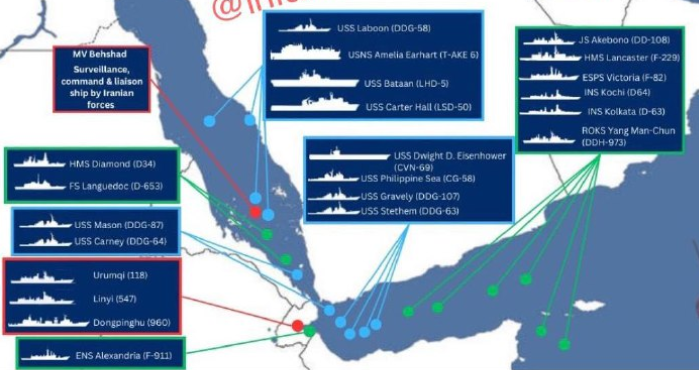
A Russian military blog post posted on Thursday, December 21 at 11:33 Moscow time, has revealed the hitherto secret positions of all warships in the area which the Pentagon has announced for its OPERATION PROSPERITY GUARDIAN.
The fresh data and the open map (lead image) were not available when yesterday’s report was published at 09:32 Moscow time of Russia’s “two-track” strategy for opposing the US and NATO, and for protecting Russian oil shipments while the Houthi drone and missile operations are under way against Israel.
No Russian Navy vessel is in the area at present although Russian crude oil cargoes are moving through the Red Sea with Iranian and Houthi agreement. Because these ship movements are defying US and NATO sanctions, it has been decided in Moscow to negotiate safe passage with Iran and Yemen rather than deploy the Russian Navy to protect them. However, the new combined US and NATO operation, targeting the Houthis and their Iranian support and supply systems, increases the possibility of a direct American, allied, or false-flagged attack on a tanker carrying Russian oil.
In yesterday’s morning report, I indicated that “the current whereabouts of the [Chinese] warship group has not been reported in the open press.”
The Russian source map is now reporting that the Chinese Navy’s 45th Escort Task Force, comprising the Type-052 destroyer Urumqi, the Type-547 frigate Linyi, and supply ship Dongpinghu were at berth at the Chinese base at Djibouti as of Wednesday, December 20.
The Russian map also reveals that the Iranian vessel MV Behshad is in a standing position in the Red Sea (lead image, top left of map). According to the Russian source, it is operating as an electronic surveillance, command and control centre to monitor friendly state ship movements – Russian, Chinese, Indian – and also hostile vessels of the US, British and French navies, tracking their positions; and relaying the data to Iran and probably to shore positions in Yemen. Although US media and Pentagon statements accuse the Ansar Allah government in Yemen and Houthi forces of acting as Iranian proxies in the war against Israel, there has been no disclosure before now of this vessel in the Red Sea.
According to the western vessel tracking service VesselFinder, the Behshad is a “general cargo ship” flagged by Iran. It reportedly sailed from the port of the Iran Shipbuilding and Offshore Industries Complex (ISOICO) to reach its current position, which VesselFinder confirms in the southern half of the Red Sea as of fifteen minutes ago. The western source reports the vessel is at anchor in 6.5 metres of water.
In the Pentagon announcement of December 18, US Secretary of Defense Lloyd Austin claimed that “Operation Prosperity Guardian is bringing together multiple countries to include the United Kingdom, Bahrain, Canada, France, Italy, Netherlands, Norway, Seychelles and Spain, to jointly address security challenges in the southern Red Sea and the Gulf of Aden, with the goal of ensuring freedom of navigation for all countries and bolstering regional security and prosperity.” The new Russian intelligence now makes clear that the UK, France and Spain are already in the region, with the US.
After Austin’s statement, his Italian counterpart announced that Italy is dispatching a frigate “to protect the prosperity of trade and guarantee freedom of navigation and international law…to increase the presence in the area in order to create the conditions for stabilization, avoid ecological disasters and also prevent a resumption of the inflationary push.”
The Greek Defense Minister Nikos Dendias followed the Italian to say that Greece too is sending a frigate to join the US operation. Dendias is claiming the reason is that Greece is “the country with the largest ocean-going fleet [and so] has a primary interest in preserving the freedom of maritime zones and protecting the lives of seafarers.” What he means is that the involvement of Greek shipowners in the sanctions-busting Russian oil trade has been so profitable, Dendias wants to protect the Greek tankers and their owners; and at the same time avoid the embarrassment of being so disloyal to the US and European Union sanctions regime.
Russia is negotiating with the Houthis of Yemen to protect Russian oil cargoes moving through the Red Sea for delivery to India and China, the principal destinations of Russian oil currently traversing the waterway, the Bab el-Mandeb Strait, and the Gulf of Aden.
Notified in advance to the Yemeni authorities and the Houthi military command, the Russian oil movements by tankers flying a variety of ship registry and national flags, are running the gauntlet of US and European Union (EU) sanctions against Russian oil exports.
China is also negotiating with the Houthis for safe passage and protection of Chinese-flagged container vessels. The Chinese military base in Djibouti, recently reinforced to support a large Chinese military group intended for a United Nations peacekeeping mission in South Sudan, is also covering the waterway.
Both Moscow and Beijing are acting in semi-secret against US and EU government threats to assemble a naval fleet to convoy shipping headed to and from Israel’s southern port of Eilat. This plan, which the Pentagon is calling Operation Prosperity Guardian, follows the failure of the two US aircraft carrier groups in the Mediterranean, the Red Sea, and the Persian Gulf to protect Israel, and deter the Houthi operations. The Pentagon is also threatening to attack Yemeni territory.
The fleet, to be assembled over the next month from the Ukraine war coalition states against Russia, will also threaten military force against the movement of Russian oil.
Responding to direct questions about the new Red Sea threats on Wednesday afternoon, the Russian Foreign Ministry spokesman, Maria Zakharova, skirted saying what the Russian Security Council and General Staff have decided by asking the rhetorical question: “What will the US presence there bring to the region? Greater stability, security, crisis resolution? Or will it all end, as always, with the opposite results?”
Asked to be more specific, Zakharova said: “I have already commented on this question today. I just want to add to what has been said that any presence must have its own purpose and its own result. We see how the United States has increased its presence in the whole region: in the form of attacks on countries, aggression against sovereign regional states, interference in internal affairs, in the form of color revolutions, arms supplies, and manipulation of conflicts in the region. We see what all this has led to…The terrible crisis that has been unfolding before our eyes since October 7 this year. There is no prospect of its immediate completion or even de-escalation. Now everything is balancing on the level of whether, God forbid, this crisis will expand further. Everything is being done on our part to ensure that this does not happen.”
Vzglyad, the semi-official security analysis publication in Moscow, has been pro-Israel since the Gaza war began. But yesterday it published a warning from sources identified as Russian experts on the region. “Yemen has already reacted to this statement. Representatives of the Houthis said that this coalition does not frighten them at all. That they have all the necessary capabilities to provide an adequate response to any actions directed against them and against Yemen. And this is not just a bluff, but words that have a real understanding of their resources and the capabilities behind them. In fact, the coalition ships which will be in the Red Sea will themselves be targets for Yemeni missiles (as the Houthis have already warned)…And the Americans are unlikely to risk conducting a ground operation against them. It is generally difficult to cope with any of the armed formations in Yemen, given the experience of the Yemeni militants and the terrain…The composition of the coalition has turned out to be quite specific. It did not include Egyptians and Jordanians suffering from Yemeni actions, nor the leaders of the region, the Saudis. There is not a single country in the Middle East except Bahrain. It turns out that none of them has wanted to defend their region, their sea and their interests from the Houthis, together with the Americans. Partly because they understand the futility of such an undertaking. Partly because they are afraid of a backlash from the Houthis. Partly because speaking out against the Houthis would mean, in this particular case, opposing their demands to de-blockade the Gaza Strip.”
“No one needs this war — except, of course, the United States with its Western allies and Israel,” Vzglyadconcluded.
On Monday, General Lloyd Austin (lead image, left), the US Secretary of Defense, announced that the US is assembling a fleet of warships to defend Israel’s port of Eilat, the Gulf of Aqaba, and Israel’s Red Sea shipping route by threatening to attack Yemen if it exercises its Law of the Sea right to regulate military transit through the Bab el-Mandeb Strait (lead image, right).
The Austin fleet is to be assembled from the coalition of NATO states at war with Russia in the Ukraine. Austin’s call, announced by the Pentagon while Austin is in Israel, follows the failure of the USS Eisenhower and its squadron, with additional French and British warships, to prevent the collapse of commercial container and tanker shipping to and from Israel.
“The recent escalation in reckless Houthi attacks originating from Yemen,” Austin announced, “threatens the free flow of commerce, endangers innocent mariners, and violates international law. The Red Sea is a critical waterway that has been essential to freedom of navigation and a major commercial corridor that facilitates international trade. Countries that seek to uphold the foundational principle of freedom of navigation must come together to tackle the challenge posed by this non-state actor launching ballistic missiles and uncrewed aerial vehicles (UAVs) at merchant vessels from many nations lawfully transiting international waters.”
“This is an international challenge that demands collective action. Therefore, today I am announcing the establishment of Operation Prosperity Guardian, an important new multinational security initiative under the umbrella of the Combined Maritime Forces and the leadership of its Task Force 153, which focuses on security in the Red Sea. Operation Prosperity Guardian is bringing together multiple countries to include the United Kingdom, Bahrain, Canada, France, Italy, Netherlands, Norway, Seychelles and Spain, to jointly address security challenges in the southern Red Sea and the Gulf of Aden, with the goal of ensuring freedom of navigation for all countries and bolstering regional security and prosperity.”
Bahrain on the Persian Gulf — the only Arab state included on Austin’s list — and the Seychelles, the island state in the Indian Ocean, are included to provide shore base facilities for the proposed Yemen-attack fleet. However, no country with naval bases on the Red Sea shore, territorial waters, and exclusive economic zones extending into the waterway — Saudi Arabia, Yemen, Egypt, Sudan, Eritrea, and Djibouti — has publicly agreed to participate or approved this escalation of the Gaza war to benefit Israel.
The Pentagon has also asked the Australian Navy for a frigate to join the Red Sea fleet, but the Australian government in Canberra is reluctant to agree, and Austin has dropped the country from his list.
All of the governments on Austin’s list, with the exception of the US, voted last week at the United Nations General Assembly for Israel to halt its operations in the Gaza war. In this context, none of these states recognizes Israel’s right to impose its blockade of Gaza’s ports extending into Palestine’s territorial waters, the Gaza Maritime Area, and Israel’s de facto military rule of the international waters of the Mediterranean, including the Gaza Marine gas field.
“Freedom of navigation”, Austin’s version of the legal doctrine of his Operation Prosperity Guardian, does not apply to the Gaza Maritime Area.
In the Red Sea, maps of the International Institute for the Law of the Sea Studies show overlapping territorial waters and economic zone claims from the eastern and western shore states, leaving no international waters for the passage of warships, particularly through the southern gateway to the Red Sea, the Bab el-Mandeb Strait. Austin’s operation is not innocent passage, as the international Law of the Sea requires, and it defies Yemen’s right to exercise prior authorization.
Russia’s response is no response, for the time being.
In the face of genocide, well-meaning people are obliged to ask themselves what they mean.
They must decide if they wish to be collabos and kapos with those whose well-meaning includes the elimination of the Palestinian people on the land between the Jordan River and the Mediterranean Sea; attacking those who resist by word or arm; repeating the Passover prayer “Next year in Jerusalem”, invoking the Amalek commandment, blowing trumpets to celebrate the fall of the walls of Jericho; and lighting the menorah for Hanukkah.
In Prime Minister Benjamin Netanyahu’s national address of October 28 (lead image) he erased all differences between the Jewish religion, Zionist ideology, and Israeli state policy. He invoked this trinity in the “chain of heroes of Israel that has continued for over 3,000 years, from Joshua, Judah Maccabee and Bar Kochba, and up to the heroes of 1948, the Six Day War, the Yom Kippur War and Israel’s other wars. Our heroic soldiers have one supreme goal: To destroy the murderous enemy and ensure our existence in our land. We have always said ‘Never again’. ‘Never again’ is now.” And finally, he invoked the benediction of the Jewish God. “On your behalf, on behalf of all of us, I pray for the wellbeing of our soldiers: ‘May G-d make the enemies who rise against us be struck down before them! May He subdue our enemies under them and crown them with deliverance and victory.’”
If Netanyahu were a Russian Israeli, these remarks would be a Russian crime.
In the constitution for the multi-ethnic and multicultural Russian Federation, every Russian has the Article 26 right “to determine and indicate his nationality”, and the Article 28 freedom of religious belief, including the right to no religious belief. Russians living in Israel and Palestine have the same rights, which is why the Foreign and Emergencies Ministries are doing everything they can now to evacuate them to Russia if that’s why they request.
However, the Russians in Israel, like the Russians in Russia, cannot exercise their Article 26 and 28 rights without accepting the Constitution’s Article 18(3): “The exercise of the rights and freedoms of man and citizen shall not violate the rights and freedoms of other people.”
Speaking jurisprudentially, the one million Russians of Israel – about 90% of whom have taken Israeli nationality under Aliyah, the law of Jewish return – are violating their Article 18(3) duty if they profit from, collaborate in, or defend state and settler terrorism against the Palestinians, wherever and however this is occurring between the Jordan River and the Mediterranean Sea.
The Russians of Israel — if that is the nationality they choose in order to apply for evacuation to safe haven — may also be violating the Russian law against terrorism and extremism under Articles 205 and 282 of the Russian Criminal Code depending on where they live, how they live, the arms and military training they have accepted, what they do for a living, and who they vote for in Israeli elections.
According to the Russian Foreign Ministry, Russians at home and also abroad may not support or participate in terrorism propaganda, plans, or acts, whether of the Arab, Muslim, Israeli, Zionist, or Jewish variety. It is not yet settled in Russian foreign policy whether the rights of national liberation and self-defence apply as equally to Palestine state groups like Hamas, Fatah and their associated armed units as they apply to Israel state groups like the Israel Defence Forces (IDF) and their associated armed settler units.
In the meantime, and until the contradictions in Russian policy toward the Gaza and West Bank wars, the Litani ultimatum to Hezbollah, and the Israeli Air Force attacks on Syria are settled, there is a moratorium on domestic Russian media debate and public demonstration on the contentious issues.