President Vladimir Putin has revealed secret details of the Russian initiative on the Gaza war.
According to the President, Russia has a three-point proposal. “First, it is necessary to keep people in Gaza. Second, it is necessary to bring humanitarian aid on a massive scale to these people.”
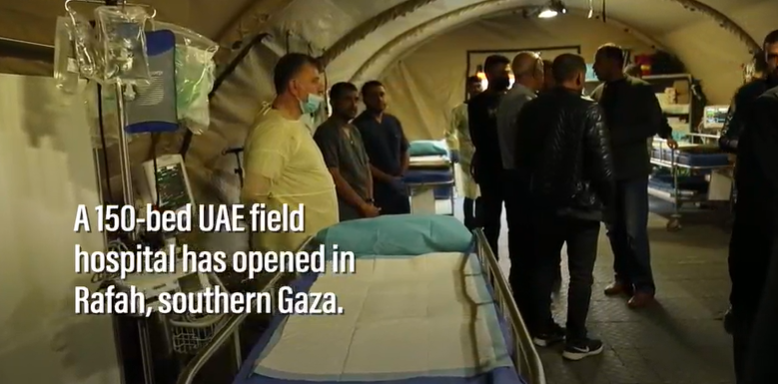
Putin’s third proposal is establish a Russian field hospital to treat wounded Palestinians at the Rafah stadium, rebuilt in 2019 after Israel destroyed the original one in 2009. “But for this to happen, we need to have consent from both Egypt and Israel. I talked to the President of Egypt, and he is in favour of this idea. I also talked to Prime Minister Netanyahu, and they consulted various armed agencies. The Israeli side believes that opening a Russian hospital in Gaza is not safe.”
Putin made his disclosures in response to a Turkish reporter’s question about the Gaza war during the Direct Line broadcast on Thursday.
Putin did not mention a ceasefire; he did not criticize Israeli military operations in Gaza except to refer to the deaths of children. “The Secretary-General of the United Nations called today’s Gaza the biggest children’s cemetery in the world. This opinion speaks volumes. It is an objective opinion, what else can I say?”
Putin praised the Turkish President Recep Tayyip Erdogan for “playing a significant leading role in improving the situation in Gaza…He is very active in this matter. And God bless him.”
Putin omitted to mention Iran, ignoring his talks in Moscow a week ago with Iranian President Ebrahim Raisi. Following their five-hour negotiations, Iranian Foreign Minister Hossein Amir Abdollahian announced that “Russia is thinking about an initiative on Gaza.”
A Moscow political analyst commented after viewing Putin’s latest remarks: “Netanyahu refused a Russian field hospital but allows a UAE one? That is telling. This shows that Putin defers to the Israelis on anything related to Gaza. Nothing has changed in his position.”
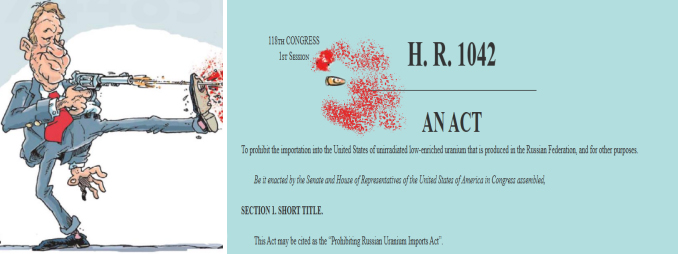
US Congressmen have adopted the unusual procedure of approving by voice vote – no tally — a ban on imports of Russian uranium to fuel US nuclear reactors. Hidden from the record are the Congressmen who insisted on including a loophole, Section 2, allowing a waiver of the law until January 2028 to keep the lightbulbs in their districts from blacking out.
The Pentagon also insisted on a loophole, Section 3A, allowing a waiver so that the manufacture of depleted uranium munitions for the Israeli, Ukrainian, and US armies, as well as nuclear warheads for tactical and strategic missiles aimed at Russia, will not be cut off from their Russian import source.
By Christopher Busby, Bideford, introduced by John Helmer, Moscow @bears_with
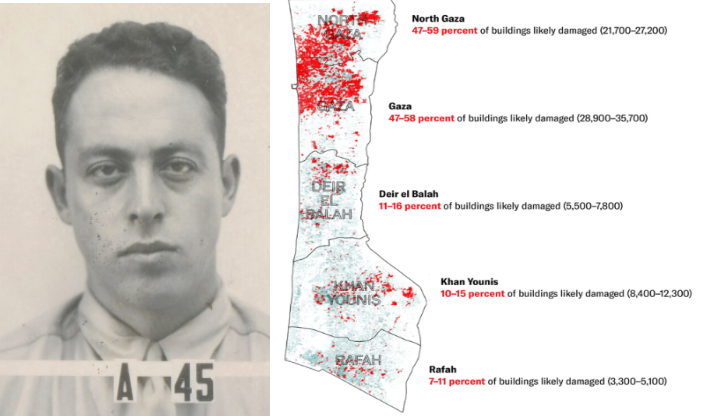
The neutron bomb was invented in 1958 by Samuel Cohen (lead image, left) of the Livermore Laboratory of California and then RAND.
In 1984 he proposed that Israel construct a neutron radiation wall around the country. “What I am suggesting is the construction of a border barrier whose most effective component is an extremely intense field of nuclear radiation (produced by the operation of underground nuclear reactors), sharply confined to the barrier zone, which practically guarantees the death of anyone attempting to breach the barrier. Establishing such a ‘nuclear wall’ at the borders of a threatened country can make virtually impossible any successful penetration by ground forces – as well as a preemptive ground attack by the threatened country.”
Cohen, who described himself as an “unbelieving Jew”, believed that by creating this radiation barrier around Israel, no Arab state army would attack. He also believed that by deterring that form of escalation, Cohen’s neutron wall would be protecting the US because, in the end, Cohen believed the US would abandon Israel to its fate if the US were threatened directly. “If the Soviets intrude again in an Arab-Israeli war, “ Cohen wrote, “this time with vastly improved nuclear capabilities to back up their actions, the survival of the United States would be at stake. Clearly this is a situation where it would be irrational—indeed, intolerable—for us to remain committed to Israel. Clearly, the most responsible thing the United States can do, to ensure its own security, is to make drastic changes in its military assistance to Israel (and to other Mideast countries as well) to prevent such a situation from ever arising. Otherwise, based on the wretched history of this turbulent arena, there is every reason to expect that one of these days a nuclear showdown will arise.”
What Cohen was proposing was a neutron bomb to be deployed by Israel except that, because there was no detonation, no explosion, he claimed there was no neutron bomb.
“During peacetime, the reactors (employed underground, for protection and safety) are operated on a continual basis, as are our power reactors. The neutrons produced by the fission reactions escape into a solution containing an element that, upon absorbing the neutrons, becomes highly radioactive and emits gamma rays (very high energy X-rays) at extremely high intensity. The radioactive solution is then passed into a series of pipes running along the barrier length in conjunction with conventional obstacle components—mines, Dragon’s Teeth, tank traps, barbed wire, etc. To the rear of the pipes and obstacle belts is a system of conventional defensive fortifications. (The obstacles, the firepower from the fortifications, and tactical air power all serve to impede the rate of advance of the attacker, increasing the attacker’s exposure to the gamma radiation. Vice versa, by quickly incapacitating the attacker, the radiation serves to make it difficult, or even impossible, for the attacker to remove the obstacles and assault the fortifications.) The width of the entire defensive system need be no more than a few miles.”
Since it was Cohen’s idea that the Palestinians and the Arabs were neither defending their lands or themselves, but were the “aggressors” against Israel, Cohen argued it was perfectly moral for the Israelis to use their neutron weapon “defensively”.
“Regarding the morality (or immorality) of such defensive use of nuclear radiation, one should keep in mind that the gamma rays themselves can, of course, have no intentions; nor is there necessarily any intent by those who produce them to kill anyone. The intent to kill has to lie with the aggressor—to kill himself. This contrasts sharply with the employment of conventional weapons, where there is every intent to kill the enemy. The basic purpose of the radiation is to deter the would-be aggressor from attacking; that is, to prevent war.”
Cohen thought a quick radiation death was more moral than a lingering one from conventional munition wounds.
He also dismissed the idea that his radiation wall was a weapon of mass destruction (WMD) or a war crime. “The radiation barrier involves a pipe filled with radioactivity of controlled duration, installed on friendly soil for the purpose of self-defence, and whose radiation effects are constrained to a very narrow strip of unpopulated territory. Clearly, this cannot be called a weapon of mass destruction, and a radiation barrier could be constructed without any violation of existing or contemplated nuclear arms control treaties.”
While in Cohen’s case for the Israeli neutron weapon he believed it would deter tactical operations of the Hamas or Hezbollah-type incursions, he argued the bigger threat to Israel’s survival was that the US would not risk itself in a nuclear escalation with the Soviet Union, if escalation between Israel and the Arabs headed in that direction. Cohen didn’t mention Iran. He did say that the Kremlin was Israel’s strategic enemy.
“For the United States to risk nuclear war by risking a confrontation with the Soviets in the Middle East would defy reason. This unhappy fact of life, if there is to be any sanity on the part of my country [US], excludes the possibility of US military intervention in the event of another Mideast war. Should Israel once again put itself in a position where its military forces threaten the integrity of an Arab country and should the USSR threaten to come to the aid of that country, Israel would have to be on its own. Considering the overwhelming military force the Soviets could bring to bear, this would place Israel in an untenable position whether or not it used nuclear weapons. The real threat to Israel in the future, if it continues with its past military doctrine, will thus be the Soviet Union, not the Arab nations, however powerfully they may arm themselves with conventional weapons. And this compels Israel to change its doctrine in favour of a guaranteed defence of its borders to ensure that they will never be placed in a position that brings the Soviets into an Arab-Israeli war.”
Cohen is dead. His tactical and strategic calculations are alive; they are secretly being recalculated at this moment. When US President Joseph Biden warned overnight that Israel’s military methods were threatening “[world] support by the indiscriminate bombing that takes place”, and that “[Prime Minister Benjamin Netanyahu] has to change, and with this government”, Biden was signalling the US will not escalate if the Israelis try to provoke it.
Cohen’s ghost – Russian intervention – is behind the Biden warning to Israel. “We continue to provide military assistance to Israel until they get rid of Hamas. But — but — we have to be careful,” Biden said twice. “Have to be careful.” (Biden was also revealing his re-election calculation of donor money now, votes later, depends on it. )
What Biden and President Vladimir Putin secretly suspect is that Israel has already escalated to tactical nuclear weapons on the battlefield, to genetic destruction warfare against the Palestinians, — and to something like the neutron bomb.
This is not the Cohen version of forty years ago. Nor is it the depleted uranium (DU) artillery shells and air-dropped DU bombs or rockets, which have been used for years by the Israel Defence Forces (IDF) in Gaza and Lebanon.
Here is the case, the physical evidence, that the Israelis are using a new type of uranium radiation weapon.
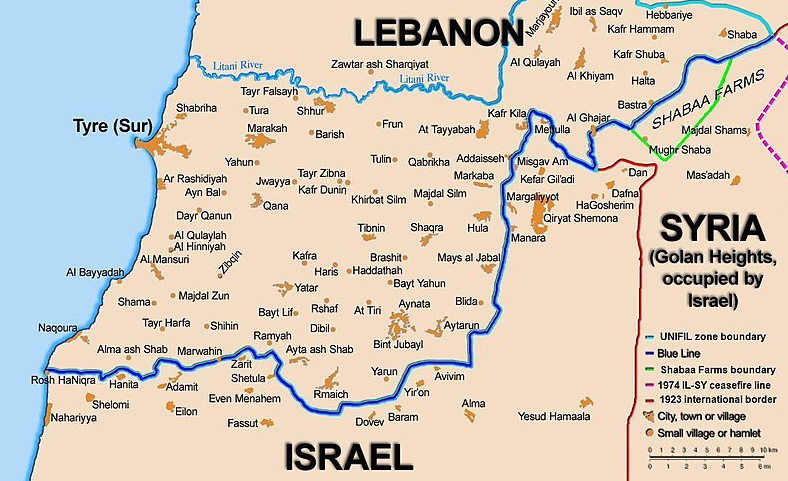
Arab, Russian, and international media are reporting the Israeli government has issued an ultimatum that if Hezbollah does not withdraw its army and arms from their positions in southern Lebanon, between the Litani River and the Blue Line (lead image), and redeploy north of the Litani, Israel will launch an air and ground attack on the region of southern Lebanon, and also on Beirut. The Israeli ultimatum reportedly sets a 48-hour time limit.
There is no official Israeli record of this ultimatum. In the non-Israeli press, it is attributed to remarks on local television made on Saturday night, December 9, by Israel’s National Security Advisor, Tzachi Hanegbi. However, in the version reported by Times of Israel, Hanegbi did not set any time limit.
Instead, Hanegbi claimed that “Hezbollah’s Radwan force could attempt a similar murderous invasion from the north, targeting civilians in communities near the border. Israel, he acknowledged, was tackling Hamas ‘17 years too late,’ and it could no longer dare to tolerate the danger of the prevailing situation in the north, with Hezbollah’s forces at the border. Some 60,000 residents of border communities have been evacuated from the north since October 7, amid relentless and sometimes deadly clashes across the border between Hezbollah and Israel. ‘Residents will not return if we don’t do the same thing’ in the north against Hezbollah as is being done in the south against Hamas…”
“‘We can no longer accept [Hezbollah’s] Radwan force sitting on the border. We can no longer accept Resolution 1701 not being implemented,’ he added, referring to a UN Security Council resolution from 2006, at the end of the Second Lebanon War, that barred any Hezbollah presence within almost 30 kilometres of the border with Israel. Asked directly if there would be a war in the north, Hanegbi said: ‘The situation in the north must be changed. And it will change. If Hezbollah agrees to change things via diplomacy, very good. But I don’t believe it will.’ Therefore, he said, ‘when the day comes,’ Israel will have to act to ensure that residents of the north are no longer ‘displaced in their land, and to guarantee for them that the situation in the north has changed.’
“Hanegbi noted that while many countries have missiles pointed at Israel, including Iran, Syria and Iraq, ‘Israel doesn’t invade them’. The fear regarding Hezbollah’s Radwan force is that ‘within minutes’, it could cross the border and begin a murderous rampage in northern communities as Hamas did in the south on October 7. Israel cannot tolerate this threat any longer, he said. Hanegbi said Israel does not want to fight simultaneously on two fronts, and indicated it would therefore tackle Hezbollah after Hamas is defeated. He said Israel has been ‘making clear to the Americans that we are not interested in war [in the north], but that we will have no alternative but to impose a new reality’ if Hezbollah remains a threat.’”
The Russian Foreign Ministry is reporting no reaction to these claims, nor any ministry contact in Moscow with a Lebanese government official. None of the mainstream Russian newspapers nor the media specializing on military and security affairs are reporting the remarks of Hanegbi as a signal of imminent Israeli air and ground attack against Hezbollah.
The Russian reaction is that the Israelis are bluffing.
Not even in revolutionary times have Russian elections been waged on the issue President Vladimir Putin proposed a few days ago of what it means, what it costs, what it risks for Russia to lead the national liberation of the world.
Nor has Putin revealed after two days of intensive talks with Emirati, Saudi, and Iranian leaders, and then a telephone call with the Egyptian President, Abdel Fattah al-Sisi, what plan of action for the Gaza war they discussed. “Russia is thinking about an initiative on Gaza,” Iranian Foreign Minister Hossein Amir Abdollahian has announced after the talks concluded.
El-Sisi was so negative about this, the Kremlin record of his Saturday morning telephone call reveals no more than that he and Putin talked over “a number of issues related to Russian-Egyptian cooperation, which has been developing very successfully. Both parties expressed their interest in further expanding cooperation in various areas in a traditionally friendly manner based on the principles of strategic partnership.” The two presidents then wished each other good luck for their re-elections.
The Egyptian presidential vote is running for three days from Sunday with the result to be declared on December 18; the Russian poll will be held on March 15-17. The outcome is certain for both.
Two hours after Putin put down the phone with el-Sisi, he picked it up again to call Israeli prime minister Benjamin Netanyahu. The Kremlin communiqué has omitted to report what Netanyahu said.
Instead, Putin gave the Israeli his personal assurance there will be no Russian participation in a Gaza blockade-busting plan to deliver humanitarian aid to the Palestinians by sea, or across the Egyptian land border. Nor will the Russian military intervene to threaten Israeli aircraft if they commence bombing Beirut and southern Lebanese targets in the war against Hezbollah.
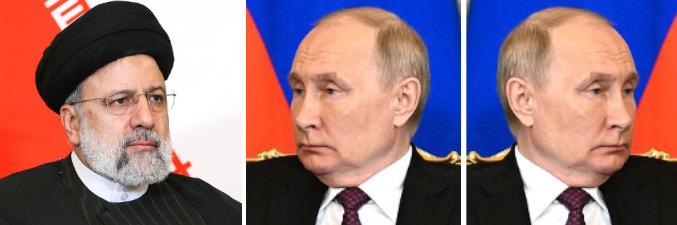
An Iranian-Russian initiative on the Gaza War was tabled when Iranian President Sayyid Ebrahim Raisi met with President Vladimir Putin for several hours on Thursday. For the time being the Kremlin is doing its best to hide it.
According to Iran’s Foreign Minister Hossein Amir Abdollahian, speaking after Raisi had returned home, “a significant part of the negotiations focused on the Palestinian issue and Russia is thinking about an initiative on Gaza. The two sides stressed the need for an immediate cessation of the war and genocide in Gaza and the West Bank, he said, noting that the presidents of Iran and Russia also called for stopping the forced migration of Gazans and the immediate opening of the Rafah border to deliver massive humanitarian aid to Gazan people.”
There was a one-on-one session between Raisi and Putin at the commencement of the talks; a session of the two presidents with brief public statements; and then closed delegation presentations and a supper. Altogether, the talks lasted five hours. There were no press briefings at the conclusion.
There has been a blackout on the talks by Russian Defense Ministry, the military bloggers, and Moscow media like Vzglyad which has been taking a pro-Israel line. No Russian official will clarify what Abdollahian meant by his claim that “Russia is thinking about an initiative on Gaza” – except to point out that Abdollahian’s wording does not mean that the “initiative” at this stage was initiated by the Russian side.
Vedomosti reports that “Iran would like Russia to more actively express the pro-Palestinian position within the framework of public discourse, which would correspond to Iranian rhetoric. From the point of view of the North–South economy, of course, Tehran has a priority, it’s just that against the current background it, like any Muslim country, cannot demonstrate that it can have something more important than the situation in the Gaza Strip.”
According to the Kremlin communiqué, Raisi told Putin “the events unfolding in Gaza” are “surely genocide and a crime against humanity. It is lamentable that more than 6,000 children have been killed by the hands of the Zionist regime. Even sadder is the fact that all these crimes have been supported by the United States and Western countries. What is even more regrettable is that international organisations and the human rights organisations have lost their effectiveness… One of the issues that I would like to discuss with you, Mr Putin, is Palestine, as well as the challenges faced by the oppressed but strong Palestinian people. According to statistics, one child dies every ten minutes. Bombing must be stopped as soon as possible. This is not a regional issue, but a global issue, and a solution should be found promptly.”
Putin replied by changing the subject.
“Mr President, I will definitely take you up on your invitation [to visit Iran]. And I should note that we will keep working almost through the end of the year. We have scheduled the signing of an agreement on creating a free trade area between Iran and the Eurasian Economic Union in late December. It will create additional opportunities for expanding our interaction.”
The Kremlin has published the names of the Russian delegation accompanying Putin at the talks but refuses to disclose the names of their Iranian counterparts. “Wait for additional materials on our website”, the spokesman said.
Although Russian Defense Minister Sergei Shoigu was the second ranking member of the Russian side, Iranian sources confirm there was no military counterpart on their side.
Privately, Russian sources believe the two sides are discussing the protracted, long war strategy of Hamas and Hezbollah and the parallel engagement from Yemen and Iraq. They are also discussing ideas for breaking the Israeli blockade of Gaza with massive humanitarian aid in which the Arab states and China are also engaged in the planning.
“The war has to be economic and infrastructure suffocation [of Israel],” a Moscow source says. “Yes, that’s the only way to beat the beast.”
It has never happened before among the world’s diamond-producing and diamond-processing countries.
Meeting together last month in Zimbabwe in what is called the Kimberley Process (KP), the 57-member states refused to agree to the US and European Union (EU) attempt to exclude Russia, producer of half the diamonds in global trade. To camouflage the outcome of the fight, the KP delegates decided not to issue a communiqué. Without that, the rules of the meeting nullified all points of agreement which the Kimberley Process states had accepted during their two-day sessions.
This dramatic collapse of the Kimberley Process happened in Harare on November 10. The disagreement and deadlock came over a letter from the Kiev regime, backed by the US, the EU, Japan, and Canada (the G7 member states) to impose a full ban on the trade in Russian diamonds. The Ukrainian attempt was backed by intense pressure from the US State Department and by Jewish diamantaires in New York for the international diamond trade to accept the US Diamond Protocol, a scheme of registration, inspection, auditing, and certification enforced by US intelligence and Treasury agents, to prevent any Russian-mined diamond from entering the international diamond jewellery market.
Instead, what has happened is that the global diamond industry has been cracked in half by the sanctions war. The defeat of the so-called “western bloc” in Zimbabwe is big news in Africa and India. It has not been reported in the New York and London financial press.
Diamonds are now likely to follow oil, gas, coal, gold, and other commodities into parallel and competing global market operations. In the diamond war, however, the outcome is also going to backfire on the Israeli diamond industry and the traditional Jewish centres in Antwerp, Belgium, and New York City, which have combined to take sides against Russia. In time, they will be replaced by the Arabs, Indians, and perhaps the Chinese.
The Israelis don’t think so. They are calculating that in the short run they will gain from the recovery of diamond prices when the shortage of Russian supplies hits much harder than it has to date. A source in Antwerp reports “absolutely no backlash [against the Gaza war] here from any of the five main diamond communities including the Lebanese. The Israeli industry has been declining for many years anyway, especially manufacturing – it’s uncompetitive with the Indians — but also trading. There is no diamantaire sympathy with any Arab country (or Iran). I hope and believe business rises above the political nonsense.”
The Kimberley Process, first created in 2003 to stop “blood diamonds” from entering the market from the genocidal wars of western Africa, is about to be confronted by blood diamonds from Israel.
Between 1917 and right now in Russian history, it has been clear that the horse pulls the cart. That’s to say, the ideas people have, or the ideology of groups and the propaganda of media, churches, and governments are pulled along by their economic interests, by the class structure of the underlying society.
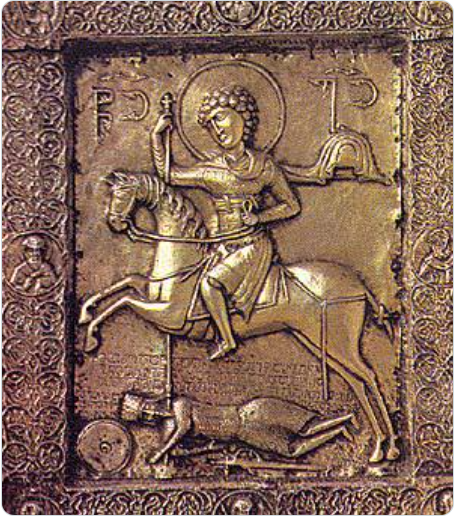
Not the horse in the picture. That’s the icon image, popularised in the Georgian Orthodox Church from the 11th century, depicting St. George, patron saint of believers, spearing to death the Roman emperor Diocletian. Actually, Diocletian ruled the Roman empire from 284 until 305 AD, when he became the first emperor to resign voluntarily and retire harmlessly. Before that Diocletian, a professional soldier, did a lot of spearing of Gauls, Balkan tribesmen, and Persians, as well as Christians in Syria, before he decided to rusticate in his garden on the Adriatic.
The icon doesn’t represent what really happened. Long after Diocletian was forgotten, the icon has come to represent the victory of Orthodoxy over the anti-Christian empire. The icon image was mentioned last week by Andrei Ilnitsky, an advisor to the Russian Defense Ministry and lead ideologist for the United Russia party, in a speech to the Patriarch and President Vladimir Putin. According to Ilnitsky, St George represents Russia, and the spearing of Diocletian represents what Russia is doing to the US empire on the Ukrainian battlefield.
Now — most precisely at the World Russian People’s Council meeting in Moscow on November 28 — Ilnitsky, the Patriarch, and Putin are reversing the order of history. It’s now the cart of Russian ideology pulling the horse of Russian forces into battle with the Americans.
“They are fighting with us,” declared Ilnitsky, “for the way people think, for the way they perceive the world. Right now we are fighting a civilisational war for the future. It is this war that we are waging on the battlefields of our own. We will win and revive ourselves by being reborn, or our identity will be wiped out. This is exactly what happened in the Ukraine for thirty years before the start of the SVO [Special Military Operation].”
Putin went further than spearing the emperor. “Our fight”, he declared, “for sovereignty and justice is, without exaggeration, one of national liberation, because we are upholding the security and well-being of our people, and our supreme historical right to be Russia – a strong independent power, a civilization state. It is our country, it is the Russian world that has blocked the way of those who aspired to world domination and exceptionalism, as it has happened many times in history. We are now fighting not just for Russia’s freedom but for the freedom of the whole world.”
This is the first time Putin has identified the doctrine of national liberation in ideological, economic, and in battlefield war against the US doctrine of hegemony and exceptionalism.
“We can frankly say that the dictatorship of one hegemon is becoming decrepit. We see it, and everyone sees it now. It is getting out of control and is simply dangerous for others. This is now clear to the global majority. But again, it is our country that is now at the forefront of building a fairer world order. And I would like to stress this: without a sovereign and strong Russia, no lasting and stable international system is possible.”
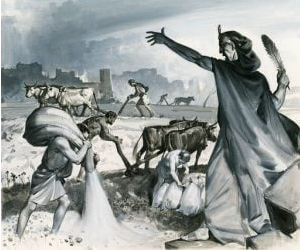
Salting the earth, ploughing a toxic chemical into farmland so that no food can be harvested again, was the invention of Abimelech, one of the tribal leaders of the Jewish people after they had invaded Caanan to create the Israelite kingdom, and after the Israelite tribes had begun fighting among themselves.
Abimelech’s salting of Shechem is about three thousand years old. The Israeli use of depleted uranium ordnance supplied by the US, which invented depleted uranium as a “terrain-denial” weapon in 1943, is right now. The objective is the same as the Book of Judges 9:45 tells the story – genocide by making the land occupied by the Palestinians uninhabitable for the future.
Listen to Gorilla Radio tell the story of what the Israeli-US war aim is – and where it comes from in Jewish history.
When President Vladimir Putin wrote a condolence on the death of Henry Kissinger (lead image), according to the Kremlin communiqué, the president said things in private to Kissinger’s widow which he left unreported to the Russian press.
The Kremlin communiqué says: “Condolences over the passing of Henry Kissinger. Vladimir Putin offered condolences over the passing of Henry Kissinger to his wife, Nancy Kissinger. The message reads, in part: An outstanding diplomat, a wise and far-sighted statesman who enjoyed well-deserved respect around the world for decades, has passed away. Henry Kissinger’s name is inextricably linked with America’s pragmatic foreign policy, which played a pivotal role in defusing international tensions at the time and achieving crucial Soviet-American agreements that contributed to strengthening global security. I had multiple opportunities to talk face-to-face with this profound and extraordinary man, and I will certainly cherish the warmest memories of him.”
What the Russian intelligence services, General Staff, Foreign Ministry, and Russian historians remember about Kissinger, and Putin’s relationship with him, has also not been reported. In the official record of Putin’s communications with Kissinger, Putin himself has never acknowledged, let alone agreed with the official assessments of Kissinger by advisors led by Yevgeny Primakov, former KGB head, foreign minister, prime minister, and, like Kissinger, of Jewish origin. They told Putin that Kissinger was an untrustworthy liar; a violent schemer; a hegemonic expansionist if he could get away with it – always dangerous for Russia’s security.