by John Helmer, Moscow
@bears_with
Long before the British intelligence agency MI6 invented the story that Russian military agents had carried the nerve agent weapon Novichok into England, fired it at two Russians, and left it in a dustbin for a local scavenger to find, take home and kill his girlfriend, there was depleted uranium poisoning.
This is a weapon of mass destruction (WMD).
In the past thirty years it has been used by the US, British, and Israeli armies in their wars against Iraq, Lebanon, and Palestine (Gaza), Serbia, and recently against the Russians on the Ukrainian battlefield. As a US invention, however, depleted uranium dispersal as a gas to contaminate terrain for enemy soldiers has been acknowledged in secret since 1943.
In the official military manuals, depleted uranium rounds are used because their metal concentration and intense heat burn their way through armour plate. In practice, they vaporise high concentrations of radioactive particles to cover large swathes of territory, civilian and military.
The US Department of Homeland Security defines a weapon of mass destruction (WMD) as “a nuclear, radiological, chemical, biological, or other device that is intended to harm a large number of people.” DU harms a relatively small number of soldiers on a battlefield operating in tanks, other armoured vehicles, self-propelled artillery and reinforced bunkers. DU strikes a much larger number of people through the release of radiation downwind of the battlefield by penetrating their bodies, attacking their genetic codes, and triggering cancers, birth defects, miscarriages of the unborn, and premature death of adults.
According to Homeland Security, it “works every day to prevent terrorists and other threat actors from using these weapons to harm Americans.” But when the US supplies its DU weapons to the Israeli and Ukrainian armies, it intends to cause this mass destruction by not caring for the harm they do — in fact concealing this harm, and publicly pretending DU ordnance is not what it is.
DU is a WMD by stealth. The US knows this because US and British soldiers who participated in the first battlefield use of DU shells and bombs, the war against Iraq in 1991, have been the long-term victims of their own weapons.
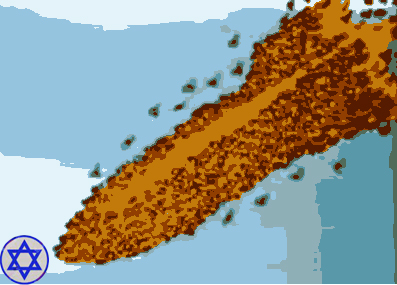
When the Israel Defence Forces (IDF) fire their DU shells and bombs into the buildings of Gaza, they are not aiming at Hamas tanks, armoured personnel carriers, or howitzer units – the Palestinian forces have none of those. Instead, the Israelis are aiming at the mass destruction of the Palestinian people, including those still unborn. The supply chain for this WMD includes the Cypriot, Greek, German and British governments.
In Gaza, and in the Ukraine, they are all witting participants in targeting a race of people for extermination, now and for the future.
(more…)