The Polish government is dragging its feet, closing its eyes, and covering its mouth over prosecution of Ukrainian war crimes against Poles, Jews, and Russians during the German war of 1939 to 1945.
Officials reveal they are reluctant to pursue the Canadian Ukrainian Yaroslav Hunka (lead image, right) for war crimes against Poles and Jews between 1943 and 1945, when Hunka was a volunteer in the German-led SS unit, the SS Waffen Grenadier Galician Division. After it was routed by the Red Army at the Battle of Brody in July 1944, Hunka and the survivors fled southwest where the German SS command re-formed them in a new unit called the SS 14th Grenadier Division; later the 1st Ukrainian Division, which in May 1945 surrendered to the British Army. But not before the Ukrainians had operated against the anti-German partisans of Slovakia, Yugoslavia, and Austria, where investigations have identified more of their war crimes.*
There is also more to the Polish government’s reluctance. It is a combination of misinformation, deliberate inaction, and camouflage to pacify Jewish communities in the US, Israel and Canada; satisfy the Ukrainian diaspora of Canada led by Deputy Prime Minister Chrystia Freeland (lead image, left); and mislead Polish voters who go to the polls in ten days’ time.
The four Polish officials responsible for this deceit are the former prime minister Beata Szydlo; the current minister of education Przemysław Czarnek; the chief archivist and spokesman for the Institute of National Remembrance (IPN) Rafał Leśkiewicz, who is also an adviser to Prime Minister Mateusz Morawiecki; and Poland’s ambassador to Canada in Ottawa, Witold Dzielski.
Despite their public statements about the Hunka case, they are Russia haters, proponents of the war against Russia, and defenders of the Ukrainian leader Vladimir Zelensky.
To obscure the contradiction between what the four have said publicly after Hunka was saluted by Zelensky and the Canadian parliament on September 22, and what they have done behind the scenes with senior officials in Warsaw, they are now covering up what Polish, British, Yugoslav, and Russian records already expose of Hunka’s wartime actions, along with those of the Galician units in which he participated.
Cynically, the four Poles are proposing to request information and assistance from the two sources certain not to provide it, the Canadian and Ukrainian governments; and make promises to the Polish media certain that journalists will ask no further questions.
Canada’s parliament, the Canadian Armed Forces and Royal Canadian Mounted Police (RCMP) demonstrate what the other NATO allies keep trying to hide. They aim to reverse the outcome of World War II and resume Adolf Hitler’s operation to destroy Russia.
However, the fate of soldier Yaroslav Hunka of the SS Waffen Galician division, whom the MPs, the chief of the Defence Staff, and the RCMP commissioner, saluted a few days ago for his exploits killing Jews and Poles in the Ternopil region of western Ukraine between 1943 and 1945, now rests with two dossiers. One is in the archive of the Polish war crime prosecuting authority, the Institute of National Remembrance, in Warsaw. The second is the Soviet Army intelligence and KGB archives on the operations of Hunka’s unit before it fled a thousand kilometres southwest to Austria in order to surrender to the British Army.
“Beasts in human form with a red star on their foreheads,” Hunka has called the Russians whom he was afraid to fight.
His Jewish schoolmates in the Berezhany Gymnasium – 32 of them refugees from Poland – caused him to “wonder why they ran away in front of such a civilized Western people as the Germans.” They were all murdered by June 1943 when the town was declared Judenfrei. Hunka remembered that time as “the happiest years of my life [dreaming] of the company of charming girls.”
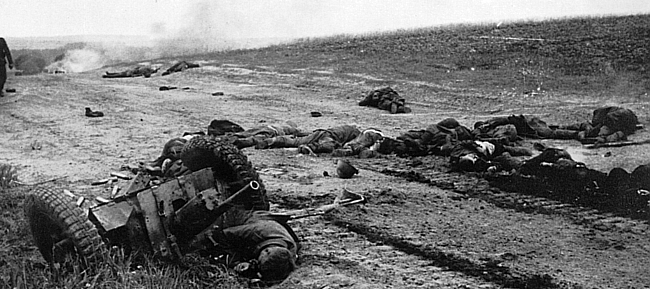
A year later, the Red Army launched its offensive against Lvov and in four weeks Hunka’s division was destroyed at Brody, 70 kilometres north of Hunka’s home. Of 11,000 of the Galicians with Hunka in the battle of the Brody pocket, less than a third survived. He fled with the retreating Wehrmacht towards Graz, Austria. “It was now every man for himself”, a recent history of the Battle of Brody (lead image, July 14, 1944) has described the outcome for the Galicians.
What Hunka had already done to the “charming” Jewish girls of Berezhany, and what he did when facing the Russians has been described by the Speaker of the Canadian House of Commons, in a script drafted by the Canadian Foreign Ministry, applauded by General Wayne Eyre, chief of the Defence Staff, as “heroic”.
With Hunka as their inspiration, the Canadian military wants to repeat this battle against “the beasts with a red star on their foreheads” — this time with the Canadian Jewish community for allies, one of them the Leader of the House of Commons, Karina Gould. But she and her fellow government ministers must now decide whether to block Polish and Russian requests for assistance in documenting Hunka’s war record from Canadian, British and US military intelligence files. If they refuse, they will be protecting Hunka from prosecution for the war crimes in the Ukraine they declare they know nothing about, in order to improve themselves on Hunka’s performance at Brody seventy-nine years ago.
North Bay, Ontario, is a small Canadian city of immigrants from Europe, their upwardly mobile children, and their children’s children.
It’s the town where Yaroslav Hunka (lead image) lives after he left the British prisoner of war camp where he and other Ukrainian soldiers of the SS Waffen Grenadier Galician Division were held after the end of fighting in Europe in 1945. North Bay is where his son Martin Hunka was chief financial officer of Redpath Mining, a mine engineering company. By North Bay standards, the Hunka family is better educated and wealthier than most, donating substantial sums of money to the local hospital, universities, and Ukrainian national organisations, and through the Redpath mining company to local politicians.
North Bay is also where the children of these men demonstrate Hitler salutes and Nazi Party slogans on the local high school football field.
This is the model of small-town church-going people of modest but respectable means who share the prevailing ideology of their homeland grandparents who were on the side of Adolf Hitler, Benito Mussolini, and Stepan Bandera in the last world war. The smiles remain the same, the stand-up stiff-arm salutes have changed. The minds remain fixed where they were in their grandparents’ ideology – that was the collective fascism of a century ago.* These people continue to believe that for their liberation, the Russian race should be destroyed – “suffocated” is the state policy term used by Canada’s Foreign Minister, Melanie Joly.
The churches they attend organised a rally for this goal at the North Bay City Hall featuring statements by the two Hunkas; they were St. Andrew’s United, Trinity United, Emmanuel United Church, and Omond Memorial United Church. “Nothing has changed,” Yaroslav Hunka said at what the churches called a “peace vigil”. “The same enemy. First Stalin was there and now this idiot. But Ukraine is not by itself like it was before. The whole world knows about Ukraine and the whole world supports Ukraine and that is very important.”
Martin Hunka added: “I think the support in Canada, the support around the world has been fantastic. At least now we have friends, whether that is going to translate into anything concrete on the ground, I think it already is.”
This is the town where the first Italian to become Speaker of the House of Commons in Ottawa ran a business and collected election campaign donations. That’s Anthony Rota, the man who invited the two Hunka men to be guests in the Speaker’s Gallery during the speech of Ukrainian president Vladimir Zelensky on September 22. Rota and the government’s leader of the House of Commons, Karina Gould, arranged for the two Hunka men to be seated in the front row of the gallery next to the leaders of Canada’s military and internal security forces, General Wayne Eyre, the chief of the Defence Staff, and Deputy Commissioner of the Royal Canadian Mounted Police, Bryan Larkin, protected by two armed bodyguards.
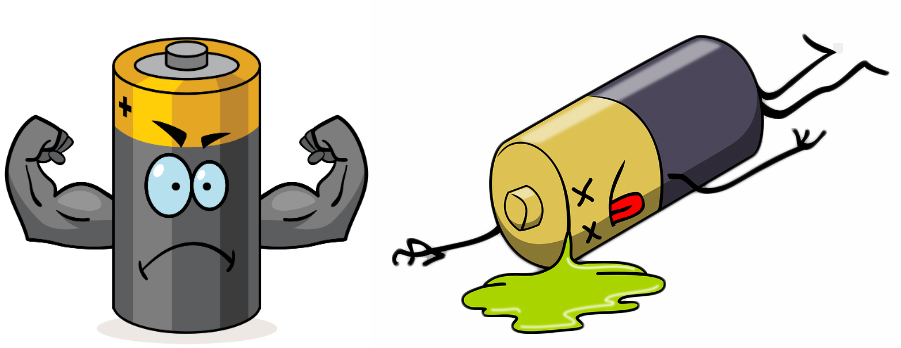
In January of this year the United States Geological Survey (USGS) reported the reserves of the nine leading countries in the world which mine lithium, the new fuel to power electric batteries. Chile led, followed by Australia, Argentina, China, and the US which claims to have one million tonnes. Russia was left out of the USGS chart.
Russian sources report its lithium reserves are currently between 3.5 million and 5 million tonnes; that’s at least three times more than the US. The US is also much more limited in its capacity to develop new domestic lithium mines compared to Russia. Bolivia was also omitted from the US Government chart because its reserves were called unproven resources. In fact and in the ground, Bolivia leads the lithium world with 21 million tonnes.
The difference between what USGS reports and what happens next isn’t the distinction in geologists’ terminology between reserves and resources. It’s US Government policy to stop, sabotage and destroy Russia’s ability to meet its lithium requirement from its own, domestic sources, or by importing from friendly countries like Bolivia.
In response, a new plan for combining lithium mining projects in Bolivia and Russia will produce a surplus of Russia’s foreseeable requirement for lithium battery production. But not only that. Allied in technology sharing, investment, trade, and political agreement, the two countries will protect each other in the conservation of the lithium market. If everything goes according to plan, Russia, Bolivia, and the three BRICS states – Argentina, Brazil and China – will dominate the trade in global lithium. They are already discussing the formation of a collective marketing organisation – a lithium OPEC.
Unless the US can stop them.
In the latest official paper issued by the State Department on July 23, “the bilateral relationship between the United States and Bolivia” is “strained. Despite these challenges, the United States maintains a strong and respectful relationship with the Bolivian people, with whom we work to advance human rights, entrepreneurship, and cultural and educational initiatives…However, the United States remains concerned by anti-democratic actions and the politicization of the legal system.”
In the war at sea between the US-NATO alliance and Russia, the Russian shipping company Sovcomflot says its future has never been better. The US State Department directing the sanctions campaign against Russian oil and gas exports says the future for the Russian trade is never again. Both of them are right.
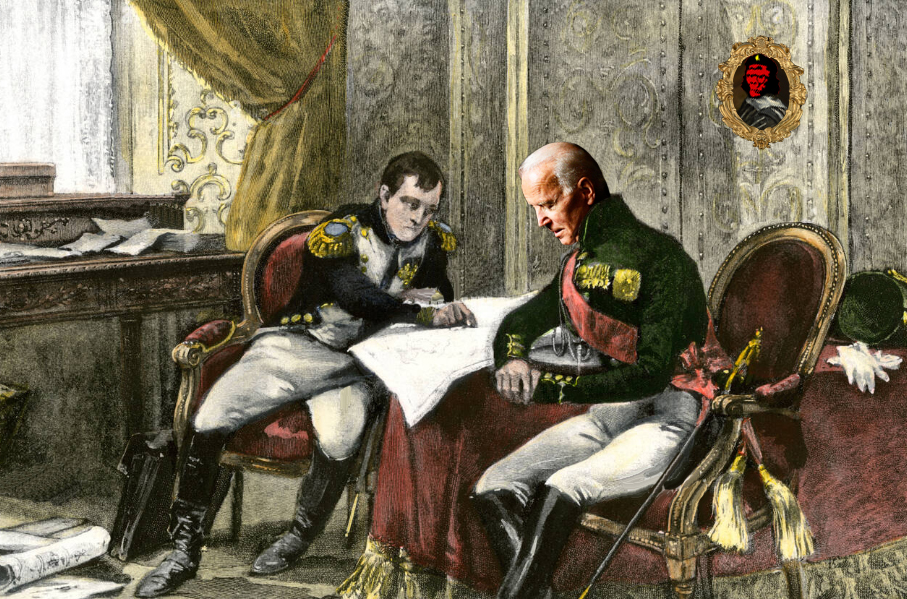
Belgium has decided to host its second Battle of Waterloo in two hundred and eight years, this time on Napoleon’s side. But on this occasion it won’t be, as the Duke of Wellington claimed before, a “close run thing”.
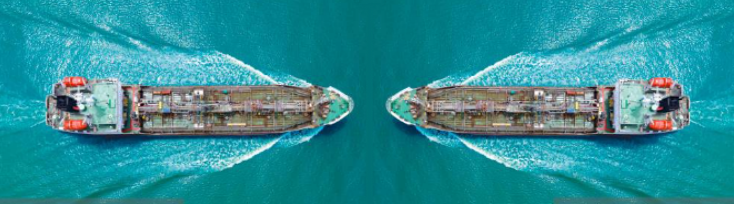
In the last episode of the Napoleon-sized mistakes the US and NATO are making in their sanctions war against Russia, the battleground was at sea. There, the sanctions war has transformed the global movement of oil and gas tankers – the routes, ports, insurance, contracts, pricing, certification, and recording. The major commercial and state fleets have now split into two blocs, ending the unified global tanker market and returning to the conditions of secrecy, smuggling, and bypass port hubs last seen in Europe when Napoleon attempted to impose his blockade of British merchantmen in what was called the “Continental System” at the time. That was more than two hundred years ago, between 1806 and 1814.
France did not recover from the damage the over-confident Napoleon did to the French position in Europe’s seaborne trade. Napoleon multiplied the cost of his misjudgement by deciding that, in order to enforce his blockade, he should invade Spain, Portugal and Russia, and close their ports. Russia then buried Napoleon twice — once in Moscow in 1812, then in Paris in 1814, before he and the French army were finished off at Waterloo. This time round, the US-NATO blockade of the Russian tanker trade is Napoleonic in the obviousness of the miscalculation; it is also Napoleonic in the magnitude of losses on the NATO side — and the acceleration of profits on the Russian side.
In today’s new episode, the battleground is the diamond trade based in Antwerp, Belgium.
Almost $14 billion worth of diamonds are imported annually for cutting, polishing, and trading there, and about the same value is exported. In their rough form, most of the diamonds in the Belgian market have been mined in Russia, and either sent direct to the Antwerp diamond market, or indirectly through India. Most of the diamonds exported from Antwerp have been going to India, United Arab Emirates (UAE), and Israel. The Israeli diamond processing business exports mostly to the US jewellery market.
The diamond trade in Europe has traditionally been a Jewish operation; until the Germans arrived in 1940 that was based in Amsterdam, Netherlands, for four hundred years. German race hatred wiped out the Jews of Amsterdam; Belgian race hatred for Russians is about to wipe out the Antwerp diamond market. The Jewish business is about to become an Arab one. As one Antwerp diamantaire described the situation, “if the Belgian government thinks it’s giving the finger to the Russians, all that will happen is that the diamond on that finger will move, and the finger will be what Dubai will be pointing.”
Martin Rapaport’s price sheet for the trade in Tel Aviv and New York reports that in Belgium “sentiment [is] very low. Serious concerns for coming months. 0.50 and 1 ct. [carat] diamonds especially weak due to sluggish US orders. Many hope holiday activity will kickstart trading. Uncertainty surrounds Russian diamonds as fresh sanctions loom.”
Rapaport, a dual Israeli-American citizen and self-reported “world’s largest and most trusted marketplace for diamonds & jewelry”, has been promoting fresh sanctions against Russian diamonds to cut the volume of Russian rough in the global market; these have been causing diamond inventories to overflow, diamond prices to fall, and Israeli margins to shrink. “Russia was the wild card in 2022. Whereas it was assumed the sanctions imposed in February by the US on Russian-sourced diamonds would lead to shortages, the goods continued to enter the market — propping up polished inventories.”
Rapaport’s fix is heavier US artillery in the war against Russian diamonds.
“There is a need,” he editorialised on July 12, “to address the issue of ‘substantial transformation’ — a pathway through which the current US sanctions still allow Russian-origin rough diamonds to enter the US if they are cut and polished in a third country, as explained by the Jewelers Vigilance Committee (JVC). The Group of Seven (G7) nations — Canada, France, Germany, Italy, Japan, the UK and the US — are working on measures that will require companies to disclose the origin of their diamond imports, both rough and polished.”
Rapaport was endorsing the attack on the Belgians by Vladimir Zelensky of the Ukraine, speaking to the Belgian parliament: “There are people”, he said, “for whom the diamonds sold in Antwerp are more important than the battle we are waging.”
Following Rapaport at the end of August, Brad Brooks-Rubin of the US State Department’s Office of Sanctions Coordination and career Russia diamond-fighter, announced that consumption of Russian diamonds must be stopped in the G7 nations, which currently account for almost 70% of all diamond purchases. “By cutting off most of their demand, if an import ban were to be agreed, Russian diamonds would have a narrower lane through which to work their way into the marketplace,” he said. “The focus of all discussions is how to target Alrosa and Russia’s diamond revenues that could then be funneled to their war efforts.” Like Rapaport, Brooks-Rubin is also a dual national.
In New York three weeks later, Belgium’s prime minister Alexander De Croo followed with an announcement of his new sanctions plan against Russian diamonds: “Russian diamonds are blood diamonds,” he said. Beginning January 1, 2024, “the G7 has a goal of banning Russian diamonds from the market. [We still must go] the final mile. We are extremely happy to play a role in this [effort]. We are a partner in this.” The new sanction, he said, is “good and strong and makes sure that we don’t have to have second thoughts about what is being sold.”
The plan is that anyone importing rough or polished diamonds into a G7 country, including the US, would be required to declare on their invoices that their shipments do not contain Russian diamonds, either original rough from Russia or processed in a third country. The plan puts Russian rough on a par with the so-called “conflict” or “blood” diamonds from Africa and Kimberley Process, which have been under source and invoice tracking for twenty years.
De Croo is no Napoleon. He is losing control of a weak coalition of minority government parties; his own party, the Open VLD (Flemish Liberals and Democrats), has dwindled in the polls to single digits since the beginning of the year; he faces oblivion when the Belgian election is called next June. The diamantaires of Antwerp are viewed in this election as carpetbaggers, not Belgians.
Portraying the new anti-Russian diamond move as a “European Union” initiative won’t save the plan or De Croo, Belgian sources comment. They believe the global diamond market will be split into two blocs, and what will remain for Antwerp will be the diminishing, high-cost market of Europeans and Americans. When they are defeated on the Ukrainian battlefield, the sources expect Antwerp will not recover, and Dubai will boom.
“I cannot see [the new sanction plan] working, especially for polished,” adds a leading London diamantaire. “How will polished be traced as Russian? Despite the so-called technology it won’t happen, as people will dream up ways around.”
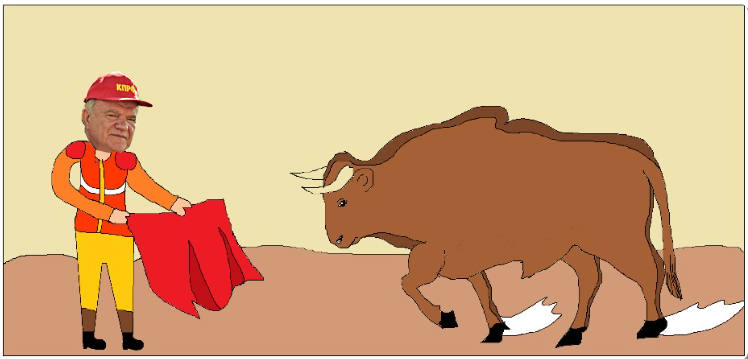
Everybody should know by now that bulls are colour blind. They don’t like or dislike the colour red. They are threatened and so they charge, not at the red, but at the waving of the cape, whatever its colour, or at the bull fighter moving around the ring. Bulls are perceptive – they can tell the difference between an armed man and his camouflage.
Since 1985, when Mikhail Gorbachev became General Secretary of the Soviet Communist Party, the Russian communists have not been as astute.
Like men, bulls grow less intelligent, more stubborn and miscalculating with age. This is also a problem for the Communist Party of the Russian Federation (KPRF) whose leader, Gennady Zyuganov (lead image, left), has recently turned 79 years of age. He is compos mentis compared to the similarly aged leaders of the Democratic and Republican parties in the White House and US Congress. But that’s not saying much – not enough to have persuaded Russian voters to support the KPRF candidates in the regional, gubernatorial, and mayoral elections which were held across the country between September 8 and 10.
This month the KPRF polled significantly more poorly than it had done at the last regional elections in 2018, although it retained its two governors, Valentinin Konovalov in Khakassia and Andrei Klychkov in Oryol; they have the advantage of incumbency, and were first elected in 2018. Communist Party support in the new Donbass regions was poor; 11% was their second place result in Kherson; they ran third in the three other Donbass region polls.
United Russia, the government party, did significantly better than in 2018, taking majorities in the legislative assembles of the regions, and a two-thirds vote countrywide.
A KPRF spokesman claimed the war is the reason for the communist defeat. “In 2018, there was the [government’s] increase in the retirement age and the rise of the pension protest movement which affected our results. Now the situation is reversed – [there is the] special military operation and society is consolidated [around the government].”
In fact, voters viewed the KPRF as having no policy differences with President Vladimir Putin on any significant issue. “Except in Khakassia,” according to one source, “the Communist Party doesn’t really exist.” Even there, the source concedes, the government’s United Russia party withdrew from the gubernatorial race, and the party took the majority of seats in the regional legislature.
Zyuganov insists the KPRF still leads the opposition in the country. “We need to realise that this war has been declared against the entire Russian world, our civilisation,” Zyuganov says in an interview published on the party website on Monday.
“So we have only one way out — to win a complete and unconditional victory. But to do this, it is necessary to correctly assess the current situation, understand our strengths and weaknesses — and resolutely go on the offensive. It is necessary to unite society as much as possible, to mobilise resources, to master all the most advanced and freshest. And to be able to do it in conditions of unprecedented sanctions.”
“Putin has changed his strategy four times over the past twenty years. He came to power after the ‘dashing 1990s’, during which more than 80,000 enterprises were destroyed and sold off, citizens’ savings were blown to the wind, and the Soviet government was shot. In the 1990s, the country turned itself into Uncle Sam’s wagging tail and decided to turn into an oil and gas pipe, a quarry, and a sawmill. But Putin realised it was necessary to change the strategy… But the remnants of the Yeltsin era [remain] in power. They still occupy many offices in the Kremlin and the government…”
“Putin made a very interesting and informative speech at the Fareastern Forum. But I would like to pay special attention to the part of his speech that concerned tax legislation. The oligarchy breathed a sigh of relief — the president says we will not change the situation with taxes. But of all the twenty leading countries in the world, only we have a flat tax scale, in which the same percentage of income is collected from both the poor and the leading rich! This is absolutely unfair and directly contradicts the interests of the state. Thanks to this policy, the oligarchs do not pay normal taxes…They continue to plunder the country at an unprecedented pace. In 2022 alone, $261 billion was transferred from Russia abroad. The total capital of our 25 richest oligarchs has already exceeded $ 300 billion. This is more than the entire Russian budget! And all this happens in the conditions of the special military operation, when help, support, and compassion are needed! When maximum consolidation and cohesion is needed!”
The US-led sanctions war against Russian fossil fuel exports, especially oil, has been the best thing to have happened to Sovcomflot, Russia’s leading shipping company and operator of the world’s largest oil and gas tanker fleets.
Revenues are up, earnings and profits are multiplying; Sovcomflot has never had so much cash in the bank; its debt is down to the lowest level in more than twenty years – and none of it is in American or European bank hands.
Released on August 28 and expressed in discreet language, the new company financial report says: “Revenues from tanker business segments (transportation of crude oil and petroleum products) are supported by favourable market conditions against the background of increased demand for tanker tonnage, taking into account the changing geography of international trade in oil and petroleum products. Despite the presence of a seasonal reduction in freight rates in the summer, the company believes that the market fundamentals, including the limited growth of the global tanker fleet due to the small number of orders for the construction of new vessels, suggests a high probability of stability in the medium term of freight rates at a level above the historically average.”
“Favourable market conditions” is Sovcomflot’s phrase for the US and NATO sanctions, first imposed on Sovcomflot’s financing and payment operations in February 2022, and escalated this year in European Union (EU) and UK sanctions targeting Dubai and Hong Kong fleet management companies. The reference to “changing geography” means what shipping experts and analysts from London to Oslo, Piraeus to Singapore acknowledge privately: “The war is good, very good for the oil tanker companies which can run the gauntlet of the Americans”, says a Greek source. The international shipping media are fearful of reporting this publicly.
London-based shipping publications like Lloyds List, sold by the London-listed Informa group to the Montagu investor group, are not reporting what their industry sources agree is happening. “Some people tend to close doors behind them”, a veteran maritime news reporter coyly describes the news blackout. Seatrade, another Informa outlet, is restricting its reporting to NATO tracking of sanctions busting.
US maritime media like GCaptain (California) and Marine Money (Connecticut) refuse to respond to questions about their news blackout. Equally quiet, although for different reasons, are the Indian, Chinese and Singaporean shipping press.
Sovcomflot is now confidently predicting the worldwide split between the Russian and US- NATO fleets will continue for the foreseeable future. “Despite the presence of a seasonal reduction in freight rates in the summer, the company believes that the fundamental market fundamentals, including the limited growth of the global tanker fleet due to the small number of orders for the construction of new vessels, suggests a high probability of stability in the medium term of freight rates at a level above the historically average.”
Never better – that’s what the last phrase means in Russian.
In the very long history of men and women who snatch defeat from the jaws of victory; miss the forest for the trees; and turn a molehill of profit into a mountain of loss, the US, British and German attempt to stop the tankers which carry Russian oil and gas to market is an exceptional failure.
It’s exceptional in the same way, and for the same reason of strategic miscalculation that Napoleon’s “Continental System” failed to destroy British trade with Europe – but destroyed the French economy instead. That was 217 years ago – France has never recovered from the damage the over-confident, miscalculating Napoleon did to the French position in Europe’s seaborne trade.
Napoleon multiplied the catastrophic cost of his misjudgement by deciding that, in order to stop the smuggling and bypass trade, and enforce his blockade, he should invade Spain, Portugal and Russia, and close their ports. Russia then buried Napoleon twice — once in Moscow in 1812, then in Paris in 1814, before he and the French army were finished off by others at Waterloo.
This time round, the NATO blockade of the Russian maritime trade is Napoleonic in the obviousness of the miscalculation; it is also Napoleonic in the refusal to acknowledge defeat.
So stubborn is this American blindness that even the Greek shipowners, stalwart defenders of the US occupation of Greece since 1945, cannot resist cashing in on the profits to be made from carrying Russian oil and gas across the sea. This is despite every attempt the arch US coup plotter, Geoffrey Pyatt – now State Department inspector of “energy resources”, formerly US ambassador to Athens and before that US ambassador to Kiev — is making to persuade, deter, threaten, and hurt them.
The defeat of the war against Russia on the land has yet to reach its Waterloo. The US, British and German idea of escalating the war on the Dnieper River battlefields westwards to Kiev and Lvov will become as obvious as Waterloo in a few months’ time.
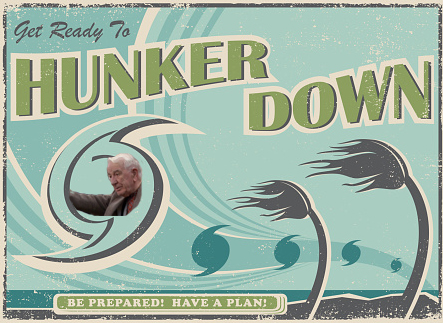
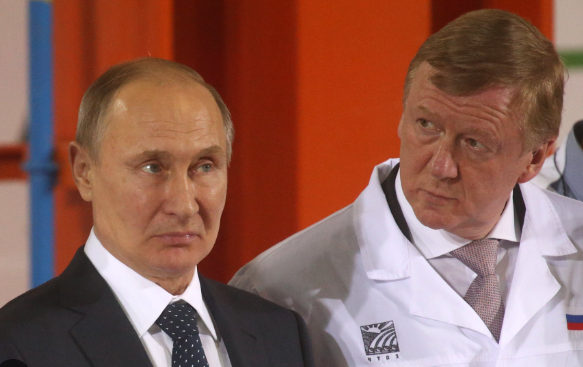
It must be the sea air at Vladivostok that causes temporary clumsiness and misspeaking on the part of President Vladimir Putin (lead image, left) during the carefully orchestrated question-and-answer session of the annual Far Eastern Economic Forum.
At the forum in September 2018, asked about British government and media reports of two Russian military intelligence soldiers using Novichok to attack Sergei and Yulia Skripal in Salisbury, Putin said he knew their names and denied they were GRU agents. “Of course, they are civilians,” he said in Vladivostok.
Again in Vladivostok on Tuesday this week, asked about Anatoly Chubais (right), the former Kremlin chief of staff and privatisation chief during the Yeltsin administration who has moved to Israel, Putin referred to him as “Moshe Israelevich”. Putin added: “the fact [is] that Anatoly Borisovich is hiding there [Israel] for some reason… I was shown some kind of photo from the Internet, where he is no longer Anatoly Borisovich Chubais, but some kind of Moshe Israelevich, lives there somewhere… Why he’s doing this, I don’t understand why he ran away.”
The US government propaganda agency and the Russian opposition have called Putin anti-Semitic for referring to Israel and calling Chubais “Moshe Israelevich”.
They were ignoring the context and Putin’s complimentary remarks about other Russian runaways to Israel, before he got to Chubais.
So was Putin misspeaking, or was he launching his presidential re-election campaign by trying to reassure two opposing blocs of Russians – the majority of voters who have long regarded Chubais as one of the most hated politicians in the country; and the Russian oligarchs for whom the current investigation of Chubais for billion-dollar theft of state funds is a harbinger of their own fate?