
By John Helmer, Moscow
@bears_with
The Black Sea is a small body of water by international sea standards.
It is so small that when the navies of the shore states go to war, the battles tend to be brief, hit-and-run affairs, like the skirmishes between the Romanians, Germans and Soviets in 1941-42, and between the Georgians and the Russians in August 2008. The Russians, with the bigger, better equipped navies, tend to win. When they win, as they did over the Ottoman Turks at the Battle of Sinope in 1853, the outside powers try to equalize by taking the anti-Russian side: it was the French and British in 1853; the Americans and the NATO allies now.
In the recent history of their direct encounters with the Russian vessels and their air support, the Americans and British have come off with what is known in maritime history as their tails between their legs.
The surface area of the Black Sea is 436,400 square kilometres. By comparison, the Mediterranean, into which the Black Sea drains, is 2.5 million square kms, and there are several much larger seas than that. .
The Black Sea is also not the biggest of the seas on which Russia has a shore line and frontier. The Caspian Sea is 371,000 square kms; the Baltic Sea is 377,000 square kms; the Chukchi Sea, 595,000 square kms; the Barents Sea, 1.4 million square kms; the Sea of Okhotsk, 1.6 million square kms; and the Bering Sea, 2.4 square million kms. For the time being, the Black Sea is the only one of these seas in which one of the littoral territories, the Ukraine, has declared war on one of the littoral states, Russia.
In the year since the Special Military Operation began on February 24, 2022, Turkish figures count 52 ship losses altogether; most of the Russian losses are Ukrainian claims which have not been verified. All of the Ukrainian losses on the Turkish list have occurred in port harbours or at a limit of 12 nautical miles (23 kms) offshore. The principal causes have been mines, shore-based artillery, missile, aircraft, and drone strikes.
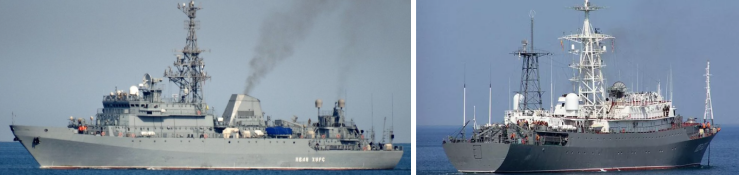
In the past three weeks, the Kiev regime has declared war in the international waters of the Black Sea by launching drone boats to attack two Russian naval vessels operating to guard the gas pipelines which run on the seabed between Russia and Turkey. The pipelines are known as Blue Stream, operational in 2003, and Turkstream from 2020. On May 24, the Russian Navy’s Ivan Khurs (lead image, left) was attacked by three Ukrainian surface drones; at the time the location was 140 kms northeast of the Bosphorus Strait, outside Turkish territorial waters, inside Turkey’s exclusive economic zone, but in international waters.
The Russian Defense Ministry reported the destruction of the attacking vessels without their reaching the Ivan Khurs, and the return of the vessel undamaged to its homeport of Sevastopol. Its mission, the ministry said, had been “to ensure safe operation of the Turkstream and Blue Stream gas pipelines in the exclusive economic zone of the Republic of Turkey and also [it] monitored the surface situation in the southwest part of the Black Sea to ensure the safety of navigation under the ‘grain deal.’”
On June 11, six Ukrainian surface drones attacked the Russian Navy’s Priazovye (“Azov Sea”, lead image, right). All six were destroyed before they could strike. The reported location was about 300 kms southeast of Sevastopol; that is the northern limit of the Turkish exclusive economic zone, but still in international waters.
The Ukrainian military have made no claim of responsibility.
The official Russian reporting of the incidents has treated them as Ukrainian terrorism. The method of the operations, and the vessels from which the drone boats were launched, have not yet been disclosed, although the positional data appear to have been recorded by the overhead US Air Force FORTE11 operation, and by overhead Russian surveillance aircraft, drones, and satellites, and by naval radars. The probability is also that real-time course targeting coordinates for the drones in their runs at the Ivan Khurs and the Priazovye were transmitted to the Ukrainians by the US Air Force (USAF).
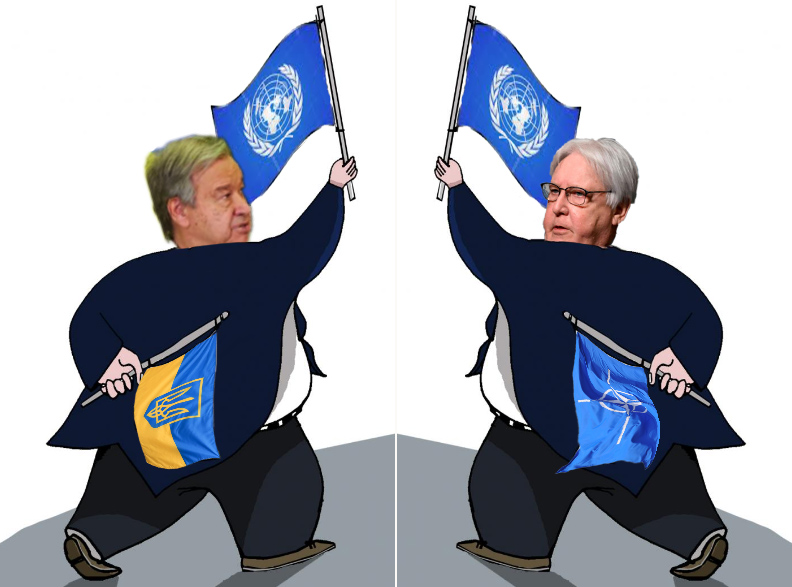
The likelihood also is that the Ukrainian attackers used the shipping channel designated for the security of grain transportation under the Black Sea Grain Initiative agreements of July 2022. Compliance with these agreements is the responsibility of the United Nations Secretary-General, Antonio Guterres. Ukrainian terrorism in violation of the agreements indicates the complicity of that UN official as the war has been extended by the Ukrainians and the USAF into international waters.
(more…)