
By Paul Fitzgerald and Elizabeth Gould, Boston*
@bears_with
George Bernard Shaw once said if you want to tell people the truth, make them laugh otherwise they’ll kill you.
(more…)

By Paul Fitzgerald and Elizabeth Gould, Boston*
@bears_with
George Bernard Shaw once said if you want to tell people the truth, make them laugh otherwise they’ll kill you.
(more…)

By John Helmer, Moscow
@bears_with
When it came to ingratiating American presidents, no Russian leader tried harder than Mikhail Gorbachev followed by Boris Yeltsin. Vladimir Putin did his best to match their examples with Bill Clinton. Putin was slow to learn, slower to anger. That began in 2008 when Hillary Clinton, then Secretary of State, broke a promise after taking a bribe to allow the Kremlin to buy the Opel car division in Germany from General Motors.
(more…)

By John Helmer, Moscow
@bears_with
Investigations by US government officials, including the Federal Bureau of Investigation (FBI), of Christopher Steele’s (lead image, right) Russiagate dossier have identified Catherine Belton (left) as one of the targets for his fabrications. Belton was herself investigated as one of the journalists Steele recruited to plant his allegations of Russian interference days before the 2016 presidential election.
In her book Putin’s People, Belton repeats many of Steele’s allegations but she does not cite him or his consulting company Orbis as her source. Belton adds at the end of the book: “I’ll always be grateful to Chris [Steele] for his moral support.” After Belton’s book appeared in April 2020, Steele admitted to lawyers engaged in a London High Court lawsuit against him that Belton is “a friend, yes, she’s a friend”.
Fresh evidence revealed in the indictment issued by the US Department of Justice on September 16, shows that the FBI has concluded Steele was lying when he and his American accomplices planted false allegations of Russian election interference through several named intermediaries, including a Russian bank and Russian émigrés in the US,. The New York Times and The Atlantic were identified in last month’s US court papers as willing outlets for the fabrications. Earlier litigation by the Alfa Bank group in the US has identified five New York Times reporters and David Corn of Mother Jones as collaborators in the scheme.
Belton’s name, tagged with the note “London meeting”, has also surfaced in meeting notes taken at the State Department on October 11, 2016, when Steele met with Assistant Secretary Victoria Nuland and a deputy, Kathleen Kavalec. Kavalec’s meeting notes, partially declassified, reveal that Steele’s allegations of Russian election interference followed a briefing of the same allegations at the FBI a month earlier, on September 19, 2016, by Michael Sussmann, a lawyer working in secret for the Democratic National Committee (DNC). Sussmann is now charged with lying then to the FBI.
The Justice Department’s indictment says Sussmann was one of the plotters with Steele and others, including journalists, university academics, and IT experts in publishing false stories of Russian election interference; their plot aimed at hurting the Republican candidate, Donald Trump, by making it appear he was in cahoots with the Kremlin to hurt the Democratic candidate, Hillary Clinton.
“In or about late October 2016 – approximately one week before the 2016 U.S. Presidential election – multiple media outlets reported that U.S. government authorities had received and were investigating allegations concerning a purported secret channel of communications between the Trump Organization, owned by Donald J. Trump, and a particular Russian bank (‘Russian Bank-I’).”
The Kavalec notebook also reveals that Steele claimed there were “3 distinct channels” for this Russian operation “run by Kremlin, not FSB, Ivanov, Peskov, Putin.” In addition to accusing Alfa Bank as the first channel “Alfa-Trump-Kremlin-comms”, Steele told Nuland that Serge Millian, a Russian émigré businessman in the US, was the second; Carter Page, a wannabe Trump campaign adviser, was the third.
In the sequence of Kavalec’s notes. Steele told Nuland there were “hackers out of R[ussia] – acting in US – [payments out of the state] pension fund Miami consulate payments – implants. Operations Paige [sic], Millian (émigrés?), Manafort.” Steele then mentioned the London meeting with Belton whom he identified as “FT [Financial Times]”.
Reporting by Belton in the Financial Times followed days after her meeting was mentioned by Steele to Nuland. In Belton’s published report, she named Serge Millian as the channel Steele had alleged at State and the FBI. “Now, “ Belton claimed on November 1, one week before Election Day, “the US administration has formally accused Russia of attempting to interfere in the US electoral process through the hacking of the Democratic National Committee’s email servers, Mr Millian’s activities — and his ties to the Republican presidential nominee — are coming under increasing scrutiny.” Belton did not identify her sources for her allegations against Millian. She implied, however, that they were US intelligence agents and the FBI. “Mr Millian came on to the FBI’s radar”, Belton reported. “The FBI probe was part of a wake-up call for US intelligence over suspicions that Russia was activating networks long thought defunct after the end of the cold war.”
Millian avoided Belton for an interview and she reported. “He declined repeated requests for an interview and left the US for Asia on a business trip in early October.” Two weeks before, Steele had told Nuland, according to Kavalec’s transcript, Millian was “now in China.”
According to Belton, Millian had been a real estate broker for Trump, selling Trump organisation properties to Russians. Steele had told Nuland “real estate entities used for massive set of purchases by Russians. Set up espionage network in FL[orida] – to buy a lot of properties for POTUS [Trump’s] businesses through a R[ussian] brokage. 100’s of real estate transactions.”
Two months ago, on July 28, Belton was exposed as a liar and fabricator of her source material by her British publisher, HarperCollins. Settling the High Court case brought against them both by Mikhail Fridman and Pyotr Aven of Alfa Bank, the publisher said there was “no significant evidence” for Belton’s allegations of KGB connections in the early careers of Fridman and Aven; and that she had failed to check her claims with Fridman and Aven before publishing them. The publisher agreed to delete Belton’s allegations from the book.
The terms of that settlement, and the ongoing High Court case in London, have stopped Macmillan, the US publisher of the book, from issuing the paperback edition, according to industry sources.
(more…)

By Liane Theuerkauf, Munich, with introduction & illustrations by John Helmer, Moscow
@bears_with
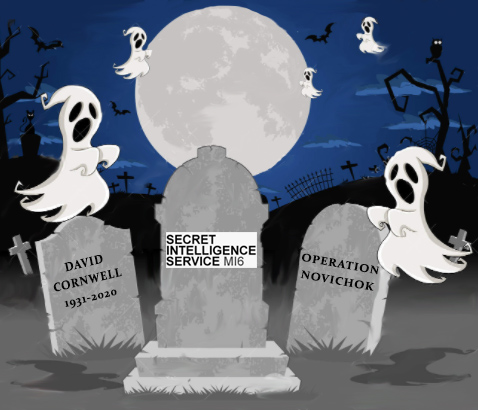
On September 22, 2021, Dame Heather Hallett, the coroner appointed by the British government to conduct an inquest into the death of Dawn Sturgess, held a second hearing in court in London. Sturgess died in Salisbury District Hospital on July 8, 2018, from what Hallett has already announced to be Novichok poisoning from a Russian military attack.
The full transcript of what Hallett said can be read here. Analysis of the proceedings recommended skepticism towards the veracity and intentions of Hallett and the lawyers testifying in court. Read for more detail.
Hallett has proposed putting an end to the proceeding under the Coroners and Justice Act of 2009 and the British legal rules which apply to an inquest in a coronial court. These require a jury, in addition to the coroner, when “the death was caused by a notifiable accident, poisoning or disease”. The rules also require that evidence should be presented and witnesses testify in open court for cross-examination by lawyers and for public accountability. Instead of this, Hallett decided last month that a public inquiry will be substituted in which she alone will decide what evidence and witnesses to take in secret, and what secrets to keep out of the public record.
Hallett and the lawyers for the British government and police say this inquiry isn’t likely to open for another two years. In the meantime, the police say they will be assembling the evidence which they believe may be open to public scrutiny, and the evidence which may not. After three years of investigation of the Sturgess case, and also of the cases of Sergei and Yulia Skripal, allegedly poisoned by Novichok fifteen weeks before Sturgess; and following police announcements of criminal indictments of three Russian military intelligence agents, this new police effort is code-named Operation VERBASCO.
In the meantime, Hallett’s statements and those of Michael Mansfield, Sturgess’s advocate in court, invite a series of questions. Not a single policeman, prosecutor, pathologist, lawyer, member of parliament, or forensic expert in the United Kingdom has thought to ask them, at least not yet and not in public. To anticipate and to assist them, therefore, read Hallett’s statements in italics; the questions follow in bold.
(more…)

By John Helmer, Moscow
@bears_with
There’s a lot to be afraid of in life. Mine has been dominated by the fear of suffocating to death.
Compared to that, verbal insults, the headmaster’s cane, my father’s screaming, army camp, police on horses, Harvard University, the doorman at Fortnum’s, bad reviews, Russian gunmen, Georgian gunmen, and threats by lawyers amount to less. When they strike, they generate an equal or greater mass of energy to fight back. But when suffocation comes on, all I am able to do is to gasp for air, and prepare for the worst.
The problem with the fear of suffocating is that it leads to three other fears – the fear of dentists working in my mouth; the fear of being gagged by robbers; and the fear of laughing.
(more…)

By John Helmer, Moscow
@bears_with
When China was an empire in 1792, the emperor Ch’ieng Lung told the British ambassador to take his gifts and bribes back to London, along with this message for the British king: “we have never valued ingenious articles, nor do we have the slightest need of your country’s manufactures. You, O King, ought, looking upwards, to carry out our wishes, and for ever obey our edict, so that we both enjoy the blessings of peace…Do not say you have not been forewarned.”
When Russia was an empire in 1773, the empress Catherine the Great was persuaded by bribes to purchase from Wedgwood & Bentley, the Staffordshire porcelain manufacturer, the largest order of dinner and table plates in the history of British pottery. After haggling over the price for the 944 pieces, the tsarina paid Wedgwood’s invoice at today’s equivalent of £4 million – the largest price ever charged and paid for such things until that time. Wedgwood lost money on the deal, though. That was because the bribery and costs of production and delivery turned out to be greater than Catherine’s payment. The way the bribes worked, Wedgwood told the British ambassador in St Petersburg and his wife to make gifts of expensive samples he had sent them, keeping some for themselves as commission. The ambassador’s wife wrote back: “Her Imperial Majesty has kept all the Vases and the Dejeuné [sic — luncheon plates] you sent me, as samples, and they were very much liked.”
There are political lessons in this – especially if you read them while eating your dinner off a paper plate or out of a cardboard box.
(more…)

By John Helmer, Moscow
@bears_with
It has not been proved that an unlimited number monkeys in a room with typewriters to match and an infinite amount of time would type the complete works of Shakespeare, or even one of the Bard’s lines.
But the improbability of the infinite monkey theorem is nothing compared to the certainty which the British government, its judiciary, the Metropolitan police, and the combined forces of the London Bar proved on Wednesday in a room of the Royal Courts of Justice on The Strand. They proved that a troop of humans are making a monkey out of every principle of British justice and the criminal law — in order to advance the government’s war against Russia.
On September 22, Dame Heather Hallett, the coroner in the inquest into the cause of death of Dawn Sturgess on July 8, 2018, officially ordered the prosecution of a crime without a defence; in a trial in which the verdict has already been declared by the judge herself and the prosecutors; in which the surviving victims of the alleged crime, Sergei and Yulia Skripal, are not allowed to testify and forbidden to appear in public at all; when the three Russians accused of the crime are not permitted to be represented in the proceeding; in which there will be no jury; and in which the evidence of the crime, the weapon, the intention and motive of the perpetrators will be presented in secret so that there can be no testing for truth, fabrication, or lie.
(more…)

By John Helmer, Moscow
@bears_with
Following last week’s meeting in Washington of Australia’s Foreign Minister Marise Payne (lead image left), the Australian defence minister and their US counterparts, a strategic military and basing agreement was announced between Australia, the UK and US (AUKUS). This is being reinforced with summit meetings in Washington this week.
The declared target of their war-making preparations is China.
Australian strategy against Russia in the Pacific region follows in lockstep with the US. But for the time being the Russian enemy, and Russian submarine and surface fleet operations in the Indo-Pacific region, are not being discussed by Australian officials in public; at least not to the extent when President Vladimir Putin last visited Australia in November 2014 with a nuclear-powered, nuclear armed naval escort.
Ahead of schemes for strategic warmaking in the Pacific, the US, the UK and Australia are also engaged in proxy war operations. These have accelerated recently in Myanmar, where Russia and China are allied in support of the military government of General Min Aung Hlaing. Next, from both sides, state bribery, subversion, putsch-making, and other special operations are likely to accelerate in the Pacific islands from Fiji to Papua-New Guinea.
For the moment, the initial reaction to AUKUS from the Russian Foreign Ministry has been as close to uncritical as the ministry can be. “We noted the plans, announced by Australia,” said spokesman Maria Zakharova last Thursday, “to build nuclear-powered submarines as part of an ‘enhanced trilateral security partnership’ agreed yesterday by the United States, Great Britain and Australia. We proceed from the premise that being a non-nuclear power and fulfilling in good faith the Nuclear Non-Proliferation Treaty, Australia will honour its commitments under this document, as well as the IAEA Safeguards Agreements along with its Additional Protocol. We hope that Canberra ensures the necessary level of cooperation with the IAEA in order to rule out any proliferation-related risks.”
The first detailed technical and strategic assessment of the AUKUS scheme has followed this week in Vzglyad, the leading strategy publication reflecting the Russian General Staff and GRU assessments. A translation from the Russian article by Alexander Timokhin follows.
(more…)

By John Helmer, Moscow
@bears_with
Robots can be easily programmed to correct their mistakes; robot voters can be programmed to re-vote. But robots are missing the intelligence to cover up their tracks.
In the twenty-four hours since the Russian polls closed on Sunday at 8, the robot voters of Russia have exposed themselves to one of the most thorough analyses of their lack of intelligence ever produced by the mainstream Russian media, Russian election technologists and think tanks, and the Russian social media. Indeed, so swift and thorough have they been that protests of election-rigging from the Communist Party, the Navalny group and the State Department have proved superfluous. The silent majority of Russian voters had anticipated the outcome – they have already recorded their response.
(Something similar has happened at the University-Rosedale riding of Toronto. In Monday’s Canadian parliamentary election, voters delivered a similar message of silent rebuke to Chrystia Freeland, chief Russia hater and Ukrainian candidate for prime minister of Canada.)
(more…)

By John Helmer, Moscow, and Liane Theuerkauf, Munich
@bears_with
The leading hospital doctors on Novichok poisoning in Britain and Germany are not allowed by their governments to reveal publicly the medical information they have exchanged with each other.
James Haslam, the chief doctor at Salisbury District Hospital treating Sergei Skripal and Yulia Skripal for Novichok poisoning in March 2018, and Elspeth Hulse, an anaesthetist at Newcastle upon Tyne hospital and co-author with Haslam of a medical research paper on the Skripal case, refused this week to say if they participated with German doctors in the treatment of Alexei Navalny for Novichok poisoning at Charité Hospital in Berlin in August 2020.
According to Hulse, she has been ordered to keep silent by the British Ministry of Defence. Asked what communications and consultations on their expertise in the Skripal case they exchanged with the Berlin doctors treating Navalny, Hulse replied: “I have been advised that you should in the first instance go though [sic] the UK MOD press office. Press Office 020 7218 7907 I hope that this helps.”
Haslam also refused to answer if he had communicated with Navalny’s doctors in Berlin, or when.
Cara Charles-Barks, chief executive of the Salisbury hospital, refused this week to say what collaboration there has been between Salisbury and the Charité — the only two hospitals in the world to claim to have successfully treated cases of Novichok poisoning.
However, the British and Germans did collaborate in secret. Last week Philipp Jacoby, the German doctor directing the medical evacuation of Navalny from Omsk Hospital in Russia to Charité in Berlin in August last year, revealed that when he brought Navalny to Charité, there was “a welcome committee (Empfangskomitee) of about 30 people present.” He added he didn’t know who they were except that they were an “international” group.
The lead German doctors treating Navalny, Kai-Uwe Eckardt and David Leindl, published last December a detailed clinical case report on the Navalny case; they reported the psychotropic drugs, lithium and benzodiazepines, in his blood and urine on arrival; his biochemical test scores for each of the days he was in hospital; and their course of treatment with atropine and blood plasma. Jacoby is one of their co-authors. This week Eckardt and Leindl were asked “to confirm the contacts and communications you had with British doctors of Salisbury District Hospital on the August 22 day of [Navalny’s] admission and subsequently?” They refuse to reply.
Since Jacoby’s fresh disclosure of the “welcome committee”, the record of what the British and German doctors did, and when they did it, is evidence of how the two governments planned the public disclosure of the two Novichok attacks and the Anglo-German allegation that the Russian government was behind both of them.
A leading British specialist on organophosphate poisoning commented: “Here is an irony. Jacoby and the Charité hospital group published in The Lancet every minute detail about Navalny’s diagnostics. Now Dr.Hulse defers to the Ministry of Defence. What is the secret they are concealing — that the British treatment of the Skripals for Novichok exposure was different from the German treatment of Navalny? Or is the secret that there was no Novichok in either case?”
(more…)