-  Print This Post

By John Helmer, Moscow
The Russian government’s competition watchdog is waiting for state tanker company Sovcomflot and gas exporter Novatek to clarify exactly what plan they have decided on for liquefied natural gas (LNG) shipments from Sabetta, Russia’s newest gas export outlet on the eastern shore of Yamal and the Kara Sea. Sovcomflot said last week it has signed with Novatek an undertaking to cooperate on a feasibility study of two tankers for shipment of LNG, once Novatek launches shipments from its Yamal gasfield and refinery in three to four years’ time.
A press release from Sovcomflot said that state-owned lender Vnesheconombank (VEB) “is to look into the possibility of financing the construction of two ‘pilot’ liquefied natural gas carriers for the Yamal LNG project. Sovcomflot has confirmed its interest in operating the new vessels as a bareboat charterer and technical manager.” According to Sergei Frank, Sovcomflot’s chief executive, “we are confident that our long-standing experience of Arctic shipping…will ensure we cope successfully with the task of providing uninterrupted LNG transportation, in the challenging climatic conditions of the Yamal Peninsula.”
(more…)
by John Helmer - Wednesday, June 26th, 2013
No Comments »
- Print This Post

By John Helmer, Moscow
Koros Trading Limited Liability Partnership (LLP), a false front company created in London to receive regular monthly payments of millions of dollars from Rusal, the Russian aluminium monopoly, has been struck off the UK Companies Register for failing to report its annual revenues and income.
Details of Koros transactions have revealed more than $25 million in payments for which sources claim there is no trading, supply or services agreement. The sources believe the money was illegally paid; they suspect the Swiss bank account receiving the funds was a conduit to a beneficiary unwilling to disclose his identity.
(more…)
by John Helmer - Tuesday, June 25th, 2013
No Comments »
- Print This Post

By John Helmer, Moscow
It has been known for a long time that the British Government Communications Headquarters (GCHQ) has been intercepting millions of Russian telephone calls, SMS texts and internet traffic, along with the communications of other target nationals, including Americans and the British themselves. Older eavesdropping operations, such as ECHELON, have been documented by European Parliament investigations. More recent operations, such as PRISM and TEMPORA, have been confirmed by the former National Security Agency (NSA) contract agent, Edward Snowden, whose disclosures substantiate the methodology of surveillance, the range of data produced, targeting, sorting, and purported value.
ECHELON snooped on satellite traffic; PRISM on internet data from server companies; and TEMPORA, a telephone surveillance operation, tapped international fibre-optic cables. The signal collection stations are in all sorts of places, including the US, Puerto Rico, Cyprus, Japan, Germany, Canada, UK, and Australia. The Snowden material is up to two years old; the operations he has documented date from about 2007.
(more…)
by John Helmer - Sunday, June 23rd, 2013
No Comments »
- Print This Post

By John Helmer, Moscow
In a hearing in a Lagos court yesterday, Nigerian judge James Tsoho dismissed all charges against eight of the 15 Russian crewmen on the Myre Seadiver, a security support vessel arrested by the Nigerian Navy last October. At the time, the vessel, which had arrived with Nigerian Navy and Lagos port approvals on September 19, had rotated 11 mariners back to Moscow, and taken on board their replacements; they arrived by plane with visas issued by the Nigerian Embassy in Moscow.
(more…)
by John Helmer - Thursday, June 20th, 2013
No Comments »
- Print This Post

By John Helmer, Moscow
It isn’t known whether Dmitry Shatokhin (right), the chief executive, board chairman, and apparent control shareholder of Siberian Anthracite, reads the news. Not the commodity price reports showing that the demand and price for the coal he is selling are falling. Rather, the news that President Vladimir Putin, along with the heads of the other G8 governments, agreed formally this week to put a stop to concealment of beneficiary ownership of public companies, and of the trust, tax and trading schemes by which hidden owners cheat public shareholders.
According to the G8 communique, “a lack of knowledge about who ultimately controls, owns and profits from companies and legal arrangements, including trusts, not only assists those who seek to evade tax, but also those who seek to launder the proceeds of crime, often across borders. We will make a concerted and collective effort to tackle this issue and improve the transparency of companies and legal arrangements. Improving transparency will also improve the investment climate.” If that’s the standard, how come Siberian Anthracite refuses to publish audited financial reports and won’t disclose the shareholding structure of the company?
(more…)
by John Helmer - Wednesday, June 19th, 2013
No Comments »
- Print This Post
By John Helmer, Moscow
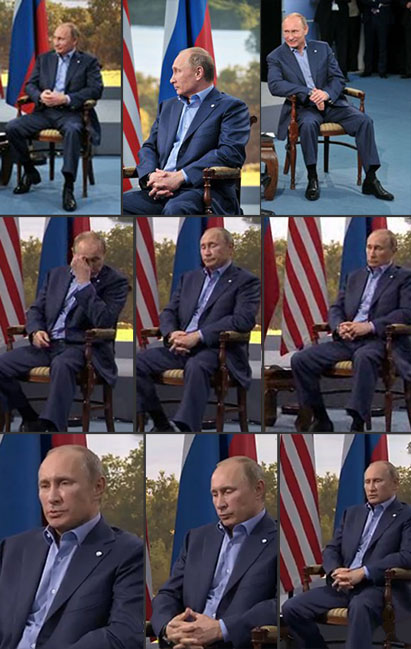
By the conventional polling and political measures, President Vladimir Putin ought to be the most relaxed figure at the G8 summit meeting in Ireland. If he wanted to, he might look straight at the cameras and tell the world he shares their opposition to starting another war in the string of wars the NATO alliance has already lost in Afghanistan, Iraq, and Libya; and is now threatening in Syria, Lebanon, Iran, Turkey too, not to mention Mali.
Instead, Putin displayed an unusual set of body signals rarely seen at events like these, or at his bilateral meetings with the same set of characters. Was he nervous, irritated, or plain angry?
(more…)
by John Helmer - Tuesday, June 18th, 2013
No Comments »
- Print This Post

By John Helmer, Moscow
Rusal’s share price collapsed through the four-dollar threshold today, as the release of results at Friday’s Annual General Meeting (AGM) of Rusal shareholders revealed that the company is planning to use its shrinking cash reserves to try to prop up its share price.
In a dramatic warning issued in Moscow at the same time, Otkritie Capital warned current shareholders to sell. Rusal, according to Otkritie, is now “too illiquid and expensive to short given the lack of real catalysts, but we would avoid the stock on valuation grounds.” A Citi source has reiterated the US bank’s forecast of HK$1.80 as Rusal’s target share price, adding that since Citi’s April 18 assessment of Rusal “nothing has changed”.
(more…)
by John Helmer - Monday, June 17th, 2013
No Comments »
- Print This Post

By John Helmer, Moscow
You could pack your bathing togs, sunglasses and sailing cap, and thus attired pay a call at 24 De Castro Street, in Tortola, British Virgin Islands, to drop your eighteen dollars off personally. This would be more fun than calling your stockbroker to put the money on buying a share in Luxoft in its initial public offering (IPO) on the New York Stock Exchange this week. The BVI address is where Luxoft, a Russian computer programmer and software developer, is registered. The sailing weather is milder than the Isle of Man, in the English Channel, where Luxoft’s controlling shareholder, the IBS group, is based.
IBS and Luxoft are hoping to collect as much as $84 million on the share punt. Punt is the word for the IPO, which beats all previous Russian IPOs in leaving the control shareholders and Russia’s state bank VTB with 98.5% of the voting shares of the newly listed company. The tiny 1.5% of voting shares being sold for $84 million also come with the proviso that the payoff for the control shareholders is entirely up front. This, the prospectus explains, is because no future dividend will be paid to the new shareholders. The only gain they can bet on is capital gain on the share price. But that depends on Anatoly Karachinsky (image right), the control shareholder behind both Luxoft and IBS, earning a future profit which he doesn’t plan to share.
(more…)
by John Helmer - Thursday, June 13th, 2013
No Comments »
- Print This Post

By John Helmer, Moscow
“It is easier for a camel to go through the eye of a needle than for a rich man to enter the kingdom of God” – Jesus Christ
After the ancient Jewish preachers spoke of improbability as elephants trying to navigate needles, the Christians slimmed down to camels. But there was also the post-gospel interpretation that what Jesus actually meant, in that piece of advice to a nervous rich man, was a gate in Old Jerusalem, which opened after the main gate was shut at night. A camel could only pass through this smaller gate if it stooped and had its baggage removed. A lot of camel bones have been excavated around Jerusalem, but the small gate hasn’t turned up yet.
By contrast, there are plenty of small gates in the Kremlin wall, and plenty of camels who make it through without having to unload their baggage until they get inside. So is there a small gate in Federal Law (FZ) No. 79, which President Vladimir Putin (image left) signed on May 7, 2013?
(more…)
by John Helmer - Tuesday, June 11th, 2013
No Comments »
- Print This Post
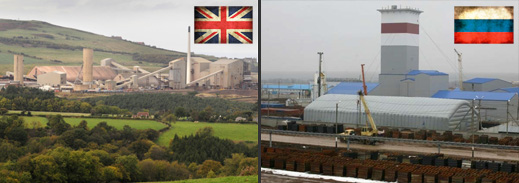
By John Helmer, Moscow
Eurochem, a Russian fertilizer miner and manufacturer owned by Andrei Melnichenko, is suing the South African mine technology company Shaft Sinkers for $800 million on account of a mining technology which Eurochem says has failed in Volgograd (image right). Shaft Sinkers says the technology works perfectly well, in Yorkshire (left) for example. $800 million is the sum of Eurochem’s claims. Much less than that is at stake — according to Shaft Sinkers $15 million in unpaid invoices – but also much more, in Kazakhstan, where Eurochem’s plan for a large new phosphate mine is in trouble of another sort. About that Eurochem doesn’t want to talk at all.
In 2008 Eurochem made several announcements about its new potash mine, Gremyachinskoye mine in Volgograd. In the context of Melnichenko’s proposal to reduce his personal exposure in the company, and sell assets to Gazprom or shares to international investors, Eurochem reported growing reserves, speed in mining new output, and jumping sales revenues. Gremyachinskoye was to be commissioned in two stages, start shipping 2.3 million tonnes of potash per annum in 2012, and by 2015 double that volume.
(more…)
by John Helmer - Monday, June 10th, 2013
No Comments »