Kinetic lesson learning is a euphemism for what military and political commanders learn from mistakes, miscalculations, misjudgements, and misfortunes – their own, and their adversary’s. Kinetic is the newspeak; lesson learning, if it happens, is the reality.
A NATO military veteran has reviewed General P.R. Shankar’s detailed assessments of the Ukrainian war published yesterday. The Indian artillery expert’s analysis has been appearing regularly in the Indian media. But Indian military experience has not been getting the attention it warrants in the North American and European press; there a handful of Swiss, German, and US officers have been pitting their expertise against the mainstream media line.
The NATO military veteran’s views follow without editorial comment. The illustrations have been added for reader reference.
P.R. Shankar, Madras, with John Helmer, Moscow @bears_with
The Indian Army has had more warfighting experience than the other world Powers on battlefields similar to the conditions of the Russian Special Military Operation against the NATO lines in the Ukraine. The Indian generals have also won more victories than the others with the combination of heavy artillery, tanks, infantry manoeuvre, and air power now engaged between Russia and the US and NATO allies.
Coming out of this experience is a deep reserve of analyses and discussions, some of them open and public, by Indian officers who are now retired from active duty but who continue to advise and teach, and assist in the lessons which the Indian forces believe they must learn facing hostile states to the north and the west, as well as insurgency threats inside the country, and spilling over the eastern border.
To begin to understand how the Indian military views the war in Europe, Lieutenant General P.R. (Ravi) Shankar (lead image, right) has agreed to answer a series of questions. Shankar retired from the Indian Army as Director General of Artillery in October 2016. Last July, he wrote a comparison between the Kargil War, won by Indian forces against Pakistan in May-July 1999, and Russian operations in the Ukraine beginning on February 24, 2022.
“Artillery is winning the war for Russia at this point in time,” Shankar wrote. “Similarly in the period May-July in 1999, artillery won the war for India by pulverising Pakistani defence to smithereens in Kargil. The Indian artillery fired over 2,50,000 shells, bombs, and rockets during the Kargil conflict. Most of these were fired in an approximately 10-15 days period of intense fighting. 9,000 shells were fired on Tiger Hill alone when it was regained. During the peak period of assaults, on an average, each artillery battery fired over one round per minute for 17 days continuously. The Pakistanis were simply and overwhelmingly OUTGUNNED! Such intense firing was seen only after the Second World War. After that war, it is only now in Ukraine that such intense firing is being witnessed. In fact, the Ukraine and Kargil wars bear a similarity of the Gunner stamp on the battlefield.”
“The importance and value of artillery has been reinforced manifold in the Ukraine war. The terrain conditions during the Kargil War in the Himalayas were almost like the muddy ‘Rasputitsa’ conditions in Ukraine.”
Shankar graduated from the National Defence Academy Khadakvasala, and from several higher Indian staff colleges and the US Navy’s Naval Postgraduate School at Monterey. Over his 40-year career he held many high command, staff and instructional appointments in the Army, and led Indian planners in the modernization of domestically produced artillery, including 155mm gun projects like the Dhanush howitzer, the ultra-light M777 howitzer, and the K9 Vajra; as well as rocket and missile weapons such as the Pinaka, and the BrahMos .
Following his retirement, Shankar became a professor in the Aerospace Department of the Indian Institute of Technology at Madras.
The Dutch police have just released US satellite photographs (lead images) purporting to reveal Russian truck transporters of BUK missile units at Millerovo and Kursk on July 18 and July 20, 2014, just hours and days after the shoot-down of Malaysia Airlines Flight MH17 in eastern Ukraine on July 17, 2014.
The new evidence, kept secret until now, confirms the US and NATO satellite capability to have recorded the scene of the MH17 shoot-down, before the alleged Russian missile launch; during the missile trajectory and detonation; and in the minutes which followed when the aircraft cockpit, fuselage, engines and other parts were falling to earth.
The US satellite infra-red, photographic and other records of the July 17 evidence have never been revealed, however.
The two US satellite photographic images for July 18 and July 20 have now been published as part of a final Dutch government attempt to show that the BUK missile battery and radar unit known as a BUK TELAR (transporter erector launcher and radar) had been withdrawn from the Ukraine across the border into Russia, after the alleged firing at MH17.
In the new presentation, however, the Dutch admit the satellite evidence has proved nothing. “In summary, the investigation was unable to establish what happened to the TELAR after it arrived in Russia,” the JIT now says.
By admitting this now, the Dutch, and indirectly the US Government, are intimating that their satellite evidence of the MH17 incident also proves nothing. In other words, there is no evidence from either the US or NATO that a Russian missile was fired at MH17, destroying the aircraft and killing all 298 people on board. US officials who have claimed otherwise have been lying. The media reporting of these claims has been false.
Proof of nothing, when concealed, is evidence of cover-up.
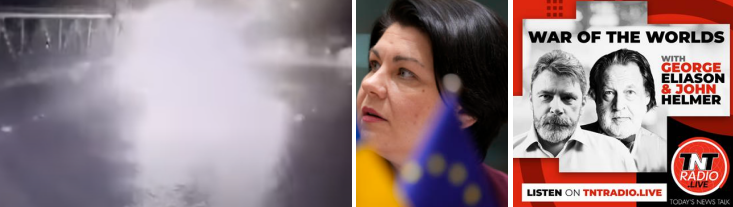
In a single strike with a new naval weapon on Friday (lead image, left) Russian forces have stopped the French plan to deliver tanks to the Ukrainian battlefront; triggered the replacement of Moldova’s prime minister; and tightened the siege on Odessa, accelerating the choice the city residents will make between Kiev and Moscow.
“The time has come for me to announce my resignation”, Prime Minister Natalia Gavrilita (centre) said in Chisinau, the Moldovan capital, explaining that she had been unable to “manage so many crises caused by Russian aggression”.
At almost the same time, over the Bering Sea off the Alaska coast, the White House and Pentagon announced that US fighter jets had shot down a small, unarmed object in the sky. The shoot-down, they said, followed after land, sea and aerospace defences had failed to identify the target after tracking it for 24 hours. “We have no further details about the object at this time,” US Air Force Brigadier General Pat Ryder, the Pentagon press briefer, revealed, “including any description of its capabilities, purpose, or origin. The object was about the size of a small car.”
The news of the two military operations and their strategic significance are analyzed in the first broadcast of “War of the Worlds”, the new TNT Radio show (right) by George Eliason and John Helmer.
Seymour Hersh’s (lead image) report on President Joseph Biden’s decision to destroy the Nord Stream gas pipelines on the Baltic seabed on September 26, 2022, and the involvement of the US Navy in preparing the explosives, has been based on a single anonymous US source with what Hersh calls “direct knowledge of the process”.
From the full text of the Hersh report, it appears that neither the source nor Hersh has “direct knowledge” of the history of US-led operations to sabotage and destroy the pipelines which became public more than a year before; they directly involved the Polish government and the Danish government. In fact, by error of omission Hersh and his man are ignorant of those operations and of that history.
Also, the two of them are ignorant of the British government’s role in this history, and in the final destruction, which was revealed publicly by then-Prime Minister Elizabeth Truss to Secretary of State Antony Blinken sixty seconds after the detonation; and by the Russian government when it announced its knowledge of the British involvement.
The source and the reporter appear to be equally oblivious of the role German government officials played in the operation, and of the history of German warfighting operations against Russia stretching back to Chancellor Angela Merkel’s engagement in the NATO plan for military intervention in eastern Ukraine, following the shoot-down of Malaysia Airlines Flight MH17 on July 17, 2014. That attack was costlier in lives and in the US warfighting strategy against Russia than the Nord Stream operation.
In terms of cost, the US attack seizing more than $300 billion in Russian Central Bank reserves, announced on February 28, 2022, was much greater. Hersh implies, without identifying his source at all, that there were “US promises to minimize direct conflict with Russia”; that because the Nord Stream attack plan violated those “promises”, they were in the source’s opinion either illegal in US law, or violations of US intelligence and military operation standards, or breaches of international undertakings the US has given its NATO allies or its Russian targets. Without explanation, Hersh omitted to ask Russian officials or others with “direct knowledge of the process” to confirm these claims or deny them.
Hersh and his man dismiss the Germans with the same disdain. They report that “after some wobbling [Chancellor Olaf Scholtz] was now firmly on the American team” in January 2022, when the Nord Stream attack plan had already been under way, Hersh reports, for at least a month. Hersh omitted to ask any German source — active official, army general, navy admiral or retiree – to confirm or clarify.
Hersh’s text implies that he himself, like his source, think it’s good and lawful US policy to fight Russia’s “threat to western dominance [in Europe]”; to strike against Gazprom because it “is dominated by oligarchs known to be in the thrall of [President Vladimir] Putin”; because Nord Stream was “a vehicle for Vladimir Putin to weaponize natural gas for his political and territorial ambitions”; and because “American’s political fears [of Putin’s ambitions] were real: Putin would now have an additional and much-needed major source of income, and Germany and the rest of Western Europe would become addicted to low-cost natural gas supplied by Russia – while diminishing European reliance on America.”
If this is what Hersh and his man believe to be the truth, then what follows in their report is that one of them must be lying, one of them dissimulating.
Hersh and his source imply that what they claim to have been a US Navy covert operation was wrong, not because the US warfighting objectives against Russia were (are) mistaken, but because the scheme of planning the attack intentionally evaded the US law “requiring that Congress be informed”. This was the illegal scheme, Hersh reports his source as saying; it was illegal because it intended to broadcast Biden’s and State Department official warnings against Nord Streamfor the purpose of fabricating lawful compliance for those involved, and legality for the operation itself. The fabrication aimed at converting a “highly classified intelligence operation with US military support [which] under the law, the source explained, ‘there was no longer a legal requirement to report the operation to Congress”.
To make his case that the little secret was illegal, and justify the big and open secret, Hersh and his source have been obliged to ignore the history, the NATO allies, and of course, the record which the Russians have made. This is either cynically calculated dishonesty, or else it is the fantasy of an American journalist pretending to investigate, even castigate one government operation; and at the same time loyally serve the purpose, ideology and propaganda of the war at large.
Hersh is quixotic – except that this time the old Don’s lance is broken, his tilt is in the wrong direction, and the windmill is a fabrication of US exceptionalism, not only of the warfighters in Washington and Langley, but of the journalists who profess to be reporting on them.
The Massachusetts philosopher Ralph Waldo Emerson was making a mistake when he claimed “there are only ten minutes in the life of a pear when it is perfect to eat.” Although he grew pears himself, Emerson isn’t known to have made them into pear cider, also known as poiré in France, perry in England.
Russians understand how to prolong the pleasure of consuming pears by turning them into cider. And so, despite the efforts of the warmongering English, Poles, and Czechs to cut off the supply of pear concentrate from which, until the sanctions war began, Russian pear cider producers bottled their drinks, the Russian taste for it continues to grow. Known as пуаре after the French name, pear cider has been steadily gaining in sales volume of the market for light alcohol drinks. Friendlier foreign sources of pear concentrate, sanctions-busting alternate trade, and state-backed investment in the planting of new Russian pear varieties are all substituting in the domestic cider market.
According to Vadim Drobiz, “the import of pears concentrate has not been influenced too much [by the sanctions war].” Drobiz is the national expert on the alcohol market; he is the director of the Centre for Federal and Regional Alcohol Markets (TsIFRRA). “There have been changes in domestic consumer tastes and preferences, and so the [cider] producers have followed them. There are many ways in which the sanctions and prohibitions on import of different goods can be avoided, and these are widely used.”
All the English, Poles and Czechs have managed to do is to make pear cider a state secret. This secret is profitable enough that the Russians don’t care if the enemy thinks the cider market is going pear-shaped. For that reason, no Russian poiré producer or bottler will talk on the record to a foreign correspondent reporting in English. They say ваше здоровье! Cheers! instead.
If the US Government, including the President and the Pentagon, have been telling the truth, the Chinese balloon incursion over US territory for a week has proved to be one of the most effective spy missions ever attempted against US air and missile defences in recent memory.
If the Chinese Government has been telling the truth, and the balloon was nothing more than a “civilian unmanned airship” out of control due to force majeure, the outcome is exactly the same. It is also the same outcome if the Chinese have been lying, and the balloon was a military intelligence operation.
And if US officials have been lying, concealing what they knew and when they knew what they have publicly announced about the balloon’s mission, the conclusion remains the same: the balloon has exposed fundamental warfighting weaknesses of the US against both Russia and China to its enemies; and equally to the US allies on the Ukrainian battlefield, in Japan, Korea, Canada and Australia to see for themselves.
In the war of the worlds which the US insists its allies fight on their territories in Asia and in Europe, the flight of the Chinese balloon demonstrates the reverse of the propaganda message on who in this war is strong; who is weak; who will prevail; who will survive.
Suppose the balloon payload now being secretly salvaged from the seabed off South Carolina is empty; or suppose it’s weather surveillance sensors; or suppose it’s spyware – we will never know which for certain — the Chinese have proved they can float, they have floated a “civilian unmanned airship”, as the official Beijing statement calls it, across the breadth of Canada and the United States. By accident or under direction and remote control, this Chinese “threat” has prevailed in enemy airspace, uncontested, for a full week, January 28 to February 4.
Even before detonation, China’s airship has inflicted multiple shock waves on US officials, their Canadian and Australian allies, and destroyed the warfighting confidence they need for the battlefields of the Taiwan Strait, the South China Sea, and the Ukraine. The “force majeure” which the official Chinese statement explains to have been the reason for the balloon’s flight is indeed the force, legally as well as strategically, which has proved to be the superior one.
Paper tiger German tanks, delivered on the insistence of lame-duck Ukrainian politicians, will become sitting ducks on the battlefield, while the economic front of the war against Russia is looking more and more like the story of over-confidence and guile as told by Uncle Remus to generations of American children. That’s the one about Brer Fox, Brer Rabbit and the tar baby.
Who’s fabulating whom? From the Donbass George Eliason asks the questions.
There is nothing like facing the gun muzzles of the Germans, British and Americans to teach Russians what to do to correct their past mistakes. The International Monetary Fund (IMF) would be the last US bank in the world to admit as much.
Nor would the IMF concede that everything it bribed the Kremlin to accept, when Boris Yeltsin was president and Anatoly Chubais and Alexei Kudrin were his economic ministers, is now being reversed – at a speed unmatched since Joseph Stalin directed the relocation of heavy industry out of reach of German guns between August and December of 1941.
This time round, the IMF is reporting that after Russia recorded a 2.2% drop in real Gross Domestic Product (GDP) measurement in 2022 – 35% less than the IMF had been forecasting – by 2024, the second and third years of the war, the Russian growth rate will be more than double the US, British and Japanese rates; 33% better than Germany’s; 24% better than France; 29% better than Canada.
This is the first official acknowledgement by the US and international banks that the long war against Russia is being lost.
They follow the evidence of last week and this in the stock markets of Frankfurt and New York that institutional investors are cutting the share prices and market capitalizations of the major German and American weapons companies. This reflects the market expectation these arms makers will be defeated in the short war to follow the deployment on the Ukrainian battlefield of the Abrams and Leopard tanks, together with more HIMARS and M777 artillery weapons.
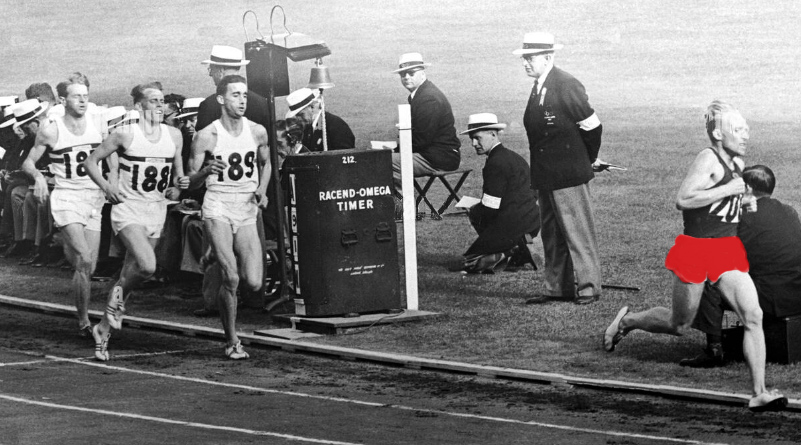
Long distance is the race the Soviets dominated when Vladimir Kuts (lead image) was world champion over 5,000 and 10,000 metres. Watching him run in the 1956 Olympics in Melbourne, Australia, despite the anti-Soviet, pro-Hungarian, pro-British demonstrations in the stadium, was a lesson in marshalling strength, conserving it over time, and exhausting the adversary. This lesson is now being taught in war.
The IMF report also confirms that the economic sanctions war pursued by the US and the European Union (EU) and their global allies is not only failing at the macro-economic level. The sanctions are also causing the reorientation of Russian trade flows eastward towards China and southward towards India. These flows, as revealed in a new report published in Vzglyad in Moscow this week, are forcing the replacement of more than twenty-five years of oligarch-dominated Kremlin economic decision-making by state planning.
This quiet revolution is also Stalin-sized. It would have been impossible without the US and NATO adoption of war for the destruction of Russia.